
Montreal in 1 day: the old town, Notre-Dame and Mont Royal
Montreal is the North American city that most resembles Europe to Europeans, and it’s no accident: it’s the second French-speaking city in the world after Paris, it has an old town with sixteenth-century cobblestone streets and eats better than almost anywhere in North America. It sits on an island in the middle of the St. Lawrence River, with a hill in the middle — Mount Royal, which gives its name to everything — and an urban rule that has never been broken: no building can exceed the cross at the top. In one day you can fit the old city, a basilica that’s blue inside, the hill and the neighborhoods where people actually live.
In summary
- Duration · one full day, from 9 to 10 p.m.
- How much we walk · 8-9 km, with a true climb on Mount Royal
- Transport · metro and bus, single ticket around $3.75 CAD, daily around $11
- Budget · $90-140 CAD per person, accommodation excluded
- Language · French is the official language and is used everywhere; almost everyone also speaks English, and downtown many understand Italian
- When · from May to October. Winter is long and reaches twenty below zero: beautiful, but must be tackled equipped
- What’s left out · the Olympic park, Jean-Talon market, museums: these are the second and third day
You climb from the riverbank to the hill and descend on the other side, into the neighborhoods.
Morning — The old city
3 km · 2 stages · from 9 to 12:30 · cobblestones, so wear comfortable shoes
1 — Vieux-Montréal and the old port
Time 2 hours · Free · Metro Place-d’Armes or Champ-de-Mars

Old Montreal is the piece of city born in 1642 as Ville-Marie, a French Catholic mission founded to convert the Iroquois. It has narrow cobblestone streets, gray stone buildings and signs in French: if it weren’t for the skyscrapers poking up behind, it could be a provincial town in Normandy.
The route: Place Jacques-Cartier uphill, with street musicians and terraces; the Marché Bonsecours, the neoclassical building with the silver dome, which has been a market, town hall and for a few years the parliament of Canada; and the Chapel of Notre-Dame-de-Bon-Secours, the “sailors’ church,” with votive boats hanging from the ceiling and a bell tower terrace overlooking the port.
It ends at Vieux-Port, the waterfront converted into a walkway: there’s a observation wheel, there are rollerblades in summer and ice skating in winter. From here you can see the St. Lawrence River, which is enormous: it’s the waterway that made this city exist, because here the Lachine rapids stopped the boats and they had to unload.
2 — The Basilica of Notre-Dame
Time 1 hour · Ticket about $16 CAD · Closed to visitors during services

From outside the Notre-Dame Basilica is a severe neo-Gothic building, gray stone, from 1829. Inside it’s one of the most surprising churches in America: the vault is midnight blue with thousands of golden stars, the columns are painted, and the altar is lit from behind. It’s not marble: it’s all carved and painted wood, because marble wasn’t here and was too expensive to bring.
The stained glass windows don’t tell stories from the Bible but the religious history of Montreal, which is extremely rare. And the architect, James O’Donnell, was an Irish Protestant from New York: he converted to Catholicism at the end of the work and is the only person buried in the crypt.
Here Céline Dion got married, in 1994, and the state funeral of Maurice Richard, the great hockey player, was held. If you’re here in the evening, the Aura light show projects images on the vaults: very touristy, but technically remarkable.
Noon — The center, and the city under the city
2 km · 1 stage · from 12:30 to 3 p.m. · lunch included
3 — The center and the ville souterraine
Time 2.5 hours with lunch · Free · Metro Bonaventure or McGill
Modern Montreal has something no one expects: under its feet is another city. The ville souterraine, the underground city, is a network of thirty-two kilometers of pedestrian galleries connecting metro stations, shopping centers, universities, hotels, offices and concert halls. Half a million people pass through it every day.
It was born in the Sixties, with the construction of Place Ville-Marie, for an obvious reason once stated: here winter lasts five months and reaches twenty below zero. Underground you go to university, go shopping and go to the theater without putting on your coat. In summer it’s less useful, but it remains the fastest way to cross downtown, and you get happily lost.
Above, on the surface: rue Sainte-Catherine, the shopping street, and the campus of McGill University, which is a tree-filled park at the foot of the mountain. For lunch, two things to try at least once: Montreal’s bagel, smaller and sweeter than New York’s, boiled in water and honey and baked in a wood oven, and poutine, fries with fresh melted cheese curds and meat sauce, which is the national dish of Quebec and should be tried knowing it’s heavy.
Afternoon — Mount Royal
3 km · 1 stage · from 3 to 6 p.m. · with a climb of two hundred meters elevation
4 — The mountain in the middle of the city
Time 3 hours · Free · On foot from downtown, or bus 11 to the top
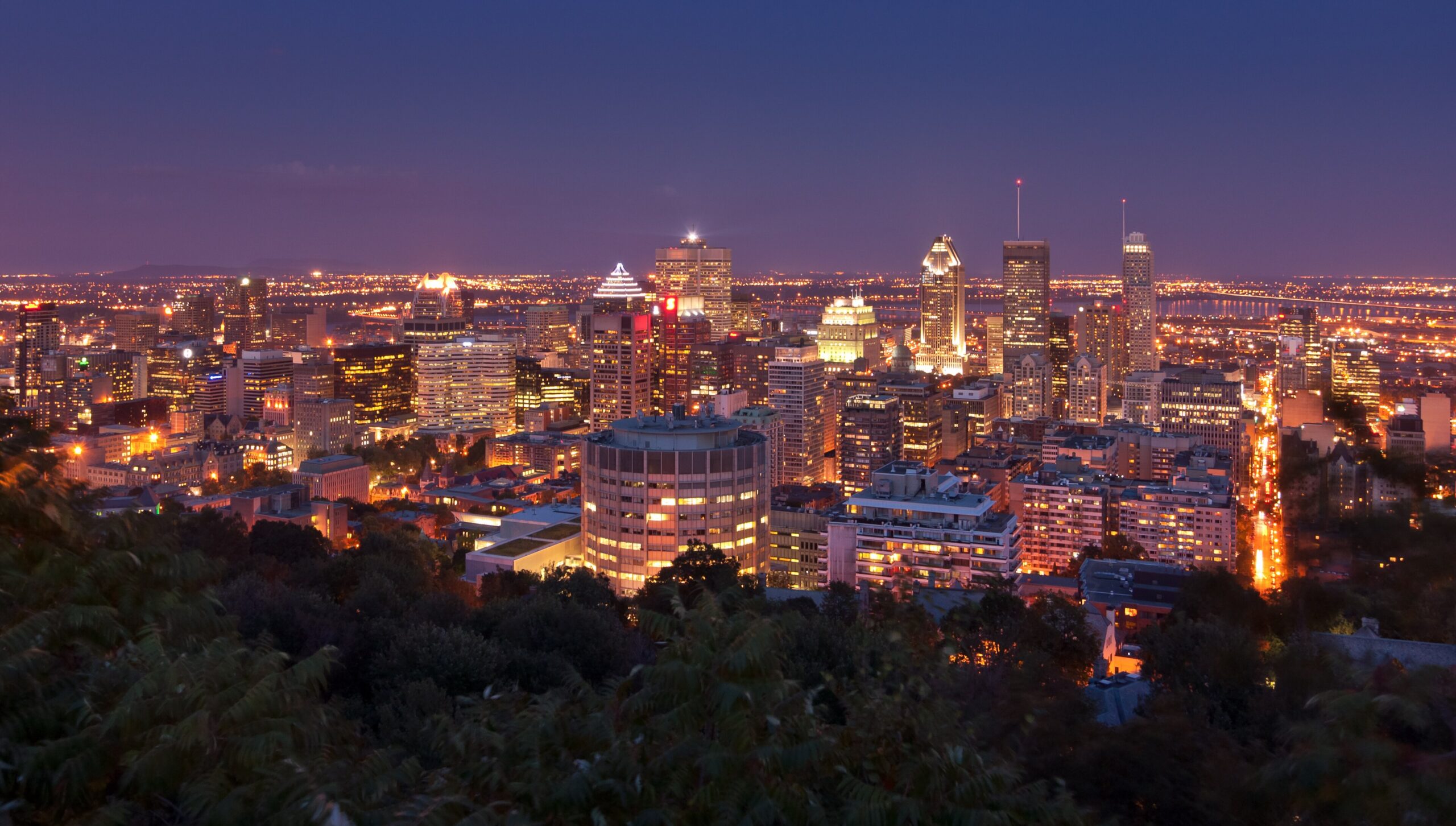
Mount Royal is a 233-meter hill in the middle of the island, and Montreal calls it the mountain. The park was designed in 1876 by Frederick Law Olmsted, the same one who designed Central Park: his idea was that the visitor would climb slowly, with the landscape changing, without ever seeing the destination before arriving. The town cut his budget and the project was only partially realized, but the layout is recognized.
You climb on foot from downtown in forty minutes, via a trail and a long staircase, or by bus. At the top is the Kondiaronk Belvedere, in front of the chalet, and from there you can see the whole city with its skyscrapers, the river and, on clear days, the mountains of the United States at the horizon.
The illuminated cross on top is thirty meters high and has been there since 1924: it commemorates a wooden cross planted in 1643 by the founder of the city as a vow, after a flood spared the mission. And it’s the reason for Montreal’s most famous rule: no building can be taller than the mountain, which keeps skyscrapers under two hundred meters and gives the city a low and orderly skyline.
On Sunday afternoons in summer, at the foot of the mountain, tam-tams are held: hundreds of people with drums around the monument to George-Étienne Cartier, people dancing, stalls. It goes on spontaneously since the Seventies and is one of the most beautiful things in the city.
Evening — The Plateau and Mile End
2 km · 1 stage · from 6 p.m. to 10 p.m.
5 — The neighborhoods where people live
Time 4 hours with dinner · Free · Metro Mont-Royal or Laurier

The Plateau Mont-Royal is the most photographed neighborhood in Montreal for a peculiar architectural feature: the external stairs, iron, often spiral, that go up from the sidewalk directly to the first floor. They’re everywhere, and they have a practical origin: in the early twentieth century a regulation required leaving a strip of green in front of houses, and putting stairs outside instead of inside saved heated space and allowed more apartments on the same lot. In winter they become icy and dangerous, and for decades they were banned; now they’re a protected element.
Next door is Mile End, the neighborhood that has been Jewish, then Greek and Portuguese, then artists: the Arcade Fire were born here, there’s the Ubisoft studio and there are the two historic bagel bakeries, rivals for seventy years, open twenty-four hours a day. Buying one hot at eleven at night is a local ritual.
For dinner: rue Saint-Denis and boulevard Saint-Laurent — which Montrealers call the Main and is historically the boundary line between the French city to the east and the English city to the west — are full of restaurants. Try the smoked meat, in one of the historic Jewish delicatessens: it’s corned beef brisket brined and smoked, served in a rye sandwich with mustard.
Many Plateau restaurants are apportez votre vin: they don’t have a license for alcohol and you bring the wine, buying it at the wine shop next door. It’s not allowed everywhere: check the sign, and it’s the best way to dine well spending less.
If it rains, or if it’s very cold
- The underground city · it is literally the city’s plan B: thirty-two kilometers of galleries with shops, museums and restaurants, and you cross downtown without going outside.
- Instead of Mount Royal · the Museum of Fine Arts on rue Sherbrooke, which is large and free in the permanent collection for under 20s, or the Pointe-à-Callière Museum, built over the excavations of the seventeenth-century city.
- In winter · from December to March it reaches twenty below zero. It’s not a reason not to come — the city works fine, and there’s ice skating at the old port — but you need real snow boots and layers.
- If you have an extra hour · the Oratory of St. Joseph, on the other slope of the mountain: the highest dome in Canada and a staircase of ninety-nine steps that pilgrims climb on their knees.
How much the day costs
| Voce | Spesa |
|---|---|
| Basilica di Notre-Dame | circa 16 $ CAD |
| Old Montreal, old port, Mount Royal, neighborhoods | | free |
| Trasporti, biglietto giornaliero | circa 11 $ CAD |
| Colazione con bagel e pranzo | 25-35 $ CAD |
| Cena | 35-60 $ CAD |
| Totale | circa 90-125 $ CAD a persona |
Reference figures for August 2026, in Canadian dollars, which are worth less than American ones: for a European Montreal costs significantly less than New York. As in the United States, taxes are added at checkout (here there are two, federal and provincial) and at the restaurant you leave 15-20%.
How to get around
The metro has four lines, is clean and punctual, and each station was designed by a different architect with its own works of art: it’s worth looking at them. Trains are on rubber wheels, like in Paris, and for this reason they are silent. A single ticket costs about $3.75 Canadian dollars, a daily ticket about $11 and always pays off.
The city is very bikeable: it has one of the most extensive networks of bike paths in North America and the public bike rental service BIXI, active from April to November, with stations everywhere. It’s the best way to tour the Plateau.
A note on language: French is the official language of Quebec and signs are in French by law. Downtown and in tourism English is understood everywhere, but starting with a bonjour changes the tone of the conversation — and it’s also why shopkeepers greet you with “bonjour-hi,” leaving the choice of language to you.
Frequently asked questions
Is one day enough in Montreal?
For a first taste yes: the old city, the basilica, the mountain and the neighborhoods fit in one day of walking. Missing are the Olympic park, Jean-Talon market, museums and islands, which are the second and third day.
Do they speak English in Montreal?
Yes, almost everyone speaks it, but the official language is French and signs are in French by law. An initial bonjour is truly appreciated. The typical greeting from shopkeepers downtown is “bonjour-hi,” which serves to let you choose the language.
Why are Montreal’s skyscrapers short?
Because a regulation prohibits building higher than the cross on Mount Royal, which is at 233 meters of hill. The result is a compact skyline and a mountain always visible from downtown: it’s one of the few urban planning rules of this type in the world, and has never been broken.
What is the underground city?
A network of thirty-two kilometers of pedestrian galleries under downtown, connecting metro, shops, university, hotels and theaters. It was born in the Sixties for a simple reason: here winter lasts five months. Half a million people pass through it every day and it’s free.
Why do houses have stairs on the outside?
Because of an early twentieth-century regulation that required a strip of green in front of houses: putting stairs outside instead of inside saved heated space and allowed more apartments per lot. In winter they become icy and dangerous, and for decades they were banned; today they’re a protected element and the symbol of the Plateau.
What is poutine?
Fries with fresh cheese curds and hot meat sauce, which partially melts the cheese. It was born in rural Quebec in the Fifties and is the identity dish of the province. It’s heavy and should be tried, maybe shared with someone.
Does the Notre-Dame Basilica have an admission fee?
Yes, about sixteen Canadian dollars for visitors, while those attending services enter freely. The inside is worth the ticket: the vault is midnight blue with golden stars and the entire apparatus is carved and painted wood, not marble.
What does “apportez votre vin” mean?
They are restaurants without a license for alcohol, where you bring the wine yourself, buying it outside. It’s a peculiarity of Quebec, very common in the Plateau, and allows for good dining spending much less. The sign always declares it.
When is it worth going?
From May to October, with September and early October particularly beautiful for autumn colors. Summer is full of festivals, starting with the jazz festival at the end of June. Winter is long and harsh, reaching twenty below zero, and should be tackled with the right equipment.
Is Montreal expensive?
Less than New York and Toronto: prices are in Canadian dollars, which are worth less than American ones, and you eat very well at reasonable prices. Watch out though for the two taxes that add to the price shown at checkout, and the 15-20% tip at the restaurant.
September 6, 2026