Los Angeles in 1 day: Griffith, Hollywood and sunset over the ocean
Los Angeles is not a city, it’s eighty-eight cities placed side by side over an area the size of half Liguria, held together by highways. It has no center in the European sense and visitors looking for one leave disappointed. The right way is different: choose two or three neighborhoods and stay there, accepting that the rest will remain out of reach. In one day you can fit the hill with the sign, the observatory from which you can see everything, the center with Gehry’s auditorium and the beach with the Ferris wheel at sunset. One thing is essential: a car.
In summary
- Duration · one full day, from 9 am to 10 pm
- Car needed · yes, practically essential: between stops there are 20-40 minutes of driving
- Walking distance · 5-6 km total, split between stops
- Budget · 90-140 dollars per person, accommodation and car rental excluded
- Traffic · avoid driving between 7-10 am and 3:30-7 pm: travel times double
- When · year-round; May and June often have low clouds in the morning, which locals call May Gray and June Gloom
- What’s left out · museums, film studios, Malibu: that’s the second and third day
From east to west it’s forty kilometers: the day is designed to cross the city just once.
Morning — The hill and the observatory
2 km on foot · 1 stop · from 9 am to 12 pm · start high to beat the haze
1 – Griffith Observatory and the Hollywood sign
Time 3 hours · Free admission, planetarium about 10 $ · Paid parking, fills up early · Closed Mondays

Griffith Observatory sits at 350 meters above the city, inside a 1,300-hectare park, and has two rare qualities: it’s free and the view includes both downtown Los Angeles and the Hollywood sign. It was built in 1935 with money from Griffith J. Griffith, a Welsh immigrant who made his fortune in mining, who attached a precise condition to his bequest: admission must be free forever. His idea was that looking through a telescope changed people.
Inside is the Foucault pendulum, the Zeiss telescope used by more people than any other telescope in the world — over eight million — and the planetarium. Outside, on the terrace, is the panorama you’ve seen in La La Land, Rebel Without a Cause and dozens of other films.
The Hollywood sign is viewed from here, and it’s worth knowing what it is: it was erected in 1923 as a billboard for a real estate development and said HOLLYWOODLAND. It was supposed to last a year and a half; the last four letters fell apart in the 1940s and were never replaced. The letters are fifty feet high, you can’t get close — there’s an alarm system and cameras — and the best spots to photograph from are here and Lake Hollywood Park.
The observatory parking lot is small and fills up by 10 am on weekends. Arrive early, or leave your car lower down and take the shuttle that goes up from the Los Feliz neighborhood.
Noon — Hollywood, without illusions
1.5 km · 1 stop · from 12 pm to 2:30 pm · lunch included
2 – Hollywood Boulevard
Time 1.5 hours, no more · Free · Metro line B, Hollywood/Highland

It must be said clearly: Hollywood Boulevard disappoints almost everyone. The Walk of Fame is a sidewalk with over 2,800 brass stars and terrazzo, surrounded by souvenir shops and people dressed as superheroes asking for money for photos. The stars aren’t awarded for merit: whoever proposes a name has to pay a fee of tens of thousands of dollars, usually paid by a studio or record company.
That said, an hour here passes willingly, and two things are really worth seeing:
- the TCL Chinese Theatre from 1927, with a pagoda façade: in the courtyard there are handprints and footprints of two hundred actors, left in wet concrete starting, legend has it, from an incident when an actress stepped in by mistake. There are also a horse’s hooves and Groucho Marx’s cigars
- the Dolby Theatre, where the Oscars are held: you can visit with a guide, and see the statuette and stage
The neighborhood where movies are actually made is not this one: the studios are in Burbank and Culver City, on the other side of the hills, and are visited on tours (that’s the second day).
Afternoon — The center nobody visits
2 km · 1 stop · from 2:30 pm to 5:30 pm · 30 minutes by car or metro
3 – Downtown and the Walt Disney Concert Hall
Time 2.5 hours · Disney Hall garden free, The Broad free with reservation · Metro line B, Civic Center

Downtown Los Angeles is the part tourists skip and that has changed most over the last twenty years. The Walt Disney Concert Hall, opened in 2003 to a design by Frank Gehry, is the symbol of this change: stainless steel sails that bend over each other, containing a concert hall acoustically among the best in the world. You can freely climb into the garden on the roof, which almost nobody knows about.
A detail that says much about this city: some curved walls were so shiny they reflected the sun into nearby apartments, raising room temperatures by several degrees and blinding drivers. In 2005 those surfaces were sanded down to reduce the reflection.
Next to it are The Broad, a contemporary art museum with free admission by reservation, and the Grand Central Market, a covered market from 1917 full of Mexican food stalls, where you eat well and cheaply. If you have twenty minutes left, Union Station from 1939 is one of the most beautiful stations in America, half art deco and half Spanish mission.
Evening — The ocean
3 km · 2 stops · from 6 pm to 10 pm · 40 minutes driving west
4 – Venice Beach
Time 1.5 hours · Free · Paid parking on the waterfront
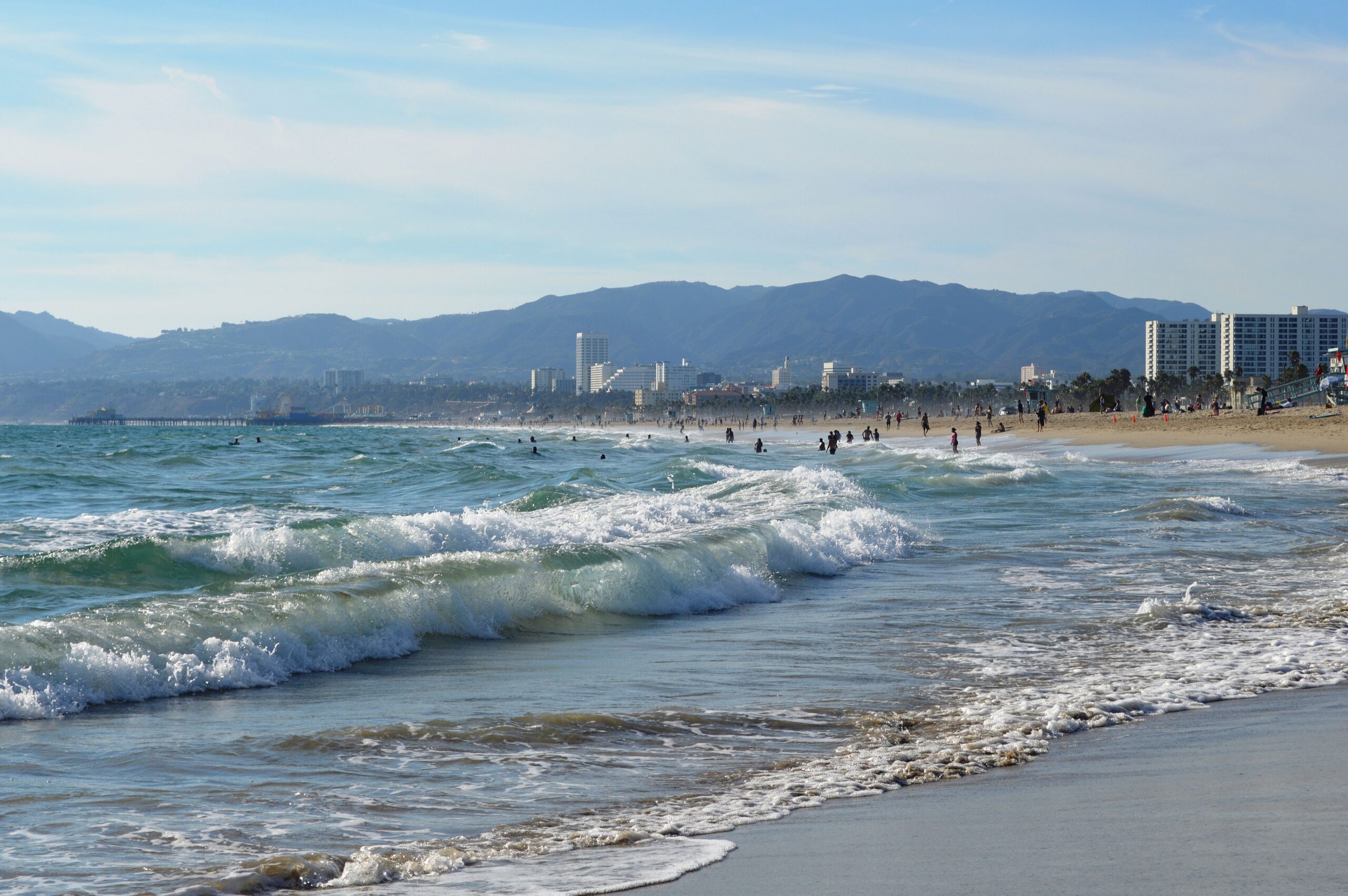
Venice was founded in 1905 as a project by a tobacco entrepreneur, Abbot Kinney, who wanted to recreate Venice in California: he had fifteen kilometers of canals dug, imported real gondolas and gondoliers from Venice and built the Venetian-style porticos still seen on the main street. In the 1920s the city filled in most of the canals to make roads, but some remain, with footbridges and houses: they’re just a few blocks inland and almost nobody goes. They’re worth the detour more than the waterfront.
On the boardwalk are Muscle Beach bodybuilders in the open, skaters, vendors and street artists: it’s chaotic, a bit frayed and much photographed. Go knowing that after sunset it empties quickly.
5 – Santa Monica Pier
Time 2 hours · Pier free, rides by token · 4 km north of Venice, you can also walk along the waterfront

Santa Monica Pier is from 1909 and has a small amusement park on top, Pacific Park, with a Ferris wheel that’s the first in the world powered by solar energy. At sunset it lights up and becomes the city’s postcard.
This is also where Route 66 ends: the road that starts in Chicago and crosses the continent for four thousand kilometers has its end-of-route sign right on the pier. It’s not exactly the historic point — the official terminus was an intersection a bit further down — but the sign is there, and everyone photographs it.
For dinner, the restaurants on the waterfront are expensive and mediocre: it’s better to move two blocks inland, to Third Street Promenade or Main Street, where you eat better and spend less.
If it rains, or if there’s haze
- June Gloom · from May through June, low clouds cover the coast until mid-day almost every day. It’s not rain: it clears on its own by noon. Just reverse the day and do the beach in the afternoon.
- Instead of the hill · if there’s haze from the observatory you can’t see anything. Backup plan: the Getty Center, which is free (you only pay for parking) and is indoors.
- Instead of the beach · The Broad downtown or the LACMA with the Urban Light lamps in front, which is the most photographed installation in the city.
- Real rain · Los Angeles gets little rain but when it does traffic becomes chaotic: add half time to every trip.
Cost of the day
| Voce | Spesa |
|---|---|
| Griffith Observatory / free, planetarium | about 10 $ |
| The Broad | gratis su prenotazione |
| Walk of Fame, Venice, Santa Monica Pier / | free |
| Parking for the day / | 25-45 $ |
| Gas / | about 15 $ |
| Lunch at Grand Central Market / | 15-25 $ |
| Dinner / | 30-55 $ |
| Totale | circa 95-150 $ a persona, oltre al noleggio |
Reference figures for August 2026, in dollars. The item Europeans underestimate is parking: in Los Angeles you pay almost everywhere, and downtown an hour can cost as much as lunch. Many free museums have paid parking, and that’s where the real cost hides.
How to get around
The honest answer is: by car. Los Angeles covers 1,300 square kilometers and the distances between interesting zones are twenty-forty minutes of driving. Car rental is economical compared to Europe, gas costs less and roads are wide; the problem is traffic, which doubles travel times during rush hours, and parking, which you pay for almost everywhere.
The metro exists and has grown a lot in recent years: line B connects downtown to Hollywood and is very useful for two of the stops on this day, while line E reaches Santa Monica in about fifty minutes from downtown. With some patience, this itinerary can be done without a car, just taking longer.
On urban freeways, which are called freeways here and referred to with an article (“the 405”, “the 101”), two practical rules: the left lanes reserved for multi-occupant cars are often the only ones that flow, and exits can even be on the left. A GPS is essential.
Frequently asked questions
Is one day in Los Angeles enough?
No, but a good day is useful for understanding it: the hill with the observatory, an hour of Hollywood without illusions, the center with Gehry’s auditorium and sunset over the ocean. The rest — museums, studios, Malibu, Pasadena — is material for the second and third day.
Do you really need a car?
Almost always yes: the city covers 1,300 square kilometers and between zones there are twenty-forty minutes. The metro has improved a lot, though: line B connects center and Hollywood, line E reaches Santa Monica. With more time available you can do without.
Can you get close to the Hollywood sign?
No: it’s fenced and monitored with cameras and alarms, and trails only lead behind or above the letters. The best points to photograph from are Griffith Observatory and Lake Hollywood Park. It was created in 1923 as a billboard for a real estate development and said HOLLYWOODLAND.
Is the Walk of Fame worth it?
One hour yes, more than that no. It’s a sidewalk with over 2,800 stars surrounded by souvenir shops. The stars aren’t awarded for merit: whoever proposes a name pays a fee of tens of thousands of dollars. What’s really worth seeing is the courtyard of the Chinese Theatre with the handprints in the cement.
Do you have to pay for Griffith Observatory?
No, admission is free and always will be, by the donor’s will, who set this condition in his 1919 bequest. You only pay for the planetarium, about ten dollars, and parking. It’s closed Mondays, and on weekends the parking fills up by 10 am.
What is June Gloom?
Low clouds that from May through June cover the California coast almost every morning and dissolve by noon. It’s not bad weather and it’s completely predictable: just reverse the day and save the beach for the afternoon.
Is it true there are canals in Venice?
Yes: in 1905 Abbot Kinney had fifteen kilometers of canals dug to recreate Venice in California, even importing real gondolas and gondoliers. In the 1920s most were filled in to make roads, but some canals remain, just a few blocks inland from the waterfront, and they’re much nicer than the boardwalk.
Is Los Angeles safe?
The neighborhoods on this itinerary are busy and normal during the day. But more than elsewhere, the American rule applies: neighborhoods change character in just a few blocks. The Venice boardwalk empties after sunset, and downtown some areas aren’t recommended at night. Never leave anything visible inside your car.
How much do parking spaces cost?
Much more than you’d expect: downtown and on the waterfront you pay almost everywhere, and over a day you easily reach thirty-forty dollars. Even free-admission museums, like the Getty, charge for parking: that’s where the real cost hides.
When is it best to go?
Year-round: the climate is mild even in winter. The best months are September and October, hot and clear. May and June have June Gloom; July and August are hot but bearable on the coast, much less so in the interior valley.
September 6, 2026