Rome in 5 days: the complete day-by-day itinerary
Five days is the point at which Rome stops being a list of monuments and becomes a city. The first three cover the landmarks — ancient Rome, the Vatican, the baroque centre — and are the same as in any short itinerary. The two that get added are the ones that change the trip: the fourth takes you to the museums and the parks, which is to say the Rome that passing tourists never see; the fifth leaves the centre and shows how the city ended, among the tombs of the Appian Way or among the houses of Ostia. This itinerary is built for people who walk, with real travelling times and the two bookings that decide whether the whole thing works.
At a glance
- Length · 5 full days, 5 nights
- Best time to go · April-May and October; July and August are punishing
- Walking distance · between 6 and 9 km a day, largely on cobblestones
- Budget · €85-130 per person per day, accommodation excluded
- To book well ahead · Colosseum, Vatican Museums and Galleria Borghese
- Where to stay · Monti if it is your first time, Trastevere if you are after the evenings
- Transport · the CIS weekly pass is worth it, €24
Five layers, one per day: switch them on and off from the box at the top right. Day five has two alternative destinations — you do one, not both.
Day 1 — Colosseum, Roman Forum, Palatine and the Capitoline
7.5 km · 4 stops · lunch in Monti · start from metro line B, Colosseo stop

The first day fits almost entirely inside a single square kilometre and is the one to do first: if the trip has to be cut short, this is the part you cannot skip. One ticket covers the Colosseum, the Roman Forum and the Palatine, costs €18 and is valid for 24 hours, but entry to the Colosseum has a compulsory time slot: book it on the official website as soon as sales open, thirty days ahead.
With five days ahead of you, you can afford something short itineraries cannot: adding the Capitoline Museums in the afternoon, which is the right way to close the ancient Rome day. They are the oldest public museum in the world and they sit directly above the Forum you have just walked through.
1 – Colosseum
Visit 2 hours · Opens 8:30 am · Ticket €18 with Forum and Palatine, booking compulsory
Take the first available slot. At 8:30 am the Colosseum is still empty and the light comes in sideways through the eastern arches: two hours later it is a different place. Go straight up to the second tier, from which you see the whole underground level — the hypogeum where the cages and the hoists were — and only then come down to the arena. With five days available, it is worth paying a little more for the ticket that includes the arena floor and the underground: it is forty extra minutes and you walk where no Roman spectator ever set foot.
2 – Roman Forum
Visit 1 hour 30 · Getting there 5 minutes on foot from the Colosseum exit · Opens 9 am

You enter from Via dei Fori Imperiali, under the Arch of Titus. Without a guide the Forum is a field of stones: take at least a plan, or climb the Palatine first and look down on it, which is how it becomes readable. The things to look for are the Via Sacra, the House of the Vestals with its pool and statues, and the Basilica of Maxentius, the only one that shows how tall these buildings were.
3 – Palatine Hill
Visit 1 hour · Getting there 10 minutes uphill from the Forum · Ticket the same as the Colosseum

The hill where Rome was born and where the emperors lived for three centuries. It is the greenest and least crowded of the three sites, and the terrace of the Farnese Gardens is the point from which the whole Forum makes sense at once. On the other side the view opens onto the Circus Maximus. With five days there is no hurry: this is a good moment to sit in the shade for twenty minutes before lunch.
4 – Capitoline Hill and Capitoline Museums
Visit 2 hours 30 · Getting there 10 minutes on foot · Ticket about €16, no booking needed
Walk back up Via dei Fori Imperiali to Piazza Venezia and climb Michelangelo’s ramp. The Capitoline Museums hold the She-wolf, the original bronze Marcus Aurelius on horseback (the one in the square is a copy), the reassembled colossus of Constantine and the Spinario. But the thing that justifies the ticket more than any statue is the Tabularium gallery: a Roman corridor overlooking the Forum, seen from above through the arches, and at the end of the day it is the best place in Rome.
If there is time left, the Vittoriano has a lift up to a panoramic terrace: it costs money, but it is the only place from which you see Rome with the Vittoriano in it.
Lunch · walk up to Monti, ten minutes from the Colosseum: the district behind Via Cavour, full of proper trattorias at normal prices. Avoid anything with a photographed menu outside near the Amphitheatre.
Dinner · Monti again, around Piazza della Madonna dei Monti, or the Ghetto if you want carciofi alla giudia.
Day 2 — Vatican and Castel Sant’Angelo
6.5 km · 3 stops · lunch in Borgo Pio or Prati · metro line A, Ottaviano stop

A day to be planned to the minute, because the Vatican Museums are the one place in Rome where getting the time wrong ruins the visit. The Museums are closed on Sundays, except the last of the month, when entry is free and the queue is enormous. If your second day falls on a Sunday, swap it with the third or the fourth.
1 – Vatican Museums and Sistine Chapel
Visit 3 hours · Hours Monday to Saturday 8 am-8 pm, last entry 6 pm · Ticket €20, €25 booked online
Book the first slot, 8 am, and walk straight to the Sistine Chapel before looking at anything else: at 8:20 am there are fifty people in it, at 11 am five hundred and you can no longer hear a thing. Only then double back and do the normal route — the Pinecone Courtyard, the Gallery of Maps, the Raphael Rooms. The dress code is genuinely enforced: shoulders and knees covered, or they stop you at the entrance.
2 – St Peter’s Basilica
Visit 1 hour 30 including the dome · Getting there 15 minutes on foot along the walls · Entry free, dome charged
Entry to the basilica is free, but you go through security on the square and in summer the queue can be over an hour: arriving around midday, when many people are at lunch, works better than arriving at nine. Inside, look for Michelangelo’s Pietà, immediately on the right, and Bernini’s baldachin. The climb to the dome is charged separately and has two prices, on foot or with the lift to the first level: either way the last hundred and fifty steps are on foot, in a corridor that narrows and tilts, and they are not for everyone.
3 – Castel Sant’Angelo
Visit 1 hour 30 · Getting there 10 minutes on foot along Via della Conciliazione · Ticket separate, bought at the door

Built as Hadrian’s mausoleum, turned into the popes’ fortress, with the raised corridor connecting it to the Vatican that was there for escaping. The Roman spiral ramp is still the original one. But the real reason to go up is the terrace at the top: from there you see St Peter’s opposite and the whole bend of the Tiber, and at sunset it is the finest view in Rome. On the way out, cross Ponte Sant’Angelo on foot between Bernini’s angels.
Lunch · do not eat on Via della Conciliazione. Move two streets north, to Borgo Pio, or go into Prati towards Via Cola di Rienzo, where the Romans who work there eat.
Dinner · Prati, which is quiet in the evening and has good pizza by the slice.
Day 3 — The baroque centre and Trastevere
8.4 km · 5 stops · lunch at Campo de’ Fiori · no booking needed
The lightest day and the best one for walking: the whole route stays inside the historic centre, nothing needs booking and the distances between stops are a few minutes each. The one serious piece of advice is to start early: the Trevi Fountain at eight in the morning and the Trevi Fountain at eleven are two different experiences.
1 – Piazza Navona
Visit 30 minutes · Entry free
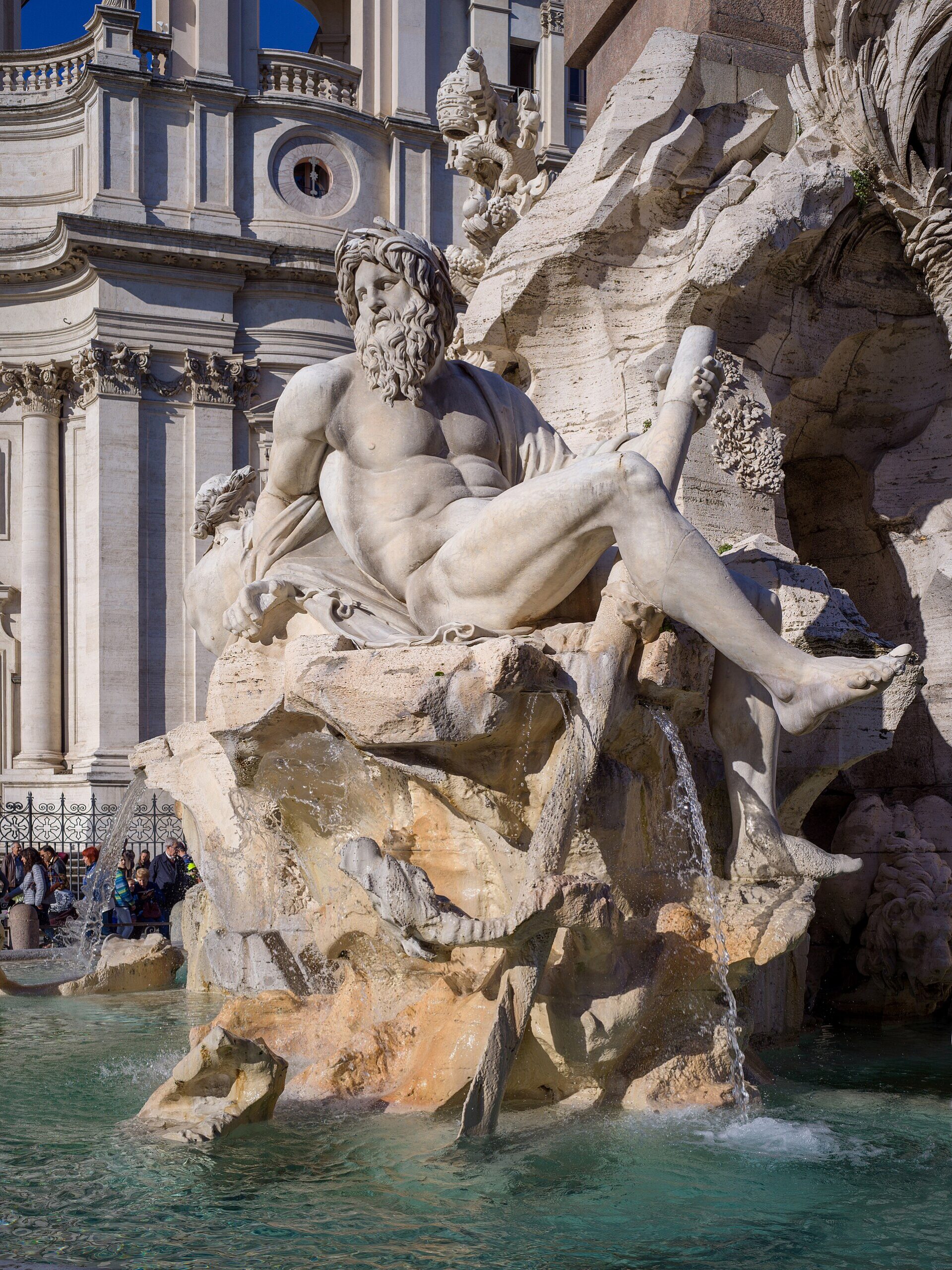
The elongated shape of the square is that of Domitian’s stadium underneath: that is why it is an oval. At the centre is Bernini’s Fountain of the Four Rivers, with four figures standing for the Nile, the Ganges, the Danube and the Río de la Plata. The church of Sant’Agnese in Agone opposite is by Borromini — and the rivalry between the two men can still be read in the postures of the statues.
2 – Pantheon
Visit 40 minutes · Getting there 5 minutes on foot · Ticket €5, entry has not been free since 2023

It is the best preserved building of Roman antiquity and still has the largest unreinforced concrete dome in the world. The diameter of the dome is identical to its height from the floor: exactly forty-three metres, which is to say a perfect sphere wedged into the cylinder. The oculus at the top is genuinely open: when it rains, it rains inside, and the sloping floor carries the water to drainage holes that have been there for nineteen centuries.
3 – Trevi Fountain
Visit 20 minutes · Getting there 8 minutes on foot · Entry free

Thirty metres of baroque facade wedged into a square too small to hold it: that is precisely the effect Nicola Salvi wanted. The coin is thrown with your right hand over your left shoulder, with your back to the fountain. What almost nobody does is turn the corner to the left and look down on it from Via della Stamperia, where there is nobody at all.
4 – Spanish Steps
Visit 30 minutes · Getting there 10 minutes on foot · Entry free
The staircase up to Trinità dei Monti, the Barcaccia fountain at the bottom and Via dei Condotti running straight ahead with all the windows. You can no longer sit on the steps and the fines are real. Go to the top: from the terrace in front of the church you see the whole centre of Rome, and there is also a lift up from Spagna metro station if your legs have already had enough.
5 – Trastevere
Visit 2 hours, ideally in the evening · Getting there 20 minutes on foot from Campo de’ Fiori across Ponte Sisto

You cross the Tiber and everything changes: narrow lanes, ivy on the walls, washing hung out. The heart of it is Piazza Santa Maria in Trastevere, with a basilica carrying twelfth-century mosaics on its facade — go inside, the ones in there are better still. After that you do not need a plan: you wander, you have a drink, you eat late. If you have energy left, walk up to the Janiculum for the night view over Rome: twenty minutes uphill and worth every one of them.
Lunch · Campo de’ Fiori is still a market in the morning: buy something there and eat it sitting in Piazza Farnese, a hundred metres away and empty.
Dinner · Trastevere, but away from the main square: three lanes are enough to halve the bill.
Day 4 — Galleria Borghese, the park and Piazza del Popolo
6 km · 4 stops · lunch inside the park or on Via del Babuino · metro line A, Spagna or Flaminio

This is the day you earn by reaching a fourth one, and for many people it is the finest of all: a small, perfect museum in the morning, an enormous park in the afternoon, a sunset from the Pincio and a monumental square at the end. You walk less than on the other days and you are in the shade almost throughout.
One thing has to be done before you leave home: book the Galleria Borghese. Entry runs in two-hour slots, the number of visitors per slot is capped by law, and in peak months the places go weeks in advance. There is no such thing as buying a ticket at the door.
1 – Galleria Borghese
Visit exactly 2 hours, you cannot stay longer · Ticket about €15 plus booking fee · Booking compulsory, closed on Mondays
Twenty rooms, two floors, and inside more masterpieces per square metre than any other museum in Italy. On the ground floor are Bernini’s sculptures: the Rape of Proserpina, with the fingers sinking into a marble thigh, and Apollo and Daphne, which has to be seen by walking round it because the transformation only reads from one side. In the same room, the David with Bernini’s own face. Upstairs, the Caravaggios — six canvases, among them the Boy with a Basket of Fruit and David with the Head of Goliath.
The slot lasts two hours and when it ends you really do leave. The advice runs against instinct: go straight up to the first floor, look at the paintings while you are still fresh, and keep Bernini’s sculptures for the last hour, because those survive tiredness.
2 – Villa Borghese
Visit 2 hours · Getting there you walk out of the museum and you are in it · Entry free
Eighty hectares of park above the centre of Rome, with tree-lined avenues, a lake with rowing boats, an Italian garden and a small zoo. It is where Romans take their children on Sundays, and in the middle of five days of monuments it is exactly the break you need. Bicycles are hired from kiosks near the entrances and are the fastest way to cross it.
Inside the park, if you still have an appetite for museums, there are the National Gallery of Modern Art and the Etruscan Museum of Villa Giulia, which is excellent and always half empty: it holds the Sarcophagus of the Spouses, the reclining couple who are smiling, and it is one of the loveliest things Italy owns.
3 – Pincio terrace
Visit 30 minutes, best at sunset · Getting there 20 minutes on foot across the park · Entry free

The park ends in a balcony over Piazza del Popolo, and from there, in the distance, you see the dome of St Peter’s. It is the place where Rome is seen from above without paying anything and without climbing stairs, and it is only crowded for the half hour around sunset — which is precisely the half hour worth being there for.
4 – Piazza del Popolo
Visit 45 minutes · Getting there 10 minutes down the ramp · Entry free
You come down the ramp into the oval of the square, with the Egyptian obelisk at its centre — over three thousand years old, brought from Heliopolis, and already ancient when the Romans carried it here. The two «twin» churches at the mouth of the trident are not identical at all: one has an oval plan and the other a circular one, because the sites were different sizes, and the symmetry is a trick of perspective.
Before you leave, go into Santa Maria del Popolo, on the north side, which looks like any ordinary church and in fact contains two Caravaggios — the Conversion of Saint Paul and the Crucifixion of Saint Peter, facing each other in the same chapel — plus a chapel designed by Raphael. Entry is free and there is almost never a queue.
Lunch · inside Villa Borghese there are kiosks and a casina with outdoor tables; otherwise walk down to Via del Babuino or the streets behind the Spanish Steps.
Dinner · the area behind Piazza del Popolo towards Via Margutta is quiet and expensive; to pay a fair price, walk down towards the Pantheon or go back to Monti.
Day 5 — Out of the centre: the Appian Way or Ostia Antica
Half a day of visiting plus travel · choose one of the two, you do not do both
The fifth day is the one where you leave the centre, and it is also the most underrated in the itineraries you find elsewhere. The two options are very different from one another and the choice depends on what kind of day you want: the Appian Way is a walk or a bike ride through the Roman countryside; Ostia Antica is an entire Roman town where you go inside the houses. Both take half a day and leave the afternoon or the evening free for the centre.
Option A – The Appian Way
Time half a day · Getting there bus 118 from Circo Massimo, or metro A to Colli Albani then bus 660 · Bicycles for hire at the Regional Park office, near the Domine Quo Vadis church

The road the Romans called regina viarum starts at the Aurelian Walls and runs south between cypresses, pines and the tombs of the families who had them built along the way — by law cemeteries had to be outside the city, so the road became a funerary corridor kilometres long. In some stretches you walk on the original basalt slabs, worn down by cart wheels.
The things to see along the route are the tomb of Cecilia Metella, an enormous cylinder turned into a fortress in the Middle Ages; the catacombs of San Callisto or San Sebastiano, which can only be visited with a guide in groups of about forty minutes; and the Villa of the Quintili, the largest private villa of imperial Rome, which almost nobody reaches and which has its own separate entrance.
Go on a Sunday if you can: the road is closed to traffic and you walk down the middle of it. On other days the first stretch has cars and no pavements, so a bicycle is the sensible choice: hire one at the park entrance and in three hours you reach the Quintili and come back.
Option B – Ostia Antica
Time half a day · Getting there train from Porta San Paolo (metro Piramide), 30 minutes, Ostia Antica stop · Ticket about €18, the train is covered by the urban fare

It was the port of Rome; then the river changed course, the town emptied and the sand covered it, which is why it has reached us in far better shape than the Forum. There are not only temples and basilicas here: there are the insulae, apartment blocks several storeys high with their staircases still in place, the baths with mosaics on the floor, the public latrines with the marble seats in a row, the fire brigade barracks and the Thermopolium — a Roman bar with its counter, the menu painted on the wall and the amphorae set into the masonry.
The theatre is still standing and behind it is the Piazzale delle Corporazioni, where every commercial office had a mosaic in front of it saying where it came from and what it sold: elephants for Africa, ships, oil amphorae. It is the thing that reads most clearly of all, and the reason Ostia says more about everyday Roman life than the Forum does.
Allow a full half day; there is almost no shade and almost nowhere to eat inside. Bring water and a hat, and in summer go first thing in the morning.
The afternoon that is left
Getting back into town in the middle of the afternoon leaves you two or three free hours, and the best way to spend them is the district you pass through anyway: Testaccio, if you are coming back from Ostia, with its covered market, Monte dei Cocci — a hill made of broken amphorae — and the Non-Catholic Cemetery where Keats and Gramsci are buried. If you are coming back from the Appian Way, the natural stop is the Circus Maximus with the Baths of Caracalla, which are enormous and have the right light at that hour.
Then you close with dinner in the centre, which is the right way to end five days in Rome: you have looked at the city from every distance, and on the last evening you come back to where you started.
Appian Way · there are a couple of trattorias along the road, but they are few and touristy: better to bring a sandwich and eat it on a wall.
Ostia Antica · the café inside the excavations is basic; the medieval village next to the station has a few decent places.
Testaccio · the covered market at lunchtime is one of the best things you can eat in Rome, at half the price of the centre.
What changes if you have 4 days instead of 5
You drop the fifth and redistribute: the Appian Way or Ostia Antica are the easiest thing to sacrifice, because they are the only ones requiring a transfer. In that case day four stays as it is — Galleria Borghese, park, Pincio, Piazza del Popolo — and the fifth simply disappears.
If you have to drop two days, the structure goes back to the classic three days: ancient Rome, the Vatican, the baroque centre. With a single day the cut is different again and is set out in Rome in one day.
What stays out anyway
Even with five days Rome does not run out, and it is only honest to say what does not fit. The major basilicas other than St Peter’s stay out — San Giovanni in Laterano, Santa Maria Maggiore, San Paolo fuori le Mura — three of them, each wanting an hour at least. EUR stays out, the rationalist district of the 1930s, which is a piece of twentieth-century Italian history. The Castelli Romani and Tivoli stay out, with Villa d’Este and Hadrian’s Villa, each worth a full day on its own.
And what also stays out is the best way of being in Rome, which is doing nothing: sitting in any square in the evening and staying there. If you give half of one of the five days to that, the itinerary above still works.
What it costs
| Item | Indicative cost |
|---|---|
| Colosseum, Roman Forum and Palatine | €18 |
| Capitoline Museums | €16 |
| Vatican Museums booked ahead | €25 |
| Galleria Borghese with booking fee | €17 |
| Castel Sant’Angelo | separate ticket, at the door |
| Pantheon | €5 |
| Ostia Antica or catacombs on the Appian Way | €18 / €10 |
| Transport, CIS weekly pass | €24 |
| Lunch in a trattoria | €15-25 a day |
| Dinner | €25-40 a day |
| Total per person, 5 days | about €450-650 excluding accommodation |
Reference figures as of August 2026: museums change their prices often, check the official websites before you travel.
Where to stay in Rome
Monti is the right choice the first time: you sleep between the Colosseum and Termini, you walk everywhere, and in the evening the district is alive without being chaotic.
Trastevere is for people who want the evenings out and accept noise until late; by day you are slightly further out, but the bridges take ten minutes.
Prati is the quiet option: an orderly residential district two steps from the Vatican, with lower prices for the same room. Less character, more sleep.
Avoid the area immediately around Termini, which is cheap for a reason.
Over five nights the price difference between districts adds up: if the budget is tight, Prati or the Aventine will save you enough to pay for two dinners.
Getting around
Rome is done on foot, and the metro is mostly useful in the morning to reach the day’s starting point. Two lines matter: A for the Vatican, the Spanish Steps and Villa Borghese, B for the Colosseum, Piramide and Ostia. They cross at Termini.
Over five days the weekly CIS pass is worth it at €24: seven days on all urban services, including the train to Ostia, and it pays for itself halfway through the third day. A single ticket, by comparison, is valid for 100 minutes on buses and trams but only one pass through the metro barriers.
Take taxis only from official ranks or through the apps: not the ones offered to you outside stations. And one thing nobody tells you: wear shoes you have already broken in. Over five days the cobblestones do more damage than the tiredness.
Frequently asked questions
Are five days in Rome too many?
No, five days is the length at which Rome stops being a race. Three days show you the landmarks; the fourth and fifth add the museums, the parks and the ancient outskirts, which is what separates a visit from a passing-through. And if hours were left over, they fill themselves.
What is the best order for the days?
Ancient Rome first, because it is the part nobody wants to skip and the ticket lasts 24 hours. The Vatican on day two, never on a Sunday. The baroque centre on day three, which needs no bookings and acts as a buffer. Days four and five are the most flexible and move happily for the weather.
What do I need to book in advance?
Three things: the Colosseum (timed slot, sales open thirty days ahead), the Vatican Museums (timed slot, closed on Sundays) and the Galleria Borghese (capped two-hour slots, closed on Mondays, often sold out weeks ahead). Everything else is bought at the door.
Appian Way or Ostia Antica?
Ostia Antica if you are interested in how Romans lived: there are the apartment blocks, the baths, the public latrines and a bar with the menu on the wall. The Appian Way if you would rather have a day outdoors: you walk or cycle on the original paving between tombs and pines, and on Sundays there are no cars.
How much do five days in Rome cost?
Between €450 and €650 per person excluding accommodation, counting all the entry fees (about €100), the weekly transport pass and two meals a day. It drops considerably if you have lunch at the markets rather than in restaurants.
Is the Roma Pass worth it?
It depends how many state museums you visit. The 72-hour version includes two entries plus transport: if in those three days you do the Colosseum and the Capitoline Museums it is marginally worth it, otherwise not. The Vatican Museums are not included, because they belong to another state.
Do five days allow for Tivoli or the Castelli as well?
No, not inside this itinerary. Villa d’Este and Hadrian’s Villa together want a full day, and they would replace the fifth day rather than be added to it. With five days the sensible choice is to stay in the city.
Is there too much walking for people who cannot stand for long?
The hardest days are the first and the third, between 7.5 and 8.5 km on cobblestones. Day four is the lightest and can be done almost entirely sitting down or on a bicycle inside the park. The Forum and the Palatine have uphill paths and uneven ground, while the Colosseum, the Vatican Museums, the Capitoline and the Galleria Borghese all have lifts.
August 22, 2026