Rome in 1 day: what to see and what to leave out
One day is not enough for Rome and everybody knows it: the real question is not what to see, but what to leave out without regretting it. This itinerary holds ancient Rome and the baroque centre together in a single walking route of about 9 kilometres, with one booking to make and no long transfers. The Vatican is deliberately left out — at the bottom of the page you will find the alternative version for those who want it, and what it costs in exchange.
At a glance
- Length · one full day, from 8:30 am until after dinner
- Walking distance · about 9 km, mostly on cobblestones
- Only compulsory booking · the Colosseum, with a timed entry slot
- Budget · €70-95 per person, accommodation excluded
- Starting point · metro line B, Colosseo stop
- Ending point · Trastevere, for dinner
- What is left out · the Vatican, the museums, Villa Borghese
Three parts of the day, seven stops in order. The whole route is done on foot.
Morning — Colosseum, Roman Forum and the Capitoline Hill
3.5 km · 3 stops · 8:30 am to 1 pm · start from metro line B, Colosseo stop

With a single day, the order is not negotiable: ancient Rome comes first, because the ticket has a timed slot and because the Forum, with no shade, becomes an endurance test after midday. One ticket covers the Colosseum, the Roman Forum and the Palatine, costs €18 and is valid for 24 hours, but only the Colosseum has a fixed entry time: book it on the official website as soon as sales open, thirty days ahead.
1 – Colosseum
Visit 1 hour 30 · Opens 8:30 am · Ticket €18 including Forum and Palatine, booking compulsory
Take the very first slot. At 8:30 am you walk straight in, at 10:30 am you queue: that is twenty minutes gained against twenty minutes lost, and on a single day they matter. Go straight up to the second tier, where you can see the whole underground level with the cages and the lifts, then come down to arena level and leave. With one day only, skip the add-on for the arena floor and the hypogeum: it costs more and takes forty minutes you will need later.
2 – Roman Forum and Palatine
Visit 2 hours · Getting there 5 minutes on foot from the Colosseum exit · Ticket the same as the Colosseum

You enter under the Arch of Titus, from Via dei Fori Imperiali. And here is the advice that changes the day: go straight up to the Palatine instead of wandering among the ruins. From the terrace of the Farnese Gardens the Forum reads as a whole, in ten minutes, whereas from ground level it is a field of stones that says nothing without a guide. Then come down and walk the Via Sacra as far as the Basilica of Maxentius, the only building left standing high enough to convey the real proportions.
3 – Capitoline Hill
Visit 40 minutes · Getting there 10 minutes on foot · Entry free
Leave the Forum towards Piazza Venezia and climb Michelangelo’s ramp. At the top is the Campidoglio square with Marcus Aurelius at the centre — the original is inside the Capitoline Museums, this one is a copy. Walk round the right-hand side of the Senatorial Palace: there is a terrace looking down over the Forum, free of charge, that almost nobody finds. It is the right way to close the morning.
Walk up to Monti, the district behind Via Cavour: ten minutes from the Colosseum, proper trattorias at normal prices, and you are already heading towards the afternoon. One rule, no exceptions: nothing with a photographed menu outside it near the Amphitheatre.
Afternoon — Pantheon, Piazza Navona and the Trevi Fountain
3.5 km · 3 stops · 2:30 pm to 7 pm · no booking needed

The afternoon is the easy part: three stops a few minutes from one another, all in the historic centre, all outdoors except one. From Piazza Venezia take Via del Corso and turn left: a quarter of an hour later you are at the Pantheon.
4 – Pantheon
Visit 40 minutes · Getting there 15 minutes on foot from Piazza Venezia · Ticket €5, no longer free since 2023
It is the best preserved building of Roman antiquity and still has the largest unreinforced concrete dome in the world. The diameter of the dome is exactly the same as its height from the floor — forty-three metres — which means a perfect sphere fits inside the cylinder. The oculus at the top is a real hole: when it rains, it rains inside, and the sloping floor drains the water through holes that have been working for nineteen centuries.
5 – Piazza Navona
Visit 30 minutes · Getting there 5 minutes on foot · Entry free
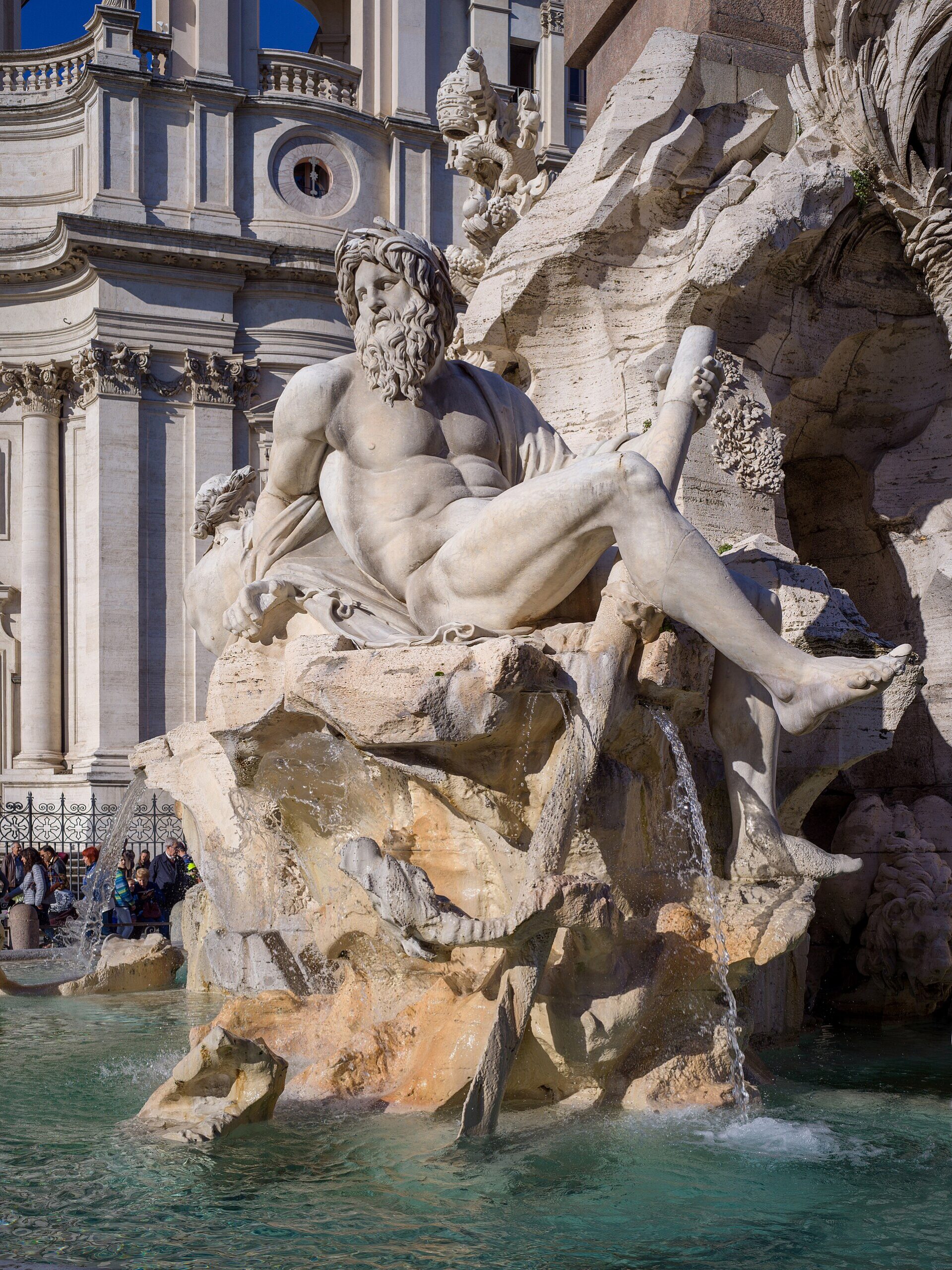
The elongated shape of the square is the shape of Domitian’s stadium underneath it: that is why it is an oval and not a rectangle. At the centre is Bernini’s Fountain of the Four Rivers, with figures for the Nile, the Ganges, the Danube and the Río de la Plata. The church opposite, Sant’Agnese in Agone, is by Borromini: the two men loathed each other, and the poses of the statues are what remains of it.
6 – Trevi Fountain
Visit 20 minutes · Getting there 15 minutes on foot past Montecitorio · Entry free

Thirty metres of facade wedged into a square that cannot contain it: that is exactly the effect Nicola Salvi was after. In the afternoon it is packed and there is no way round that: what you can do is turn the corner to the left and look down on it from Via della Stamperia, where nobody goes. The coin is thrown with your right hand over your left shoulder, with your back to the fountain.
Evening — Trastevere
2 km · 1 stop · from 7:30 pm onwards · cross the Tiber at Ponte Sisto

You cross the river and everything changes: narrow lanes, ivy on the walls, washing hanging from the windows. The heart of it is Piazza Santa Maria in Trastevere, with twelfth-century mosaics on the facade of the basilica — go inside, the ones in there are better still, and the church stays open into the evening. After that you do not need a plan: you wander, you eat late, you have a drink in the square.
If your legs still work at the end of the day, walk up to the Janiculum: twenty minutes uphill from the square, and from the terrace you see the whole of Rome lit up, which is the right image to close a single day with.
Trastevere, but away from the main square: three lanes are enough to halve the bill and improve the food. Otherwise the Ghetto, ten minutes away on the other bank, if you want carciofi alla giudia and a quieter evening.
The Vatican variant

If you want to spend your only day in Rome at the Vatican, it can be done, but the cost has to be stated plainly: the Vatican Museums alone eat half a day, and to fit them in you have to give up either the Colosseum or the afternoon in the centre. There is no version that holds both together decently.
The alternative day looks like this: Vatican Museums on the first slot at 8 am, walking straight to the Sistine Chapel before looking at anything else; St Peter’s Basilica around midday, when the security queue shortens because many people are at lunch; lunch in Borgo Pio or Prati, never on Via della Conciliazione; Castel Sant’Angelo in the afternoon, with the rooftop terrace looking across at St Peter’s and the whole bend of the Tiber; then on foot along the river to the Pantheon and Piazza Navona for the evening.
Two warnings that decide whether it works: the Museums are closed on Sundays, except the last of the month when entry is free and the queue is enormous; and the dress code is genuinely enforced, shoulders and knees covered, even in August.
Three things not to do
Do not put the Vatican and the Colosseum in the same day. They are two hours of visiting each plus queues, they sit at opposite ends of the centre, and you would end up doing both badly.
Do not count on taxis to save time. Most streets in the historic centre are closed or one-way: from the Pantheon to Piazza Navona you get there faster on foot than by car, and at peak times a taxi takes three times as long.
Do not buy tickets from sellers outside the monuments. The «skip the line» sold in the street is almost always an overpriced guided tour. The official Colosseum website is the only place where buying in advance is necessary.
What it costs
| Item | Indicative cost |
|---|---|
| Colosseum, Roman Forum and Palatine | €18 |
| Pantheon | €5 |
| Public transport, day ticket | €7 |
| Lunch in a trattoria in Monti | €15-25 |
| Dinner in Trastevere | €25-40 |
| Total per person | €70-95 |
Reference figures as of August 2026: museums change their prices often, check the official websites before you travel.
Getting around
This day is done almost entirely on foot: the metro is only needed in the morning, to reach the Colosseum, and in the evening if you would rather not walk back. Two lines are useful, B for the Colosseum and A for the Spanish Steps and the Vatican, and they cross at Termini.
A single ticket is valid for 100 minutes on all services, with one pass through the metro barriers. For a single day the €7 day ticket is worth it if you expect to take more than three journeys; otherwise two single tickets will do.
One thing nobody tells you: wear shoes you have already broken in. Nine kilometres of cobblestones in one day do more damage than tiredness.
Frequently asked questions
Can you see Rome in one day?
You can see part of Rome, not Rome. A full day holds the Colosseum with the Roman Forum, the Pantheon, Piazza Navona, the Trevi Fountain and an evening in Trastevere: those are the landmarks, and the route works. The Vatican, all the museums and Villa Borghese are left out.
Colosseum or Vatican, if I only have one day?
The Colosseum, if it is your first time: it is central, it combines with the Forum and with the rest of the day on foot, and it takes less time. The Vatican Museums on their own take half a day and force you to give up the whole afternoon in the centre.
How much walking does this itinerary involve?
About 9 kilometres in total, spread over three parts of the day: 3.5 in the morning, 3.5 in the afternoon and 2 in the evening. Almost all of it is on cobblestones, so shoes matter more than fitness.
Do I need to book anything?
Only the Colosseum, which has a compulsory timed entry slot: sales open thirty days ahead and in peak months the morning slots go within hours. The Pantheon is paid at the door and everything else in the day is free.
How much does one day in Rome cost?
Between €70 and €95 per person excluding accommodation, counting entry fees (€23), transport and two meals. It drops below €50 if you skip the restaurant in the evening.
When is the best time for a day in Rome?
April to May and October: good weather and days long enough to reach Trastevere in daylight. In July and August the morning at the Forum is hard going because there is no shade; in December and January it is dark by five and the itinerary has to be shortened.
Does this itinerary work with children?
Nine kilometres is a lot for a small child. The version that holds up is this: Colosseum in the morning, lunch in Monti, then only the Pantheon and Piazza Navona, with Trevi instead of the Capitoline Hill. Entry to state sites is free for under-18s.
August 22, 2026