

Rome in 3 days: a day-by-day itinerary
Three days is the right length for Rome: enough for ancient Rome, for the Vatican and for the baroque centre without rushing, and it only leaves out the things that deserve a fourth day. This itinerary is built for people who walk: each day starts from a point you can reach by metro and closes on foot, with the real travelling times between one stop and the next.
At a glance
- Length · 3 full days, 3 nights
- Best time to go · April-May and October; July and August are punishing
- Walking distance · between 7 and 9 km a day, largely on cobblestones
- Budget · €90-140 per person per day, accommodation excluded
- Tickets to book ahead · Colosseum and Vatican Museums, both with timed entry
- Where to stay · Monti if it is your first time, Trastevere if you are after the evenings
Three layers, one per day. The numbers follow the order of the visit.
Day 1 — Colosseum, Roman Forum and Palatine
7.2 km · 4 stops · lunch in Monti · start from metro line B, Colosseo stop

The first day fits inside a single square kilometre, which is exactly why it should come first: if the trip has to be cut short, this is the part you cannot skip. One ticket covers the Colosseum, the Roman Forum and the Palatine, costs €18 and is valid for 24 hours, but entry to the Colosseum has a compulsory time slot: book it on the official website as soon as sales open, thirty days ahead.
1 – Colosseum
Visit 2 hours · Opens 8:30 am · Ticket €18 with Forum and Palatine, booking compulsory
Take the first available slot. At 8:30 am the Colosseum is still empty and the light comes in sideways through the eastern arches: two hours later it is a different place. Go straight up to the second tier, from which you can see the whole underground level — the hypogeum where the cages and the hoists were — and only then come down to the arena. If your ticket includes the arena floor and the underground, add forty minutes.
2 – Roman Forum
Visit 1 hour 30 · Getting there 5 minutes on foot from the Colosseum exit · Opens 9 am

You enter from Via dei Fori Imperiali, under the Arch of Titus. Without a guide the Forum is a field of stones: take at least a plan, or climb the Palatine first and look down on it, which is how it becomes readable. The things to look for are the Via Sacra, the House of the Vestals with its pool and statues, and the Basilica of Maxentius, the only one that shows how tall these buildings were.
3 – Palatine Hill
Visit 1 hour · Getting there 10 minutes uphill from the Forum · Ticket the same as the Colosseum

The hill where Rome was born and where the emperors lived for three centuries. It is the greenest and least crowded of the three sites, and the terrace of the Farnese Gardens is the point from which the whole Forum makes sense at once. On the other side the view opens onto the Circus Maximus. If your legs are holding out, this is a good moment to sit in the shade for twenty minutes.
4 – Piazza Venezia and the Capitoline
Visit 45 minutes · Getting there 10 minutes on foot · Entry free
The day closes by walking back up Via dei Fori Imperiali to Piazza Venezia. Climb Michelangelo’s ramp to the Campidoglio square, then go round the right-hand side of the Senatorial Palace: there is a terrace looking down over the Forum, free of charge, and at sunset it is the best spot of the day. The Vittoriano has a lift up to a panoramic terrace: it costs money, but it is the only place from which you see Rome with the Vittoriano in it.
Lunch · walk up to Monti, ten minutes from the Colosseum: it is the district behind Via Cavour, full of proper trattorias at normal prices. Avoid anything with a photographed menu outside near the Amphitheatre.
Dinner · Monti again, around Piazza della Madonna dei Monti, or the Ghetto if you want carciofi alla giudia.
Day 2 — Vatican and Castel Sant’Angelo
6.5 km · 3 stops · lunch in Borgo Pio or Prati · metro line A, Ottaviano stop

A day to be planned to the minute, because the Vatican Museums are the one place in Rome where getting the time wrong ruins the visit. The Museums are closed on Sundays, except the last of the month, when entry is free and the queue is enormous. If your second day falls on a Sunday, swap it with the third.
1 – Vatican Museums and Sistine Chapel
Visit 3 hours · Hours Monday to Saturday 8 am-8 pm, last entry 6 pm · Ticket €20, €25 booked online
Book the first slot, 8 am, and walk straight to the Sistine Chapel before looking at anything else: at 8:20 am there are fifty people in it, at 11 am five hundred and you can no longer hear a thing. Only then double back and do the normal route — the Pinecone Courtyard, the Gallery of Maps, the Raphael Rooms. The dress code is genuinely enforced: shoulders and knees covered, or they stop you at the entrance.
2 – St Peter’s Basilica
Visit 1 hour 30 including the dome · Getting there 15 minutes on foot along the walls · Entry free, dome charged
Entry to the basilica is free, but you go through security on the square and in summer the queue can be over an hour: arriving around midday, when many people are at lunch, works better than arriving at nine. Inside, look for Michelangelo’s Pietà, immediately on the right, and Bernini’s baldachin. The climb to the dome is charged separately and has two prices, on foot or with the lift to the first level: either way the last hundred and fifty steps are on foot, in a corridor that narrows and tilts, and they are not for everyone.
3 – Castel Sant’Angelo
Visit 1 hour 30 · Getting there 10 minutes on foot along Via della Conciliazione · Ticket separate, bought at the door

Built as Hadrian’s mausoleum, turned into the popes’ fortress, with the raised corridor connecting it to the Vatican that was there for escaping. The Roman spiral ramp is still the original one. But the real reason to go up is the terrace at the top: from there you see St Peter’s opposite and the whole bend of the Tiber, and at sunset it is the finest view in Rome. On the way out, cross Ponte Sant’Angelo on foot between Bernini’s angels.
Lunch · do not eat on Via della Conciliazione. Move two streets north, to Borgo Pio, or go into Prati towards Via Cola di Rienzo, where the Romans who work there eat.
Dinner · Prati, which is quiet in the evening and has good pizza by the slice.
Day 3 — The baroque centre and Trastevere
8.4 km · 5 stops · lunch at Campo de’ Fiori · no booking needed
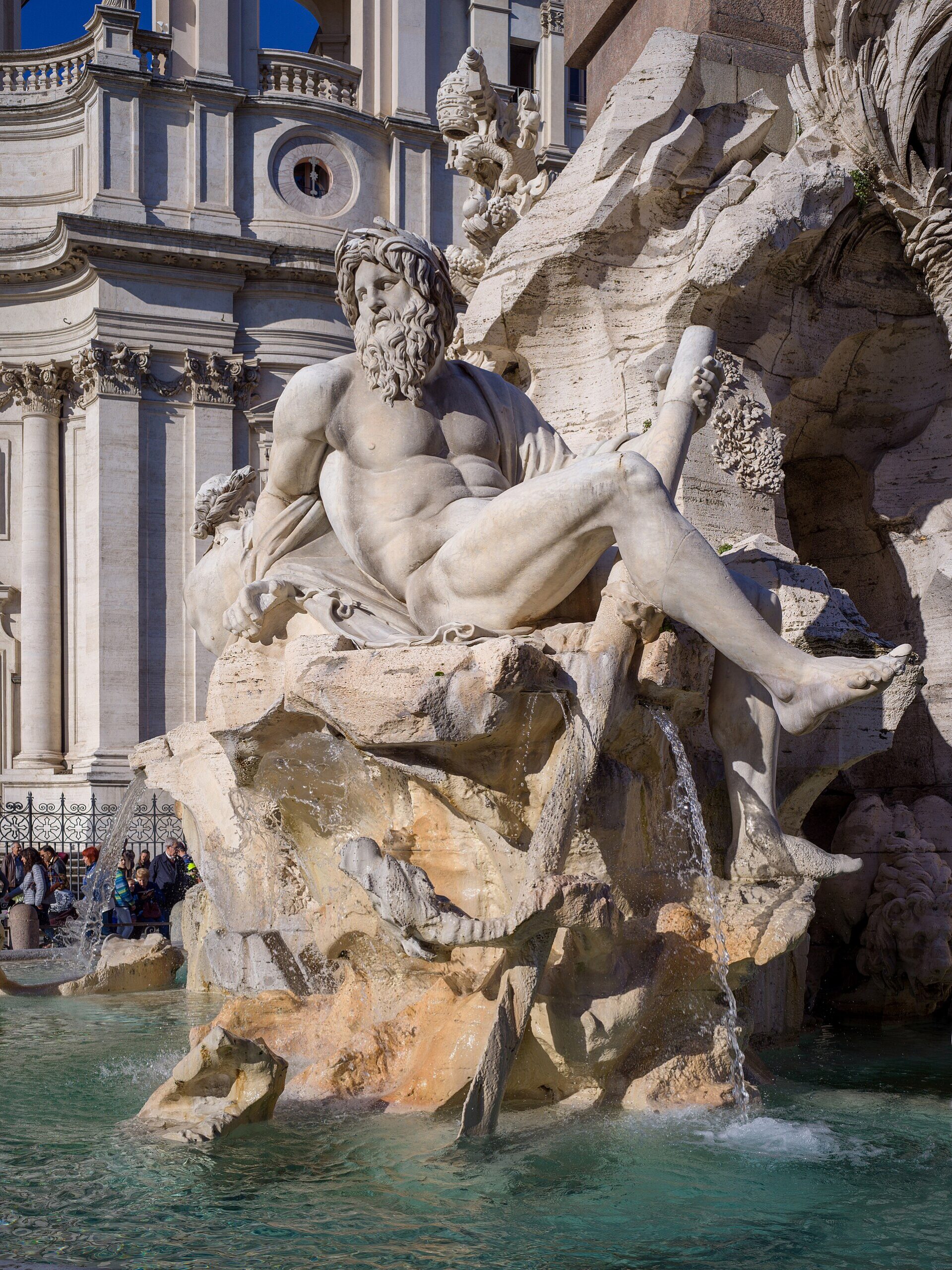
The lightest day and the best one for walking: the whole route stays inside the historic centre, nothing needs booking and the distances between stops are a few minutes each. The one serious piece of advice is to start early: the Trevi Fountain at eight in the morning and the Trevi Fountain at eleven are two different experiences.
1 – Piazza Navona
Visit 30 minutes · Entry free
The elongated shape of the square is that of Domitian’s stadium underneath: that is why it is an oval. At the centre is Bernini’s Fountain of the Four Rivers, with four figures standing for the Nile, the Ganges, the Danube and the Río de la Plata. The church of Sant’Agnese in Agone opposite is by Borromini — and the rivalry between the two men can still be read in the postures of the statues.
2 – Pantheon
Visit 40 minutes · Getting there 5 minutes on foot · Ticket €5, entry has not been free since 2023

It is the best preserved building of Roman antiquity and still has the largest unreinforced concrete dome in the world. The diameter of the dome is identical to its height from the floor: exactly forty-three metres, which is to say a perfect sphere wedged into the cylinder. The oculus at the top is genuinely open: when it rains, it rains inside, and the sloping floor carries the water to drainage holes that have been there for nineteen centuries.
3 – Trevi Fountain
Visit 20 minutes · Getting there 8 minutes on foot · Entry free

Thirty metres of baroque facade wedged into a square too small to hold it: that is precisely the effect Nicola Salvi wanted. The coin is thrown with your right hand over your left shoulder, with your back to the fountain. What almost nobody does is turn the corner to the left and look down on it from Via della Stamperia, where there is nobody at all.
4 – Spanish Steps
Visit 30 minutes · Getting there 10 minutes on foot · Entry free
The staircase up to Trinità dei Monti, the Barcaccia fountain at the bottom and Via dei Condotti running straight ahead with all the windows. You can no longer sit on the steps and the fines are real. Go to the top: from the terrace in front of the church you see the whole centre of Rome, and there is also a lift up from Spagna metro station if your legs have already had enough.
5 – Trastevere
Visit 2 hours, ideally in the evening · Getting there 20 minutes on foot from Campo de’ Fiori across Ponte Sisto

You cross the Tiber and everything changes: narrow lanes, ivy on the walls, washing hung out. The heart of it is Piazza Santa Maria in Trastevere, with a basilica carrying twelfth-century mosaics on its facade — go inside, the ones in there are better still. After that you do not need a plan: you wander, you have a drink, you eat late. If you have energy left, walk up to the Janiculum for the night view over Rome: twenty minutes uphill and worth every one of them.
Lunch · Campo de’ Fiori is still a market in the morning: buy something there and eat it sitting in Piazza Farnese, a hundred metres away and empty.
Dinner · Trastevere, but away from the main square: three lanes are enough to halve the bill.
If you have an extra day
A fourth day in Rome has three good answers: the Galleria Borghese with the park of Villa Borghese, to be booked days in advance because entry runs in two-hour slots; the Appian Way by bicycle, with the catacombs and the tomb of Cecilia Metella, closed to traffic on Sundays; or Ostia Antica, half an hour by train from Piramide, which is an entire Roman town, empty, and far easier to read than the Forum.
What it costs
| Item | Indicative cost |
|---|---|
| Colosseum, Roman Forum and Palatine | €18 |
| Vatican Museums booked ahead | €25 |
| Pantheon | €5 |
| Castel Sant’Angelo | separate ticket, at the door |
| Transport, 3 days | €18 with the 72-hour ticket |
| Lunch in a trattoria | €15-25 |
| Dinner | €25-40 |
Reference figures as of August 2026: museums change their prices often, check the official websites before you travel.
Where to stay in Rome
Monti is the right choice the first time: you sleep between the Colosseum and Termini, you walk everywhere, and in the evening the district is alive without being chaotic.
Trastevere is for people who want the evenings out and accept noise until late; by day you are slightly further out, but the bridges take ten minutes.
Prati is the quiet option: an orderly residential district two steps from the Vatican, with lower prices for the same room. Less character, more sleep.
Avoid the area immediately around Termini, which is cheap for a reason.
Getting around
Rome is done on foot, and over three days the metro is mostly useful in the morning to reach the day’s starting point. Two lines matter: A for the Vatican and the Spanish Steps, B for the Colosseum. They cross at Termini.
A single ticket is valid for 100 minutes on all services, metro included but with only one pass through the barriers. For three days the 72-hour ticket is worth it and pays for itself on the third journey. Take taxis only from official ranks or through the apps: not the ones offered to you outside stations.
One thing nobody tells you: wear shoes you have already broken in. Over three days the cobblestones do more damage than the tiredness.
Frequently asked questions
Are 3 days really enough for Rome?
They are enough for ancient Rome, the Vatican and the baroque centre without rushing. They are not enough for the museums: the Galleria Borghese, the Capitoline Museums and Palazzo Massimo stay out. If it is your first time, three days is the right length.
Does the Colosseum have to be booked?
Yes, and it is the only genuinely compulsory booking along with the Vatican Museums. Sales open thirty days ahead and in peak months the morning slots go within hours.
When is the best time to go to Rome?
April-May and October: good weather and long days. July and August are very hot and the Forum has no shade. January and February have fewer people and lower prices, but the day ends at five.
Are the Vatican Museums open on Sundays?
No, except the last Sunday of the month, when entry is free but the queue is very long. If your plan falls on a Sunday, move the Vatican day.
Can it all be done on foot?
Almost. Each day is built to be walked within itself; the metro is only needed to reach the starting point in the morning. In total you walk between 7 and 9 km a day.
How much do three days in Rome cost?
Between €90 and €140 per person per day excluding accommodation, counting entries, transport and two meals. The entry fees alone come to about €50 in total.
August 22, 2026


