Zurich in 1 day: banks, churches, and street art
Zurich has a precise and wrong reputation : the city of banks, orderly and boring, where everything costs double. The double is true, the rest is not. It’s a city of four hundred thousand people built where a river exits a lake, with an old town of alleys you can walk through in an hour, twelve hundred fountains of drinking water, and the summer habit of throwing yourself into the river downtown after the office. In a four-metre alley, in 1916, Dada was born while Lenin lived two doors away. And yes, there are the banks. In a single day everything fits : the two churches, the Roman terrace, Europe’s largest clock face, the alleys and the lake.
At a glance
- Duration · a full day, from 9 to 22
- How much walking · about 6 km, with two short climbs (Lindenhof and the tower)
- What to book · nothing
- Budget · 70-120 francs per person, accommodation excluded : it’s one of the most expensive cities in the world
- Starting point · Central Station, at the top of Bahnhofstrasse
- Ending point · the lake, or the alleys of Niederdorf
- The trick to save money · the water from public fountains is drinkable everywhere : bring a water bottle
- What’s left out · the Kunsthaus, Zürich West, the Rhine Falls and the lake cruise : those are the second and third day
Seven stops in a square kilometre : Zurich’s centre is truly small.
Morning — The avenue of banks and the Roman hill
1.5 km · 3 stops · from 9:00 to 13:00 · one short climb
1 – Bahnhofstrasse and Paradeplatz
Time 1 hour · Free · Start from Central Station · The tram along the street is included with any ticket

You start from the station and descend toward the lake along Bahnhofstrasse, fourteen hundred metres straight to the water. The street has existed since 1864 and lies exactly where the moat of the medieval walls used to run, called Fröschengraben, the frogs’ moat, which was filled in to make an avenue.
It’s one of the world’s most expensive shopping streets, and the upper part — toward the station — has normal shops, while the lower you go toward the lake the window displays become watches, jewellery and banks. There are no cars : only trams pass, which here are blue and come every three minutes.
Halfway down opens Paradeplatz, a small square with nothing beautiful in it, and which for a century was the centre of the world financial system : here are the headquarters of the two big Swiss banks, which after absorbing Credit Suisse in 2023 became one. The legend says that under the asphalt are the vaults with gold reserves : the banks do indeed have their deposits in the area, but what really lies under Paradeplatz is the tram terminus.
On the square there’s also the Sprüngli pastry shop, since 1859, where you buy Luxemburgerli : tiny, very light macarons that are Zurich’s sweet treat. They’re expensive and delicious. A practical tip : on the same street there’s also the chocolate shop, and the two brands — the pastry shop and the industrial tablet — were born from the same family but have been separate companies for one hundred fifty years.
2 – The Lindenhof
Time 30 minutes · Free · Movement 6 minutes on foot, uphill · Always open

The Lindenhof is a gravel terrace with linden trees above the old city, and there’s nothing to visit : there are benches, a couple of tables with giant chess where pensioners play, and the best view of Zurich. You climb up in five minutes from Bahnhofstrasse.
It’s the point where the city was born. Here the Romans, around 15 BC, put a customs post to collect tolls on merchandise travelling up the river : it was called Turicum, and that’s where Zürich’s name comes from. A Roman plaque found in the area still bears that name. Above the Roman fort a Carolingian palace was later built, demolished in the Middle Ages ; the hill was left empty by choice, and by statute nothing can be built on it.
The story the Zurichers tell is about 1292. The city was besieged by Habsburg troops and the men were elsewhere fighting ; the women of Zurich dressed in armour, lined up on the hill and made themselves visible from below. The besiegers, believing an army had arrived, lifted the siege. The fountain with the armoured figure in the middle of the terrace commemorates that episode.
3 – St. Peter’s Church
Time 20 minutes · Free entry · Movement 4 minutes on foot downhill
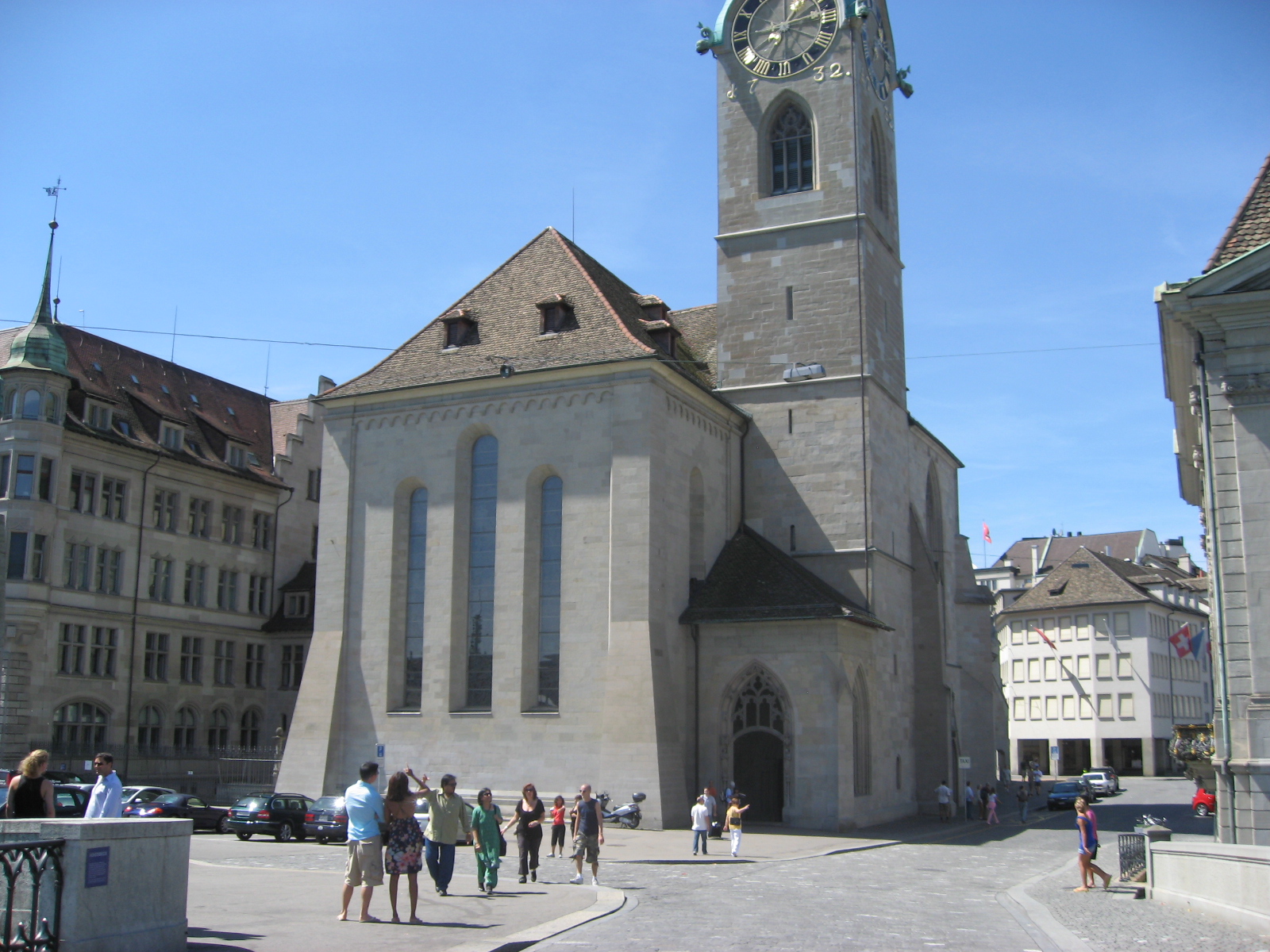
Coming down from Lindenhof you pass St. Peter’s Church, which from outside is an ordinary church except for one thing : its clock face is Europe’s largest, eight metres sixty-four in diameter, with the minute hand almost four metres long. It was built this way so it would be readable from the whole city and from boats on the lake, at a time when nobody had a pocket watch.
Until the nineteenth century a fire guard lived in the tower, whose job was to look out the window every quarter hour and, if he saw a fire, hang a flag from the side of the city that was burning. The interior of the church is as austere as all the Reformed churches in Zurich, and the reason becomes clear at the next stop.
Zurich is expensive and lunch hits the wallet. Three ways to manage : the daily menu (Tagesmenü), which almost every restaurant does at noon for office workers and costs about half the menu (20-28 francs) ; the university canteens of the Polytechnic and university, open to everyone, with the view thrown in from the ETH terrace ; and takeaway stands. The local dish is Zürcher Geschnetzeltes, veal strips in cream and mushroom sauce served with Rösti, a grated potato omelette : 32-42 francs in a traditional restaurant. And remember the fountains : Zurich has over twelve hundred and the water is drinkable in all of them, so you never buy a bottle.
Midday — The two churches
1 km · 2 stops · from 14:00 to 17:00 · the two churches face each other across the river
4 – The Fraumünster and Chagall’s stained glass
Time 45 minutes · Ticket about 5 francs · Closed during services · Check if photography is allowed : the rule has changed over time
The Fraumünster, the church with the green pointed spire, was founded in 853 by Ludwig the German for his daughter Hildegard, as a convent of noble nuns. What follows is the interesting part : for centuries the abbess of this convent was the sovereign of Zurich. She had the right to mint coins, collect tolls and appoint the mayor. A woman, at a time when women counted for nothing, governed the city — until the Reformation, which in the sixteenth century abolished the convent.
People come here for the five choir windows by Marc Chagall, installed in 1970 when the painter was eighty-three years old. Each has a dominant colour and a biblical theme : the red of war, the blue of Jacob, the green of Christ, the yellow of Zion, the deep blue of the prophets. They’re nearly ten metres tall and you watch them in silence, sitting, waiting for the sun to turn. In the north transept there’s another window, from 1945, by Augusto Giacometti — a relative of the more famous Alberto — and it’s almost equally beautiful and almost nobody looks at it.
5 – The Grossmünster
Time 1 hour with the tower · Church free, tower about 5 francs, 187 steps · Movement 5 minutes on foot, crossing the bridge

On the other bank of the Limmat are the twin towers of Grossmünster, which are the symbol of the city. The foundation legend is one of the most beautiful : Charlemagne, while hunting a stag, would have arrived here and his horse knelt by itself on the spot where Felix and Regula, the city’s patron saints, were buried, beheaded by the Romans — and who, according to the tale, after beheading picked up their own heads and walked forty steps uphill before lying down. The two saints with their heads in their hands are still today on Zurich’s seal.
What really matters happened here on January 1, 1519, when a thirty-five-year-old priest, Huldrych Zwingli, climbed this pulpit and began commenting on the Gospel of Matthew from the beginning, verse by verse, instead of following the liturgical calendar. From that gesture comes the Swiss Reformation, which is something different from Luther’s and much more radical.
The consequences are visible in the building : images were covered with whitewash, altars dismantled, organs removed, and in Zurich for about eighty years there was no singing in church because sacred music was considered a distraction. The Romanesque bareness you see is not medieval austerity : it’s an ideological choice of the sixteenth century. Zwingli died in battle in 1531 and his body was quartered and burned by victorious Catholics.
Climb the Karlsturm, the left tower : it’s one hundred eighty-seven spiral steps and from the top you see the river, the lake and, on clear days, the Alps. The modern stained glass in the choir is by Sigmar Polke, from 2009, and some are made with paper-thin slices of agate instead of glass : they look like illuminated stone sections.
Afternoon and evening — The alleys and the lake
2 km · 2 stops · from 17:00 onwards · all flat
6 – Niederdorf and the alley of Dada
Time 1 hour and a half · Free · Cabaret Voltaire entry by donation, closed Mondays · Movement 3 minutes on foot
Across the river from the Grossmünster is Niederdorf, the old city’s tangle of alleys. This is where you come to eat, drink, look at the shops and, if you want, visit the place where Dada was born. Dada was an anti-art movement that emerged during World War One as a response to the senselessness of war : why make sense in a world without sense? There’s no manifesto : the point was that there should be none.
In 1916 a group of neutrals — poets, singers, painters from different countries — were in Zurich during the war and met at the Cabaret Voltaire, a venue on Niederdorfstrasse. Tristan Tzara, Hans Arp, Hugo Ball, Emmy Hennings and others spent their evenings inventing nonsense, performing increasingly absurd happenings, and calling it art. The Cabaret Voltaire still exists, in the same spot, and you can go in — it’s usually full of tourists who know nothing about Dada, which is perfectly in the spirit of the thing.
Six doors down the same street, at Spiegelgasse 1, lived Lenin — he was there because Switzerland was neutral and he was a Russian refugee. And at number 14 of the same street lived Bakunin. The street is four metres wide. A whole history of the twentieth century is compressed into forty metres of alley in Zurich.
7 – The lake at sunset from Bürkliplatz
Time whatever time is left · Free · Best at sunset · Movement 10 minutes on foot from Niederdorf
Follow Niederdorfstrasse down to the lake at Bürkliplatz, a promenade with restaurants where you can sit outside. The water of the lake is cold year-round but on summer evenings Zurichers jump in after work and swim until the sun sets. If you can’t swim, just sit and watch the mountains on the far side, the water and the light changing. The last stop of the day is to understand why people live in this small, expensive, orderly city : for moments like this.
If it rains
- Kunsthaus (free on Wednesdays after 5 PM) : one of the world’s great art museums, with works by Monet, Picasso, Matisse, Giacometti.
- Museum Haus Konstruktiv : art and design, free entry.
- Swiss National Museum (“Landesmuseum”) : art, history, culture of Switzerland from ancient times to today.
- Inside Cabaret Voltaire : seats you can occupy until the place gets crowded.
- The arcaded streets of the old city : the Niederdorf alleys have covered passages where you can stay dry and window-shop.
What the day costs
| Item | Cost |
|---|---|
| St. Peter’s Church, Fraumünster, Grossmünster tower, Cabaret Voltaire entry | 15-20 CHF |
| Breakfast | 8-12 CHF |
| Lunch (daily menu or takeaway) | 15-25 CHF |
| Dinner | 25-40 CHF |
| Drinks and miscellaneous | 15-20 CHF |
| Tram ticket (24 hours) | 9 CHF |
| Total | 70-120 CHF per person |
Prices as of September 2026, converted from 2025 data : check official sites and account for exchange rate changes. Zurich is one of the world’s most expensive cities, but many of its best things — churches, fountains, parks, sunsets — are free. The real difference is in food and transport : alcohol, restaurants, and the lack of cheap accommodation options make the bill climb.
Frequently asked questions
Is Zurich really that expensive?
Yes. A coffee costs 5-7 francs, a sandwich 10-12, a restaurant dinner 40-70. But you can drink from the fountains, and many museums are free or cheaper than elsewhere. The real shock is accommodation and transport. Once you arrive, it’s possible to do a full day for 70-80 francs if you don’t eat in restaurants.
Is one day enough?
For the essentials, yes. You see the two churches, the Lindenhof, the old city alleys and the lake. You miss the Kunsthaus, Zürich West (modern quarters with design shops and galleries), the Rhine Falls outside the city, and Lake Zurich from the water. That’s why there’s a second and third day. But one day leaves you with the core and the flavour.
Can I swim in the lake?
Yes. The water is cold (usually 15-20°C depending on the season) but Zurichers swim year-round. There are designated swimming areas with changing facilities : Bürkliplatz, Mythenquai, and others along the shore. Summer evenings people jump in after work.
What does the Dada movement have to do with Zurich?
Zurich was neutral during World War One, so while Europe was in chaos, artists and intellectuals who opposed the war took refuge here. In 1916 they invented Dada at Cabaret Voltaire as a response to the senselessness of war : if the world is absurd, make absurd art. It spread to Berlin, Paris and New York, and became one of the movements that shaped twentieth-century art.
Why are there so many clocks in Zurich?
Switzerland’s reputation for punctuality and precision is real. But also : Zurich has been the centre of watchmaking since the eighteenth century. Precision timekeeping was a huge industry here, and the clock towers you see everywhere are a legacy of that.
Is it true that you can drink water from the fountains?
Completely true. Over twelve hundred public fountains deliver clean, cold drinking water. In summer, bring a bottle and refill it. In winter, many fountains are shut off, but most fountains in museums, train stations and restaurants are always on.
What is Sp’s Luxemburgerli?
Tiny macarons (almond meringue biscuits filled with ganache), about 2 cm across. They’re intensely flavoured and expensive (about 2.50 francs each). They’re the iconic sweet of Zurich, and worth trying once. The shop on Paradeplatz has been there since 1859.
September 5, 2026