Munich in 3 Days: The Wittelsbachs, the Pinakotheken and Nymphenburg
Three days is the right measure for Munich, and for a precise reason: the city has three faces that do not resemble each other. There is the Munich of the Wittelsbachs, entirely inside the ring of the centre and doable in a day on foot. There is the Munich King Ludwig I wanted to build as a new Athens, with picture galleries and neo-Greek temples, and which in the twentieth century became the headquarters of Nazism — the two things stand on the same square and have to be looked at together. And there is the Munich that never quite took itself seriously: the summer palace with its gallery of beautiful women, the painters’ and coffee-house district, the Olympic park built specifically to look nothing like Berlin 1936. In three days you see all three, without rushing and never taking transport for more than twenty minutes.
At a glance
- How long · 3 full days
- How much walking · 8 km on day one, 6 on day two, 7 on day three · always flat
- What has to be booked · nothing is mandatory · the combined palace ticket pays off if you do the Residenz and Nymphenburg
- Budget · €150-240 per person, excluding accommodation
- Transport · from day two you need the day pass: about €10
- The day not to move · day one, if it falls on a Sunday: the Viktualienmarkt is closed
- What is left out · Neuschwanstein, Salzburg, the Königssee: those are the two days of the five-day version
Day one is entirely on foot. From day two you need the metro and trams, but no leg exceeds twenty minutes.
Day 1 — The Wittelsbach centre
8 km · all on foot · 9am to late evening · you never need public transport
Day one is what you would do even with only one day, and we summarise it here: for the full detail, stop-by-stop timings and its own map, see the Munich in one day itinerary.
Morning – Marienplatz, the tower, the market

You start in Marienplatz, Munich’s centre since 1158, for the 11am carillon: forty-three bells and thirty-two figures that for a quarter of an hour re-enact a 1568 ducal wedding and the coopers’ dance after the 1517 plague. The town hall housing it looks Gothic and was actually built between 1867 and 1908 by a twenty-four-year-old Austrian architect.
Then the 306 steps of the Alter Peter tower (€5, no lift), from which you understand that Munich is a low-rise city: a 2004 referendum bans buildings over a hundred metres in the centre, that is, taller than the cathedral’s towers. On the wall a sign tells you whether the Alps are visible from the top: it happens about thirty days a year, with the Föhn wind.

Three hundred metres away is the Viktualienmarkt, the market since 1807, with its blue-and-white maypole and fountains dedicated to the city’s popular comedians. At its centre, a seven-hundred-seat Biergarten where you can bring your own food and just buy something to drink: the cheapest lunch in the centre. Before noon, order the Weißwürste, which by tradition «must not hear the noon bells». Closed on Sundays.
Afternoon – The cathedral, the Residenz, dodgers’ alley

The Frauenkirche was built in twenty years, from 1468 to 1488, with two million bricks because there is no stone here. The onion domes arrived in 1525 in place of the planned Gothic spires, when the money ran out. At the entrance, on the floor, is the Teufelstritt, the devil’s footprint: stand on it and look toward the altar, the aligned columns hide every window. One step further and the church fills with light.

The Residenz is Germany’s largest city palace: ten courtyards, a hundred and thirty rooms, six hundred years of Wittelsbachs. The three things to see are the Antiquarium, the largest Renaissance hall north of the Alps; the Schatzkammer with the statuette of Saint George covered in two thousand diamonds; and the Cuvilliés Theatre, the rococo theatre where Mozart’s Idomeneo premiered in 1781, which survived the war because in 1944 it was dismantled piece by piece and hidden.

On Odeonsplatz the Feldherrnhalle is a copy of Florence’s Loggia dei Lanzi, and the yellow Theatinerkirche was commissioned by a princess from Turin, Henriette Adelaide of Savoy, and designed by a Bolognese architect. Here Hitler’s 1923 putsch ended in bloodshed, and ten years later the Nazis forced anyone passing to salute the loggia. Those unwilling took the alley behind it, the Viscardigasse: today a bronze strip in the cobblestones marks that detour. No sign, no plaque.
Evening – The park, the surfers, the beer hall

At the south entrance of the Englischer Garten — 375 hectares, bigger than Central Park, created in 1789 by an American loyalist who fled the revolution — is the Eisbach’s standing wave, surfed all year round, legalised by the city only in 2010. Then the Monopteros for sunset, the Chinesischer Turm with seven thousand seats under chestnut trees, and the evening at the Hofbräuhaus — touristy, historic, worth doing once — or at an Augustiner, where locals actually go.
Day 2 — The museums, the temples and the Olympics
6 km on foot · 4 stops · 9:30am to 8pm · you need the day transport pass
5 – The Kunstareal and the Pinakotheken
Time 3 hours · Ticket about €7 for the Alte Pinakothek, €10 for the Moderne · On Sundays almost all state museums cost €1 · Metro U2 Théresienstraße
The Kunstareal is a square of a few hundred metres holding sixteen museums. You do not do them all: pick one big and one small.
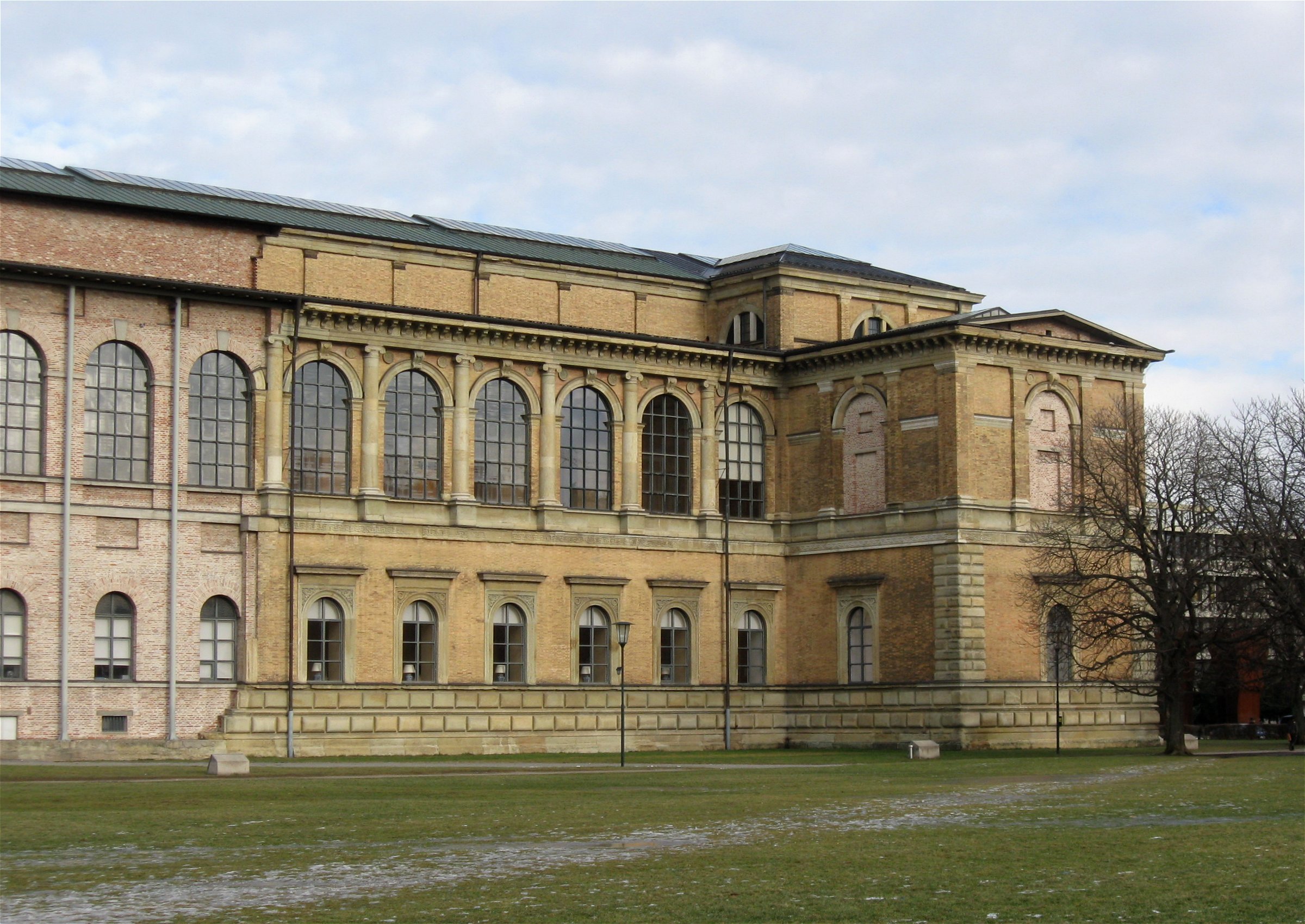
The Alte Pinakothek is the big one. It was built between 1826 and 1836 by Leo von Klenze for Ludwig I and was one of the first buildings in the world designed from scratch as a public gallery: London’s National Gallery and the Hermitage copied the model. Before going in, stop to look at the south façade: at its centre is a large expanse of bare, light-coloured brick, undecorated, clashing with everything around it. It is the patch over the gaping hole opened by 1944 bombs. When it was rebuilt in the 1950s, architect Hans Döllgast refused to recreate the original and closed the gap with plain brick: the wound is visible and was left there on purpose. It is one of the finest things about the building.
Inside is the world’s largest Rubens collection, about seventy works: the room holding the Great Last Judgement was designed around the painting, which stands over six metres tall. Then Dürer’s 1500 self-portrait, the one in which he paints himself frontally like Christ — something no painter had dared in 1500; Altdorfer’s Battle of Alexander, a cosmic sky over a hundred thousand tiny soldiers, which Napoleon took to Paris and kept in his bathroom at Saint-Cloud; Leonardo’s Madonna of the Carnation; Raphael, Botticelli, Rembrandt and Bruegel the Elder’s Land of Cockaigne.
Choose the small one by taste: the Pinakothek der Moderne (2002) holds four museums together — art, graphics, architecture and design — and its design section is the oldest of its kind in the world; the Museum Brandhorst, with a façade of thirty-six thousand coloured ceramic rods, has a room built specifically for Cy Twombly’s Lepanto cycle.
The nineteenth-century museum — home of Van Gogh’s Sunflowers, Klimt, the German Romantics — has been closed for years for a lengthy renovation, with reopening expected by the end of the decade. Its main pieces are shown on rotation elsewhere, mostly at the Alte Pinakothek and the Sammlung Schack. Check the Bavarian State Museums website for where they currently are: it changes.
6 – Königsplatz
Time 1.5 hours · Square free · Glyptothek about €6 · Walk 10 minutes
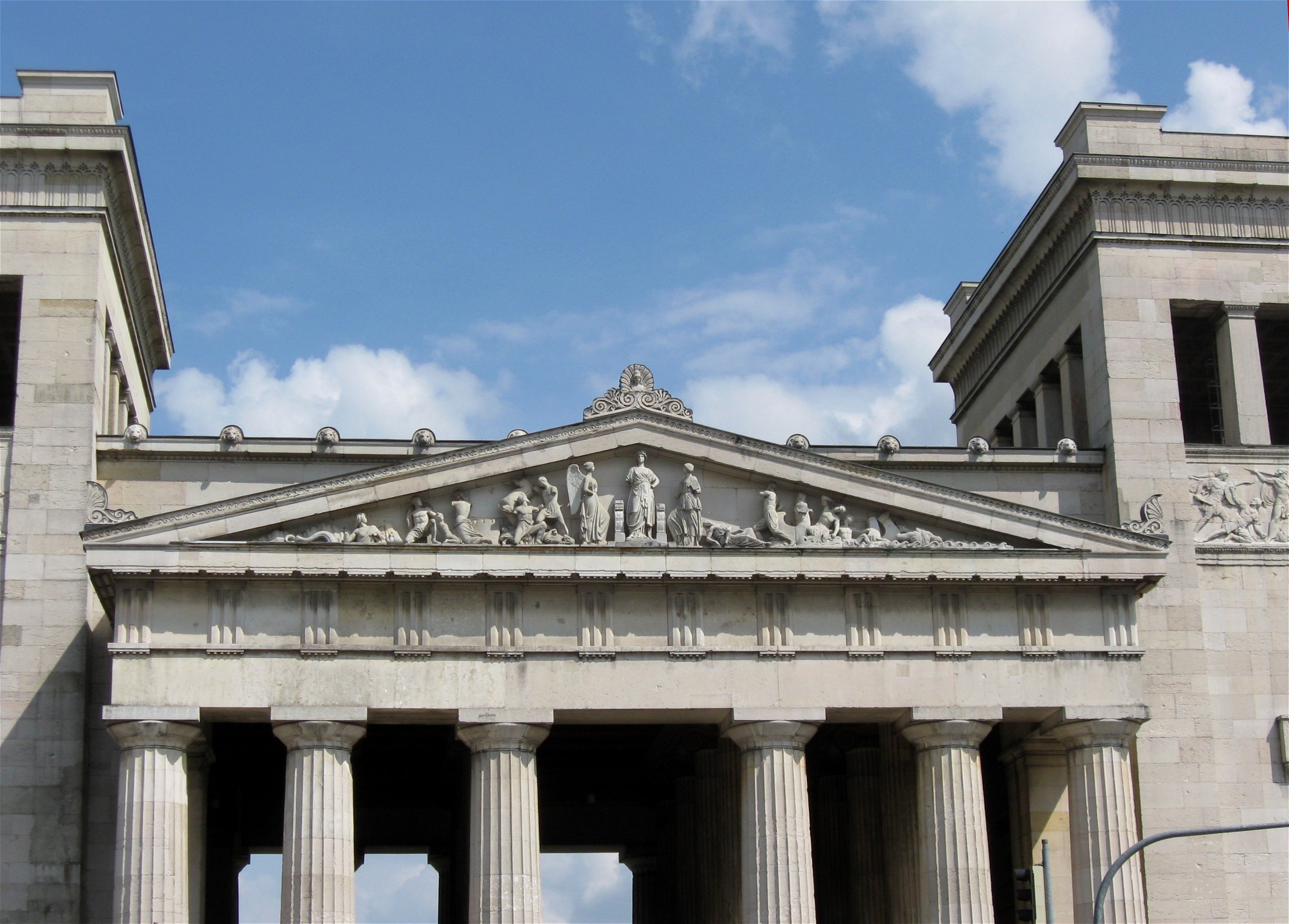
Ludwig I wanted to make Munich «an Athens on the Isar», and this square is where he tried hardest. On three sides stand three neo-Greek buildings by Klenze: the Glyptothek (1830), the world’s oldest public sculpture museum, holding the Barberini Faun and the marbles from the temple of Aegina; the Antikensammlung opposite; and at the far end the Propyläen, a copy of the Acropolis gate, built in 1862 to celebrate Greek independence — Ludwig’s son, Otto, had become king of Greece.
Then there is the other history, and on this square the two touch. In the 1930s the Nazi party headquarters stood here: the Brown House, the chancellery, dozens of offices in the surrounding streets. The square was paved with granite slabs to serve as a rally ground, and two Ehrentempel, honour temples, were built on either side, holding the sarcophagi of the sixteen dead of the 1923 putsch. In 1947 the Americans blew them up: only the plinths remain, overgrown with ivy, and the city has decided not to touch them. The granite was only removed in 1988, and the grass restored in its place is itself a political choice.
On the corner where the Brown House stood, since 2015 there is a white cube: the NS-Dokumentationszentrum, the documentation centre on National Socialism. It is not a museum of horror but a dry, local study of how an ordinary city became «the capital of the movement». If you have an hour and can handle the subject, it is Munich’s most important museum.
7 – Deutsches Museum or BMW Welt
Time 2-3 hours · Deutsches Museum about €15 · BMW Welt free, museum about €10 · Choose one: they sit at opposite ends of the city
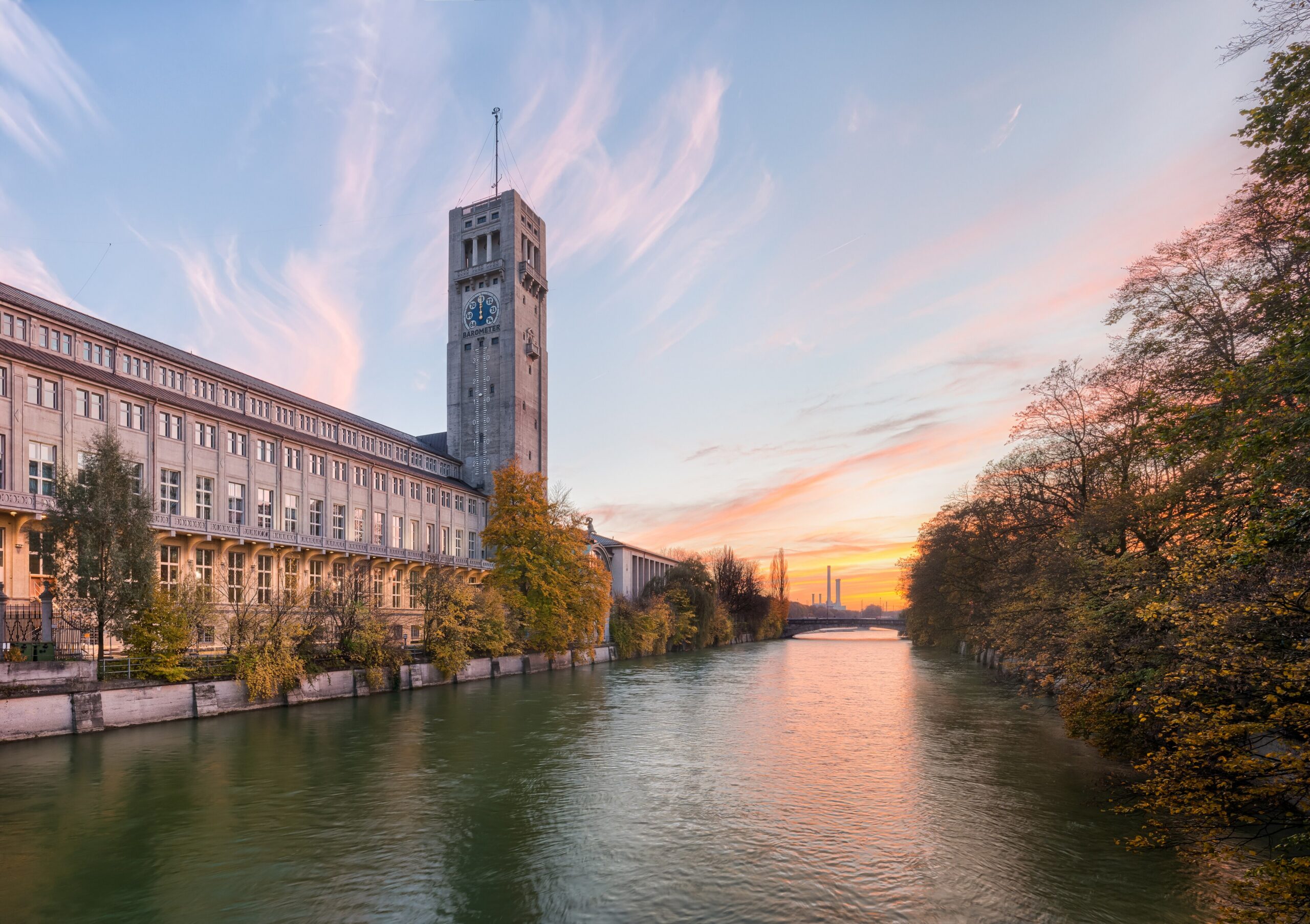
The Deutsches Museum, on an island in the Isar, is the largest science and technology museum in the world. It was founded in 1903 by electrical engineer Oskar von Miller, on an idea that was new at the time: that machines should be touched and operated, not put behind glass. There is a 1906 U-1 submarine cut lengthwise in half, a reconstructed mine walked through underground for hundreds of metres, and a lightning hall firing off high-voltage discharges every hour. One honest note here too: the museum has been under piecemeal renovation for years and part of it is always closed. Check what is open beforehand: if you were after a specific section, you might not find it.
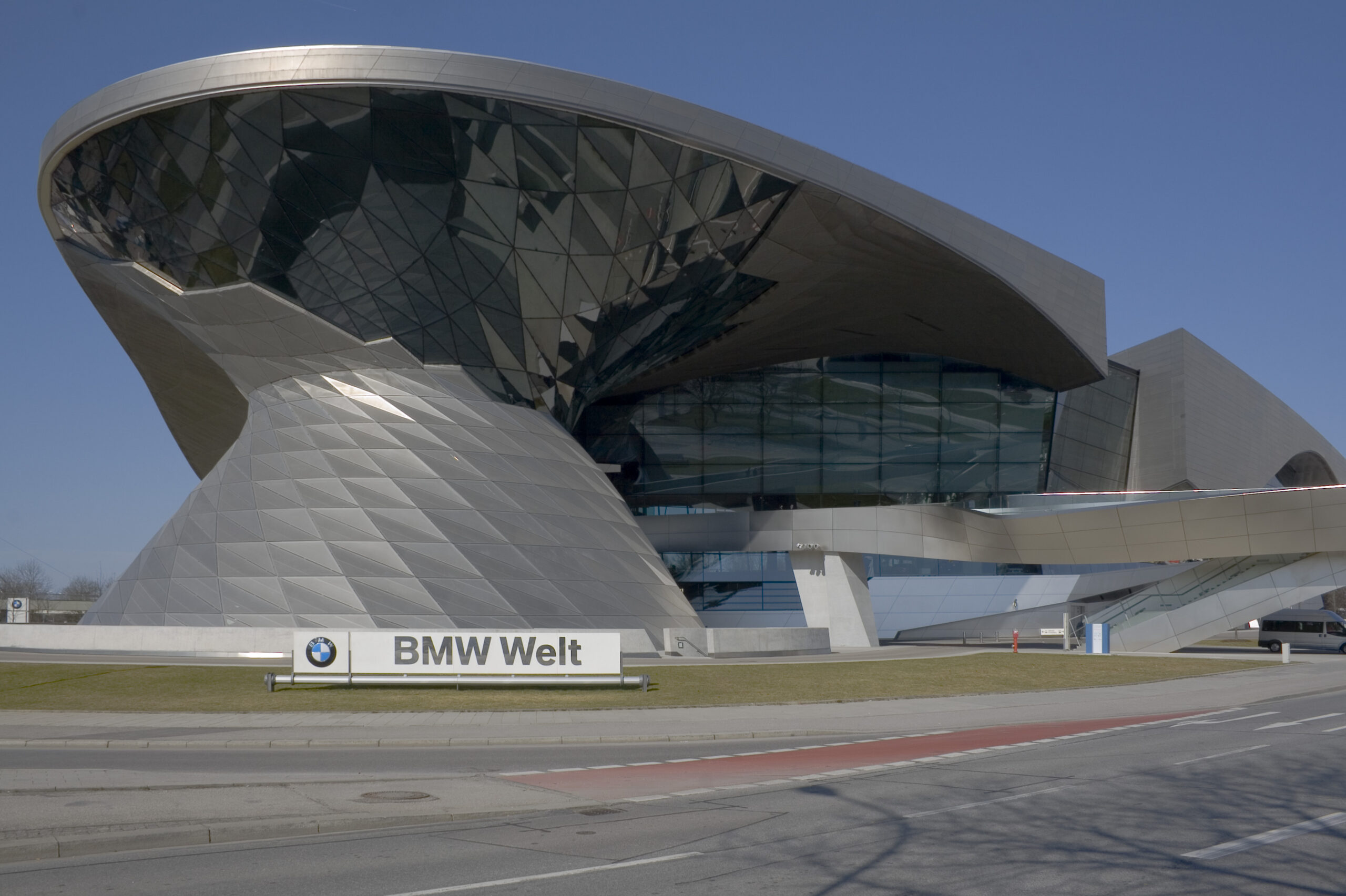
The alternative is the BMW complex, to the north. BMW Welt (2007) is a double-cone glass building where cars are delivered to customers: entry is free, half showroom, half architecture piece. Across the street, the 1973 BMW Museum, the silver «bowl», tells a century of engines; and behind it stands the headquarters’ 1972 four-cylinder tower, built with its floors hanging from a central pillar.
8 – The Olympiapark
Time 2 hours · Park free · Observation tower about €11 · Metro U3 Olympiazentrum, next to BMW Welt
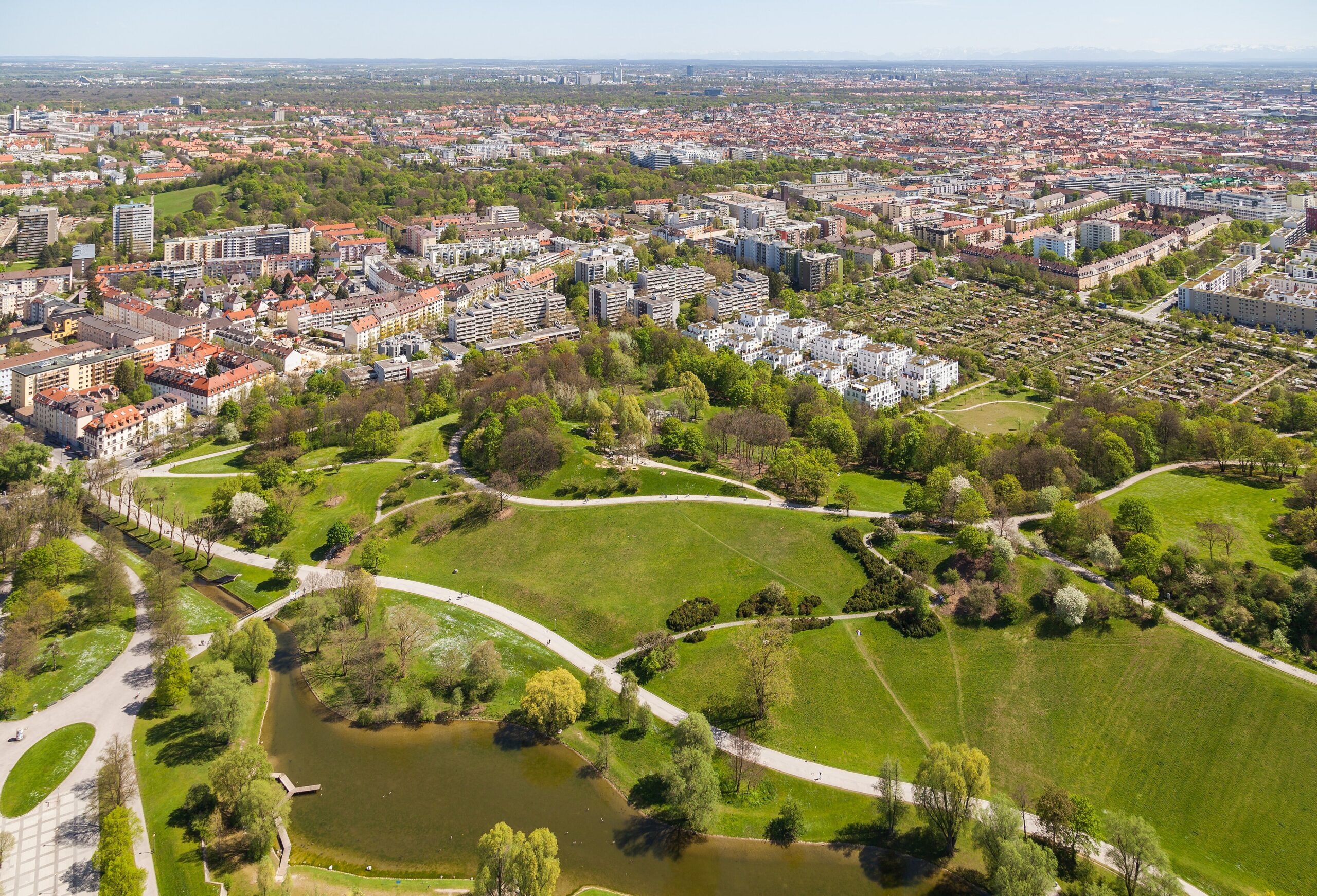
The park was built for the 1972 Olympics on a former military airfield, and its hills are made from rubble from the bombing: the destroyed city is literally under the feet of anyone walking there. The roof is what made it famous: a steel-and-plexiglass net rippling over the stadium, arena and pool, designed by Frei Otto and Günter Behnisch. It was an enormous structural gamble, and a political choice: Germany wanted «cheerful games», light and transparent, the exact opposite of Berlin 1936’s monumental stone.
Those games ended the way everyone knows. On 5 September 1972 a Palestinian commando entered the Olympic village: eleven members of the Israeli team and a German policeman were killed. In 2017 a memorial site opened at the edge of the park, a cleft cut into the hill with the names and stories of the victims. It is poorly signposted and almost no one seeks it out: it sits on the rise north of the lake.
If the weather is clear, go up the Olympiaturm, the 291-metre tower: the highest accessible point in the city, and on Föhn days the whole Alpine chain is visible. Otherwise the lawn is enough: on summer evenings locals sit on the grass, and in winter the small lake freezes over.
At lunch, in the Kunstareal, every museum has a decent café (€10-16), but the better move is to go down to Maxvorstadt, the student district around the university: small places, cooking from every corner of the world, €9-14 a plate. In the evening, if you end up at the Olympiapark, head back toward Schwabing: the Elisabethmarkt, the neighbourhood market, has stalls that stay open like taverns. If instead you are at the Deutsches Museum, you are ten minutes on foot from the Gasteig and the bars of Haidhausen, the district where locals actually go out.
Day 3 — The summer palace and Schwabing
7 km · 3 stops · 9am to 7pm · morning by tram, afternoon on foot
9 – Nymphenburg Palace
Time 3-4 hours with the park · Ticket about €8 for the palace, €15 combined with the pavilions · Park free · Tram 17 to Schloss Nymphenburg, 20 minutes from the centre

Nymphenburg was born in 1664 for the same reason as the Theatinerkirche you saw on day one: the birth of an heir to the throne, Maximilian Emanuel, after ten years of waiting. The husband gave his wife from Turin a church in the city and a villa in the countryside. The villa, enlarged over a century and a half, became a seven-hundred-metre façade facing a canal.
Inside, the room everyone looks for is the Schönheitengalerie, the gallery of beauties: thirty-six portraits of women Ludwig I had painted by Joseph Stieler between 1827 and 1850, chosen across every social class — princesses, but also a shoemaker’s daughter and a butcher’s wife. At the end of the wall is Lola Montez, an Irish dancer posing as Spanish: her relationship with the king, and the power she was allowed to take, contributed to the 1848 uprising and Ludwig’s abdication. A wall of portraits that ends with the end of a reign.
In the same wing you see the room where Ludwig II was born in 1845, the king who would build Neuschwanstein and drown in a lake at forty. In the Marstallmuseum, the former stables, are his carriages and above all the night sleigh, gilded and covered in cherubs, with electric light powered by batteries: this is the 1880s, and the king crossed the mountains at night inside a sleigh lit up like an apparition, to be seen by the peasants.
In the park, which is enormous and free, is the piece that truly justifies the combined ticket: the Amalienburg, a hunting lodge built by François de Cuvilliés between 1734 and 1739. The Hall of Mirrors, silver and blue, is considered by many the finest rococo interior in Europe, and it sits inside a single-storey building that promises nothing from outside.
In the former outbuildings, the Nymphenburg porcelain manufactory, founded in 1747, is still active: work is done by hand as in the eighteenth century, and the shop can be visited.
10 – The Siegestor and Schwabing
Time 2 hours · Free · Metro U3/U6 Universität · Walk 30 minutes from Nymphenburg
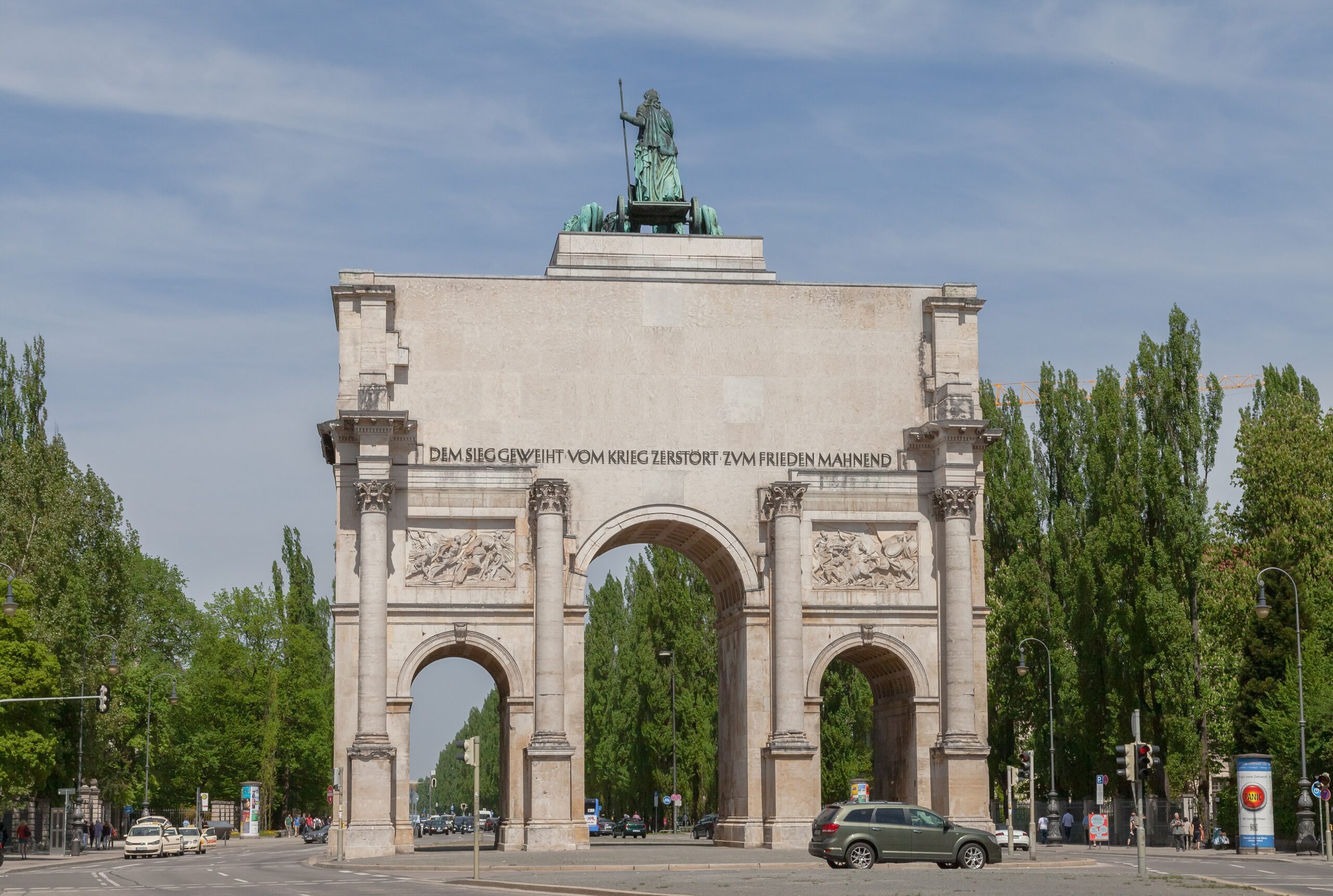
The Siegestor, the victory arch at the end of Ludwigstraße, was built in 1852 on the model of the Arch of Constantine to celebrate the Bavarian army. Bombs reduced it to a ruin, and here locals did the smartest thing: they restored only half of it. One side is rebuilt, the other left stripped bare and without relief, and on the south façade they carved a line that reverses the monument’s meaning: «Dedicated to victory, destroyed by war, a call for peace». Walk under it and look up: it is written there.
From here begins Schwabing, one of the most interesting places in Europe between 1890 and 1914. In a few streets, in the same years, lived Kandinsky and the Blue Rider group, Thomas Mann, Rilke, Frank Wedekind, the illustrators of the satirical magazine Simplicissimus — and, in a rented room under a false name, Lenin. Thomas Mann opens one of his best-known stories with the line «Munich shone», and he means this district.
Little of that Schwabing remains today: Leopoldstraße is now an avenue of chain shops and pavement cafés, and the district has become one of the priciest in the city. The good things sit on the side streets: the Jugendstil façades of Ainmillerstraße, where Kandinsky and Paul Klee lived, and the Elisabethmarkt, the neighbourhood market that is what the Viktualienmarkt was before the tourists.
11 – The university and the White Rose
Time 45 minutes · Free · Walk 5 minutes from the Siegestor
Walking down from the Siegestor toward the centre, the square in front of the university is called Geschwister-Scholl-Platz, Scholl Siblings Square. Look down at the ground, in front of the main entrance: among the cobblestones are bronze leaflets, scattered as if just fallen.
On 18 February 1943, students Hans and Sophie Scholl carried copies of the sixth leaflet of the White Rose, their resistance group against Nazism, into this atrium. Once the distribution was done, Sophie took a stack of remaining leaflets and threw them from the first-floor gallery into the atrium below: the sheets fell fluttering over students leaving their lectures. A caretaker saw them and reported it. They were arrested that same day, tried on 22 February, and guillotined that same afternoon. Sophie was twenty-one.
The atrium is freely open: it is a working university, with students on their way to lectures, and on the first floor there is a small permanent exhibition, the DenkStätte Weiße Rose, free of charge. It is one of the most powerful things you can see in Munich, and it is on none of the top-ten lists.
Twenty kilometres from Munich is Dachau, the first Nazi concentration camp, opened in March 1933 and used as the model for all the others. Today it is a memorial site, entry is free, and it takes about 45 minutes to reach (S2 to Dachau, then bus 726). It needs half a day, no less, and it is a visit that weighs on you: those who do it rarely feel like heading to a beer hall for dinner afterwards, and that is as it should be. We leave the choice to you: either Schwabing or Dachau, not both on the same afternoon. If travelling with children, the memorial advises against the visit for under-fourteens.
If it rains
It rains often in Munich, and these three days hold up well: two of the three are already almost entirely indoors. The day to move is the third, because Nymphenburg’s park is half the visit: swap it with day two and put the Deutsches Museum on the bad-weather day, since it alone fills half a day. If it rains on all three days, the fallbacks are the Pinakothek der Moderne, the NS-Dokumentationszentrum, the Museum Brandhorst and the BMW Welt, which is free. And the historic beer halls, a legitimate plan B in Munich.
What the three days cost
| Item | Cost |
|---|---|
| Alter Peter tower | about €5 |
| Residenz, museum and treasury | about €15 |
| Alte Pinakothek | about €7 (€1 on Sundays) |
| Pinakothek der Moderne or Brandhorst | about €10 |
| Glyptothek | about €6 |
| Deutsches Museum or BMW Museum | €10-15 |
| Nymphenburg with the park pavilions | about €15 |
| Olympiaturm | about €11, optional |
| Marienplatz, Viktualienmarkt, Frauenkirche, Königsplatz, Englischer Garten, Eisbach, Olympiapark, Siegestor, the White Rose, Dachau | free |
| Transport, 3 day passes | about €30 |
| Meals, 3 days | €90-150 |
| Total | about €150-240 per person |
Reference figures as of September 2026: check official websites before you travel. Two real savings: on Sundays almost all Bavarian state museums cost €1 (the Pinakotheken, Glyptothek, Antikensammlung: not the Deutsches Museum, which is private), and the combined palace ticket covers the Residenz and Nymphenburg together.
Frequently asked questions
Is three days enough for Munich?
Yes, and it is the right amount: one for the Wittelsbach centre, one for the museums and Königsplatz’s two histories, one for Nymphenburg and Schwabing. Only the day trips are left out, and they are the reason to stay five days: Neuschwanstein, Salzburg, the Königssee.
Which museum to choose if you only do one?
The Alte Pinakothek if you are interested in painting: it holds the world’s largest Rubens collection, Dürer’s 1500 self-portrait and Altdorfer’s Battle of Alexander. The Deutsches Museum if you are travelling with kids or love machinery: it is the largest technical museum in the world and needs half a day. The NS-Dokumentationszentrum if you want to understand the city, not just visit it.
Is it true museums cost one euro on Sundays?
Yes, for the Bavarian state museums: the Alte and Neue Pinakothek, the Pinakothek der Moderne, the Glyptothek, the Antikensammlung, the Schack. It does not apply to the Deutsches Museum, a private foundation, or to the BMW Museum. Temporary exhibitions stay at full price, and Sundays are busier: go at opening time.
Is it worth visiting Dachau?
It is a personal decision, not a sightseeing stop. The memorial is free, reached in about forty-five minutes by S2 plus bus 726, and needs a full half-day. If you go, put it in place of Schwabing rather than adding it to an already full day: it is not the kind of visit to squeeze between a museum and a beer hall. It is not recommended for children under fourteen.
What is the White Rose?
A group of students at the University of Munich who between 1942 and 1943 printed and distributed six leaflets against Nazism. Hans and Sophie Scholl were arrested on 18 February 1943 in the university atrium and guillotined four days later; Sophie was twenty-one. In front of the entrance, set into the cobblestones, are bronze leaflets; inside there is a small free exhibition. The square bears their name.
What is there to see at Nymphenburg?
Three things: the gallery of beauties, thirty-six portraits of women commissioned by Ludwig I, which ends with Lola Montez and the end of his reign; the Marstallmuseum with Ludwig II’s carriages, including the night sleigh with battery-powered electric light; and in the park the Amalienburg, a 1739 hunting lodge whose Hall of Mirrors is perhaps the finest rococo interior in Europe. The park is free and worth the walk.
Why does the Alte Pinakothek have a mismatched patch of wall?
Because it is the scar of war, left visible on purpose. The 1944 bombs blew a hole in the south façade; rebuilding it in the 1950s, architect Hans Döllgast refused to imitate the original and closed the gap with plain, undecorated brick. The wound is visible from a distance and was intentional: one of the most cited examples of honest post-war restoration.
What is left of Nazism at Königsplatz?
The plinths of the two honour temples built for the dead of the 1923 putsch, blown up by the Americans in 1947 and left to be covered by ivy; the rally-ground granite, removed only in 1988 and replaced with grass; and since 2015 the NS-Dokumentationszentrum, the white cube built where the Brown House, the party headquarters, once stood. Munich called itself «the capital of the movement», and this square was its centre.
What is special about the Olympiapark roof?
It is a taut steel net covered with plexiglass panels, designed by Frei Otto for the 1972 Olympics, an unprecedented structural gamble at that scale at the time. But the reason is political: Germany wanted «cheerful games», light and transparent, the opposite of Berlin 1936’s monumental stone. The park’s hills, by contrast, are made from bombing rubble.
How do you get around over three days?
Day one is entirely on foot. From day two you need the day pass for the central zone, about ten euros, or the group pass if there are two or more of you, which costs a little more and covers up to five people: by far the best value. The network is punctual, and no leg of this itinerary exceeds twenty minutes.
September 4, 2026