

San Francisco in 1 day: the Golden Gate, the cable cars and Chinatown
San Francisco is the exact opposite of Los Angeles: it fits entirely on the tip of an eleven-by-eleven-kilometer peninsula, you get around on foot and by public transport, and a car is more of a problem than a solution. In return it has the hills: forty-four of them, some with thirty-percent grades, which is why the cable cars still exist, trams pulled by a steel cable running under the street. In a single day you can fit in the red bridge, a prison island in the middle of the bay, the oldest Chinatown in America, and a row of Victorian houses you’ve already seen on television.
In short
- Duration · one full day, 9 am to 10 pm
- How much walking · 8-9 km, with real climbs: shoes with a grippy sole
- Transport · single ticket about $2.75, day pass about $6; the cable car costs $8 a ride, separately
- Budget · $90-150 per person, lodging not included
- No car · parking is expensive and difficult, and going downhill you have to turn your wheels toward the curb: it’s the law
- The summer cold · July and August are the foggiest and coldest months. September and October are the best
- What’s left out · Alcatraz, the redwoods, the museums: they’re day two and three
You cross the city from east to west: the bridge is the only stop that requires a bus.
Morning — Downtown and Chinatown
3 km · 2 stops · 9 am to 12:30 pm · uphill
1 – The Ferry Building and the Embarcadero
Time 1.5 hours · Free · Farmers market Tuesday, Thursday and Saturday
You start on the water, at the 1898 Ferry Building, with its clock tower copied from Seville’s Giralda. Before the bridges existed, fifty thousand people a day passed through here: it was the busiest passenger terminal in the world after Charing Cross. Then the Bay Bridge and the Golden Gate arrived, the ferries emptied out, and in the 1950s a two-tier elevated freeway was built in front of it, hiding it for forty years.
The elevated freeway disappeared for a specific reason: the 1989 Loma Prieta earthquake damaged it, and the city decided not to rebuild it. In its place is the Embarcadero waterfront, with palm trees and the historic streetcar. Inside the Ferry Building today there’s a covered marketplace of producers: it’s the right spot for breakfast.
2 – Chinatown
Time 2 hours · Free · enter through the Dragon Gate, on Grant Avenue · 15 minutes on foot, uphill
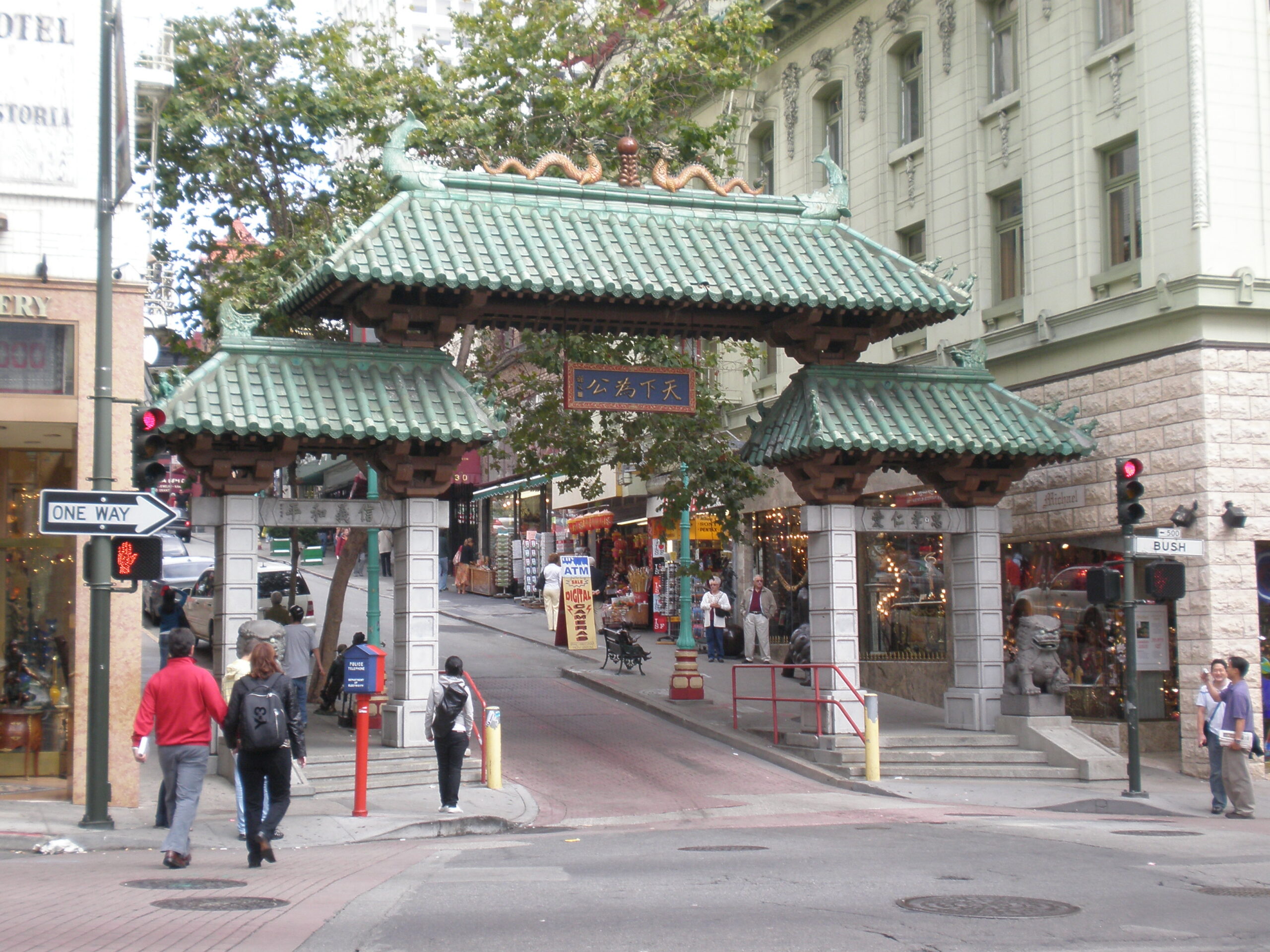
San Francisco’s Chinatown is the oldest in North America — it has existed since 1848 — and the largest Chinese community outside Asia. It has a hard history: after the 1906 earthquake and fire, which razed it to the ground, the city wanted to move its residents outside the city limits, to a swampy area. The community fought back by rebuilding quickly and in a deliberately “Chinese” style — pagoda roofs, lanterns, colors — that didn’t actually exist in China: it was architecture designed for American tourists, and it worked. The neighborhood stayed where it was.
Worth seeing, besides the main street: Ross Alley, where there’s a small fortune cookie factory where you can watch the hot wafers being folded by hand — and by the way, fortune cookies aren’t Chinese: they were invented in California by Japanese immigrants in the early twentieth century; Waverly Place, with temples on the upper floors and painted balconies; and Portsmouth Square, which fills up in the morning with elderly people playing cards and doing tai chi.
Midday — The hills and the harbor
3 km · 2 stops · 12:30 to 4 pm · lunch included
3 – The cable car and Lombard Street
Time 1.5 hours · Single ride about $8 · Powell & Market terminus, with a line

San Francisco’s cable cars are the last system of this kind still in operation in the world, and they’re a moving national landmark. They have no engine: under the street a steel cable runs continuously at fifteen kilometers per hour, and the operator grips and releases the car with a lever. They were invented in 1873 by Andrew Hallidie, who according to tradition got the idea after watching horses slip and die dragging a streetcar up a wet hill.
At the Powell Street terminus there’s always a line: you can board at a later stop, if there’s room, or take the California Street line, much less touristy and almost always free.
The Powell-Hyde line passes near Lombard Street, the famous stretch with eight switchbacks among the hydrangea beds. An honest clarification here too: it’s not the most crooked street in the city — that record belongs to Vermont Street, on Potrero Hill, which nobody visits. The switchbacks were created in 1922 for a practical reason: the natural twenty-seven-percent grade was too steep for cars of the era.
4 – Fisherman’s Wharf
Time 1.5 hours · Free · the sea lions are at Pier 39
Fisherman’s Wharf is very touristy and should be taken for what it is: souvenir shops, pricey seafood restaurants, and sourdough bread served hollowed out as a bowl for clam chowder. Two things, though, are worth it:
- the sea lions of Pier 39, which showed up on their own shortly after the 1989 earthquake, took over the boaters’ docks, and never left. There are hundreds of them, noisy and free
- the Musee Mecanique, a collection of three hundred coin-operated mechanical arcade machines from 1900 onward, all in working order: you put in coins and play
Ferries to Alcatraz leave from here, which is the main stop of day two and needs to be booked weeks in advance.
Afternoon — The bridge
3 km · 1 stop · 4 to 7 pm · bus from downtown
5 – The Golden Gate Bridge
Time 2.5 hours · Walking across free · Bus 28 or 76X · bring a jacket: there’s always wind on the bridge

The Golden Gate Bridge opened in 1937 and for twenty-seven years was the longest suspension bridge in the world: a 1,280-meter main span, towers 227 meters tall. It crosses a strait where winds and currents were considered prohibitive, and it’s regarded as one of the engineering masterpieces of the twentieth century.
The color isn’t a random aesthetic choice: the Navy wanted to paint it in yellow-and-black stripes so it would be visible in the fog. Consulting architect Irving Morrow noticed that the orange anti-rust primer the girders arrived in blended beautifully with the hills and the water, and he managed to get it adopted as the final color. It’s called international orange, and it’s continuously repainted by a crew of painters whose work never ends.
During construction, Joseph Strauss had a safety net strung under the bridge, something never done before: it saved nineteen workers, who founded a jokey club, the Halfway to Hell Club. Eleven men still died, ten of them in a single collapse when the net gave way.
You walk on the east sidewalk, open to pedestrians: crossing it all the way and back takes about an hour and a half. The best spots for photos are the overlooks on the city side and, for those with a vehicle, Battery Spencer on the other side.
The fog is a fixed presence: it rolls in from the ocean in the afternoon, especially in July and August, and can completely erase the bridge. It’s not bad luck, it’s the climate: locals have even given it a name, Karl. Early morning often has better odds of a clear sky.
Evening — The Victorian houses
2 km · 1 stop · 7 to 10 pm
6 – Alamo Square and the Painted Ladies
Time 3 hours including dinner · Free · Bus 5 or 21

On the east side of Alamo Square is the row of six Victorian houses everyone recognizes without knowing why: they’re the Painted Ladies, built between 1892 and 1896, and they appear in the opening credits of an American TV series from the 1980s seen around half the world. Behind them you can see the downtown skyscrapers, and that contrast is the photo.
The term painted ladies was coined in the 1960s, when a restoration movement began repainting the Victorians in three or more colors to highlight their details: after the war many had been covered in a single coat of military gray paint. San Francisco has over fourteen thousand of them: the ones at Alamo Square are simply the most photographed.
A little further north is Haight-Ashbury, the intersection that in 1967, during the Summer of Love, drew a hundred thousand young people from across the United States: today it’s a street of record shops, secondhand clothing and psychedelic signage, half authentic and half rebuilt for visitors.
For dinner, three neighborhoods worth more than the waterfront: the Mission District, where Mission-style burritos were born and where the murals are; Hayes Valley, next to Alamo Square; and North Beach, the Italian quarter, with the historic beat-era cafes and Ferlinghetti’s City Lights bookstore, open late.
If there’s fog, or if it rains
- Fog on the bridge · happens very often in summer, and more in the afternoon than in the morning. If the forecast looks bad, flip the day around and go to the bridge first.
- Indoors · the de Young Museum and the California Academy of Sciences, which face each other in Golden Gate Park and have, respectively, a free observation tower and a living roof with a tropical forest under a dome.
- San Francisco’s weather · temperatures shift by several degrees from one neighborhood to another at the very same moment: the Mission is sunny while the Sunset is in the fog. Dressing in layers isn’t generic advice, it’s necessary.
- In winter · it rains, but it’s less cold than in summer along the waterfront, and it’s the period with the clearest skies between one front and the next.
What the day costs
| Voce | Spesa |
|---|---|
| Cable car ride | about $8 |
| Public transport, day pass | about $6 |
| Golden Gate on foot, Chinatown, Alamo Square, sea lions | free |
| Breakfast at the Ferry Building | 12-20 $ |
| Lunch | 18-30 $ |
| Dinner | 35-60 $ |
| Total | about $80-125 per person |
Reference figures as of August 2026, in dollars. San Francisco is expensive for lodging, but the day itself costs little, because almost everything you see is outdoors and free. The cable car is paid per ride and isn’t included in the regular day pass: one ride is more than enough.
Getting around
The system is called Muni and combines buses, trolleybuses, modern streetcars, the historic streetcars of the F line — genuine vintage cars, brought in from Milan, Rome, Philadelphia and other cities, each in its original livery — and the three cable car lines. A single ticket costs about $2.75, the day pass around six; the cable car is paid separately, about eight dollars a ride.
Don’t rent a car for the city: parking is expensive and scarce, break-ins are a serious and real problem, and there’s a local rule that surprises visitors — on sloped streets it’s mandatory to turn your wheels toward the curb when you park, and the ticket really does show up.
The city is walkable, but the hills are real: some streets have grades of twenty-five to thirty percent. It’s worth planning your routes so you go up by transit and come down on foot, not the other way around.
Frequently asked questions
Is one day enough for San Francisco?
For the icons, yes: the bridge, the cable cars, Chinatown and the Painted Ladies all fit in one day, because the city is small. Left out are Alcatraz, which needs half a day and must be booked, plus the museums and the redwoods: they’re day two and three.
Do you need a car?
No, in fact it’s discouraged: parking is expensive and scarce, and break-ins are a real problem. The city is covered on foot and with Muni. If you park on a sloped street, remember that turning your wheels toward the curb is required by law.
How does the cable car work?
It has no engine: under the street a steel cable runs continuously at fifteen kilometers per hour, and the operator grips and releases the car with a lever. It’s the last system of its kind still in operation in the world, invented in 1873. It costs about eight dollars a ride, separate from the regular ticket.
How do you avoid the cable car line?
Don’t board at the Powell & Market terminus, where the line can last an hour: board at a later stop, if there’s room, or take the California Street line, which is much less touristy and almost always free.
Why is the Golden Gate orange?
Because consulting architect Irving Morrow noticed that the anti-rust primer the girders arrived in blended with the hills and the water, and he managed to get it adopted. The Navy wanted it in yellow-and-black stripes for visibility in the fog. The color is called international orange.
Can you walk across the bridge?
Yes, the east sidewalk is open to pedestrians and is free. Crossing it all the way and back takes about an hour and a half. Bring a jacket: there’s always wind on the bridge, even on warm days in the city.
Why is it cold in summer?
Because warm air from inland sucks the cold ocean fog in through the strait: July and August are the foggiest and coldest months of the year in the city. The best months are September and October. Locals call the fog Karl.
Are fortune cookies Chinese?
No: they were invented in California by Japanese immigrants in the early twentieth century, and they don’t exist in China. In Chinatown, in Ross Alley, there’s a small factory where you can watch the hot wafers being folded by hand.
Is Lombard Street the crookedest street in the world?
No, and it’s not even the crookedest in the city: that record belongs to Vermont Street, on Potrero Hill, which nobody visits though. Lombard’s eight switchbacks were created in 1922 because the natural twenty-seven-percent grade was too steep for cars of the era.
Is San Francisco safe?
The areas on this itinerary are busy and normal. Two concrete warnings: never leave anything visible in a car, not even for five minutes, because break-ins are extremely frequent; and the Tenderloin, just west of Union Square, has visible social problems and is worth avoiding, especially at night.
September 6, 2026


