

New York in 1 day: Midtown from above, Central Park and the Brooklyn Bridge
One day alone in New York is not much and anyone who lives there will tell you. But a well-spent day exists, and it does not consist of running from one monument to another: it consists of going up a skyscraper once, crossing Central Park on foot and ending on the Brooklyn Bridge at sunset, when the city lights up behind you. Manhattan is an island twenty kilometers long and four wide, with numbered streets: once you understand the grid, you never get lost again. And the subway runs twenty-four hours a day, which almost never happens in Europe.
In summary
- Duration · one full day, from 8:30 to 22
- How much walking · 9-11 km, almost all flat
- Need to book · the panoramic skyscraper, with time slot: at the counter you pay more and wait
- Budget · $100-150 per person, excluding accommodation
- Transportation · subway $2.90 per trip, paid by tapping your credit card; after 12 trips in a week the rest is free
- Prices · are in dollars, and at restaurants tax and tip are added to the bill
- What is left out · the Statue of Liberty, museums, Brooklyn: these are for the second and third days
From Grand Central to Dumbo is nine kilometers: the park is done on foot, the rest by subway.
Morning — Midtown from above
1.5 km · 2 stops · from 8:30 to 12:00 · you start inside a station, and it is not a compromise
1 — Grand Central Terminal
Time · 45 minutes · Free · Subway 4, 5, 6, 7 and S to Grand Central – 42 St

You start from a train station because this is not a station: it is the most beautiful atrium in New York, and it is free. Grand Central Terminal opened in 1913 and has forty-four tracks on two levels, the highest number of any station in the world. The main atrium is seventy-six meters long and thirty-eight meters high, and early in the morning real commuters pass through it: arriving at eight-thirty also serves to see this.
Look up: the ceiling is a starry sky with zodiac constellations, and they are drawn backwards. The official explanation says it is the sky seen from outside, from God’s viewpoint; the less noble one says the painter copied a medieval manuscript without realizing it was mirrored. In one corner they deliberately left a dark patch unrestored: it is not smog, it is the tar from decades of cigarettes smoked here.
Before you leave, go down to the lower level in front of the Oyster Bar: that is the Whispering Gallery. Two people stand in opposite corners of the archway, facing the wall, and hear each other whisper as if they were close. It really works, and it is the cheapest trick in the city.
2 — Top of the Rock
Time · 1.5 hours · Ticket · about $40 with time slot · Travel · 12 minutes on foot along 42nd Street and up Sixth Avenue

Here you have a choice to make, and it is worth making it carefully. There are four panoramic points: the Empire State Building, the Top of the Rock, Edge at Hudson Yards and Summit One Vanderbilt. They all cost between forty and fifty dollars and in one day you only do one.
My choice is the Top of the Rock, on the seventieth floor of Rockefeller Center, for a simple reason: from there you see the Empire State Building, which is the building everyone wants to photograph, and you see Central Park in its entirety, spread out like a green carpet among the skyscrapers. From the Empire State, which is higher and more famous, the skyscraper missing from the photo is the one right under your feet, and the park is seen edgewise. The terrace here is on three levels and the one at the top has no windows.
On the Empire State, if you choose it anyway: it was built in just over a year, between 1930 and 1931, in the depths of the Depression, and it is 381 meters high up to the 102nd floor. It remained the tallest building in the world for forty years. In the evening it changes color according to holidays, and people living next to it use it as a calendar.
Book the first time slot of the day or the last. Mid-morning you go up in a queue and photograph between other people’s shoulders; at nine you are almost alone, and the light is better.
Midday — Times Square and Fifth Avenue
2 km · 2 stops · from 12:00 to 14:30 · lunch included
3 — Times Square
Time · 30 minutes, no more · Free · Travel · 8 minutes on foot
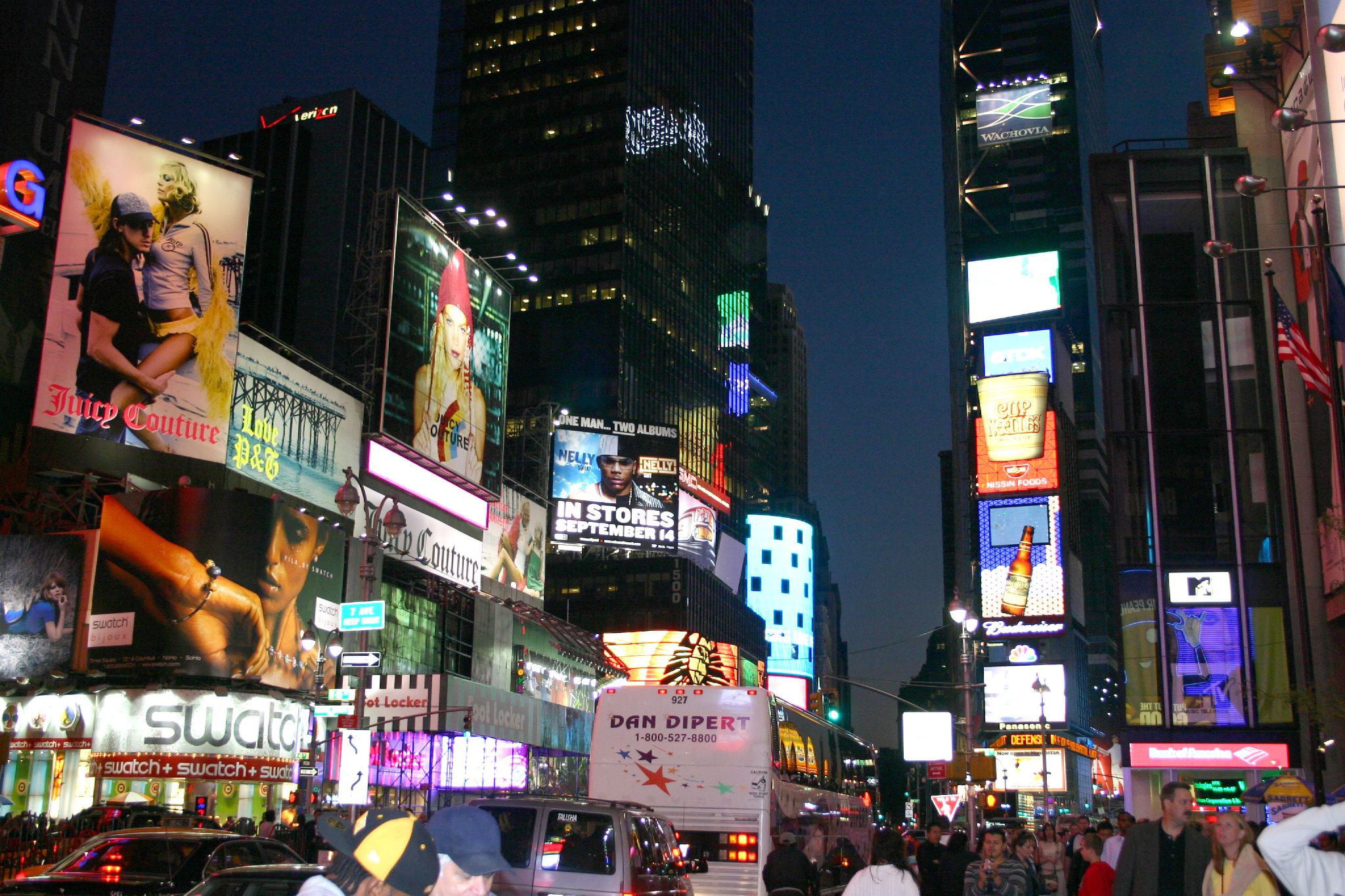
You must say it honestly: Times Square is a tourist trap, there are costumed characters asking for money for photos and restaurants cost double for no reason. You go anyway, because twenty minutes in the middle of that wall of screens is an experience that has no equal in Europe, and then you move on.
The name comes from the New York Times, which in 1904 moved its offices there: before it was called Longacre Square. For the inauguration of the newspaper’s offices, they organized a New Year’s Eve party with fireworks, and since then the city meets there every December 31: the ball that falls at midnight has been dropping from that building since 1907.
The signs are not decoration: by law, buildings on Times Square are required to display illuminated signs of a minimum area. It is the only place in America where advertising is an urban planning requirement.
4 — Bryant Park and the Public Library
Time · 1.5 hours with lunch · Free · Travel · 10 minutes on foot heading east
Two blocks east of Times Square the city changes mood. Bryant Park is a square of grass with iron chairs that move wherever you want, and it is the right place for lunch: around it are kiosks, and New Yorkers eat sitting there. In winter it becomes a Christmas market with a free skating rink.
On the east side is the New York Public Library, with two marble lions on the steps: they are called Patience and Fortitude, named by Mayor La Guardia in the 1930s, who said they were the two virtues New Yorkers needed to get through the crisis. You enter free, and on the third floor is the Rose Main Reading Room: fifty meters of reading room with a frescoed ceiling and brass lamps on the tables. It is a real library, with people studying: you stay quiet.
Afternoon — Central Park
4 km · 1 long stop · from 14:30 to 17:30 · all on foot
5 — Central Park, from south to Strawberry Fields
Time · 3 hours · Free · Subway B or D to 7 Av, or 20 minutes on foot from Bryant Park
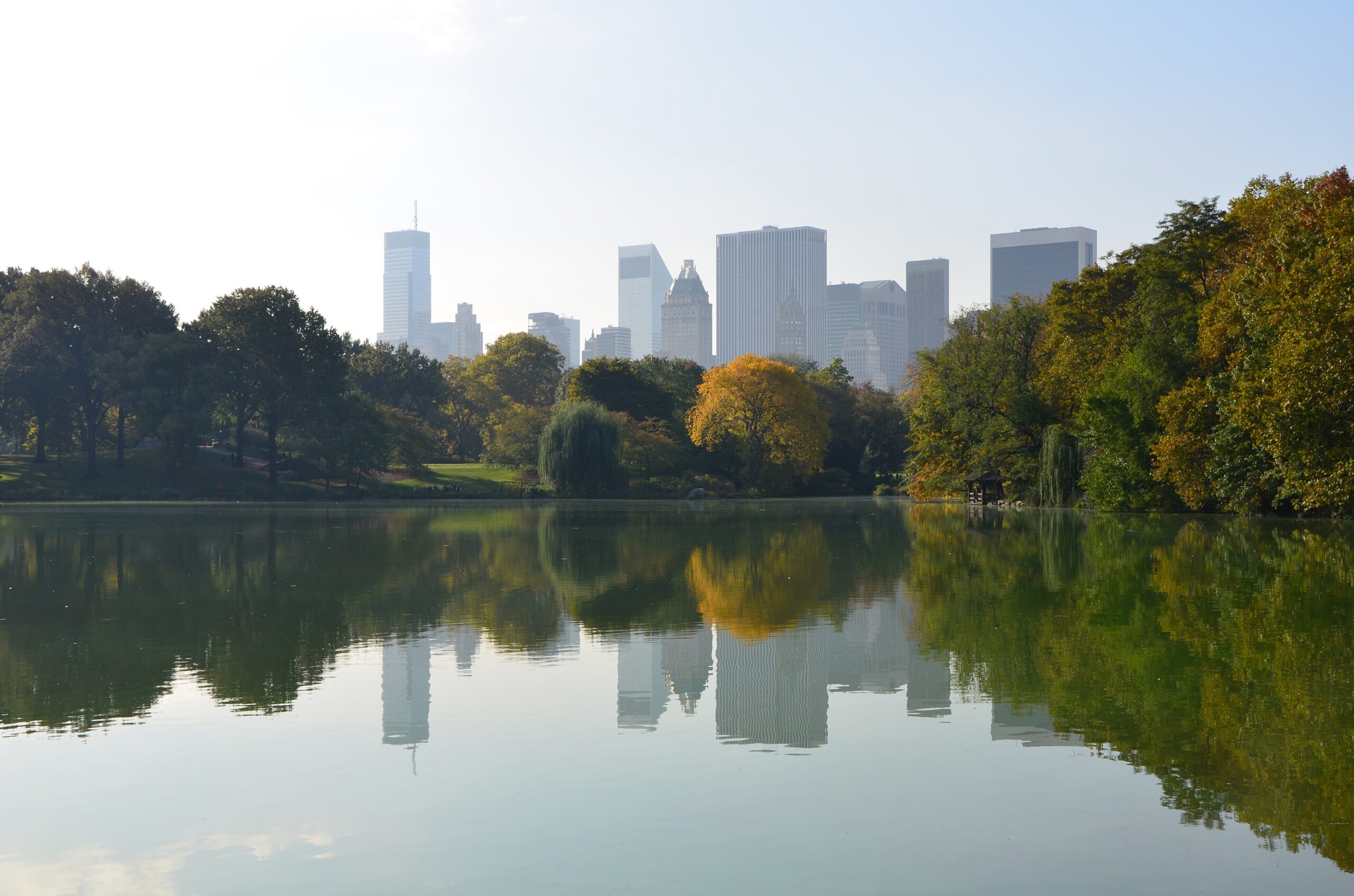
The thing almost no one knows about Central Park is that it is not a piece of nature spared by the city: it is entirely artificial. In 1858, Frederick Law Olmsted and Calvert Vaux won a competition with a project that involved moving half a million cubic meters of earth, blowing up rock with dynamite, digging lakes and planting four million trees. Every hill, every curved path and every body of water is designed.
There is also a less edifying part, which the plaques have only recently begun to tell: where the park now stands was Seneca Village, a town of about three hundred people, mostly African Americans who owned their homes, with three churches and a school. In 1857 the city expropriated everything and razed it to the ground.
The route I recommend, entering from the southeast, touches in three hours:
- the Mall, the tree-lined avenue with American elms, the only straight line in the park
- Bethesda Terrace and the fountain with the Angel of the Waters, from 1873, sculpted by Emma Stebbins: she was the first woman to receive a major public commission in New York
- Bow Bridge over the lake, the cast-iron bridge you have already seen in twenty films
- Strawberry Fields, with the black and white mosaic that says Imagine: it is exactly across from the Dakota Building, where John Lennon lived and where he was killed in December 1980. Yoko Ono had that section of park fixed up and there are almost always flowers there
The park is four kilometers long: doing it all in one afternoon means walking and nothing else. In just one day it is best to stop at Bow Bridge and exit on 72nd Street, where the subways pass.
Evening — The bridge and the skyline
3 km · 2 stops · from 18:00 to 22:00 · this is the part not to skip
6 — The Brooklyn Bridge on foot
Time · 1 hour for crossing · Free · Subway 4, 5 or 6 to Brooklyn Bridge – City Hall · Head toward Brooklyn, not the other way
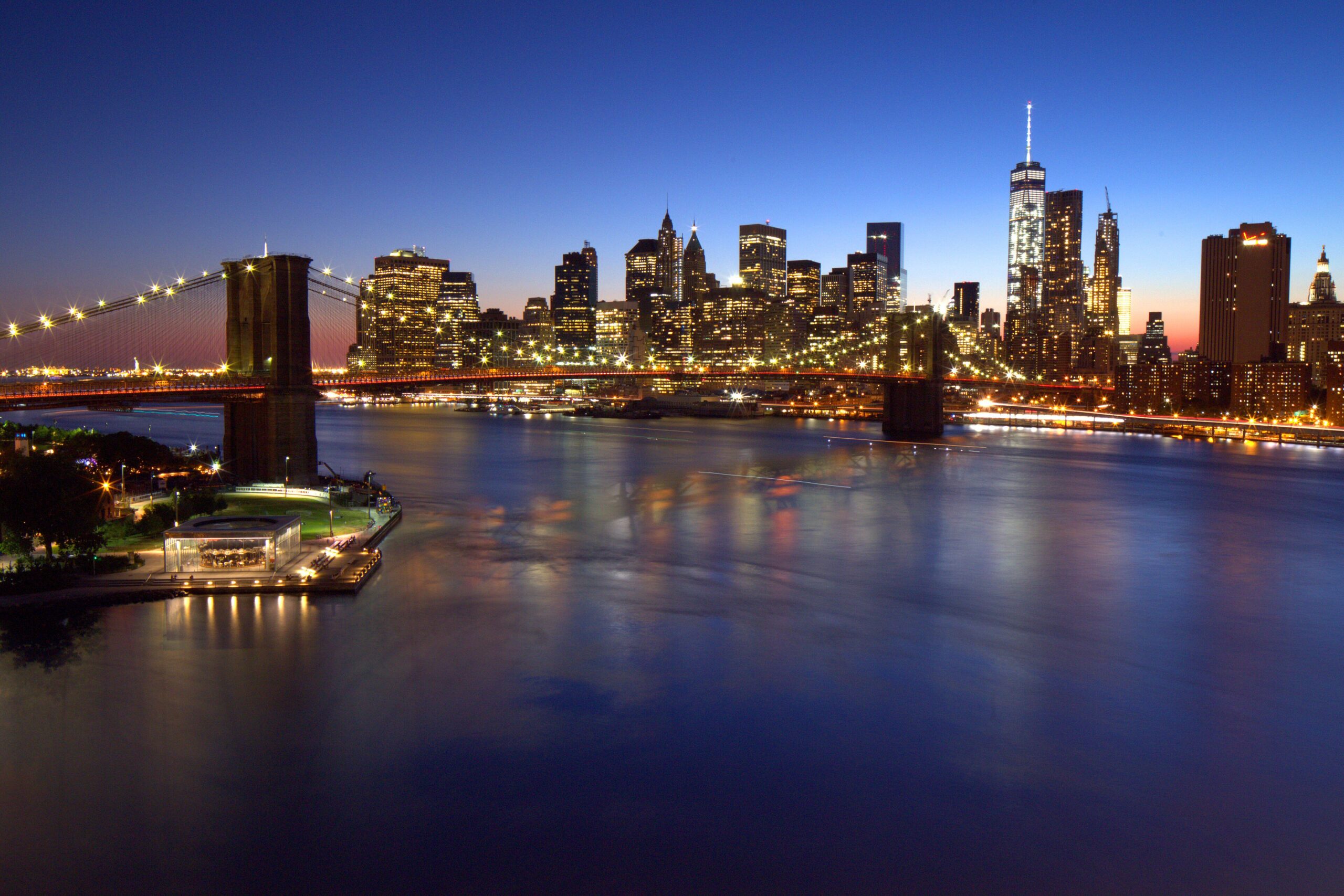
You cross from Manhattan toward Brooklyn, and this is not a detail: going in that direction you have the skyline in front of you when you turn around, and the sun sets at your back. Start one and a half hours before sunset. The pedestrian walkway runs in the middle, above traffic, and is made of wood.
The bridge opened on May 24, 1883 and was the longest suspension bridge in the world, with a span of 486 meters. Its construction is a story of family and blood: the designer John Roebling died of tetanus in 1869 after a ferry crushed his foot while he was taking surveys; his son Washington took over and became paralyzed by caisson disease, the embolism that struck those who worked in compressed air under the river. For the last eleven years he directed the work with a telescope from his house window, and every day it was his wife, Emily Warren Roebling, who brought the orders to the worksite: she taught herself mathematics and engineering and ended up actually running the job.
Six days after the opening, someone shouted that the bridge was collapsing: in the panic, twelve people died. The next year P.T. Barnum drove twenty-one elephants from his circus across it to prove it held. It still holds.
7 — Dumbo and the skyline from the other shore
Time · 1.5 hours · Free · Return · subway A or C from High Street, or the NYC Ferry

Coming off the bridge, you turn right and in ten minutes you are in Dumbo. The name is an acronym: Down Under the Manhattan Bridge Overpass, that is, “under the Manhattan bridge overpass,” and was invented by residents in 1978 in the hope it would sound ugly enough to keep developers away. It did not work: today it is one of the most expensive neighborhoods in Brooklyn.
The photograph everyone is looking for is taken on Washington Street, where the Manhattan Bridge appears framed between two rows of brick warehouses. You line up, orderly, with another thirty people. Then you go down to Brooklyn Bridge Park, on the waterfront: from there you see all of Manhattan lighting up, there is Jane’s Carousel from 1922 inside a glass case, and there are benches where you can sit for half an hour without doing anything.
To get back, the best way is not the subway but the ferry: it leaves from the Dumbo dock, costs as much as a subway ticket and goes up the East River with the lit city at your side.
If it rains, or if it is very cold
- The skyscraper · with low clouds you see nothing and the forty dollars are wasted. Tickets with time slots usually move: check the forecast the night before and move yourself.
- Instead of Central Park · the Metropolitan Museum or the MoMA, which are both on the route, or the Grand Central Market and the rooms of the Public Library.
- Instead of the bridge · the Staten Island Ferry: it is free, leaves from Lower Manhattan every half hour, lasts twenty-five minutes and passes in front of the Statue of Liberty. Indoors, with heat.
- In winter · in New York it is seriously cold and the wind between the skyscrapers cuts your face: the outdoor day should be shortened, not faced with courage.
How much the day costs
| Item | Expense |
|---|---|
| Top of the Rock (or another panoramic) | $40-50 |
| Grand Central, Bryant Park, Public Library, Central Park, Brooklyn Bridge | free |
| Subway, 3-4 trips | about $9-12 |
| Ferry to return from Dumbo | about $4 |
| Breakfast and lunch | $25-40 |
| Dinner | $30-60 |
| Total | about $110-165 per person |
Reference figures as of August 2026, in dollars. Two things that surprise Europeans: the price shown is not what you pay, because local taxes are added at checkout, and at the restaurant the tip of 18-20% is not optional in practice. Add a quarter to every seated meal.
How to get around
The grid of Manhattan is learned in two minutes and then you do not need a map anymore: avenues run north to south and are numbered from east to west, streets run east to west and are numbered from south to north. Fifth Avenue divides east and west: 20 East 42nd Street is east of Fifth, 20 West is west. Twenty blocks of streets are about a mile, or twenty minutes on foot; blocks between avenues are much longer.
The subway costs $2.90 per trip and you do not need to buy tickets: you tap your credit card or phone at the turnstile (the system is called OMNY), and after twelve trips in the same week all others are free. It works day and night. Beware of two things: on the same platform run local trains, which stop everywhere, and express trains, which skip ten stops; and on weekends many lines change route for construction, with notices posted by hand.
Taxi in the city is not worth it: during rush hours the subway is faster, and crossing Midtown by car can take forty minutes for two kilometers. Since 2025, anyone entering by car south of 60th Street also pays a congestion charge.
Frequently asked questions
Is one day alone in New York enough?
No, and nobody claims it is. But it is enough to take the city with you: a panorama from above, Central Park and the Brooklyn Bridge at sunset are three things that do not resemble each other and that together tell New York better than six museums. What is left out — the Statue of Liberty, museums, Brooklyn — is material for the second and third days.
Better the Empire State Building or Top of the Rock?
Top of the Rock, for two reasons: from there you see the Empire State Building, which is the building you want in the photo, and you see Central Park in its entirety. From the Empire State, the skyscraper you are standing on is precisely missing. They cost almost the same.
How much does the subway cost?
$2.90 per trip. You do not need a ticket: you tap your credit card or phone at the turnstile. After twelve trips in a week, the rest are free, so it is not worth buying passes in advance. It works 24 hours a day.
In which direction do you cross the Brooklyn Bridge?
From Manhattan toward Brooklyn, starting an hour and a half before sunset: that way you have the skyline in front of you when you turn around, with the right light. The other way you walk toward the sun with the city at your back. The crossing takes about an hour with photos.
Can you see the Statue of Liberty in one day?
Not up close: between the ferry, security and Ellis Island, half a day is gone, and it is the main event of the second day. If you really want to see it, take the Staten Island Ferry, which is free and passes by it: twenty-five minutes, and you return with the next trip.
Is Times Square worth it?
Twenty minutes yes, an hour no. It is a wall of light screens with no equal, but it is also the most expensive and crowded point in the city, with costumed characters asking for money for photos. Look at it, photograph it and move two blocks: everything changes.
Why is the ceiling of Grand Central backwards?
The constellations are mirrored compared to how they look from earth. The official version is that it is the sky seen from outside the celestial sphere; the more likely one is that the painter copied a medieval manuscript that was already inverted. The Vanderbilt family chose the first explanation.
Is Central Park safe?
During the day yes, and it is full of people running, bringing children and eating on the grass. At night, like all big parks, the central and wooded areas are not the place to stroll: after sunset you leave and take the subway.
How much does a day in New York cost?
Between $110 and $165 per person without accommodation, with just one panoramic building. It drops a lot if you skip the panoramic point, because everything else in the day — the park, the bridge, the station, the library — is free. It goes up quickly with restaurants: taxes and tip add about a quarter to the bill.
When is it worth going?
May-June and September-October: right temperatures and long light. July and August are hot and humid in a heavy way; January and February are really cold. December is separate: the store windows, the Rockefeller Center tree and the skating rinks are worth the cold, but prices and queues are at their peak.
September 6, 2026
