
Miami in 3 days: the city, the Everglades and Coral Gables
Three days is what Miami needs to show its three faces, and they don’t resemble each other at all. The first day belongs to the city: art deco, murals, the Cuba of Calle Ocho. The second leaves the city for the Everglades, the strangest place in America: not a swamp but a river eighty kilometers wide that flows so slowly it looks still. The third goes back a hundred years, among the villas of Coral Gables and the Key Biscayne lighthouse, and ends with a sunset over the water.
In short
- Duration · three full days, 9 am to 11 pm
- How much walking · 6-8 km a day, all flat
- Do you need a car · yes for day 2, unless you take an organized tour; not for the other two
- Budget · $330-500 per person for the three days, lodging not included
- When · November to April: in summer the mosquitoes in the Everglades are a serious problem, not just a nuisance
- Book ahead · the Everglades airboat and the Vizcaya visit on weekends
- What’s left out · the Keys and Key West: they’re day four and five
One color per day. The Everglades are to the west, the lighthouse island to the southeast: the second day is the only one that requires a car.
Day 1 — The city
7 km · 9 am to 11 pm · this is the one-day itinerary, with nothing cut

Morning in Miami Beach, among the eight hundred buildings of the art deco district and the beach with its colorful lifeguard towers. Early afternoon in Wynwood, the painted warehouses that have set the standard worldwide since 2009. Afternoon in Little Havana, on Calle Ocho, with cafecito drunk standing at the window and men playing dominoes in the park. Evening downtown on the Metromover, which is free and runs right among the skyscrapers, then back to South Beach once the neon is lit.
The art deco district should be seen twice: by day for the pastel colors, by night for the neon signs restored one by one. On a three-day itinerary you can go back without any effort.
Day 2 — The Everglades
The whole day · 2 stops · you need a car, or an organized tour · departure at 8

The thing to understand before you go is that the Everglades aren’t a swamp. They’re a river: an enormous sheet of water up to eighty kilometers wide and half a meter deep, flowing from Lake Okeechobee to the sea with a slope of three centimeters per kilometer. It moves so slowly it looks still, and the biologist Marjory Stoneman Douglas, who published the book that saved this place in 1947, called it the River of Grass. The grass is sawgrass, sharp as a saw blade.
It’s the only place on Earth where alligators and crocodiles live side by side: alligators stay in the fresh water, American crocodiles in the coast’s brackish water, and here the two meet. Manatees live here too, along with the Florida panther, of which fewer than three hundred remain.
Morning – Shark Valley
Time 3 hours · Park entrance about $35 per car, valid 7 days · Tram about $30, bike about $25 · 1 hour’s drive from Miami
Shark Valley is the best way to see the animals. A paved fifteen-kilometer loop runs straight into the water prairie: you can take it by guided tram, by bike or on foot, and the alligators lie right at the roadside, two meters away, motionless in the sun. It’s not a zoo and there are no fences: you keep the fifteen meters of distance the park requires and you don’t run.
Halfway around the loop there’s a spiral concrete observation tower, twenty meters high, from which you can see the prairie stretching to the horizon without a single tree. The bike is the best choice: you go at your own pace and stop wherever you like. Bring water: there’s no shade.
The airboats, the propeller-driven boats you see in the photos, aren’t inside the national park but in the Native American reservations along the Tamiami Trail. They’re fun and extremely loud, and precisely because of the noise they let you see almost nothing alive. If you have to choose, the Shark Valley loop shows far more animals.
Afternoon – Royal Palm and the Anhinga Trail
Time 3 hours · Included in the park ticket · 1 hour and a half’s drive from Shark Valley · Lock your car: the vultures eat the rubber seals
From the park’s other entrance, the one at Homestead, starts the Anhinga Trail: eight hundred meters of wooden boardwalk over the water, flat, probably the best wildlife trail in the whole United States for the effort it takes. In an hour you’ll see alligators, herons, ibises, turtles, big fish, and the bird it’s named for: the anhinga, which swims underwater with just its neck showing and then perches on branches to dry its spread wings, because its feathers aren’t waterproof.
Right next to it is the Gumbo Limbo Trail, another short loop that enters a hammock, a patch of tropical forest growing on a rise of just a few centimeters: that’s enough for the environment to change completely.
It’s the right place for dawn or dusk: the animals move in the cool hours and are still at midday. If you can flip the day around — Anhinga Trail at dawn, Shark Valley in the afternoon — you’ll see much more.
From May to November, mosquitoes in the Everglades aren’t a nuisance, they’re a reason to give up: the rangers publish a weekly bulletin with the level. In the dry season, December to April, there are almost none — and it’s also the time when the animals gather around the few remaining pools, so they’re easier to spot.
Day 3 — The villas, the gardens and the lighthouse
6 km · 3 stops · 9:30 am to 9 pm · the Miami of a hundred years ago
Morning – Villa Vizcaya
Time 3 hours · Ticket about $25 · Metrorail to Vizcaya · Closed Tuesdays

Villa Vizcaya is the most improbable thing in Miami: an eighteenth-century Venetian- and Tuscan-style villa, with Italian gardens and a dock on the bay, built between 1914 and 1922 by James Deering, the International Harvester farm-machinery magnate, who came to winter in Florida for his health.
Deering didn’t want a new villa that looked ancient: he wanted a villa that looked four hundred years old and reworked by different generations. So the rooms are in styles ranging from Renaissance to Neoclassical, and inside are ceilings, doorways, fireplaces and furniture bought and dismantled in Italy, France and Spain and reassembled here. Over a thousand workers built it, in a city that at the time had ten thousand inhabitants: one in ten.
The gardens are worth as much as the house: geometric hedges, fountains, grottoes, and on the bay the famous stone “barge,” a breakwater carved in the shape of a ship with statues and balustrades, in front of the façade. Vizcaya is the most photographed spot in Miami for weddings and quinceañeras: on weekends it’s full of formal dress.
Afternoon – Coral Gables and the Venetian Pool
Time 3 hours · Venetian Pool about $25 · Closed Mondays and during some winter periods · Car or bus, 20 minutes

Coral Gables is one of America’s first planned cities, laid out in the 1920s by George Merrick as a Mediterranean fantasy: tile roofs, sand-colored stucco, tree-lined avenues with banyan trees, monumental gateways. There’s still a very strict code on facade colors and even signage, which is why the neighborhood feels frozen in time.
The Venetian Pool is the most beautiful and strangest spot of all: in 1923 Merrick found himself with an exhausted coral quarry in the middle of the neighborhood, an ugly hole that the houses’ stones had been cut from. Instead of filling it in, he turned it into a public pool with grottoes, waterfalls, Venetian bridges, turrets and a sand beach. It’s filled with spring water, almost three million liters, and in spring and fall it’s drained and refilled every night. It’s the only pool in the United States listed on the National Register of Historic Places, and people really do swim in it.
Nearby: the Biltmore Hotel from 1926, with a tower copied from Seville’s Giralda and a pool that in the 1930s was the largest in the world — Johnny Weissmuller, the movie Tarzan, swam in it and worked there as an instructor; and the Fairchild Tropical Botanic Garden, if you prefer plants to houses.
Evening – Key Biscayne and the lighthouse
Time 3 hours · State park about $8 per car · 25 minutes’ drive, there’s a toll on the bridge
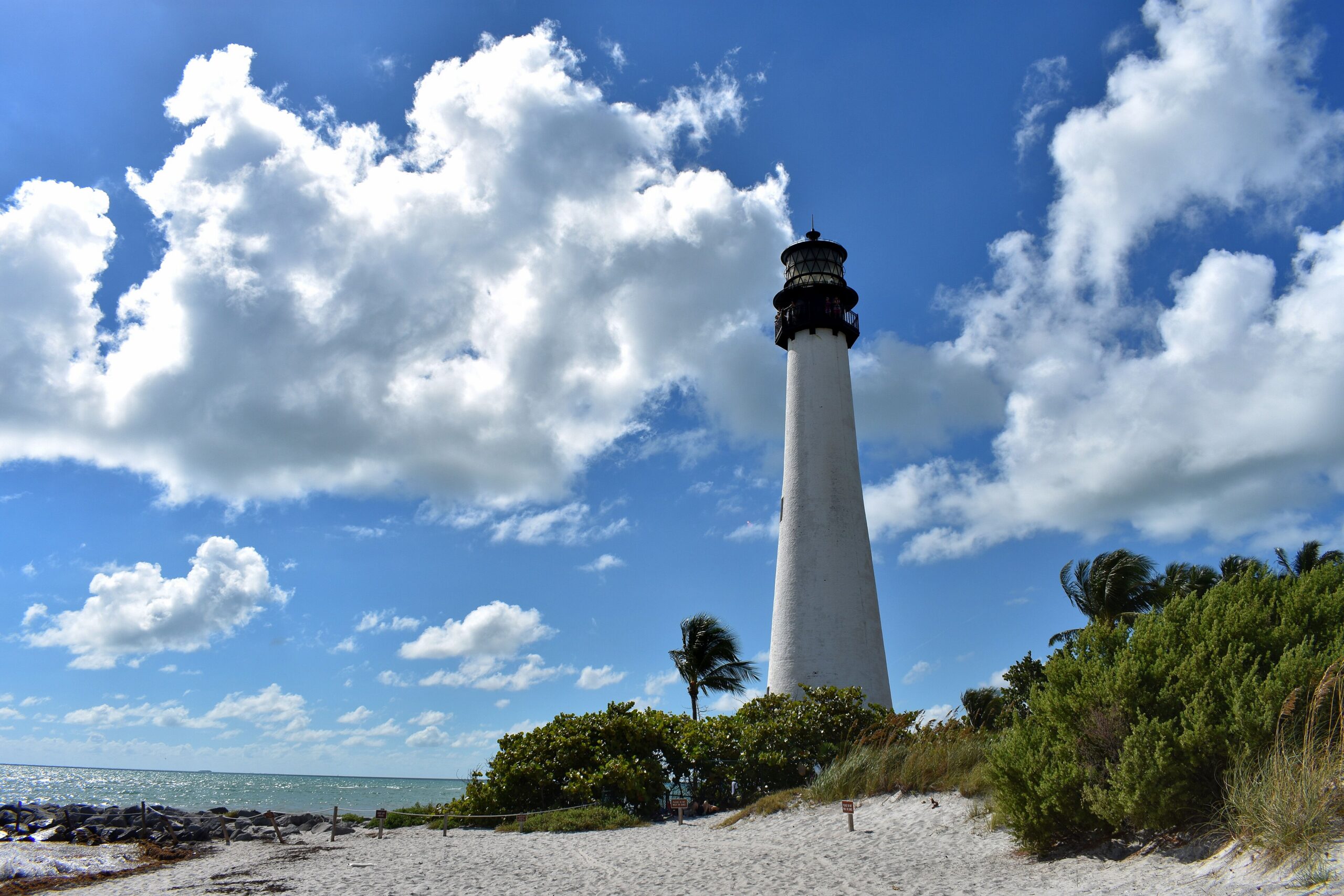
You cross the Rickenbacker Causeway, a long bridge that spans the bay with Miami behind you, and arrive at Key Biscayne, an island with two parks and a beach favored by Miami locals rather than tourists. At the southern tip is Bill Baggs Cape Florida State Park, with the 1825 lighthouse: it’s the oldest structure still standing in the entire county.
Its history is the one nobody tells tourists. Between 1821 and 1861 Cape Florida was the starting point of an escape route to freedom: hundreds of enslaved Black people and Seminoles fleeing Florida set off from here in small boats toward the Bahamas, which were British and where slavery had been abolished in 1834. Their descendants still live on Andros. In 2004 the park joined the national Underground Railroad network, and it’s the only point where that network led south.
You can climb the lighthouse (109 steps, during visiting hours), watch the sunset from the beach on the island’s west side with the Miami skyline on the horizon, and have dinner at one of the restaurants on the pier, with the pelicans waiting.
If it rains, or if it’s too hot
- Day 2, the Everglades · in heavy rain the trails flood and the animals disappear. This is the day to move: swap it with the third, which has Vizcaya and indoor museums.
- Instead of the Venetian Pool · the Biltmore Hotel, where you can walk freely into the lobby and gardens, or the Lowe Art Museum at the University of Miami, which has a good pre-Columbian collection.
- A rainy day in the city · the Pérez Art Museum and the Frost Museum of Science sit side by side on the bay and can fill a whole afternoon.
- Mosquitoes · from May to November they’re a real problem in the Everglades. Long sleeves, strong repellent, and check the rangers’ bulletin before you go.
What the three days cost
| Voce | Spesa |
|---|---|
| Wynwood Walls | about $12 |
| Everglades: ingresso al parco | circa 35 $ ad auto, valido 7 giorni |
| Everglades: Shark Valley tram or bike | 25-30 $ |
| Car rental for day 2, gas included | 60-90 $ |
| Villa Vizcaya | about $25 |
| Venetian Pool | about $25 |
| Key Biscayne: park and toll | about $12 |
| Spiaggia, Little Havana, murales, Metromover, faro | gratis o quasi |
| Meals, 3 days | 150-250 $ |
| Total | about $340-480 per person |
Reference figures as of August 2026, in dollars. The car is only needed for day 2, and it’s worth renting it just for that day: parking in South Beach is expensive and hotels charge for it. Everglades admission is valid for seven days, so if you go back you don’t pay twice.
Frequently asked questions
Are three days enough for Miami?
Yes, and it’s the right split: one for the city, one for the Everglades, and one for historic Miami — Vizcaya and Coral Gables. What’s left out isn’t Miami but Florida: the Keys, which deserve two days of their own.
What are the Everglades really?
Not a swamp but a river: a sheet of water up to eighty kilometers wide and half a meter deep, flowing toward the sea with a slope of three centimeters per kilometer. Writer Marjory Stoneman Douglas called it the River of Grass. It’s the only place on Earth where alligators and crocodiles live together.
Airboat or Shark Valley tram — which is better?
The tram, or even better the bike, on the Shark Valley loop: fifteen kilometers into the water prairie, with alligators right at the roadside. Airboats aren’t inside the national park but in the reservations along the Tamiami Trail, and they’re so loud that the animals flee before you can see them.
Is it dangerous to get close to alligators?
Not if you follow the rules. The park requires fifteen meters of distance, no running, never feeding them, and holding children’s hands near the water. Alligators used to people are the dangerous ones, which is why feeding them is a crime.
Do you need a car for the Everglades?
Yes, or alternatively an organized tour from Miami. The two useful entrances — Shark Valley and Homestead — are an hour and an hour and a half from the city and have no public transport. It’s worth renting a car for just that one day.
When should you go to the Everglades?
In the dry season, December to April: mosquitoes are almost gone and the animals gather around the few remaining pools, so they’re much easier to see. From May to November mosquitoes are a serious problem: the rangers publish a weekly bulletin.
What is Villa Vizcaya?
A Venetian- and Tuscan-style villa built between 1914 and 1922 by industrialist James Deering, with ceilings, fireplaces and doorways bought and dismantled in Europe and reassembled here. Over a thousand workers built it, in a Miami that had ten thousand residents. The Italian gardens and the stone “barge” on the bay are worth the visit on their own.
Can you actually swim in the Venetian Pool?
Yes, it’s a real public pool. It was carved out in 1923 from an exhausted coral quarry, it’s filled with spring water, and it’s the only pool in the United States listed on the National Register of Historic Places. It’s closed Mondays and during some winter periods: check before you go.
What’s special about the Key Biscayne lighthouse?
It dates from 1825 and is the oldest building still standing in Miami-Dade County. From here, between 1821 and 1861, hundreds of escaping enslaved people set off for the Bahamas, where slavery had been abolished: it’s the only point on the Underground Railroad that led south.
How much do three days in Miami cost?
Between $340 and $480 per person without lodging, including the car rental for the Everglades day. You save a lot if there are two or more of you: the car, park entrance and tolls are split, while almost everything in the city is free.
September 6, 2026