

Matera in 3 days: the ravine, the rock churches and the Crypt of Original Sin
Matera can be seen in a day, but it is understood in three. The first is spent inside the Sassi, among the stacked houses where the roof of one is the street of the one above. On the second you cross the ravine and go to the far side, into the Murgia Materana Park, where there is nothing but rock, sheep and wind, with over a hundred churches cut by Greek monks from the eighth century onwards: from there you look at the city and understand that it has always been a piece of that plateau. The third leaves Basilicata for Apulia, half an hour away: the Crypt of Original Sin with its frescoes from around the year 1000, and the two stone towns on the other side of the Murgia.
At a glance
- How long · three full days
- How much walking · 6, 8 and 5 km, with many stairways and stony paths
- Shoes · closed, with soles that grip: the second day is real trekking
- What has to be booked · the Palombaro Lungo and above all the Crypt of Original Sin, visited by appointment only, in limited numbers
- Do you need a car? · for the third day yes, or an organised tour: public transport is thin
- Budget · €130-190 per person excluding accommodation
- Worth knowing · in summer the Sassi go above 38 degrees with no shade at all
The second day crosses the canyon on foot: on the map it is a few hundred metres, on the ground it is two hours of descent and climb.
Day 1 — Inside the Sassi
6 km · 4 stops · 9am to 10pm · stairways and climbs
The first day is the one-day itinerary, summarised here: the details — the nine-thousand-year-old water system, the 1952 evacuation, how a cave house was arranged — are on the page devoted to it.
1 – The Palombaro Lungo
€3-5, guided visits at set times only
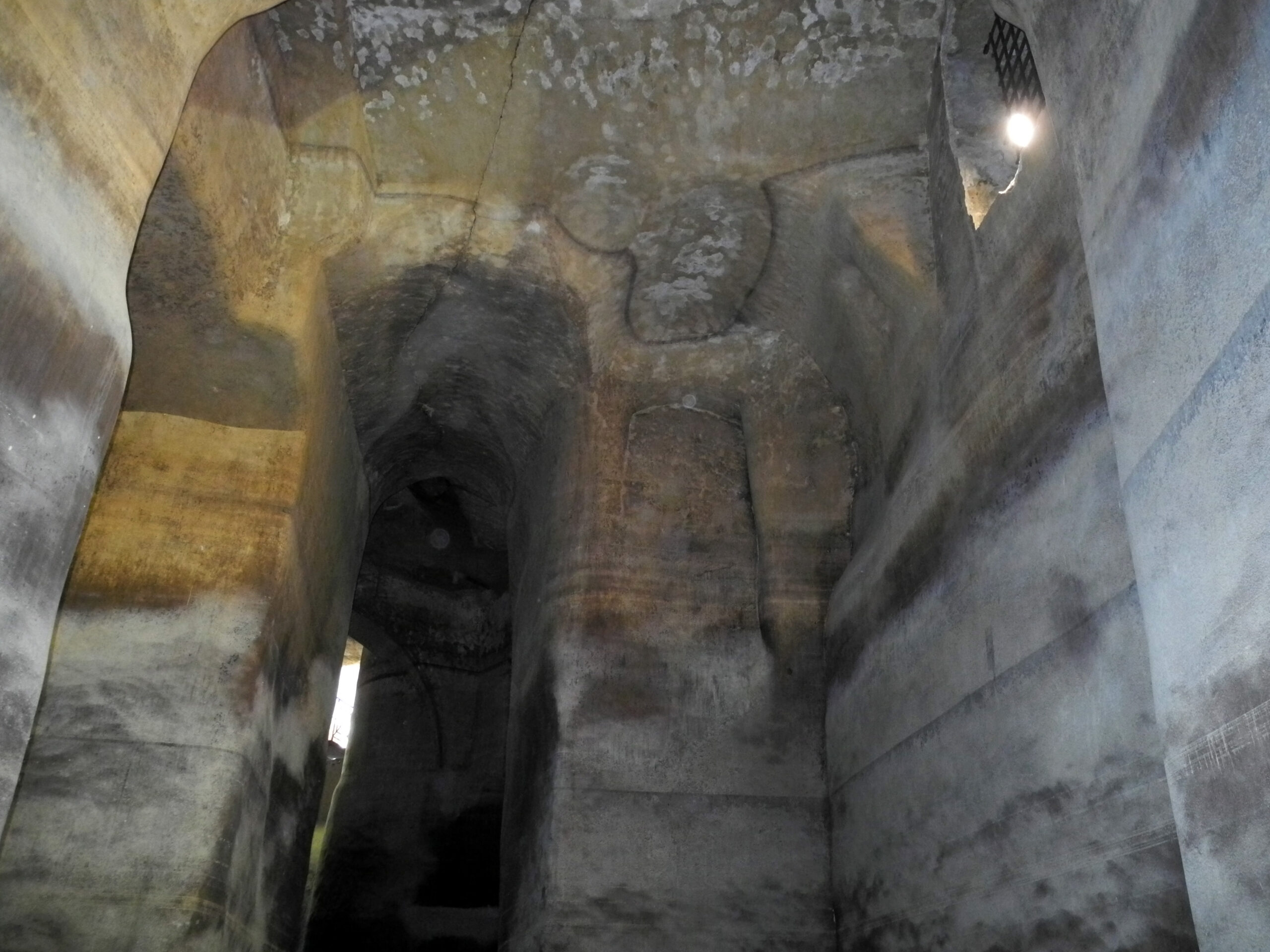
Beneath Piazza Vittorio Veneto lies a cistern the size of a cathedral, rediscovered by accident in 1991. It explains everything else: Matera lies in an area with no usable rivers, and life here for nine thousand years was possible only thanks to a rainwater harvesting system — channels in the rock, a cistern under every house, sand filters.
2 and 3 – The Sasso Barisano, the Civita, the Cathedral

The Barisano is the richer and the more restored, with carved doorways and scattered hotels. The structure has no equal: the roof of one house is the street of the one above. At the top, on the spur of the Civita, stands the Cathedral of 1270, where restoration has brought a fourteenth-century Last Judgement back to light from under the Baroque decoration.

4 – The Sasso Caveoso and a cave house
Cave house €3-5 · Rock churches €7-9 combined
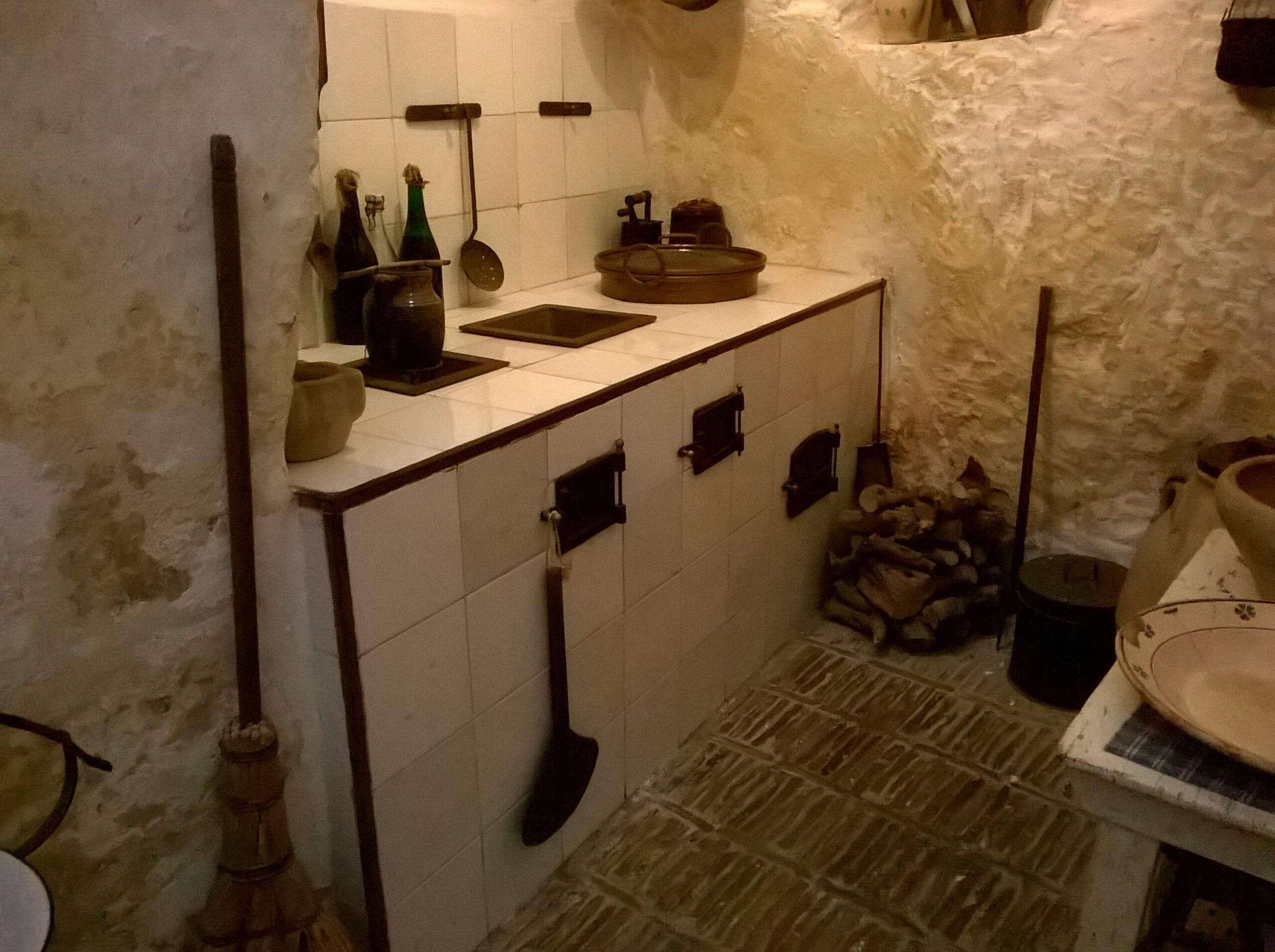
The Caveoso is the poorer and more excavated part, the one Carlo Levi denounced in Christ Stopped at Eboli and which led to the law of 1952: sixteen thousand people moved by decree, and the Sassi empty for thirty years. A cave house open to visitors — thirty square metres, the mule’s manger in the same room, the children in the chest-of-drawers — is the half hour that changes how you look at everything else. Then Santa Maria de Idris, inside the spur of rock.

Matera bread, IGP, of semolina and sourdough, in a tall horn shape: it lasted a week because it was baked once in the communal oven, and each family stamped it with a wooden mark bearing their initials. To try: peperoni cruschi from Senise, dried and fried for a few seconds, snapping like a crisp; cialledda of stale bread, tomato and onion; orecchiette with turnip tops; cotto e crudo with sausage, cheese and cruschi. With three days, add pignata, lamb cooked slowly in a terracotta pot, and caciocavallo podolico. The wine is Aglianico del Vulture, grown on an extinct volcano an hour away. A trattoria: €25-35.
Day 2 — The ravine and the Murgia Park
8 km · 3 stops · 8.30am to 9pm · real trekking, down and back up
This is the day that separates those who have seen Matera from those who have understood it. The Murgia Materana Park is the limestone plateau that begins on the far side of the canyon: eight thousand hectares of rock, scrub, sheep and wind, holding over a hundred and fifty rock churches and traces of settlement going back to the Palaeolithic. Nothing is built there, and that is the point.
5 – Down into the ravine
Time 2 hours · Free · Height difference about 150 metres down and as much up · bring water
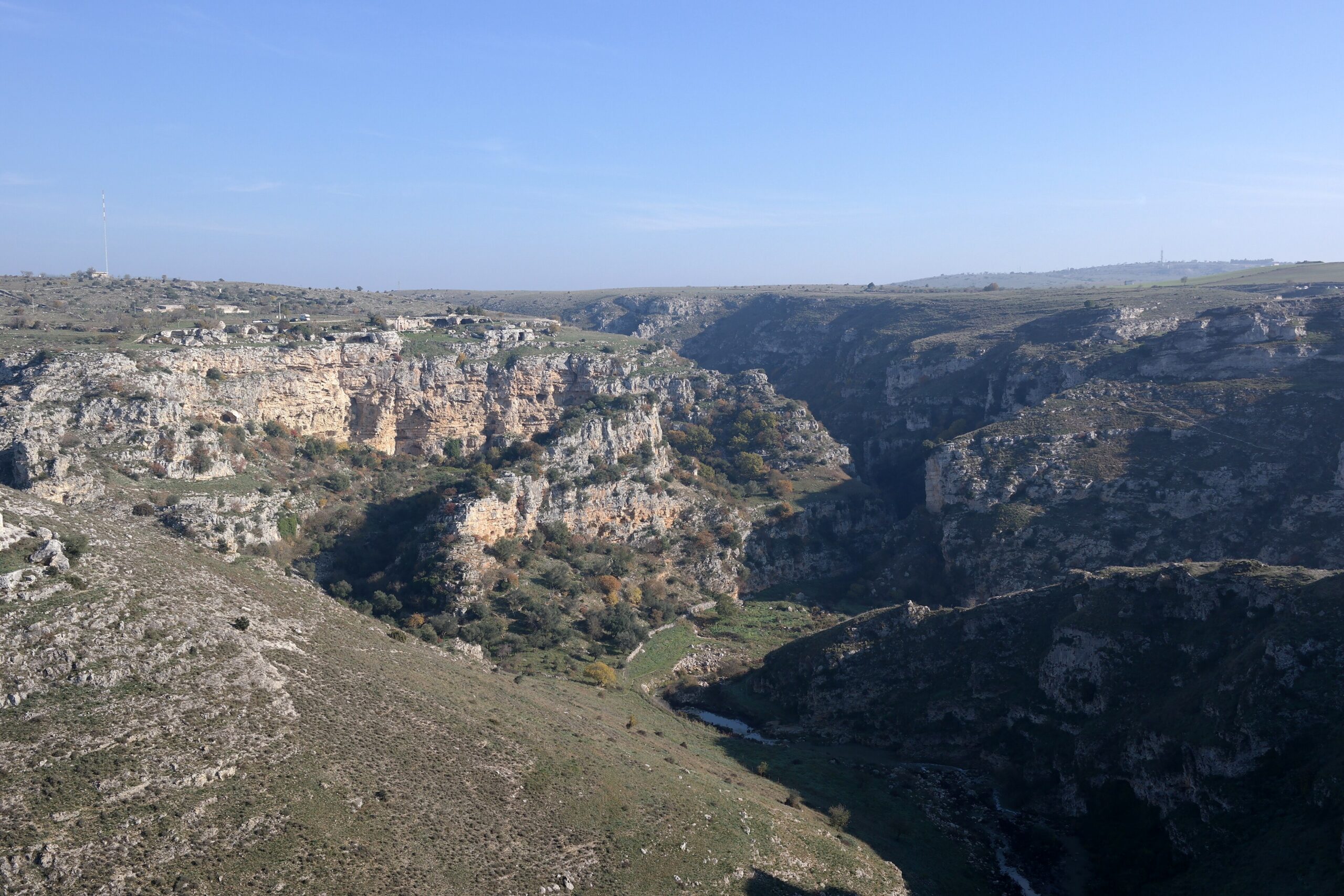
The Gravina torrent has cut a canyon up to two hundred metres deep into the limestone, and the city sits on one side. You go down from the Sasso Caveoso by a path among the boulders, cross the stream on a suspended rope bridge — or on the stones, when the water is low — and climb the other side. It is an hour and a half to two hours in all, and in the middle you are completely alone.
The landscape changes in three hundred metres: on the city side there are the houses, at the bottom the streamside vegetation, on the far side nothing at all. In the rock wall you can see, from a distance, the black mouths of caves by the dozen.
The rope bridge has been closed and reopened several times for maintenance: check before you set out. Otherwise you can reach the Murgia by car or shuttle and do only the stretch on the plateau. In summer this walk should be done early in the morning: there is no wind at the bottom of the ravine and the heat is oppressive.
6 – The rock churches of the Murgia
Time 3 hours · Admission some free, others with a guide · Waymarked paths
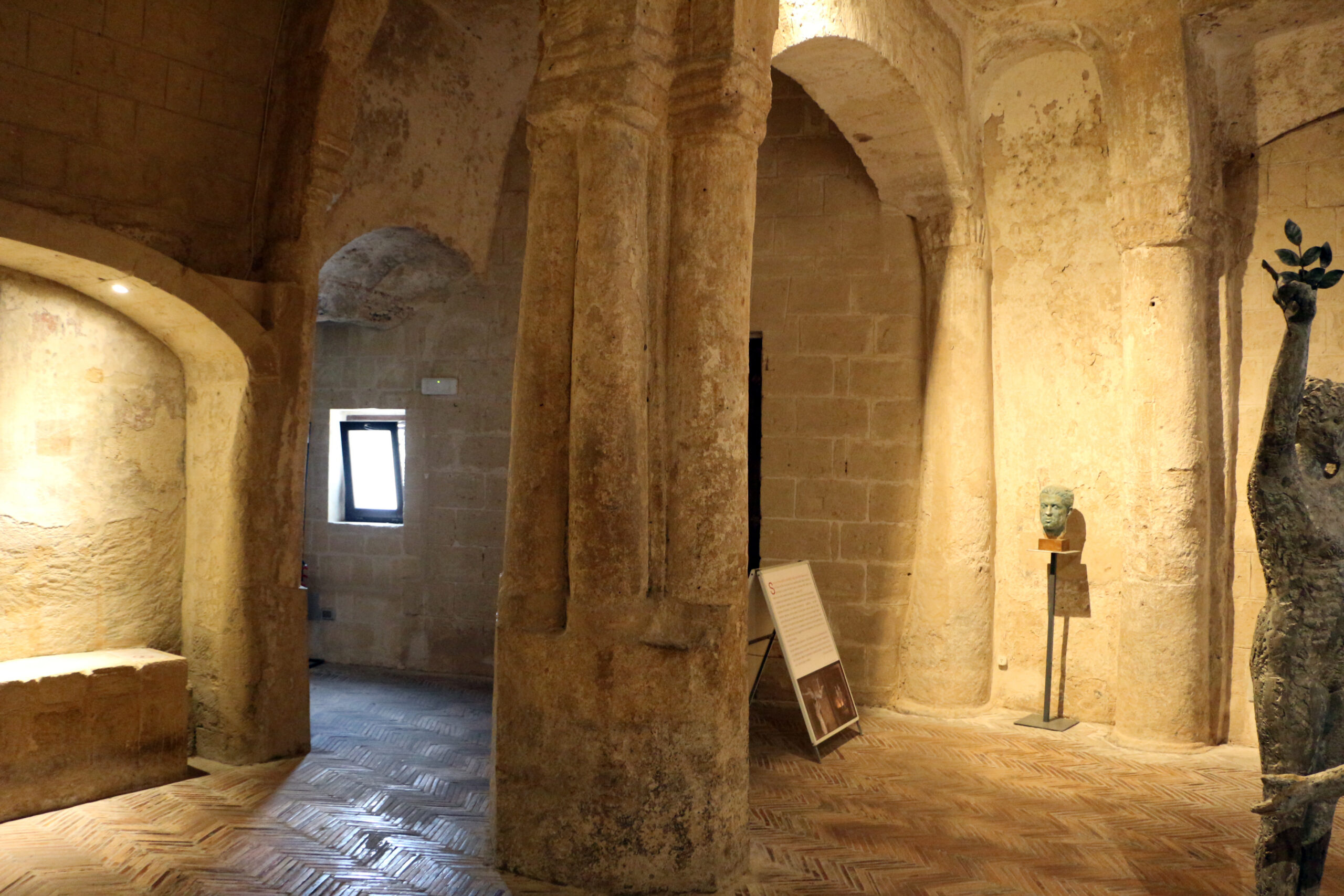
On the plateau, scattered along the paths, are dozens of churches cut into the rock. They were made from the eighth century by Greek-rite monks arriving from the East, many fleeing the iconoclast persecutions, and then by the Benedictines: inside they reproduced by digging what elsewhere was built — naves, columns, apses, false domes — and frescoed the walls in the Byzantine manner.
The main ones around here are the Madonna delle Tre Porte, with fifteenth-century frescoes; San Falcione; the Madonna della Vaglia. Many are open and empty, with no custodian and no ticket: you step in, your eyes adjust to the dark, and a Madonna painted a thousand years ago appears on the wall. Some still have their sheep pens, because after the abandonment shepherds used them as stalls: it is also why a good many frescoes are damaged.
The plateau also holds Neolithic ditched villages — Murgia Timone and Murgecchia — with the ditches cut in the rock still visible, and dozens of Bronze Age pit tombs. If archaeology interests you, take a guide: alone you walk past things without seeing them.
7 – The viewpoint, at sunset
Time 2 hours · Free
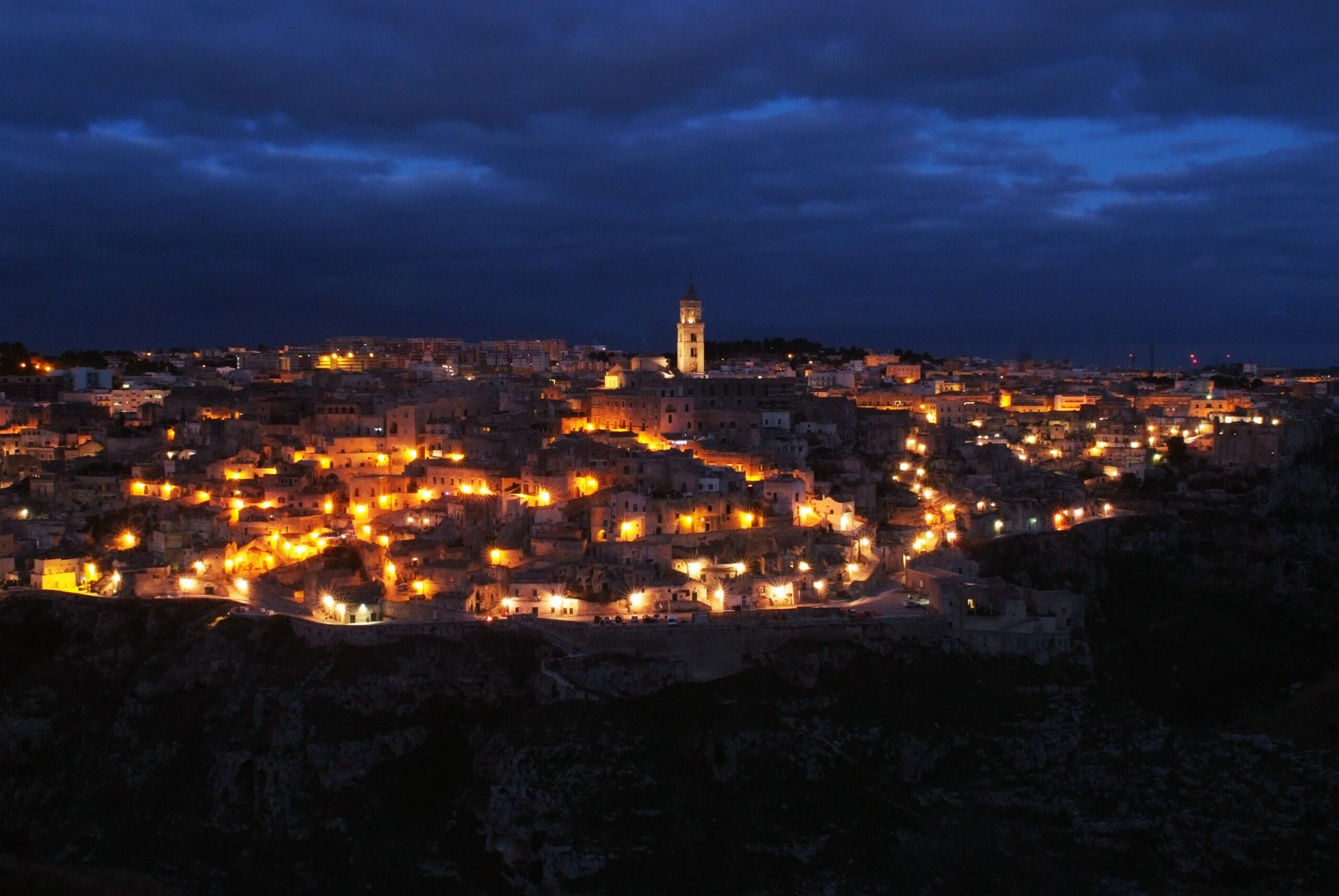
The day ends at the Murgia Timone viewpoint, looking at the city from outside. It is the spot from which almost every scene of the films set in Matera was shot — from Pasolini’s Gospel According to St Matthew to The Passion, down to the opening chase of No Time to Die — and the reason is always the same: it is the place in Europe that most resembles ancient Jerusalem.
The right moment is half an hour before sunset, and it is worth staying until the lights come on: the lit city, with every cave becoming a yellow window on the slope, is one of the finest things to be seen in Italy.
Day 3 — The crypt and the stone towns
5 km · 3 stops · 9am to 7pm · you need a car or a tour
8 – The Crypt of Original Sin
Time 1 hour 30 · Admission about €12 · By appointment only, limited numbers · 14 km from the city
They call it the Sistine Chapel of rock painting, and for once the comparison is not overblown. It is a cave in the wall of the Picciano ravine, a quarter of an hour by car from Matera, frescoed around the year 1000 by an anonymous artist whom scholars call the Painter of the Flowers of Matera, after the large red and white flowers that separate the scenes.
Inside are three niches with the apostles, the archangels and the female saints, and above all the cycle of Genesis: the creation of Adam, the creation of Eve, and original sin, with a rare scene — the separation of light from darkness — almost never depicted in medieval art. The cave was used as a sheep stall until the 1960s, when it was recognised; restoration and public opening came only in 2005.
It is visited by appointment only, in small groups at set times, with a progressive lighting system and a recorded commentary that lights one scene at a time. Book days ahead: it is the thing visitors most often find they cannot see because they left it too late.
9 – Altamura
Time 2 hours · Cathedral free · 20 km from Matera
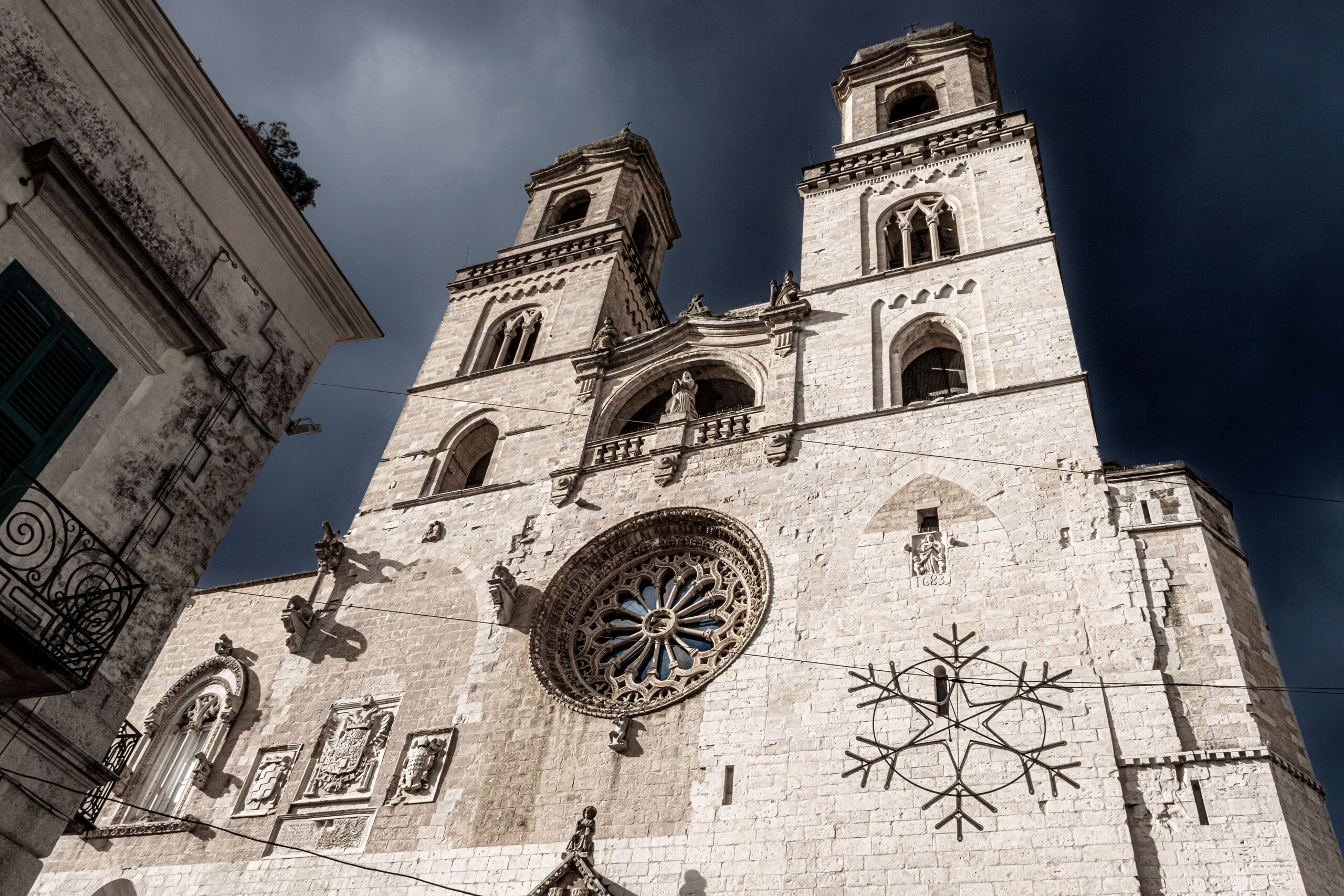
Altamura is already Apulia, twenty kilometres away. The cathedral is the only church founded directly by Frederick II, in 1232, and its doorway and rose window are worth the stop. The old town is made of claustri, small closed courtyards entered through a single arch: born as a defensive structure, they became the way neighbourhoods organised themselves.
But people come to Altamura mainly for two things. The first is Altamura bread DOP, the first bread in Europe to be awarded protected status, baked in wood-fired ovens and already praised by Horace in the first century BC as the best he had ever eaten. The second is the Altamura Man: a Neanderthal skeleton 130,000 to 170,000 years old, found in 1993 in a cave and still exactly where it is, encrusted with calcite, because extracting it would destroy it. It is one of the best-preserved ancient human remains in the world, and the town museum shows the reconstruction.
10 – Gravina in Puglia
Time 2 hours · Aqueduct bridge about €5 · 30 km from Matera
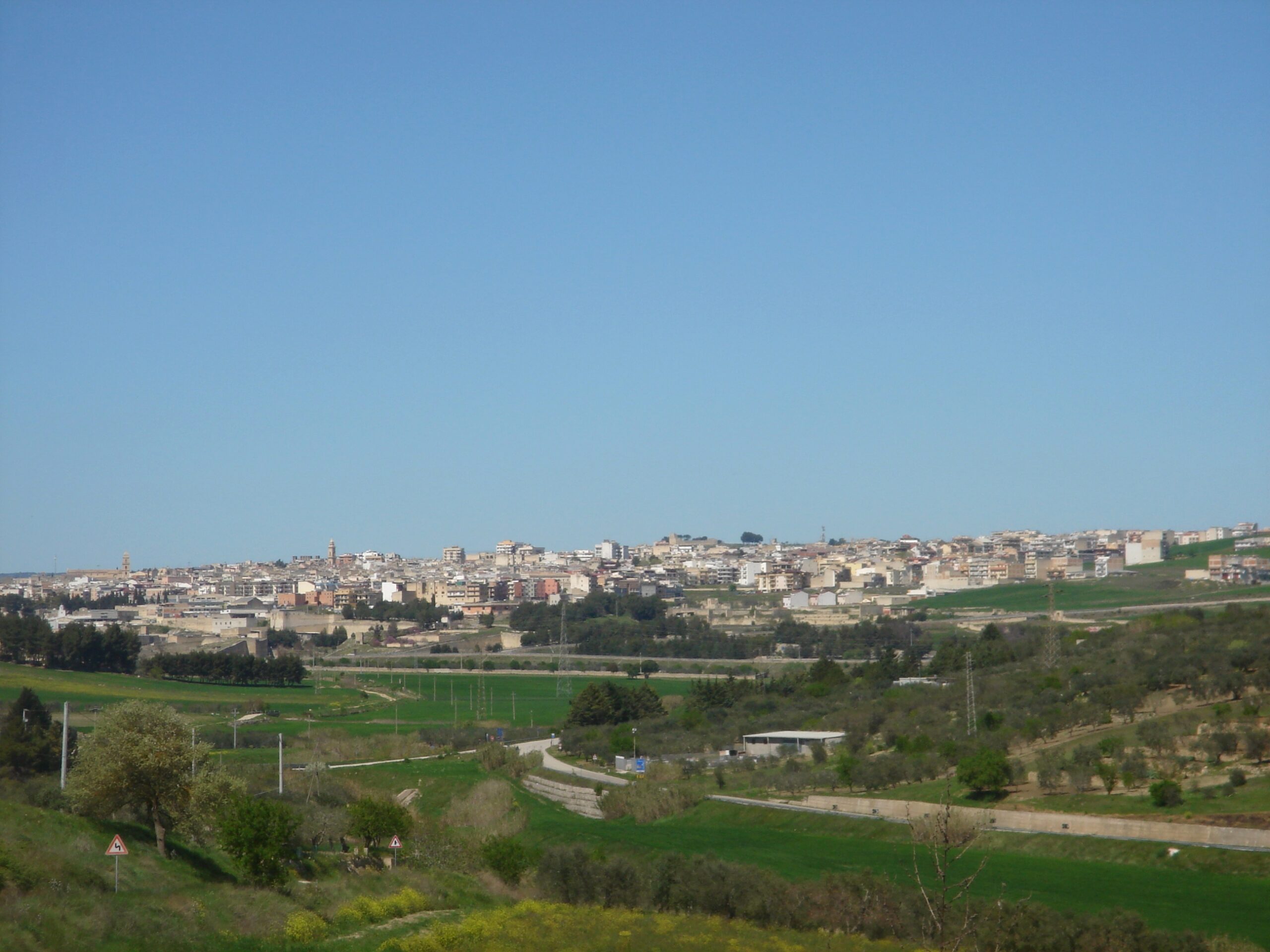
Gravina in Puglia is the lesser-known variant of the same story: another town on the edge of a canyon, with a rock quarter, excavated churches and cave houses. The thing to see is the eighteenth-century aqueduct bridge, a seven-arched viaduct spanning the gorge thirty-seven metres up, which you cross on foot: anyone who has seen No Time to Die will recognise it, because the opening scene runs across it.
Below the town there is also a two-storey rock church, San Michele delle Grotte, and a system of excavated cellars. It is a short stop, far less touristed than Matera, and in half an hour it makes clear that the Sassi were not an exception: they were how this part of the Mediterranean was inhabited.
The third day is the only one that needs transport: there is no public link to the Crypt of Original Sin and the services to Altamura and Gravina are sparse and slow. The alternatives: an organised tour from Matera, which usually combines the crypt with one of the two towns; or replace the day with a second walk in the Murgia with a naturalist guide, or with the city’s museums — the Museo Ridola with the prehistoric finds of the Murgia, Palazzo Lanfranchi with Carlo Levi’s paintings, and MUSMA, the contemporary sculpture museum housed inside the caves of Palazzo Pomarici, one of the most unusual museums in Italy precisely because of where it is.
Three practical things that make the difference. The shoes: the second day is an eight-kilometre trek on stony paths, and in the Sassi the polished limestone is slippery. The heat: in July and August there is not a tree on the plateau and in the Sassi the white stone reflects the sun; it goes above 38 degrees, so walk early in the morning and keep the caves for the middle of the day. The Crypt of Original Sin is visited by appointment only and in limited numbers: book it as soon as you have your dates, because it is the most frequent disappointment for those who arrive without having thought about it.
What three days cost
| Item | Cost |
|---|---|
| Palombaro Lungo | €3-5 |
| Cave house | €3-5 |
| Rock churches in town, combined ticket | €7-9 |
| Guide for the Murgia (optional, recommended) | €20-30 |
| Crypt of Original Sin | about €12 |
| Aqueduct bridge at Gravina | about €5 |
| MUSMA or Museo Ridola | €5-7 |
| Rental car or tour for the third day | €40-70 |
| Meals, 3 days | €75-110 |
| Total | about €160-253 per person |
Reference figures for September 2026. The best part of Matera — walking in the Sassi and in the Murgia — is free, and the tickets cost very little: the two items that weigh are transport for the third day and the accommodation, because sleeping in a restored cave costs a good deal. Anyone wanting to keep the cost down sleeps in the new town, five minutes away on foot and a fraction of the price.
Frequently asked questions
Are three days in Matera too many?
No, if you spend the second outside the Sassi. The city is seen in a day; the second is for the ravine and the Murgia Park, with the rock churches on the plateau, and the third for the Crypt of Original Sin and the nearby Apulian towns. If you stay three days shut inside the Sassi, then yes, it is too many.
How do you cross the ravine?
On foot, going down from the Sasso Caveoso by a path among the boulders and climbing the other side: an hour and a half to two hours, and about 150 metres of height each way. You cross the stream on a suspended rope bridge, which has however been closed and reopened several times: check first. Otherwise you reach the Murgia by car or shuttle and walk only on the plateau.
What are the rock churches?
Churches cut into the rock from the eighth century onwards by Greek-rite monks arriving from the East, many fleeing the iconoclast persecutions, and later by the Benedictines. Inside they reproduced by digging what elsewhere was built — naves, columns, apses — and frescoed the walls. There are over a hundred and fifty in the territory. Many, after being abandoned, were used as stalls by shepherds: which is why a good many frescoes are damaged.
Is the Crypt of Original Sin worth it?
Yes, and it is perhaps the most extraordinary thing in the area: a fresco cycle from around the year 1000 in a cave used as a sheep stall until the 1960s, with a rare separation of light from darkness. The visit has progressive lighting and a recorded commentary. It is by appointment only, in limited numbers, and it is 14 km from the city: book as soon as you have your dates.
Do you need a car?
For the first two days, no: the city is done entirely on foot and the Murgia is reached on foot or by shuttle. For the third day yes, because there is no public link to the Crypt and services to Altamura and Gravina are thin. Otherwise there are organised tours from Matera combining the crypt with one of the two towns.
How much walking is there really?
Six kilometres on the first day with hundreds of steps, eight on the second on stony paths with the descent and climb of the canyon, five on the third. Closed shoes with good soles are needed. Anyone with mobility difficulties should know that the second day is not suitable, and that many routes in the Sassi are not accessible.
When is the best time to come?
April-June and September-October. In July and August there is no shade on the plateau and the Sassi go above 38 degrees. Winter is cold and windy but the city is empty. The special date is 2 July, the feast of the Madonna della Bruna, which ends with the crowd tearing the triumphal papier-mâché float to pieces to take a fragment home: it is rebuilt every year in order to be destroyed.
What is the Altamura Man?
A Neanderthal skeleton 130,000 to 170,000 years old, found in 1993 in a cave near Altamura. It is one of the best-preserved ancient human remains in the world and it is still where it lies, encrusted with calcite: extracting it would destroy it. The town museum shows the reconstruction, and the cave is viewed from outside.
Where is best to stay?
In the Sassi, if it fits the budget: the scattered hotels made from cave houses have absolute silence and a constant temperature, and they are the experience many people come for. In the new town you spend a fraction and the Sassi are five minutes away on foot. If you arrive by car, check the parking: you do not drive into the centre.
What is MUSMA?
The museum of contemporary sculpture, housed inside the caves of Palazzo Pomarici: twentieth-century works are displayed in rooms cut out of the rock, and it is one of the most unusual museums in Italy precisely for the contrast between container and content. It is a good alternative to the third day for anyone without a car.
September 3, 2026


