

East Coast road trip: 2 weeks from Montreal to Miami via New York
This is the journey that descends along the entire east coast of North America: starting from French-speaking Quebec, crossing Ontario, entering the United States, reaching New York and continuing all the way to the Florida Keys, where the road ends in the sea ninety miles from Cuba. It’s about three thousand kilometers and crosses two countries, six different cultural zones and a climate jump from maple forests to mangroves. It needs to be said right away, because it changes everything: between the Northeast and Florida there’s a gap of two thousand kilometers, and it needs to be decided in advance whether to drive or fly.
In summary
- Duration · two full weeks; with ten days you cut something
- Route · Montreal → Toronto → New York → Atlantic City → Miami → Key Largo
- How much driving · roughly 3,000 km total, but two-thirds are on a single stretch
- The bottleneck · from Atlantic City to Miami are 1,900 km: either two full days of highway, or a flight
- Documents · you cross the Canada-United States border: Europeans need ESTA for the US and eTA for Canada, both to be done online beforehand
- Car · rental, but not needed for the entire trip: in three of the six cities it’s just a cost
- When · May-June or September-October: in Florida in summer there’s hurricane season, in Canada in winter there’s snow
From Montreal to Key Largo are three thousand kilometers: the long jump is between Atlantic City and Miami.
How to build your trip
Before looking at the stops, three decisions that change everything else.
1 – The jump between the Northeast and Florida
It’s the central problem of this itinerary, and it doesn’t have an elegant solution: from Atlantic City to Miami there are 1,900 kilometers, that is about twenty hours of driving. There are two options:
- You fly · two and a half hours, you return the car in the north and rent another one in Florida. It costs less than it seems, because you save two hotel nights and two days of rental, and it’s the right choice if you have less than two weeks
- You drive · two full days on Interstate 95, which is monotonous but allows two stops that are worth it: Washington (three hours from Atlantic City, with the Smithsonian museums all free) and Charleston or Savannah (halfway, two of the most beautiful historic cities in the South). So the jump becomes part of the trip instead of just a transfer
2 – The car isn’t needed everywhere
It looks like a car trip and it’s only partly true. In Montreal, Toronto and especially New York the car is pure cost: expensive parking, traffic, and public transportation that works well. In Manhattan a garage costs fifty to seventy dollars a night.
The practical solution is to rent by segments: car from Montreal to Toronto and back or one-way, train or flight to New York, no car in New York, and then new rental for New Jersey and Florida, where it’s essential instead. Attention: one-way rental has a surcharge, and the one that crosses the border between Canada and the United States is often not even permitted: you need to check beforehand.
3 – The border
You cross the border between Canada and the United States, and for Europeans two distinct authorizations are required, both online and paid: the ESTA for the United States and the eTA for Canada. These should be done a few days in advance, not at the last minute.
If you cross by car, the most convenient border crossing on this route is at Niagara Falls: you cross on a bridge, and during peak hours the line can last an hour or more. Don’t bring fruit, vegetables or fresh meat: customs will seize them.
Stop 1 — Montreal, three days
Starting point · no car for now · Quebec is French-speaking and you feel it

You start from the North American city that Europeans find most similar: the second largest French-speaking city in the world, with an old city of cobblestones born in 1642 as a mission, a basilica that is midnight blue inside, and a hill in the middle that no skyscraper can exceed by regulation.
In three days you can fit the old city and Mont Royal, the 1976 Olympic park with the world’s tallest leaning tower, the markets and islands of the 1967 Expo with Buckminster Fuller’s dome. If you have an extra day you go down to Quebec City, the only walled city north of Mexico.
Here the car isn’t needed: the subway works well and parking downtown is expensive. If the rental starts here, get it on the last day.
Stop 2 — Toronto and Niagara, three days
540 km from Montreal · 5.5 hours of highway, or train in 5 hours

From Montreal to Toronto the 401 highway hugs the St. Lawrence River and Lake Ontario: it’s a stretch without major attractions, and the train — five hours, comfortable and scenic — is often the best choice, especially because in Toronto the car is not essential.
Toronto is the opposite of Montreal: English-speaking, vertical, with one person in two born abroad and one hundred and sixty languages. You visit it by neighborhoods, which are effectively different countries. Two days are enough for the CN Tower, the market, the Victorian Distillery District, Kensington Market and sunset on the islands.
The third day descends to Niagara Falls, which are an hour and a half away: the Canadian side is the right one, because from here you have the falls in front of you. The boat ride inside the Horseshoe amphitheater is what to do. If the route continues by car towards the United States, Niagara is also the border crossing: it makes sense to have it coincide with the day’s visit.
Stop 3 — New York, four days
650 km from Niagara · 7 hours of driving across New York State, or a flight of 1.5 hours

The road from Niagara to New York crosses the state from west to east and passes near the Finger Lakes, the region of long narrow lakes carved by glaciers, which is also a wine region: if you have an extra day, it’s a stop that few Europeans make and it’s worth it.
In New York leave the car: return it to a suburban office or park it in New Jersey, because in Manhattan a garage costs fifty to seventy dollars a night and from 2025 there’s also an urban toll under Sixtieth Street.
Four days is the minimum to not leave with the feeling of only having seen postcards: two for Manhattan — Midtown from above, Central Park, the Brooklyn Bridge, the Statue of Liberty, Ellis Island, the memorial, the High Line — and two to get off the island, between Brooklyn and Queens, which is the most multicultural district on the planet.
Stop 4 — Atlantic City, one day
200 km from New York · 2.5 hours · here you pick up the car again

Going south you pick up the car again, and the first stop is Atlantic City: the city that invented the wooden boardwalk by the sea, the Miss America pageant and the first American casino outside Nevada, and that gave its streets to the Monopoly board. A day is enough: the Boardwalk, the Steel Pier, the 1857 lighthouse and the six-story wooden elephant of Margate.
It’s also a city that openly shows its own decay, with casino towers on the waterfront and empty blocks two streets back: that’s part of what you go to see.
From here on the choice is mandatory: either you fly to Florida, or you budget two days on Interstate 95. If you drive, break at Washington (three hours) and then at Charleston or Savannah (another eight): they are two of the most beautiful historic cities in the United States and they transform a transfer into two real stops.
Stop 5 — Miami, three days
1,900 km from Atlantic City · 2 days of driving, or 2.5 hours of flight

The climate jump is abrupt, and it’s part of the experience: you’ve left a French-speaking city with five months of winter and you arrive in a Latin American city where more than half the inhabitants were born abroad and Spanish is the first language of entire neighborhoods.
Three days: the Art Deco neighborhood of Miami Beach with its eight hundred buildings, the murals of Wynwood, the Calle Ocho of Little Havana with the cafecito standing at the window; then a day in the Everglades, which are not a swamp but a river eighty kilometers wide; and one between Villa Vizcaya and Coral Gables.
Stop 6 — The Keys, two days
100 km to Key Largo, 270 to Key West · one road only, forty-two bridges
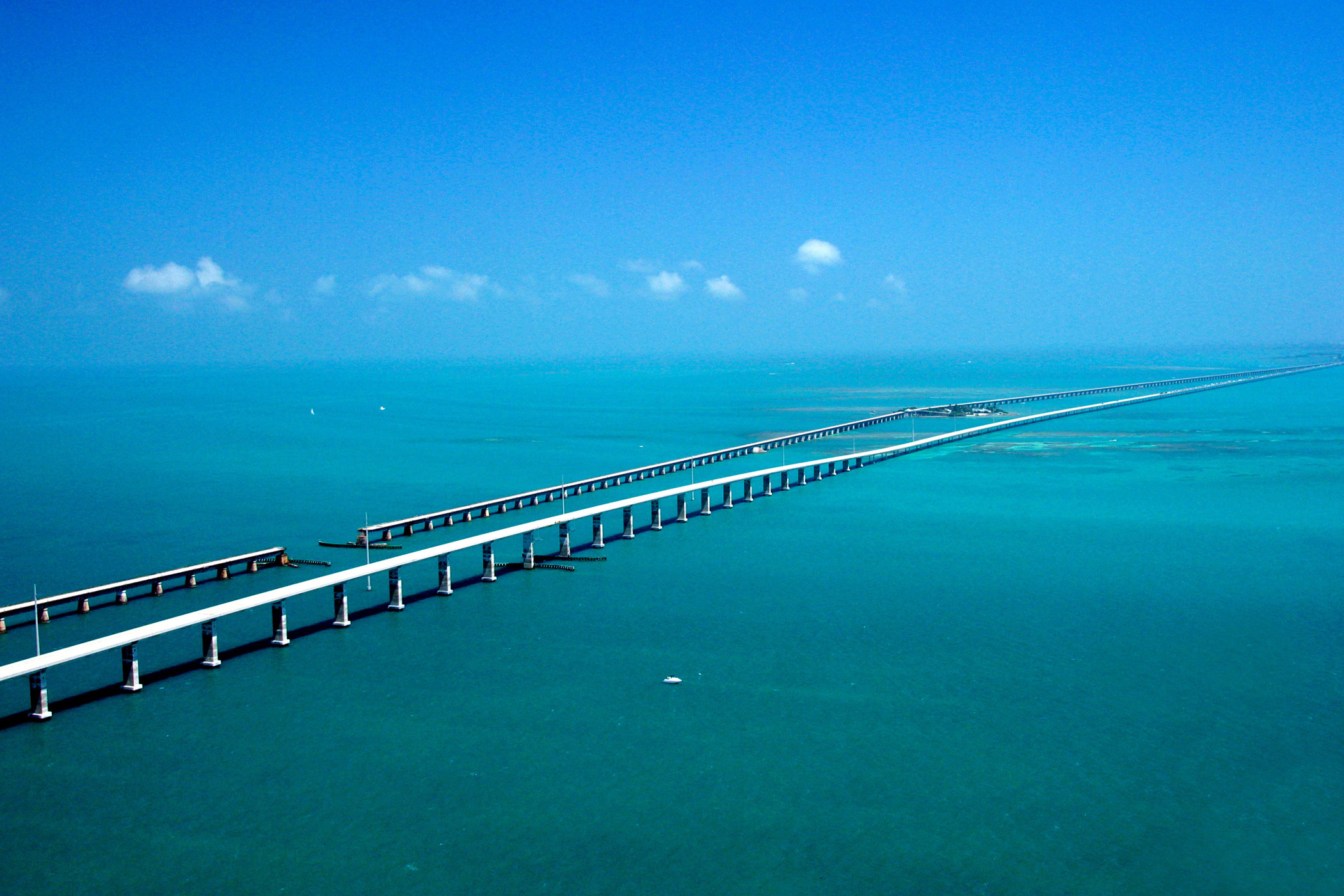
The journey ends on the water. The Overseas Highway runs for one hundred and seventy kilometers from island to island on forty-two bridges, with the Atlantic Ocean on one side and the Gulf of Mexico on the other. It wasn’t born as a road but as a railroad, built by Henry Flagler between 1905 and 1912 and swept away by the 1935 hurricane: you drive on its pillars.
The first stop is Key Largo, where there’s the only living coral reef in the continental United States and the Christ of the Abyss, a copy of the San Fruttuoso statue, placed on the bottom in 1965. If you have time you continue to Key West, which is closer to Havana than to Miami, and closes the trip with the Sunset Celebration at Mallory Square, where every evening people applaud the sun going down.
If you end in Key West, remember that you have to go back: the road is one only and there’s no other way out of the islands except the local airport, small and expensive. Allow for the four hours of return to Miami.
Variations and cuts
- If you have ten days · remove Toronto or Atlantic City, fly from New York to Miami and keep three days for the Keys: the trip remains sensible.
- If you have three weeks · drive the southern stretch and stop at Washington, Charleston and Savannah. With the addition of Quebec City at the top, it becomes a complete crossing of the east coast.
- The opposite · the trip also works from south to north, and with an advantage: you go towards spring instead of towards winter. In that case leave in April.
- In winter · the Canadian stretch has snow and ice from December to March, and the Great Lakes produce sudden and violent snowstorms. Florida instead is in its best season: if you come in winter, reverse and start from Key Largo.
What it costs
| Voce | Spesa |
|---|---|
| Montreal, 3 giorni | circa 330-430 $ CAD |
| Toronto e Niagara, 3 giorni | circa 450-570 $ CAD |
| New York, 4 days | about 420-560 $ |
| Atlantic City, 1 day | about 80-110 $ |
| Miami and Everglades, 3 days | about 340-480 $ |
| Keys, 2 days | about 250-350 $ |
| Flight Atlantic City or New York → Miami | 120-250 $ per person |
| Noleggi auto a segmenti, 8-9 giorni totali | 500-800 $ da dividere |
| Total, accommodation excluded | about 2,200-3,100 $ per person |
Reference figures for August 2026. Accommodation is the item that changes the bill most and is not included: New York and Toronto are the expensive cities, Atlantic City and the Keys out of season are the savings. On rentals: taking them by segments costs less than keeping the car idle on New York days, and one-way between Canada and the United States is often not permitted.
Frequently asked questions
How long does this trip really take?
Two weeks is the right measure: three days in Montreal, three between Toronto and Niagara, four in New York, one in Atlantic City, three in Miami and two in the Keys, plus transfers. With ten days it works, but you have to remove a city and fly on the southern stretch.
Can you do everything by car?
Yes, but it’s not worth it. From Atlantic City to Miami are 1,900 kilometers, twenty hours of driving: two full days on the Interstate. And in three of the six cities — Montreal, Toronto, New York — the car is just a cost. The practical solution is to rent by segments and fly on the long stretch.
How much does it cost to park in New York?
A garage in Manhattan costs fifty to seventy dollars a night, and from 2025 there’s also a toll for driving under Sixtieth Street. With four days in the city, keeping the car costs as much as the flight to Florida: it’s worth returning it.
What documents do you need?
For Europeans: ESTA for the United States and eTA for Canada, two distinct authorizations, both online and paid, to be done a few days in advance. The passport must be electronic. If you rent, also bring your international driving permit, which some companies ask for.
Can you take a rental car across the border?
It depends on the company and the contract: many allow it between Canada and the United States by declaring it at pickup, but one-way rental that crosses the border is often not permitted or costs a lot. It should be checked before booking, not at the counter.
Is it worth stopping at Washington or Charleston?
Yes, if you choose to drive the southern stretch: Washington has the Smithsonian museums, all free, and is three hours from Atlantic City; Charleston and Savannah are two of the most beautiful historic cities in the United States and are about halfway. So the twenty hours on the highway become three stops.
When is it worth leaving?
May-June or September-October. In summer in Florida there’s humid heat and hurricane season (June-November); in winter the Canadian stretch has snow and ice. If you travel in winter, do the route backwards, from south to north, starting in March or April.
Which side do you watch Niagara from?
From the Canadian side: from there you have the falls in front of you, while from the United States you see them from the side. On this itinerary Niagara is also the point of border crossing, so it makes sense to have it coincide with the day’s visit.
How far does the road go in the Keys?
As far as Key West, where there’s mile zero: from then on there’s only sea, and Cuba ninety miles away. The road is one only, so you have to go back: from Key West to Miami are four hours. If you have little time you stop at Key Largo, which is an hour and a half from Miami and has the coral reef.
Better from north to south or south to north?
From north to south if you leave in autumn: you chase the heat and arrive in Florida in its best season. From south to north if you leave in spring: you go towards the thaw and arrive in Canada when it’s finally nice. In both cases the trip works.
September 6, 2026

