

Berlin in 3 days: the Wall, the Berlin of before, and Potsdam or Sachsenhausen
Three days in Berlin are not for seeing three times as much: they are for moving from headlines to understanding. The first day follows the line of the Wall, the right way to get your bearings in a city with no historic centre. The second goes into the Berlin of before — Prussian Charlottenburg, Weimar Republic Berlin, the western districts — and faces the hardest part, the complete Wall memorial on Bernauer Straße. The third leaves the city: Potsdam with Frederick the Great’s palaces, or the Sachsenhausen concentration camp, forty minutes by train and not a day trip in the usual sense.
At a glance
- How long · three full days, from 9am to 10pm
- How much walking · 7-9 km a day, flat
- What has to be booked · the Reichstag dome, free but registered days ahead
- Budget · €140-230 per person for the three days, excluding accommodation
- Transport · zone AB day ticket, validated before boarding: there are no gates, but there are checks
- Day to avoid · Monday, when several state museums close
- What is left out · Wannsee, Treptower Park, the Tempelhofer Feld, Dresden: those are a fourth and fifth day
One colour per day. Potsdam and Sachsenhausen are outside the city, 40 minutes by train in opposite directions.
Day 1 — The line of the Wall
8 km · 4 stops · 9am to 10pm · the day that costs almost nothing
Morning – Brandenburg Gate, Reichstag, Memorial
9am-12:30pm · All free · Reichstag to register days ahead

The Brandenburg Gate dates from 1791 and is not a triumphal arch: it is a customs gate. Napoleon carried off the quadriga in 1806, and the Prussians took it back eight years later. Look at the ground: a double row of cobblestones with the plaque Berliner Mauer 1961-1989 marks where the Wall ran, and you will find it all day.

The Reichstag was set on fire in February 1933, and Hitler used the fire to suspend constitutional freedoms. Rebuilt by Norman Foster after reunification, it left the pencil graffiti of Soviet soldiers from 1945 visible on the corridor walls, and above the chamber it has a walkable glass dome: the public walks above the heads of the MPs. It is a political statement built into architecture.
The Holocaust Memorial is two hundred metres away: 2,711 concrete steles on undulating ground, with no names or explanations. At the centre the ground drops and the blocks rise to four metres: you can no longer see anyone or hear the traffic. Below is the information centre, free, with the stories of individual families and the room where the names of the victims are read aloud, one by one: it would take more than six years to finish them all.
Afternoon – Unter den Linden, Museum Island, Alexanderplatz
1:30pm-5:30pm · One museum €12-16 · the rest free
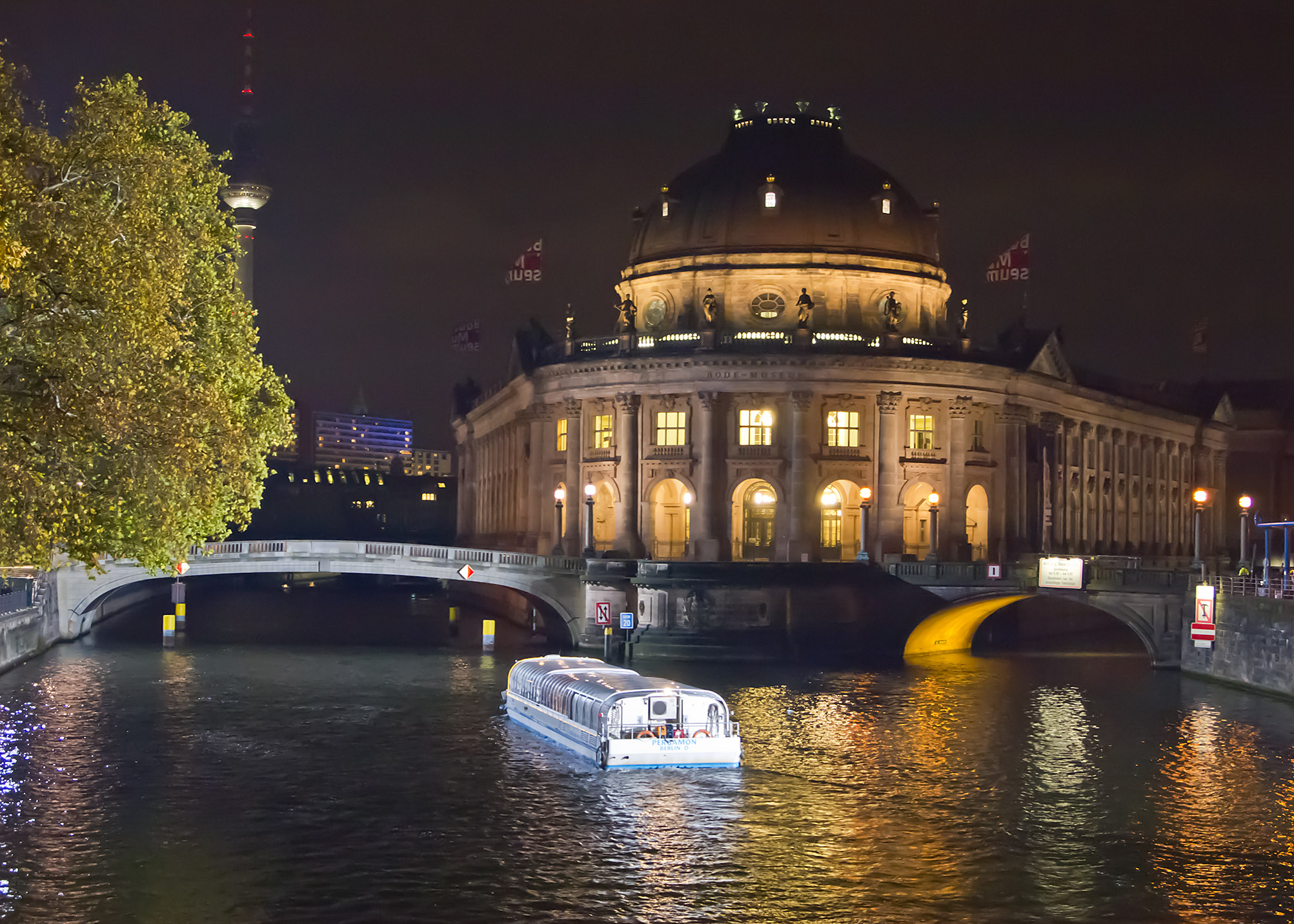
Along Unter den Linden: the Neue Wache, with its single sculpture, Mother with her Dead Son by Käthe Kollwitz, under an open oculus where rain and snow fall in; and Bebelplatz, where twenty thousand books were burned on 10 May 1933 — set into the paving is a glass pane, through which you see a white room with empty shelves.
On Museum Island you do one. The Neues Museum holds the bust of Nefertiti and was rebuilt by David Chipperfield without disguising the war damage: blackened walls, missing frescoes, new brick alongside the wounded original. The Pergamon Museum is closed for a very long restoration.

Alexanderplatz was the heart of East Berlin and has been left as it was: enormous, windswept, concrete. The 1969 Fernsehturm stands 368 metres tall, and the GDR built it to be seen from the West; the cross-shaped reflection on the sphere, in an atheist state, was nicknamed by Berliners the Pope’s revenge.
Evening – East Side Gallery and Kreuzberg
6pm-10pm · Free · S-Bahn to Warschauer Straße

The East Side Gallery is the longest surviving stretch of the Wall: 1,316 metres, painted in 1990 by a hundred and eighteen artists. The best-known mural is the kiss between Brezhnev and Honecker, reproducing a real 1979 photograph. Note: this was the inner side, facing the death strip, which no GDR citizen could approach.
Cross the Oberbaumbrücke, the two-tier red bridge that was once a crossing point, and end in Kreuzberg: a district in the West but wedged against the Wall on three sides, where Turkish workers, punks and conscientious objectors settled — there was no military service in West Berlin. The best kebab in the city, Kneipen open until dawn, and evenings on the grass along the canal.
Day 2 — The Berlin of before, and the whole Wall
7 km · 4 stops · 9:30am to 9pm · you go north, then west
Morning – Bernauer Straße, the Wall memorial
9:30am-noon · Free · S-Bahn Nordbahnhof or U8 Bernauer Straße

If yesterday you saw the painted Wall, today you see it as it was. The Gedenkstätte Berliner Mauer on Bernauer Straße preserves a complete stretch: the outer wall, the death strip with raked sand, the lights, the anti-vehicle obstacles, the watchtower and the inner wall. It is the only place where you understand that the Wall was not a wall, but a border system dozens of metres deep.
Bernauer Straße is the most dramatic street of the division, because the border ran along the façades of the houses: the buildings stood in the East, the pavement in front lay in the West. In August 1961 people climbed down from windows on bedsheets while West Berlin firefighters held out sheets below; then the windows were bricked up, then the houses demolished. Ida Siekmann died here, the first victim of the Wall, jumping from the third floor on 22 August 1961, and here the photograph was taken of soldier Conrad Schumann leaping the barbed wire in uniform, three days after construction began.
In the documentation centre, free, there is a viewing tower looking down over the reconstructed death strip, and a Window of Remembrance with photographs of people who died trying to cross. Beneath the street, a stretch of escape tunnel is marked in the paving: at least seventy were dug.
This is the most important place in Berlin on the subject of the Wall, and far fewer people go here than to the East Side Gallery. Allow two hours and read the panels: they are well done.
Early afternoon – Gendarmenmarkt and bourgeois Berlin
1pm-3pm · Free · Metro Französische Straße or Stadtmitte

The Gendarmenmarkt is considered Berlin’s finest square, and it is an almost total reconstruction: in 1945 it was a heap of rubble. On its two sides stand twin churches, and between them Schinkel’s Konzerthaus.
The two churches tell a story that explains Berlin. The one to the south is the Deutscher Dom, German; the one to the north is the Französischer Dom, French, built for the Huguenots: in 1685, when Louis XIV revoked the Edict of Nantes and French Protestants had to flee, Brandenburg took in twenty thousand of them. They were craftsmen, weavers, goldsmiths and merchants, and within a few years they made up one Berliner in five. The city was built this way, by people fleeing elsewhere, and it still is.
Around it lies elegant Berlin: Friedrichstraße, the department stores, the historic cafés. If you have time, the Museum für Naturkunde a little to the north has the world’s largest mounted Brachiosaurus skeleton, thirteen metres tall, and Berlin’s Archaeopteryx, the most important fossil in the history of evolution.
Afternoon – Charlottenburg
3:30pm-6pm · Palace about €12-19 · Garden free · Metro Richard-Wagner-Platz or bus

Charlottenburg Palace is the largest Hohenzollern residence left in Berlin: begun in 1699 as a country house for Queen Sophie Charlotte, it grew over a century. It burned down almost entirely in the bombing of 1943 and was rebuilt over the following decades, room by room.
Worth seeing: the rococo Golden Gallery in the new wing, the porcelain chamber with hundreds of Chinese pieces set floor to ceiling — an eighteenth-century mania —, and the mausoleum in the park, with Queen Louise’s marble sarcophagi. The garden is free and is Germany’s first French-style baroque garden, later remade as an English landscape park.
In the district around it stood the West Berlin that served as the division’s showcase: the Kurfürstendamm with its shops, KaDeWe — the largest department store in continental Europe, with an entire floor of food halls —, and the Kaiser Wilhelm Memorial Church, the bombed church whose broken spire was left standing, beside a new octagonal tower of blue glass. Berliners call them the hollow tooth and the lipstick and powder box.
Evening – Tiergarten and Kulturforum
6:30pm-9pm · Park free, Gemäldegalerie about €12 · Victory Column a few euros

The Tiergarten covers two hundred and ten hectares in the middle of the city, and its history says everything: in the winter of 1946-47 Berliners almost entirely felled it for firewood and grew potatoes on the cleared land. It was replanted tree by tree starting in 1949.
At its centre stands the Siegessäule, the Victory Column, and it too has a story: it originally stood in front of the Reichstag, but in 1939 Albert Speer had it moved here, to the centre of a roundabout, as part of the plan to turn Berlin into the world capital «Germania». That move saved it: had it stayed where it was, it would have been destroyed in the 1945 battle. You climb 285 steps.
On the southern edge of the park is the Kulturforum, the cultural complex West Berlin built in the 1960s as an answer to Museum Island, which had stayed in the East. Inside is the Gemäldegalerie, one of the most important collections of early European painting on the continent — Vermeer, Rembrandt, Caravaggio, Bruegel, Botticelli —, and there is almost never anyone there. Next to it, the Neue Nationalgalerie by Mies van der Rohe, the last building he designed: a steel roof on eight columns, and nothing else.
Day 3 — Potsdam, or Sachsenhausen
The whole day · regional train, forty minutes · two very different choices
Potsdam and Sanssouci
6-7 hours · Sanssouci about €14, park free · S-Bahn or regional train to Potsdam Hbf, 40 minutes · Zone C ticket needed

Potsdam was the residence of the Kings of Prussia, and the park of Sanssouci is a UNESCO site: three hundred hectares with a dozen palaces.
Sanssouci Palace — «without worries», and the name is in French because Frederick the Great spoke and wrote French and despised German — is surprisingly small: ten rooms, a single storey. It was his private home, where he came without his wife, with his dogs and his books, to play the flute and argue with Voltaire, who lived there for three years before a furious falling-out. Frederick wanted to be buried here, on the terrace, next to his greyhounds: Prussia buried him elsewhere, and his wishes were honoured only in 1991, two hundred years later. Visitors still leave potatoes on his grave, because he was the one who forced their cultivation against peasant resistance, saving Prussia from famine.
At the other end of the park, two and a half kilometres away, stands the Neues Palais, enormous and lavish: he built it right after the Seven Years’ War, when Prussia was exhausted, explicitly to show his enemies he still had money. He himself called it «a piece of bragging».
In the town: the Dutch Quarter, a hundred and thirty-four red-brick houses built in the eighteenth century to attract craftsmen from the Netherlands; the Alexandrowka Russian colony with its wooden izbas; and Cecilienhof, the Tudor-style villa where in the summer of 1945 Stalin, Truman and Churchill divided up Europe: the conference’s round table is still in the room.
The park is large and the distances between palaces are real: two and a half kilometres end to end. Rent a bicycle at the station or plan on a lot of walking. The train ticket must cover zone C.
The alternative: Sachsenhausen
5 hours · Free entry, audio guide a few euros · S-Bahn S1 to Oranienburg, 45 minutes, then 20 on foot · Indoor spaces closed on Mondays
Forty minutes by train is the Sachsenhausen concentration camp, and it should be said plainly: this is not a day trip, and it should not be rushed or treated as a box to tick.
It opened in 1936, before the war, and was not an extermination camp: it was the model the others were designed on, and the headquarters of the Concentration Camp Inspectorate, the office that administered the whole system. The SS trained personnel here. Its layout is a triangle with barracks fanning out around a central point from which a single machine gun could cover everything: an idea of engineering applied to imprisonment.
About two hundred thousand people passed through — German political opponents, Jews, Soviet prisoners of war, gay men, Jehovah’s Witnesses, Roma — and tens of thousands died there of starvation, disease, forced labour or execution. After 1945 the Soviets reused it for five years as an internment camp, and another twelve thousand people died there: the memorial tells that story too.
Entry is free. Take the audio guide or join a guided tour: alone, without context, you risk walking among empty buildings without understanding. Allow three hours on site, and a day in which you do nothing else.
If it rains
- Day 1 · instead of the East Side Gallery, the DDR Museum, where you open drawers and walk into a reconstructed East German flat.
- Day 2 · Bernauer Straße is almost all outdoors: the documentation centre is indoors, but in heavy rain move it and bring forward Charlottenburg and the Gemäldegalerie, which alone make up a day.
- Day 3 · Potsdam loses a lot in the rain, since its value lies in the park: in that case stay in the city with the Museum für Naturkunde, the Neue Nationalgalerie, or the Jewish Museum by Daniel Libeskind, a building-as-experience worth half a day.
What the three days cost
| Item | Cost |
|---|---|
| Reichstag, Memorial, Topography of Terror, Bernauer Straße, Sachsenhausen | free |
| One museum on the Island | €12-16 |
| Charlottenburg | €12-19 |
| Gemäldegalerie | about €12 |
| Sanssouci and train to Potsdam | about €25 |
| City transport, 3 days | about €30 |
| Meals, 3 days | €60-110 |
| Total | about €140-230 per person |
Reference figures as of August 2026: check official websites before you travel. Berlin remains the cheapest capital covered on this site, and the reason is that the most important things are free. With three days and several state museums, consider the three-day Museumspass.
Frequently asked questions
Is three days enough for Berlin?
Yes, and it is the right length: one for the line of the Wall, one for the Berlin of before and the complete Bernauer Straße memorial, one for leaving the city toward Potsdam or Sachsenhausen. Wannsee, Treptower Park with its Soviet monument, and the Tempelhofer Feld, the decommissioned airport turned public park, are left out.
What is the best place to understand the Wall?
The Gedenkstätte Berliner Mauer on Bernauer Straße, without question: it preserves a complete stretch with the double wall, the death strip, the obstacles and the watchtower, and it makes you understand that the Wall was a border system dozens of metres deep, not a single wall. The East Side Gallery is more famous, but it is a wall painted in 1990, on the side East Berliners could not even approach.
Potsdam or Sachsenhausen for the third day?
They are two opposite experiences, and the choice is personal. Potsdam is Prussian eighteenth-century splendour, Frederick the Great’s palaces, a three-hundred-hectare park: a lovely day. Sachsenhausen is the concentration camp that served as the model for all the others and the headquarters of the office that administered the whole system: entry is free, it takes three hours, and you do nothing else that day. If you have already visited a camp, choose Potsdam; if you never have and are willing, choose Sachsenhausen.
Is the Pergamon Museum open?
No, it is closed for a very long restoration and will reopen in stages over the coming years. Check the state of the works before you leave if your trip revolved around the Pergamon Altar or the Ishtar Gate. The other museums on the Island are open, and the Neues Museum with Nefertiti is the one we recommend.
Which museum should you pick if you can only do one?
The Neues Museum, for Nefertiti and for the building rebuilt without hiding the wounds of war. If painting interests you, the Gemäldegalerie at the Kulturforum has Vermeer, Rembrandt, Caravaggio and Bruegel, and there is almost never anyone there: it is Berlin’s most underrated museum.
How do you get to Potsdam?
On the S7 S-Bahn or a regional train, forty minutes from the central station. You need a ticket covering zone C; the urban AB ticket is not enough. In the park of Sanssouci the distances are real — two and a half kilometres between Sanssouci and the Neues Palais — so rent a bicycle at the station or plan on a lot of walking.
Why does the Gendarmenmarkt have a French church?
Because in 1685, when Louis XIV revoked the Edict of Nantes, Brandenburg took in twenty thousand French Huguenots fleeing persecution. They were craftsmen, weavers and merchants, and within a few years made up one Berliner in five. The Französischer Dom was built for them. Berlin was built this way, by people fleeing elsewhere.
Is Berlin expensive?
It is by far the cheapest capital covered on this site. The main things — the Reichstag, the Holocaust Memorial, the Topography of Terror, the whole of the Wall, Sachsenhausen — are free; you eat very well for ten euros; transport costs ten euros a day. Three days run between €140 and €230 per person excluding accommodation.
How do transport tickets work?
A single ticket covers the U-Bahn, S-Bahn, trams and buses. For the centre, the zone AB day ticket is enough, about ten euros; for Potsdam and the airport you need ABC. There are no gates, but the ticket must be validated in the yellow machine before boarding: plain-clothes inspectors exist, and the fine is steep.
Which neighbourhoods should you see beyond the centre?
Kreuzberg for Turkish, alternative Berlin, Prenzlauer Berg for East Berlin turned bourgeois, with its courtyards and Sunday markets, Neukölln for the younger, more mixed city, and Charlottenburg for the genteel West Berlin of the division years. Four different cities inside the same one.
September 3, 2026


