

Palermo in 3 days: Monreale, the Serpotta oratories and the sea at Mondello
Three days is the right length for Palermo, because the three things that make it unique are in three different places. On the first day you walk the axis of the old city and step into the Palatine Chapel, where an Islamic ceiling sits above Byzantine mosaics inside a Latin church. On the second you go up to Monreale, eight kilometres and fifty years later, where the same style reaches its maximum scale: six thousand four hundred square metres of mosaic, the largest cycle in Europe after Hagia Sophia. The third is the one nobody plans and which explains the city of today: the Serpotta oratories, the Capuchin Catacombs and the sea twenty minutes away by bus.
At a glance
- How long · three full days
- How much walking · 6, 5 and 7 km, almost all of it flat
- What has to be booked · the Palatine Chapel, which has timed entry
- Budget · €130-190 per person excluding accommodation
- Worth knowing · many churches shut at one o’clock and do not reopen, and on Sunday afternoons almost everything is closed
- Transport · the centre is all on foot; bus 389 for Monreale, the 806 for Mondello
- What is left out · Cefalù, Segesta and the other Sicilian cities: those are a longer trip
The first and third days stay inside the old city; the second climbs the hill and the third ends at the sea.
Day 1 — The spine of the old city
6 km · 4 stops · 9am to 10pm · all on foot
The first day is the one-day itinerary, summarised here: the details — the Koranic verse on the porch, the fountain bought in Florence and reassembled from 644 pieces, the sellers’ abbanniata — are on the page devoted to it.
1 – Norman Palace and Palatine Chapel
Time 2 hours · Admission €15-19 · Book ahead

The oldest seat of government in Europe still in use — Arab fortress, Norman royal palace, today the Regional Assembly — and inside it the Palatine Chapel of 1140: a muqarnas ceiling painted by Muslim artists with court scenes, Byzantine mosaics on gold ground signed by Greek masters, the plan of a Latin basilica. The inscriptions are in three alphabets, because three were the languages of the kingdom’s administration.
2 – The Cathedral
Time 1 hour · Tombs, treasury and roofs €12-15

On the left-hand column of the porch, reused from the mosque, a sura of the Koran is carved in Arabic: it has been there since the twelfth century and nobody has removed it. Inside are the imperial tombs, with Frederick II in a sarcophagus of red porphyry, the marble of the Roman emperors.
3 – Ballarò
Time 1 hour 30 · Free · Mornings only

The market where people still do their shopping, with the sellers’ abbanniata chanting the price in broad dialect: closer to a North African souk than to an Italian market.
4 – Quattro Canti, Pretoria, Piazza Bellini
Time 2 hours · Fountain €2, Martorana €2, San Cataldo €2.50
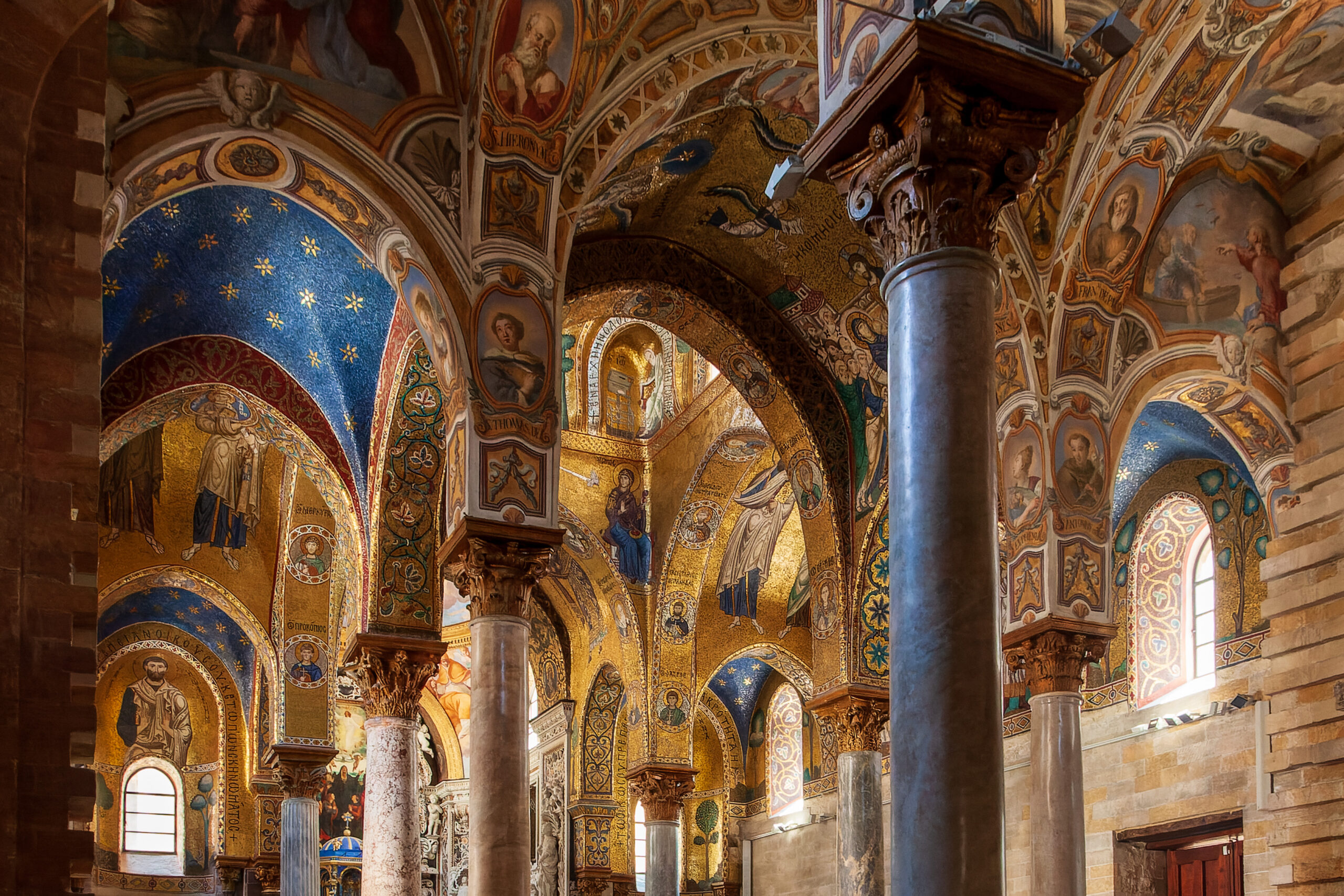
The Baroque crossing of the Quattro Canti, the Pretoria Fountain the Palermitans called the Fountain of Shame, and on Piazza Bellini the two churches that, ten metres apart, explain the whole city: the Martorana, gold and Greek mosaics with an Arabic inscription under the dome, and San Cataldo, a cube of bare stone with three red domes and absolutely nothing inside.
Panelle of chickpea flour, brought by the Arabs a thousand years ago; crocchè; the arancina — in Palermo feminine and round; sfincione from the cart; and pane c’à meusa, a roll filled with spleen boiled in lard, schietto with lemon or maritato with ricotta. A meal costs €5-10. Granita with a brioche is the normal breakfast, and cannoli must be filled to order: if they are sitting ready in the display, go elsewhere. With three days it is worth trying sarde a beccafico too, pasta con le sarde with wild fennel, raisins and pine nuts, and boiled octopus bought at a stall.
Day 2 — Monreale and the Capuchins
5 km on foot · 3 stops · 9am to 7pm · bus up the hill
5 – Monreale Cathedral
Time 2 hours · Admission €4-12 depending on the route · Bus 389 from Piazza Indipendenza, 40 minutes

Monreale stands on a hill eight kilometres from the centre and you get there by bus. William II began building the cathedral in 1174, and the reason was political: the archbishop of Palermo had grown too powerful, so the king put up a larger and richer cathedral beside him, with a Benedictine abbey answering directly to the crown. It was built in under ten years, which is why it is so coherent.
Inside there are six thousand four hundred square metres of mosaic on gold ground — the tesserae are reckoned to contain over two tonnes of gold — telling the Old and New Testaments in a readable order: you begin at the top left of the nave with the Creation and go on like the pages of a book. That was exactly the point: a Bible for people who could not read. In the apse is the Christ Pantocrator, some twenty metres tall, with a right hand the size of a man.
Two details to look for. First: in the Creation scene, God is shown resting on the seventh day, seated, which is very rare in the iconography. Second: on the sanctuary wall William II appears twice, once receiving the crown from Christ and once offering the church to the Virgin — the same political statement as at the Martorana, that the king’s power comes from God and not from the pope.
If your legs are up to it, go up onto the terraces: you walk over the roofs among apses inlaid with lava stone, and see the Conca d’Oro all the way to the sea.
6 – The Benedictine cloister
Time 1 hour · Admission €6, separate ticket · Location right beside the cathedral

The cloister is a square forty-seven metres a side with 228 paired colonnettes, some plain, some spiralled, some covered in mosaic inlay. But what makes it extraordinary are the capitals: they are all different, every one, carved with biblical scenes, trades, real and monstrous animals, secular stories. It is a carved encyclopaedia of the twelfth century, and you can spend an hour looking at one capital at a time.
In one corner is a small enclosed courtyard with a fountain on a fluted shaft that looks like a palm trunk: it is the most Arab thing in the whole complex, and it was where the monks washed before entering the refectory.
7 – The Capuchin Catacombs
Time 1 hour · Admission €5 · Getting there bus back towards the centre, then 10 minutes on foot

It should be said in advance: this is a stop that can disturb people, and anyone who does not feel up to it is right to skip it. In the Capuchin Catacombs there are around one thousand two hundred and fifty mummified bodies, dressed in their own clothes, hung on the walls or laid in niches, along corridors divided by category: friars, men, women, professionals, children.
It began by accident: in 1599 the friars, moving their dead into a new crypt, found some of them naturally mummified by the dry tufa. They read it as a sign, and over time burial here became a status symbol: families paid to display their dead well dressed, and came to visit them and change their clothes. The practice stopped in 1880. The last person buried is Rosalia Lombardo, who died of pneumonia at the age of two in 1920, embalmed by a chemical method the doctor took to his grave and which was only reconstructed a century later: she looks asleep, which is why they call her the Sleeping Beauty.
It is not a macabre curiosity for its own sake: it is an extraordinary record of how a city looked death in the face for three centuries, with fashion and social hierarchy carrying on afterwards.
In their place, in the same area, there is the Zisa: a pleasure palace of the Norman kings from 1165, whose name comes from the Arabic al-Aziz, “the splendid”. It was built by Muslim craftsmen with a system of passive cooling — air currents, indoor fountains, water basins — that made the Palermo summer liveable with nothing but architecture. Inside is a museum of Islamic art. Or the botanical garden, one of the most important in Europe, with the giant fig that is the largest tree in Italy.
Day 3 — The stuccoes, the theatre, the sea
7 km · 3 stops · 9.30am to 9pm · on foot and by bus
8 – The Serpotta oratories
Time 2 hours · Admission €3-6 each, or a combined ticket · They shut at one
This is the stop almost no visitor makes and the one Palermitans mention first. Giacomo Serpotta (1656-1732) is one of the great sculptors of the European Baroque and worked almost only in Palermo, almost only in stucco: a poor material, plaster and marble dust, which he treated as though it were marble and could bring to a porcelain shine with a technique of his own, the allustratura.
There are three oratories to see, all close together: Santa Cita, with its great wall of the battle of Lepanto and dozens of stucco children climbing everywhere; San Lorenzo, where Caravaggio’s Nativity was stolen in 1969 — a photographic reproduction hangs in its place today, and the canvas is one of Italy’s great unsolved mysteries; and San Domenico. Serpotta’s figures do not stand still in their niches: they lean out, turn, chat among themselves, and the children — his famous puttini — play with the saints’ attributes. In one niche he portrayed himself, with a lizard beside him, which in Sicilian is scupitta: his signature.
Not far away is the Vucciria, four stalls and a lot of peeling walls by day, and by night the place where people drink standing up and grill meat in the open.
9 – The Teatro Massimo
Time 1 hour · Guided tour €12-15, half an hour

The largest opera house in Italy, opened in 1897 when Palermo was extremely rich on citrus and sulphur, and then shut for twenty-three years, from 1974 to 1997: the second story says as much about this city as the first. The tour takes in the auditorium with its ceiling of movable petals and the Pompeian Room, built so that whoever speaks at its centre hears only their own voice amplified. If you are here in season, a seat up in the gods costs little more than the tour.
10 – Mondello
Time afternoon and evening · Free on the public beach · Bus 806 from the centre, 30-40 minutes

Mondello is Palermo’s beach: a bay of white sand between the two headlands of Monte Pellegrino and Capo Gallo, with shallow turquoise water. Until the end of the nineteenth century it was a malarial marsh; it was drained and turned into a seaside resort in the early twentieth century by a Belgian company, which built the Liberty-style villas and the Charleston pavilion on its piles, the building that symbolises the bay.
In summer it is very crowded and largely taken up by beach clubs; in the shoulder seasons it is perfect, and in the evening people go simply to eat fish and walk along the front. Anyone who prefers a view to sand can climb to the sanctuary of Saint Rosalia on Monte Pellegrino: it is the cave where in 1624 the bones attributed to the city’s patron were found, a discovery that tradition credits with ending the plague. From up there you see the whole Conca d’Oro.
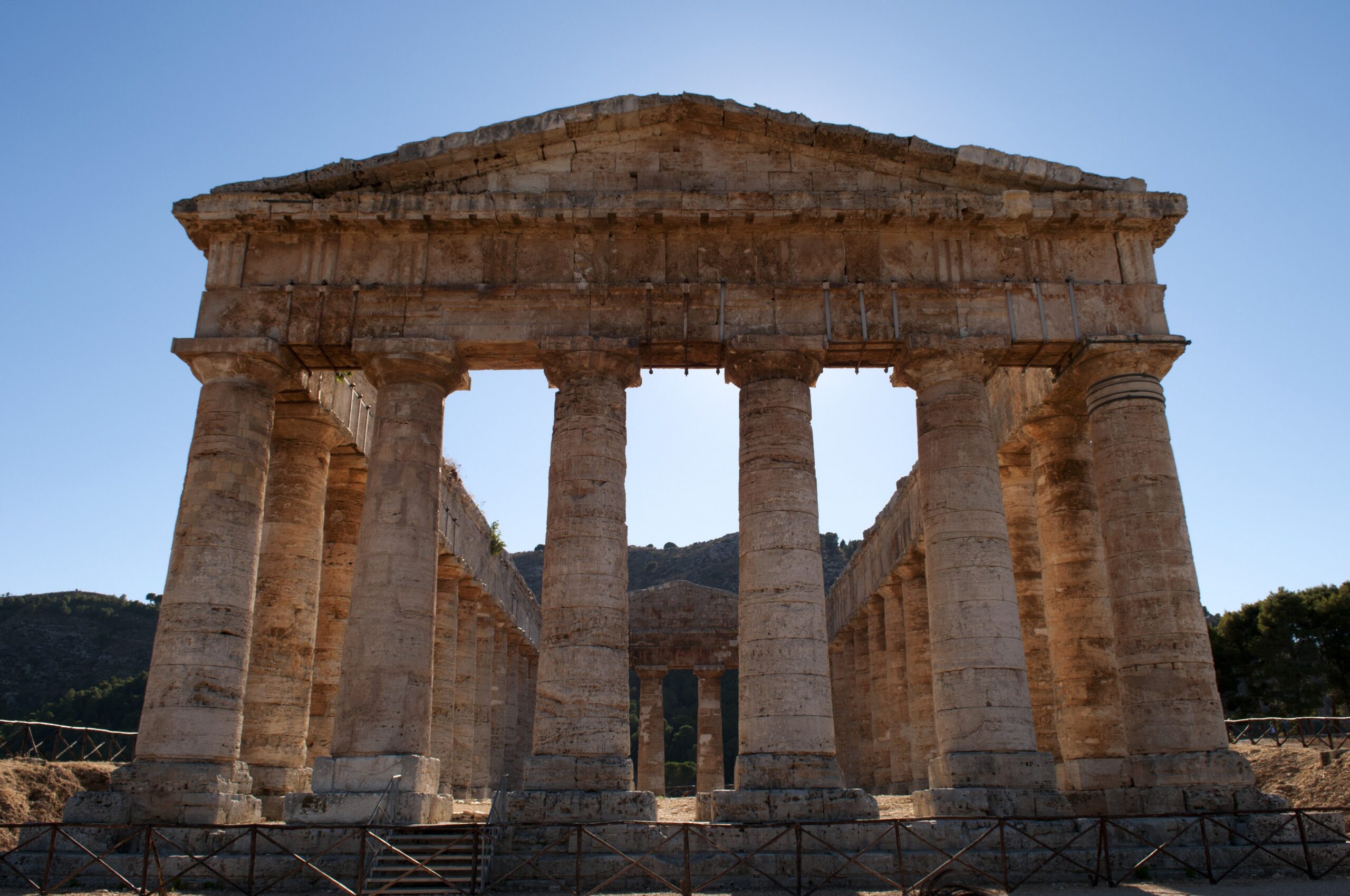
With a fourth day the two natural trips run in opposite directions. Cefalù is an hour east by train: a fishing town under an enormous crag, with a Norman cathedral of 1131 whose apse holds a Christ Pantocrator many consider finer than the one at Monreale, and a beach inside the town. Segesta is an hour and a half west: a fifth-century BC Doric temple alone on a hill, never finished — it has no roof and the columns were never fluted — and a Greek theatre facing the mountains. They are two different days: the first is sea and mosaics, the second archaeology and silence.

It rarely rains in Palermo, but the city closes early: a great many churches and all the oratories shut between 1 and 1.30pm and do not reopen, and on Sunday afternoons almost everything is closed. One rule saves your days: churches and oratories in the morning, markets, walking, theatre and sea in the afternoon. If it does rain, plan B is in the museums: the Salinas with the metopes of Selinunte, and Palazzo Abatellis with the Triumph of Death and Antonello da Messina’s Annunciata, one of the finest portraits of the Italian fifteenth century.
What three days cost
| Item | Cost |
|---|---|
| Norman Palace and Palatine Chapel | €15-19 |
| Cathedral: tombs, treasury, roofs | €12-15 |
| Martorana, San Cataldo, Pretoria Fountain | €6.50 |
| Monreale cathedral and terraces | €4-12 |
| Benedictine cloister | €6 |
| Capuchin Catacombs | €5 |
| Serpotta oratories (three) | €10-15 |
| Teatro Massimo, guided tour | €12-15 |
| Buses to Monreale and Mondello | about €8 |
| Meals, 3 days | €60-90 |
| Total | about €139-192 per person |
Reference figures for September 2026. Palermo remains one of the cheapest art cities in Italy: what weighs is the tickets, not the food, because eating the way the Palermitans do — in the street and at the market — keeps you under €15 a day. Ask at the first ticket office whether a combined ticket is running for the Arab-Norman circuit or for the oratories: they change often and save a good deal.
Frequently asked questions
Are three days in Palermo enough?
For the city yes, and comfortably: you see the Arab-Norman axis, Monreale, the markets, the Serpotta oratories and the sea without rushing. A fourth day adds an excursion: Cefalù, an hour by train, or Segesta, an hour and a half by bus.
Is Monreale worth the trip?
Yes, and it is the main reason to stay more than a day. It holds six thousand four hundred square metres of mosaic, the largest cycle in Europe after Hagia Sophia, built in under ten years from 1174 and therefore perfectly coherent. The cloister, with its 228 capitals all different, has a separate ticket and is worth as much as the church. Bus 389 from Piazza Indipendenza gets you there in about forty minutes.
Are the Capuchin Catacombs suitable for everyone?
No, and it is worth knowing in advance: there are around 1,250 mummified bodies, dressed and standing along the corridors. Anyone squeamish or travelling with small children should make a considered choice. It is not a macabre attraction staged for visitors: it is a real cemetery, in use from 1599 to 1880, and it records how a city looked at death for three centuries. In its place you can visit the Zisa.
Who was Giacomo Serpotta?
One of the great sculptors of the European Baroque, who worked almost only in Palermo and almost only in stucco — plaster and marble dust — bringing it to a porcelain sheen with a technique of his own. His oratories (Santa Cita, San Lorenzo, San Domenico) are the thing Palermitans mention first and visitors almost always skip. In San Lorenzo, in 1969, Caravaggio’s Nativity was stolen and never recovered.
What are the opening hours of churches and museums?
The critical point in Palermo. A great many churches and all the oratories close between 1 and 1.30pm and do not reopen in the afternoon; on Sunday afternoons almost everything is shut. Build your days with indoor visits in the morning and markets, walking and the sea in the afternoon. Hours change often: check them the day before.
How do you get to Mondello and when is best?
By bus 806 from the centre, 30-40 minutes. In summer it is very crowded and largely occupied by beach clubs; in the shoulder seasons it is perfect and nearly empty. Even out of season it is a good evening out, for fish and a walk along the front among the Liberty villas.
When is the best time to come to Palermo?
April-May and September-October. July and August go above 35 degrees and many businesses close around 15 August. On 14-15 July there is the Fistinu of Saint Rosalia, with the triumphal float along the Cassaro and fireworks over the sea: the most Palermitan thing of the year, but the city is full. Winter is mild, around 15 degrees.
Do you need a car?
No, and it is counterproductive: the historic centre has restricted traffic zones, very narrow streets and awkward parking. Everything in this itinerary is reached on foot or by bus. A car is only useful if you plan to tour Sicily: in that case pick it up on the last day, not the first.
Where is best to stay?
In the historic centre between the Quattro Canti and the Teatro Massimo you are walking distance from everything; the via Roma and via Maqueda area is convenient and well served. The quarters around the markets are very lively but noisy until late. Mondello is lovely but adds half an hour by bus to every journey: worth it only if you are coming in summer for the sea.
Do you eat well everywhere?
The centre has tourist traps too, with menus translated into five languages. The rule: eat where the Palermitans eat, which means the markets at midday and the historic fry shops. The best things cost very little, and a full street-food lunch runs €5-10.
September 3, 2026


