

Palermo in 1 day: the Palatine Chapel, the Cassaro and eating standing up
Palermo is the European city where you can see, in the same building, an Arab arch, a Norman column and a Byzantine mosaic, with none of the three having had to give way to the others. Founded by the Phoenicians, then Roman, then Arab for two centuries, then taken by the Normans in 1072 — who instead of erasing what they found built on top of it, keeping the Arab architects, the Greek mosaicists and the Latin masons. The result has a name, Arab-Norman, exists nowhere else, and has been a UNESCO World Heritage Site since 2015. In one day you walk the axis that crosses the old city, step into the most beautiful room in Sicily and eat standing up in a market that shouts in a language that is not Italian.
At a glance
- How long · a full day, 9am to 10pm
- How much walking · about 6 km, all of it flat
- What has to be booked · the Palatine Chapel, which has timed entry and closes when the Sicilian Assembly is sitting
- Budget · €45-70 per person excluding accommodation
- Starting point · the Norman Palace, at the top of the Cassaro
- Finishing point · the Vucciria or Piazza Bellini, in the evening
- Worth knowing · many churches shut at one o’clock and do not reopen. The morning counts double
- What is left out · Monreale, the Capuchin Catacombs and the sea at Mondello: those are the second and third day
The first five stops sit on a single line, the Cassaro: the street the Romans named that way and the Arabs called al-qasr, the castle.
Morning — The Cassaro and the market
2 km · 3 stops · 9am to 1.30pm · all on foot
1 – The Norman Palace and the Palatine Chapel
Time 2 hours · Admission €15-19 depending on the day · Note: when the Sicilian Assembly is sitting the Royal Apartments close, the Chapel does not

The Norman Palace is the oldest seat of government in Europe still in use: it began as an Arab fortress in the ninth century on Punic foundations, was turned into a royal palace by the Normans, and today houses the Sicilian Regional Assembly. Nine centuries of power in the same building.

Inside is the Palatine Chapel, consecrated in 1140 by Roger II, and it is the reason people come to Palermo. Look up and you see a muqarnas ceiling, the stalactite cells of Islamic architecture, painted by Muslim artists with court scenes, dancers, drinkers and animals — inside a Christian chapel. Look at the walls and you see Byzantine mosaics on gold ground signed by Greek masters. The plan is a Latin basilica. Three civilisations in the same room, each doing what it did best, at the wish of a Norman king who called himself basileus in the Greek manner and kept Arab poets at court.
The inscriptions are in three alphabets — Latin, Greek and Arabic — and that is not a curiosity: it was the language of the administration. Norman Sicily issued trilingual documents, and for a century it was the most learned place in the Mediterranean.
Entry is by timed slot and high season sells out: buy online. On Tuesday, Wednesday and Thursday the Assembly is often sitting and the Royal Apartments stay shut, with a reduced ticket, but the Chapel remains open. Shoulders must be covered.
2 – The Cathedral
Time 1 hour · Church free, royal tombs and treasury €7-12, roofs €5-10 · Walk 5 minutes

The Cathedral is the history of Palermo summed up in a single building, and it is also the most disorderly: a Byzantine basilica, then the main mosque under the Arabs, then a Norman cathedral from 1185, then reworked for six centuries down to the neoclassical dome of the late eighteenth century, which sits on it like the wrong hat.
The thing to look for is in plain sight and nobody notices it: on the left-hand column of the porch, reused from the mosque, a sura of the Koran is carved in Arabic script. It has been there since the twelfth century, in the porch of a Catholic cathedral, and no one has ever removed it.
Inside are the imperial tombs: Roger II, Constance of Hauteville, Henry VI and above all Frederick II, the stupor mundi, in a sarcophagus of red porphyry — porphyry was the marble of the Roman emperors, and using it was a political statement. There is also a meridian line of 1801 set into the floor: at midday a ray of sun comes through a hole in the dome and strikes the zodiac sign of the month.
For some years now you can go up onto the roofs and walk among the pinnacles: from up there the layout of the old city makes more sense than on any map.
3 – Ballarò market
Time 1 hour 30 · Free · Open in the morning, it packs up after 2pm · Walk 10 minutes

Ballarò is the oldest of Palermo’s historic markets — the name may come from Bahlara, a village near Monreale the Arab traders came from — and it is the only one of the three that is still a real market, where people from the neighbourhood do their shopping. The other two are the Capo, tidier, and the Vucciria, nearly dead by day and something else entirely at night.
The thing to understand is the abbanniata: the sellers do not speak, they sing the price in a long drawn-out chant, repeated endlessly, in broad dialect. It is an oral form with its own rules, far closer to a North African souk than to an Italian market, and anyone walking through it understands in thirty seconds why Palermo does not resemble the rest of the country.
In Palermo you eat standing up, and it is not a fallback. What to try at Ballarò, in rising order of courage: panelle, chickpea-flour fritters in a roll, brought here by the Arabs a thousand years ago; potato crocchè; the arancina — in Palermo it is feminine and round, in Catania masculine and pointed, and the argument will never end; sfincione, a thick focaccia with onion, anchovy and caciocavallo, bought from a cart; and pane c’à meusa, a roll filled with veal spleen boiled in lard, schietto with lemon or maritato with ricotta. A meal like that costs €5-10. To finish: granita with a brioche col tuppo, which counts as breakfast here; and cassata or cannoli, which must be filled to order — if they hand you one ready-made from the display, go somewhere else.
Afternoon — The centre and the Byzantine churches
2 km · 2 stops · 3pm to 6.30pm · everything within three hundred metres
4 – The Quattro Canti and the Pretoria Fountain
Time 1 hour · Fountain €2 · Walk 10 minutes

The Quattro Canti is the crossing of the two streets that cut the old city into four quarters, dressed up in 1620 with four identical concave facades. Each facade has three registers: a fountain for one season at the bottom, a Spanish king in the middle, and at the top the patron saint of that quarter. The effect is that you find yourself at the centre of an octagonal square that is in fact only a crossroads: it is pure Spanish Baroque, which is to say stage design.

Fifty metres away is the Pretoria Fountain, which has a comic history: it was carved in Florence in 1554 for the garden of a Tuscan villa, then the owner ran into debt and the Palermo senate bought it, had it taken apart into 644 pieces and reassembled here, demolishing houses to make room. The Palermitans, who found themselves with a square full of naked deities in front of an enclosed convent, renamed it the Fountain of Shame, and the name stuck.
5 – La Martorana and San Cataldo
Time 1 hour · Martorana €2, San Cataldo €2.50 · They close early, check the times · Walk 2 minutes
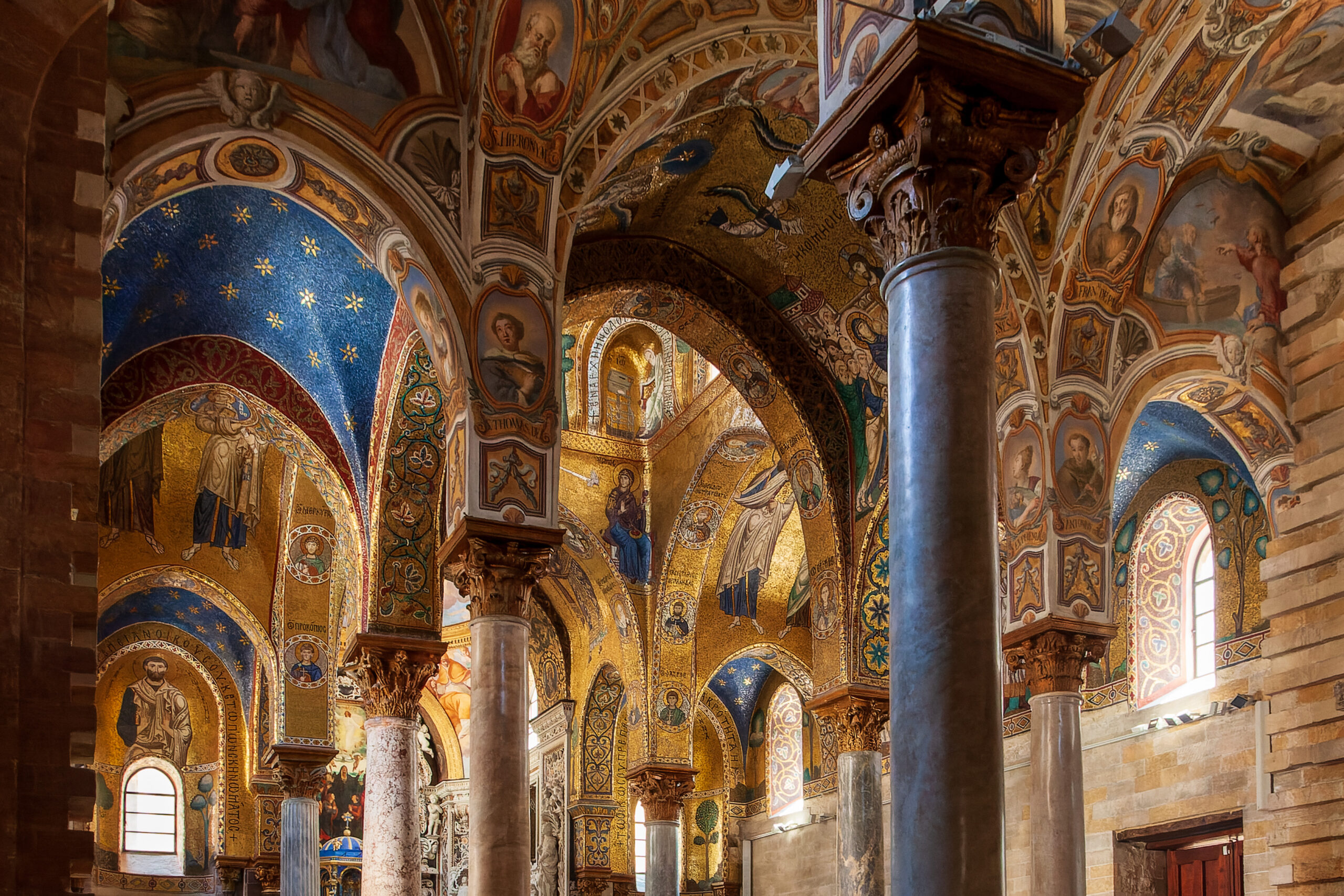
On the same square, ten metres apart, stand two twelfth-century churches that explain Palermo better than any museum.
La Martorana — its real name is Santa Maria dell’Ammiraglio — was founded in 1143 by George of Antioch, a Greek-rite Christian born in Syria, who spoke Arabic and was ammiratus ammiratorum, that is prime minister, to King Roger. The mosaics are Greek and extraordinary; round the base of the dome runs an inscription in Arabic carrying a Christian hymn. Inside is the only contemporary portrait of Roger II, crowned directly by Christ — a political statement: the king does not take his crown from the pope. Mass is still celebrated here in the Greek-Byzantine rite, for the Italo-Albanian community of Sicily.
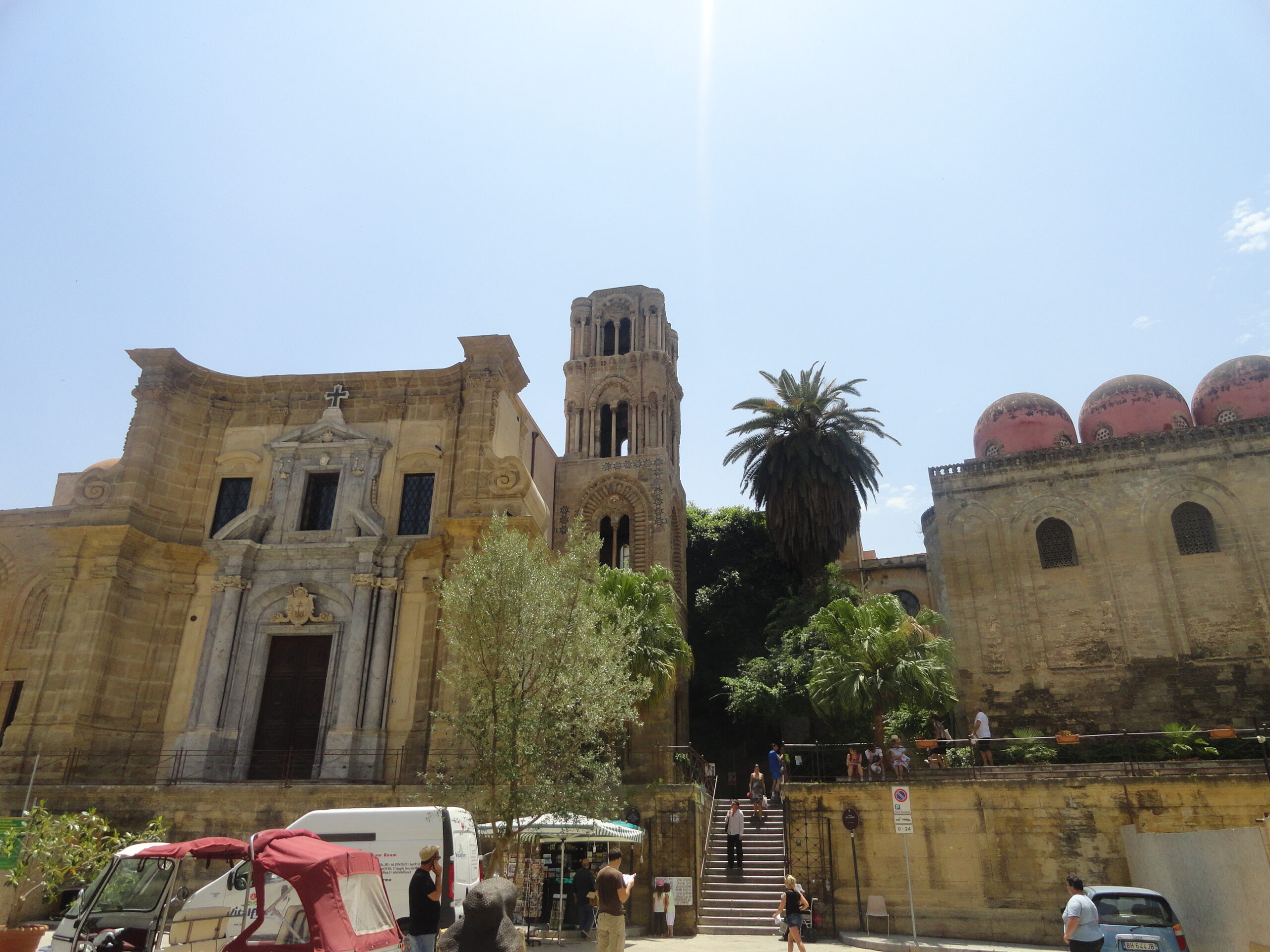
Next door, San Cataldo is the opposite: a cube of bare stone with three red hemispherical domes, not a mosaic, not a fresco. It looks like a small mosque and in its form it effectively is one. Inside there is nothing: only the original floor and the light coming through the small windows. After the gold of the Palatine Chapel and the Martorana, the effect is very strong.
Evening — The theatre and the Vucciria
2 km · 2 stops · from 7pm onwards
6 – The Teatro Massimo
Time 1 hour · Guided tour €12-15, half an hour, in several languages · Walk 15 minutes

The Teatro Massimo is the largest opera house in Italy and the third largest in Europe: it opened in 1897 after twenty-two years of building work, in neoclassical style, when Palermo was extremely rich on citrus and sulphur. Then it has a second, less glorious history: it stayed shut for twenty-three years, from 1974 to 1997, for a restoration that became the symbol of this city’s waste and neglect.
The guided tour lasts half an hour and earns its ticket on two counts: the main auditorium with its ceiling of movable petals, which open for ventilation, and the elliptical Pompeian Room, built so that whoever speaks at its centre hears their own voice amplified and nobody else does. The final scene of The Godfather Part III was filmed on the outside steps, something the guides always mention and not everyone in Palermo enjoys.
7 – The Vucciria, at night
Time as long as you like · Free · Walk 15 minutes
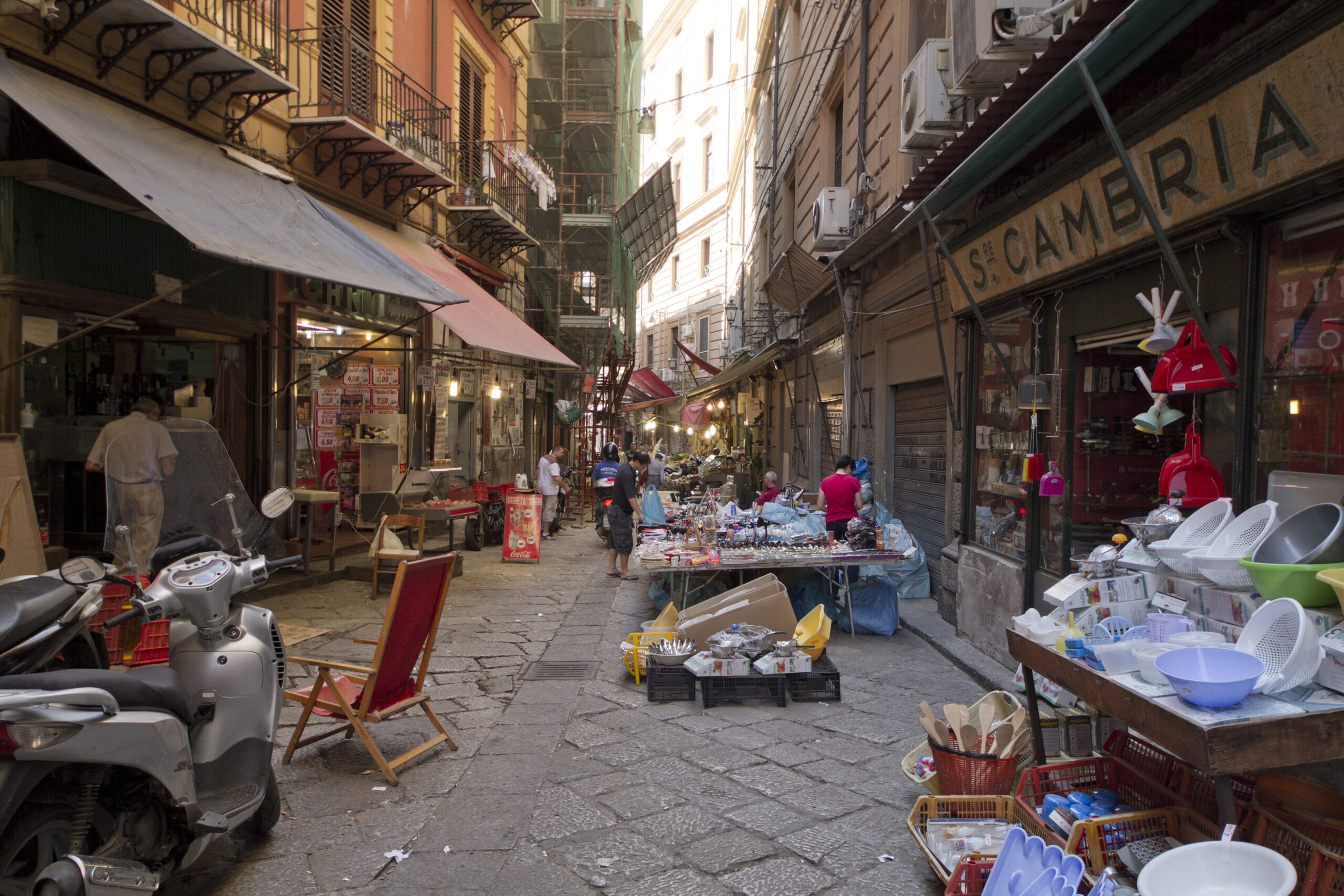
The Vucciria — from the French boucherie, butcher’s shop — was the market Renato Guttuso painted in 1974 in the most famous Sicilian picture of the twentieth century: loaded stalls, colour, crowds. That market is gone: by day four stalls remain and a lot of peeling walls. But from nine in the evening the square fills with people drinking standing up, meat and octopus grilling over charcoal in the open, and it goes on late. It is rough and not for everybody, and it is one of the most alive things in the city.
Anyone who prefers something quieter can stop in Piazza Bellini, sitting on the steps in front of the lit red domes, or in the pedestrian stretch of via Maqueda.
It rarely rains in Palermo, but there is a plan B and it is all on the same street: the oratory of Santa Cita and that of San Lorenzo, with the stuccoes of Giacomo Serpotta — an artist who worked only in Palermo, whom nobody outside Sicily has heard of and who is worth an afternoon on his own — and the Salinas Archaeological Museum with the metopes of Selinunte. The real problem, though, is not the rain: it is the opening hours. Many churches and oratories close between 1 and 1.30pm and do not reopen, and on Sunday afternoons almost everything is shut. Build the day with the churches in the morning and the markets and the walking in the afternoon, not the other way round.
What the day costs
| Item | Cost |
|---|---|
| Norman Palace and Palatine Chapel | €15-19 |
| Cathedral: royal tombs, treasury, roofs | €12-15 |
| Martorana and San Cataldo | €4.50 |
| Pretoria Fountain | €2 |
| Teatro Massimo, guided tour | €12-15 |
| Street-food lunch at Ballarò | €5-10 |
| Dinner and a granita | €15-25 |
| Total | about €66-90 per person |
Reference figures for September 2026: check them before you travel. Palermo is one of the cheapest art cities in Italy, and the way to bring the bill down further is to eat the way the Palermitans do, in the street. The Passepartout pass for the Arab-Norman circuit, when it is running, bundles several sites at a reduced price: ask at the first ticket office. The centre is done entirely on foot and you will not need transport.
Frequently asked questions
Is one day in Palermo enough?
Enough for the spine of the old city: the Norman Palace, the Cathedral, the two churches on Piazza Bellini, one market and the Teatro Massimo. Important things are left out: Monreale, eight kilometres away, with the largest mosaic cycle in Europe; the Capuchin Catacombs; the Serpotta oratories; and the sea at Mondello.
Do you have to book the Palatine Chapel?
Yes: entry is by timed slot and in high season the morning slots go days in advance. Watch the day too: when the Sicilian Assembly is sitting — often Tuesday, Wednesday and Thursday — the Royal Apartments close and the ticket costs less, but the Chapel stays open. Shoulders and knees must be covered.
What is the Arab-Norman style?
It is what happens when the Normans conquer, in 1072, an island that has been Arab for two centuries and, instead of erasing what they find, keep Muslim architects, Greek mosaicists and Latin masons at work on the same site. The result is buildings with a Latin plan, Byzantine mosaics and Islamic muqarnas ceilings. It exists nowhere else: since 2015 it has been a UNESCO World Heritage Site, with nine monuments across Palermo, Monreale and Cefalù.
Is the historic centre safe?
Yes, like any large city: you walk around freely, including in the evening in the lively areas. The usual care against pickpockets applies in crowded markets and on public transport. Some alleys are badly lit and peeling: they look worse than they are, but if you prefer, stay on the main streets.
Arancina or arancino?
In Palermo it is arancina, feminine, and round like the orange it is named after; in Catania it is arancino, masculine, and pointed, like Etna. The Accademia della Crusca has ruled that both are correct, which settled nothing. The classic filling is ragù; the other is butter with ham and béchamel.
When is the best time to come?
April-May and September-October: good temperatures and a liveable city. July and August are very hot (35 degrees and above) and many businesses close around 15 August. On 14 and 15 July there is the Fistinu, the feast of Saint Rosalia, the most Palermitan thing of the year: the triumphal float along the Cassaro, the whole city in the streets all night and fireworks over the sea. Winter is mild, around 15 degrees.
How do you get in from the airport?
Punta Raisi airport is 35 km out. The best way is the train, which leaves from under the terminal and reaches the central station in about an hour for a few euros; otherwise the Prestia e Comandè coach, or a taxi at a fixed fare. The airport is named after Falcone and Borsellino, and the motorway into town passes the monument marking the site of the Capaci bombing.
Is the Teatro Massimo worth it without a performance?
Yes: the guided tour lasts half an hour, runs in several languages and takes in the main auditorium with its ceiling of movable petals and the Pompeian Room with its acoustics. If you are here in season, though, a seat up in the gods costs little more than the tour and is another thing entirely.
Do you eat well everywhere?
The historic centre has plenty of tourist traps too. The rule that works: eat where the Palermitans eat, which means the markets at midday and the historic fry shops, and be wary of set menus translated into five languages. The best things here cost very little: a street-food meal runs €5-10.
Can you get around on foot?
Yes, the historic centre is crossed in half an hour and this day’s stops are almost in a line. For Monreale you need bus 389 from Piazza Indipendenza (about 40 minutes), for Mondello the 806. Palermo traffic is heavy and the rules are treated as suggestions: crossing the road takes decisiveness, and driving into the centre is best avoided.
September 3, 2026


