Munich in 5 days: Wittelsbach palaces, art, and the Alps
Munich in three days shows you everything. The reason to stay five is not the city: it is the Alps behind it. From here, in under two hours by train, you reach the most photographed castle in the world, a foreign city that gave birth to Mozart, and a green lake closed between rock walls where boats have run on electric motors since 1909. Munich is the only regional capital in Europe that also works as an Alpine base camp: you sleep in the city, head out in the morning, and come back to a beer hall in the evening. These five days are the three in the city plus two days out, and the two days out are the reason it is worth extending the trip.
At a glance
- How long · 5 full days, 3 in the city and 2 of day trips
- How much walking · 6-8 km a day in the city, 5-10 on the day trips depending on the option
- What has to be booked · Neuschwanstein, mandatory and weeks ahead: it is the only thing on the whole trip that cannot be improvised
- Budget · €300-450 per person, excluding accommodation
- The ticket that makes the difference · the Bayern-Ticket, a regional day pass valid all the way to Salzburg and Berchtesgaden, for up to 5 people
- Base · you always sleep in Munich: no change of hotel
- Worth knowing · the day 4 and 5 trips are long: 10-12 hours door to door
The first three points are in the city; the others are the day trips, all reachable from Munich by train and bus.
Days 1-3 — The city
In brief: these are the three days told in full in the Munich in three days itinerary, where you will find maps, timings and costs stop by stop.
Day 1 – The Wittelsbach centre

Marienplatz for the 11am carillon, the 306 steps of the Alter Peter tower, the Viktualienmarkt with Weißwürste before noon. In the afternoon the Frauenkirche with the devil’s footprint on the floor, the Residenz with the Antiquarium and the treasury, and Odeonsplatz with the alley behind the Feldherrnhalle where a bronze strip marks those who refused to give the Nazi salute. In the evening the Englischer Garten, the Eisbach surfers and a beer hall. All on foot, no transport ever needed.
Day 2 – The museums, the temples and the Olympics
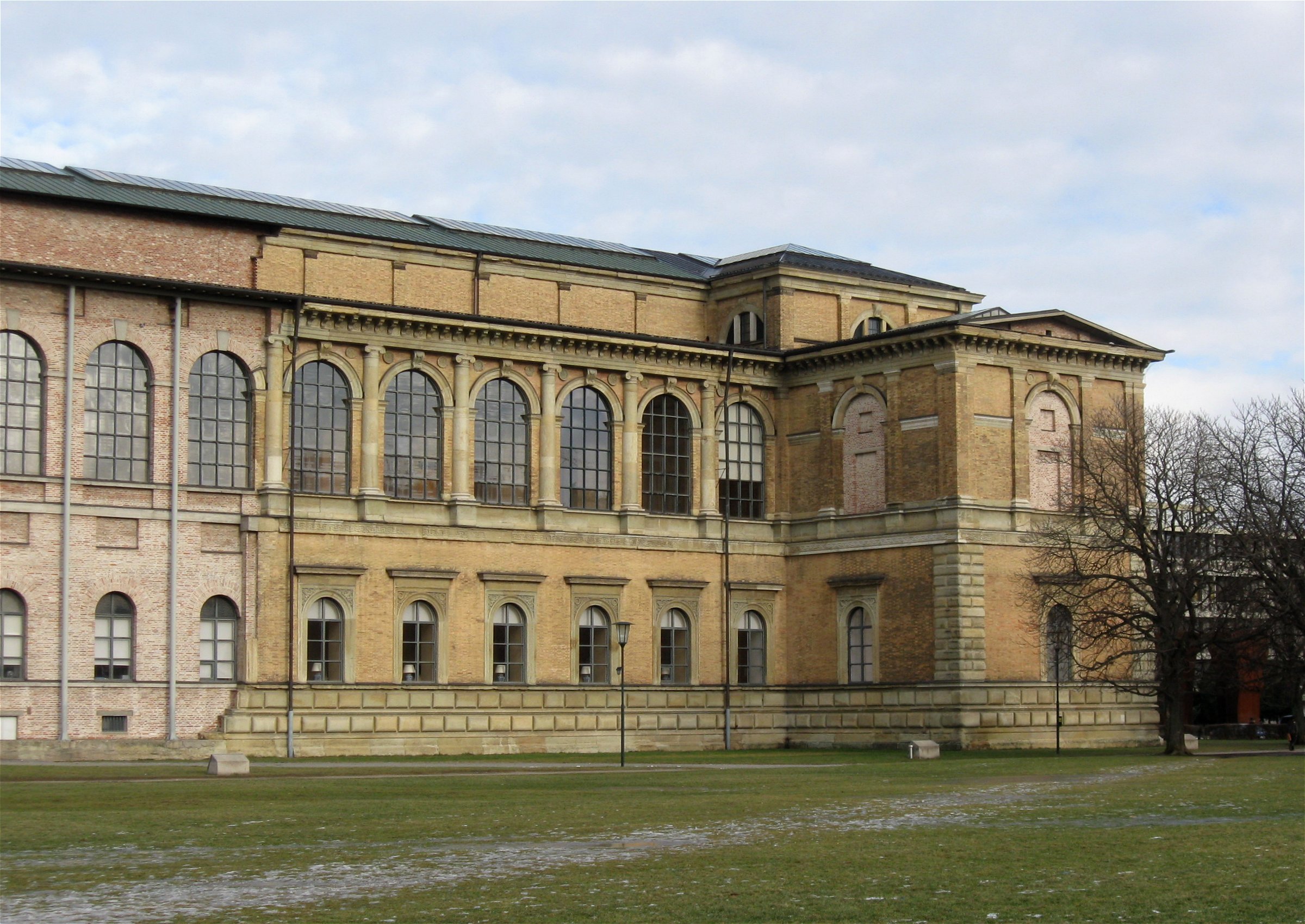
The Kunstareal with the Alte Pinakothek — the world’s largest Rubens collection, Dürer’s 1500 self-portrait — and its façade patched with bare brick after the bombs, left visible on purpose. Then Königsplatz, where Ludwig I’s neoclassical Athens and the headquarters of Nazism occupy the same square, with the plinths of the honour temples blown up in 1947 and the 2015 documentation centre. In the afternoon the Deutsches Museum or BMW Welt, and the Olympiapark of 1972, its hills built from war rubble.
Day 3 – Nymphenburg and Schwabing

The summer palace of Nymphenburg with its gallery of thirty-six beauties ending with Lola Montez, Ludwig II’s battery-lit night sleigh, and the Amalienburg in the park. In the afternoon the Siegestor, restored only half way with the inscription that reverses its meaning, Schwabing, and the university atrium where Hans and Sophie Scholl were arrested on 18 February 1943: in front of the entrance, set into the cobblestones, are the bronze leaflets of the White Rose.
Day 4 — Ludwig II’s castles
10-12 hours door to door · 2 hours by train each way · 6 km on foot, with a 200-metre climb · booking mandatory
Neuschwanstein tickets are sold only online and in advance, with a time slot: in peak months they sell out weeks ahead. You climb to the castle at the time printed on your ticket, and the visit is guided, lasts about half an hour, and cannot be slowed down or repeated. If you arrive without a ticket, you very likely will not get in: you can still walk up to the castle, walk around it, and go to the viewing bridge, which is free and gives you the view you have in mind. Allow at least an hour between the bus stop and the entrance.
4 – Hohenschwangau, the childhood castle
Time 1.5 hours · Ticket about €21, combined with Neuschwanstein about €32 · How to get there Munich-Füssen train 2 hours, then bus 73 or 78 for 10 minutes

Almost everyone skips Hohenschwangau and heads straight up to the other castle. That is a mistake, because without this one the other makes no sense.
Hohenschwangau is the yellow castle on the lower hill, rebuilt in neo-Gothic style in the 1830s by Maximilian II, the father. Ludwig grew up here, in rooms frescoed with the legends of the swan knights — the swan was already the area’s emblem. As a boy he would look from his window at the hill opposite, where the ruins of two medieval castles stood. Forty years later he would build his own on top of them.
In the great hall stands the piano Richard Wagner played for the king: the relationship between the two — Ludwig was eighteen when he took the throne, and the first thing he did was send for Wagner, who was drowning in debt and fleeing his creditors — is the key to everything you see for the rest of the day.
5 – Neuschwanstein
Time 3 hours with the bridge and the climb · Ticket about €21, must be booked · Climb 40 minutes on foot, or a paid shuttle or horse-drawn carriage

This has to be said before you climb: Neuschwanstein is not a medieval castle. It is a nineteenth-century building put up by a man who wanted to live inside a Wagner opera. Work began in 1869 and was never finished: of the more than two hundred planned rooms, only about fifteen were completed. The Throne Room is sumptuous and has no throne: there was not time to build it.
Inside it is pure theatre. Every room illustrates an opera: Tannhäuser in the study, Lohengrin in the living room with swans everywhere, Parsifal in the singers’ hall, the largest room in the castle and a concert hall in which no concert was ever held. There is even an artificial grotto with stucco stalactites, carved between two rooms, because Tannhäuser has a grotto.
What surprises people, and what the photos do not tell you, is how technologically advanced it was: central hot-air heating, running water on every floor, toilets with automatic flushing, electric bells for the servants, and a telephone line. A fake medieval castle with the most modern technology of its time, exactly the kind of contradiction Ludwig II lived inside.
He lived there for almost no time at all: about 170 days in total. He paid for the castle with his own funds rather than the state’s, but by ruining himself with debt, and it was those debts that provided the pretext. In June 1886 a commission declared him unfit to rule without ever having visited him, and deposed him. Three days later he was found dead in the shallow waters of Lake Starnberg, together with his psychiatrist: the circumstances have never been clarified, and in Bavaria it is still a live topic today. Six weeks after his death, the castle, conceived as the private refuge of a man fleeing the world, was opened to paying visitors. Today it receives about a million and a half a year.
The postcard view is taken from the Marienbrücke, the iron bridge thrown across the gorge behind the castle: twenty extra minutes of climbing, free, and it is the shot everyone knows — also because it is the one that inspired Walt Disney’s Sleeping Beauty castle. Check before you go whether it is open: it often closes in winter and for maintenance.
The village at the foot of the two castles is made up entirely of restaurants for visitors: the food is decent and you pay double (€16-25 a plate). If you have time, go back to Füssen, a real small town with a colourful old centre and normal prices. Alternatively, bring your own lunch: around the Alpsee, the lake below Hohenschwangau, there are lawns and benches, the full loop takes an hour, and it is the most beautiful, emptiest part of the whole day.
Day 4 alternatives
If Neuschwanstein is sold out, or the idea of a million and a half visitors a year does not appeal, there are two good alternatives in the same direction.
Linderhof is the only one of Ludwig II’s three castles that was actually finished, and the smallest: a rococo villa in an isolated valley, with the Grotto of Venus in the park, an artificial cave with an underground lake, a shell-shaped boat and a coloured electric lighting system powered by one of Bavaria’s first power stations, built specifically for it. Ludwig used to be rowed around alone in the dark, with the lights changing colour. It pairs well with Oberammergau, the village of frescoed houses and the Passion Play held every ten years since 1634.
The Wieskirche, on the road to Füssen, is an isolated rococo church in the middle of a meadow, a UNESCO World Heritage Site: from outside it is an ordinary yellow building, inside it is one of the most astonishing things in Bavaria. Worth the stop if you are driving.
Day 5 — Salzburg or the Königssee
10-12 hours door to door · these are two alternative day trips in the same direction, southeast: choose one
The two options for day five head the same way and rule each other out. The difference is simple: Salzburg is a city, with museums, churches and cafés; the Königssee is a day outdoors, in the mountains and on a boat. If you have already spent three days among palaces and picture galleries, the second is probably the better choice.
6 – Salzburg
Time the whole day · Train 1 hour 40 by regional service, about 2 hours · The Bayern-Ticket is valid all the way to Salzburg, even though it is in Austria · Bring ID

Salzburg is in another country and feels like a district of Munich that came out even better: same architecture, same language, same beer, but wedged between two hills and crossed by a green river. The centre is small and can be seen in an unhurried day.
The city owes everything to salt: Salzburg means «salt castle», and for centuries the prince-archbishops who ruled it — both religious leaders and sovereigns at once — grew rich on the monopoly of salt from nearby mines. With that money they hired Italian architects and built themselves a baroque capital: Residenzplatz, the Cathedral with its four bronze portals, the courtyards and fountains all feel as if they belong in Rome, and that is no accident.
The Getreidegasse is the street for strolling, narrow, with its famous wrought-iron signs: every shop has one, and even McDonald’s had to make itself a wrought-iron one like the rest. At number 9 is Mozart’s birthplace, where he was born in 1756, today a museum — extremely crowded, and honestly the less interesting of the city’s two Mozart museums: the other, the house the family moved to across the river, is richer and much emptier.
The thing not to skip is the Hohensalzburg fortress, which has dominated the city for nine hundred years: one of the largest in Europe, and never taken by force. You go up by a funicular from the centre. From the top you see the baroque city on one side and the Alps on the other, and the geography clicks into place all at once.
There are still the Mirabell gardens, free, with the staircase and flowerbeds where one of the best-known scenes of The Sound of Music was filmed — a film almost nobody mentions in Italy but which drives an entire guided-tour industry here. If the weather is good, the best walk is on the Mönchsberg, the hill above the centre: ten minutes by lift or twenty on foot, walking through woods looking down over the rooftops.
7 – The Königssee and Berchtesgaden
Time the whole day · Train + bus about 2.5 hours · Boat about €22 return to St. Bartholomä · The Bayern-Ticket covers the whole route

The Königssee is a lake eight kilometres long and just over one wide, carved by a glacier and closed between walls rising to two thousand metres. The water is emerald green and considered among the cleanest in Germany, for a precise reason: since 1909 only electric boats have been allowed on it. No combustion engine has ever been permitted, a visionary decision at the time.
The boat crosses the lake in near-total silence. Halfway across it stops beneath a rock wall and the boatman cuts the motor, pulls out a trumpet and plays a few notes toward the cliff: the echo comes back clean, two or three times over. It is a tradition going back more than a century, a little touristy but genuinely lovely, and the player passes the hat afterwards.
You disembark at St. Bartholomä, the small red church with three onion domes on a peninsula, the image the lake is known for: it was the prince-bishops’ hunting chapel. From there a path leads to the Obersee, a second small lake beyond a spit of land, with a 400-metre waterfall at its far end: another twenty minutes by boat plus an easy walk, and the most beautiful, least crowded part of the day.
In the same valley is the other thing, of a completely different kind. Above Berchtesgaden, at 1,834 metres, stands the Kehlsteinhaus — the «Eagle’s Nest» — built in thirteen months as a gift for Hitler’s fiftieth birthday: you reach it by bus on a road cut into the rock, then by a polished brass lift inside the mountain, rising 124 metres straight up. Today it is a restaurant with an immense view, and it is a place that unsettles precisely because of that. Down in the valley, Obersalzberg was the second centre of Nazi power after Berlin: today there is a serious documentation centre, with the bunkers beneath the building open to visitors. The Kehlsteinhaus is open only from mid-May to October, snow permitting.
A day pass valid on all regional trains and local transport in Bavaria, with two features that make it the best value on the whole trip: it covers up to five people for a modest surcharge per extra person, and it is also valid across the border as far as Salzburg. It covers both the Füssen train on day 4 and the whole route to Berchtesgaden and the Königssee on day 5, buses included. On weekdays it becomes valid from 9am, on Saturdays and Sundays from midnight. With two or more people the saving is substantial: check current fares and conditions on the German railways’ website before you travel.
If it rains
The two days out are the ones that suffer. Neuschwanstein in the rain can still be visited — the interior is the interior — but the viewing bridge and the climb lose almost everything: if you have a booking you cannot move it, if you do not, postpone. The Königssee in low mist is actually atmospheric, but not in heavy rain: the walls disappear and you are left on a closed boat. Salzburg is the day trip that copes best with bad weather, because it is a city: fortress, cathedral, museums and cafés are all indoors. Rule of thumb: check the forecast the evening before and swap days 4 and 5 accordingly, keeping Salzburg for the worse day.
What the five days cost
| Item | Cost |
|---|---|
| Museums and monuments of the first three days | about €60-70 |
| Urban transport, 3 day passes | about €30 |
| Neuschwanstein and Hohenschwangau, combined ticket | about €32 |
| Bayern-Ticket for day 4 | about €30 for one person, much less per person in a group |
| Bayern-Ticket for day 5 | about €30 |
| Königssee boat or Salzburg fortress and museums | €22-35 |
| Kehlsteinhaus, bus and lift | about €30, optional |
| Meals, 5 days | €150-250 |
| Total | about €300-450 per person |
Reference figures as of September 2026: check official websites before you travel. The biggest saving is the Bayern-Ticket shared by a group: with four people, the two train days cost about a coffee and a half each. The second is €1 museum Sundays at the Bavarian state museums: if your stay includes a Sunday, put it on day 2.
Frequently asked questions
Is five days too many for Munich?
No, but only if you spend two of them out of the city. The city itself is seen in three days: the fourth and fifth are for Ludwig II’s castles and for Salzburg or the Königssee. The advantage is that you sleep in the same place the whole time: Munich is an Alpine base camp with a metro system.
Do you need to book Neuschwanstein?
Yes, and it is the only mandatory thing on the whole trip. Tickets are sold only online, with a time slot, and in high season they sell out weeks ahead. Without a ticket you can still walk up to the castle and go to the viewing bridge, which is free and gives the most famous view: what you lose is the interior, that is, a half-hour guided tour.
Is it worth going inside Neuschwanstein?
It depends on what you expect. It is not a medieval castle: it is a nineteenth-century Wagnerian theatre set, with only fifteen rooms finished out of two hundred planned and a throne room with no throne. If you are interested in Ludwig II’s story, yes. If you are after the postcard image, you can get that for free from the Marienbrücke and skip the ticket.
How do you get to Neuschwanstein from Munich without a car?
Regional train to Füssen, about two hours, then bus 73 or 78 for ten minutes to Hohenschwangau. From the village to the castle is a 40-minute climb on foot, or a paid shuttle or horse-drawn carriage. With the Bayern-Ticket the whole journey is covered. Leave early: between travel and the visit, the day is full.
Salzburg or the Königssee, which is better?
They go in the same direction and rule each other out. Salzburg if you want another city, museums and cafés, and if the weather is bad: it copes with rain. The Königssee if after three days of palaces you fancy being outdoors: a green lake between rock walls, crossed by electric boat, with walking. In good weather, the second.
What is the Bayern-Ticket?
A day pass valid on all regional trains and local transport in Bavaria, for up to five people with a modest surcharge per extra person. It is also valid as far as Salzburg, in Austria. It covers both the trip to Füssen and the one to Berchtesgaden, buses included. On weekdays it becomes valid from 9am.
Why are the Königssee boats electric?
Because since 1909 no combustion engine has ever been allowed on the lake, to keep the water clean: one of the reasons it is considered among the cleanest in Germany. The silence of the crossing is part of the experience, and halfway across the boat stops under a rock wall while the boatman plays a trumpet to demonstrate the echo.
What happened to Ludwig II?
In June 1886 he was declared unfit to rule by a commission that had never visited him, on the basis of the debts run up building his castles, and deposed. Three days later he was found dead in the shallow waters of Lake Starnberg together with his psychiatrist. The circumstances have never been clarified, and it is still discussed in Bavaria today. Six weeks later, his castles were opened to paying visitors: today they are the region’s main tourist attraction.
Can this all be done without a car?
Yes, entirely. The three city days are done on foot and by metro; the two day trips are done by train and bus with the Bayern-Ticket. A car is only needed for the Linderhof and Oberammergau alternative, which is awkward by public transport, or if you want to stop at the Wieskirche along the way.
When is the best time for this itinerary?
From May to early October: the Kehlsteinhaus is open only in that period, the Königssee boats run more frequently, and the Biergarten are open. Avoid the two weeks of Oktoberfest unless you are going on purpose: hotel prices triple. In winter the city works perfectly well, but the two Alpine day trips lose a lot, and the Neuschwanstein bridge is often closed.
September 5, 2026