Brussels in 1 day: Grand-Place, beer, and Art Nouveau
Brussels has a worse reputation than it deserves: the city of bureaucrats, the one where you can never tell which language is being spoken, the one with the statuette of a boy peeing and not much else. In reality it has one of the finest squares in Europe, it is the city that invented Art Nouveau and the filled chocolate, and it has a beer culture that UNESCO has listed as intangible heritage. The key to enjoying it is to stop looking for the capital of Europe and accept that it is a Flemish and French city at once, scruffy, that does not take itself too seriously: there is a local word, zwanze, for its own brand of self-mockery, and its most famous monument stands sixty-one centimetres tall.
At a glance
- How long · a full day, from 9am to 11pm
- How much walking · about 6 km, with just one climb: up to the Mont des Arts
- What has to be booked · nothing
- Budget · €40-70 per person, excluding accommodation
- Starting point · Grand-Place
- Finishing point · a historic beer hall, five minutes from where you started
- Worth knowing · everything is written in two languages, French and Dutch, streets included: Grand-Place and Grote Markt are the same square
- What is left out · the royal museums with Bruegel and Magritte, Horta’s Art Nouveau, the Atomium: those are day two and three
Seven stops, all on foot: the centre of Brussels fits inside a rectangle a kilometre by seven hundred metres.
Morning — The square, the gallery, the cathedral
1.5 km · 3 stops · 9am to 1pm · all on foot and flat
1 – The Grand-Place
Time 1.5 hours · Free · Town Hall visitable with a guide, about €10 · Metro Gare Centrale or De Brouckère, 5 minutes on foot

You always arrive from an alley, and that is the point: the Grand-Place is not visible from a distance, you step into it all at once, and the effect is deliberate. It is a rectangle a hundred and ten metres by seventy, closed on every side by gilded façades, and many consider it the most beautiful square in Europe. Victor Hugo, who lived here in exile, simply called it «the most beautiful square in the world».
What is worth knowing is that almost everything you see is a little over three hundred years old and was born out of a disaster. In August 1695 the army of Louis XIV, besieging Namur and wanting a diversion, set up its artillery outside the city and bombarded Brussels for thirty-six hours: four thousand houses burned and the centre was levelled. Only the town hall tower stayed standing, gutted but with its skeleton intact — the very thing the French had aimed for.
The rebuilding is why the square looks the way it does. The trade guilds — brewers, bakers, tailors, painters, boatmen — each rebuilt their own house in four years, competing to outdo one another in richness, bound by a rule that designs had to be submitted to the city so the whole would stay harmonious. The result is Flemish baroque, compact and unrestrained at once. Look at the roofs: every house has a sign and a symbol of its trade, and the names can still be read — Le Renard for the haberdashers, Le Cornet for the boatmen, its gable shaped like a ship’s stern, La Brouette for the tallow merchants.
The two large buildings belong to different eras. The Hôtel de Ville, the Gothic town hall, is the only genuinely medieval one, from the fifteenth century, its ninety-six-metre tower topped by a Saint Michael slaying the dragon. Opposite, the Maison du Roi looks Gothic but is a nineteenth-century reconstruction; in Dutch it is called the Broodhuis, the bread house, because a bread market once stood there, and no king ever lived in it. Today it is the city museum.
Two things nobody points out. At number 9, the House of the Swan, once the butchers’ guild hall, held a café in 1848 frequented by Karl Marx, exiled in Brussels: it was here that he and Engels finalised the Communist Manifesto. In the same building, in 1885, the Belgian Workers’ Party was founded. And if you happen to be here in August of an even-numbered year, for three days the square is covered with a carpet of eight hundred thousand begonias laid out in a design: it is best seen from the town hall balcony.
2 – The Galeries Royales Saint-Hubert
Time 45 minutes · Free · Walk 3 minutes
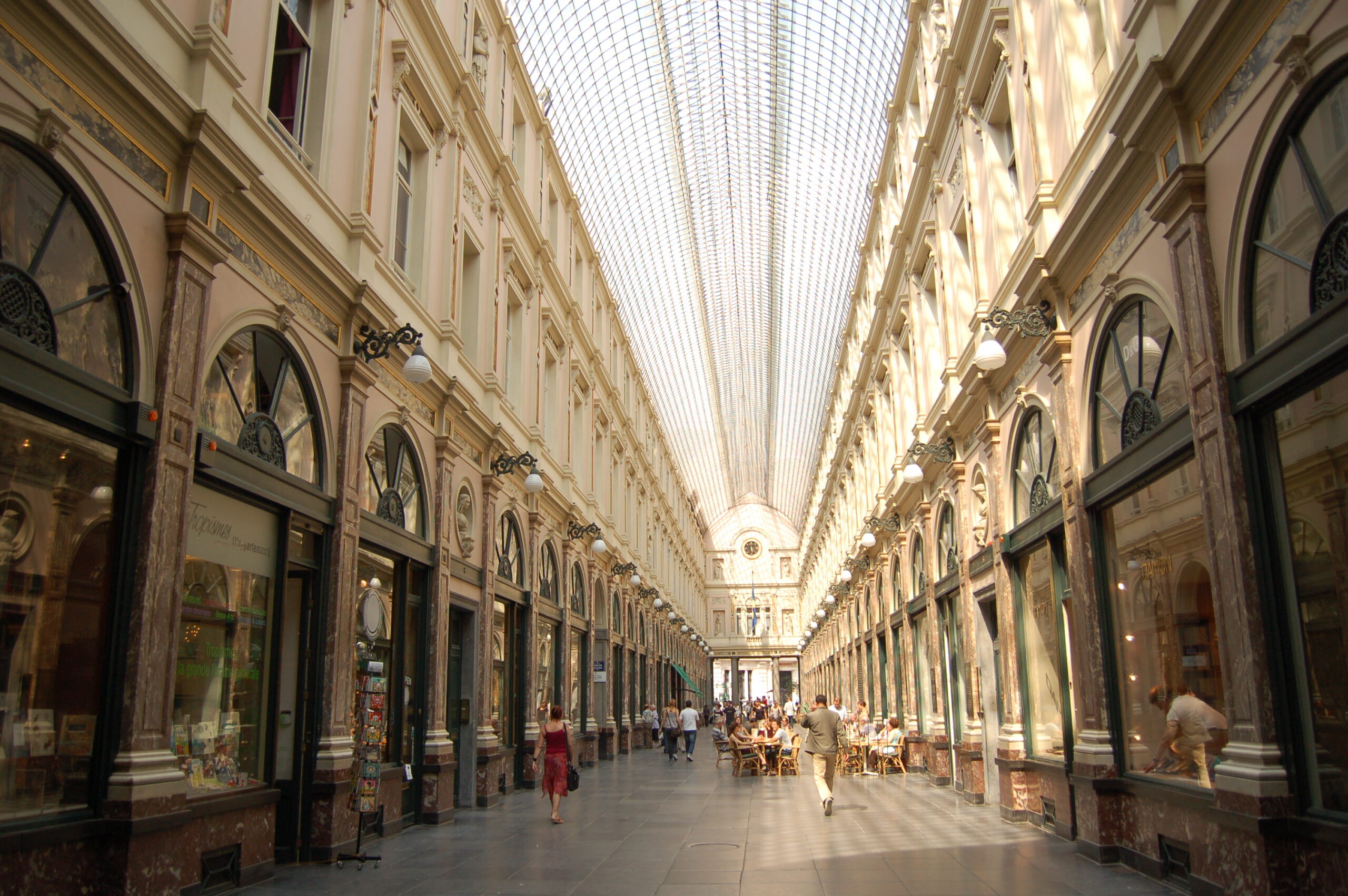
A few steps from the square is a covered gallery two hundred and thirteen metres long under a glass vault, shops along the sides and café tables down the middle. The Galeries Royales Saint-Hubert opened in 1847 under King Leopold I and are among the first covered shopping arcades in Europe: they predate Milan’s Galleria by thirty years, which has since outstripped them in fame but not in age. The idea was to give the middle class a place to stroll and shop sheltered from the rain and the mud, which in Brussels is no small detail.
Something invented here went on to travel the world. In 1857 a Swiss pharmacist, Jean Neuhaus, opened a shop in the gallery selling medicine coated in chocolate to make it easier to swallow. In 1912 his grandson had the idea of throwing away the medicine and keeping the shell, filling it with cream: he had invented the praline, the filled chocolate. The shop is still there, in the same gallery, and it is the right place to buy chocolate without ending up in an airport chain.
3 – The Cathedral of St. Michael and St. Gudula
Time 45 minutes · Free entry, crypt and treasury cost extra · Walk 8 minutes uphill
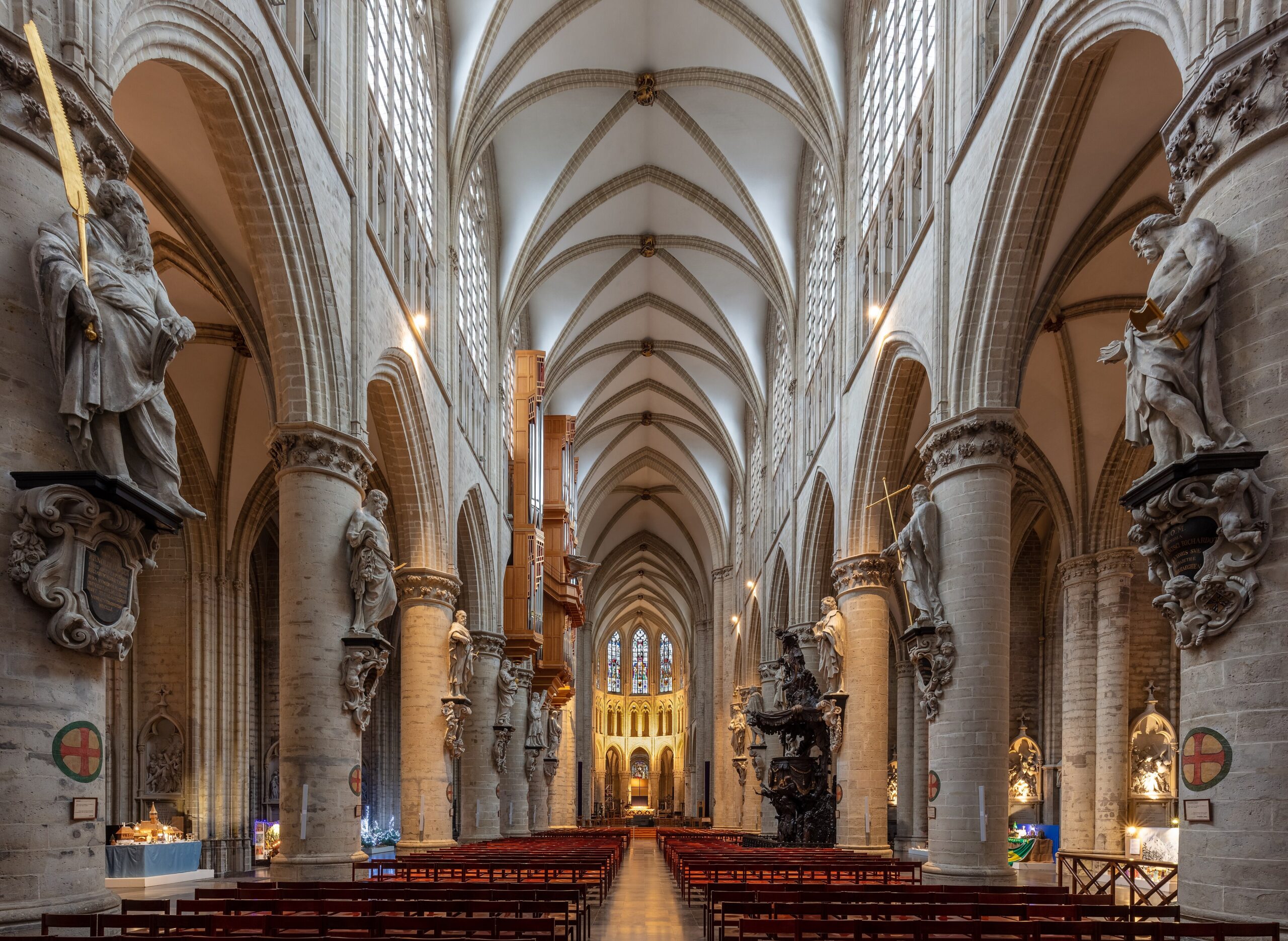
The cathedral sits on a low hill above the lower town, and it is the city’s most underrated monument: almost everyone sees it from outside on the way to the central station and keeps walking. It is Brabantine Gothic, built between the thirteenth and sixteenth centuries, with twin towers never finished quite as planned and a façade plainer than the French style.
Inside, two things are worth the stop. The transept’s sixteenth-century stained glass, with kneeling portraits of the Habsburg rulers — Charles V was born in this city, and his family left its accounts here. And, beneath the floor, the eleventh-century Romanesque crypt, the remains of the earlier church, rediscovered in the 1980s during works and opened to visitors: you go down and walk on a building two hundred years older than the cathedral above it.
It is the church of Belgian royal weddings and state funerals, so it can occasionally be closed for a ceremony: this happens only a few times a year.
In Brussels lunch is eaten standing up with a paper cone of frites, and that is no fallback option. Belgians claim to have invented them, and fry them twice, the second time at a higher temperature, which is why they stay crisp; traditionally in beef fat. You buy them at a fritkot, the street kiosk, officially recognised in Belgium as cultural heritage. A cone costs €4-6, and the real choice is the sauce: andalouse, samouraï, tartare, or plain mayonnaise, which here is the default, not an eccentricity. If you want to sit down, dishes worth trying are mussels with chips (in season September to April, €24-32), carbonnade flamande, beef stew cooked in dark beer with gingerbread (€18-24), and stoemp, mashed potato with vegetables and a sausage.
Midday — The statuette and the museum hill
2 km · 2 stops · 2pm to 5pm · one short climb
4 – The Manneken Pis
Time 15 minutes, and that is plenty · Free · Walk 6 minutes from the Grand-Place

Let us say it before you get there: it is sixty-one centimetres tall, standing in a niche at a street corner behind a railing, surrounded by a small crowd taking photos and three chocolate shops. Anyone who arrives without knowing this is disappointed, and that is tradition: the disappointment is part of the joke, and locals happily laugh along with it.
The statuette dates from 1619, by Jérôme Duquesnoy the Elder, and what you see is a 1965 copy: the original, stolen and damaged repeatedly over the centuries, is kept safe in the city museum, in the Maison du Roi on the Grand-Place. There are at least five legends explaining why it exists, all invented after the fact: the boy who put out a bomb’s fuse with his urine and saved the city, the duke’s lost son found in that pose, revenge against a witch. None of them hold up; the boring explanation is that it was a neighbourhood fountain.
The truly curious thing is the wardrobe. The Manneken Pis has over a thousand outfits, donated over the centuries by countries, guilds and associations from around the world, and is dressed more than a hundred times a year according to an official calendar published by the city. All the costumes can be seen in a dedicated museum, the GardeRobe MannekenPis, a few steps away: it costs little and is far more entertaining than the statue itself. On certain occasions, beer flows from the fountain instead of water.
He also has two relatives, added much later to round out the joke: Jeanneke Pis, the girl, in an alley near the Delirium, and Zinneke Pis, the dog, on rue des Chartreux. Tracking down all three is a game that fills half an hour.
5 – The Mont des Arts
Time 1.5 hours · Gardens free · Museum of Musical Instruments about €15 · Walk 12 minutes uphill
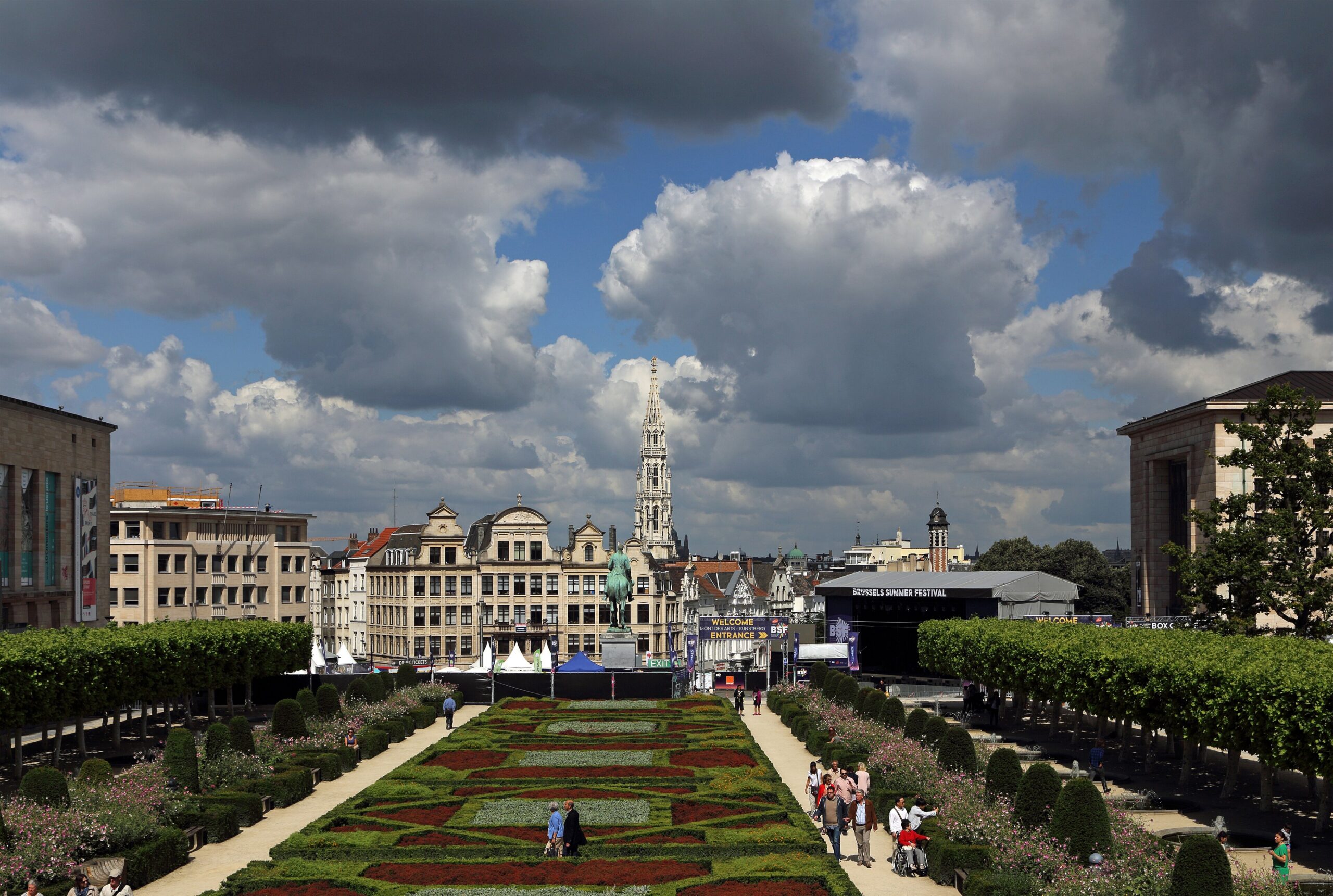
Brussels is split into a lower town — the Grand-Place, the markets, the working-class districts — and an upper town, home to the royal palace, ministries and museums. The Mont des Arts is the staircase with geometric gardens linking the two, laid out this way for the 1958 Expo. Turn around as you climb: the sightline is built so the town hall tower sits exactly at the far end of the garden’s axis. This is where the classic photos of Brussels are taken.
At the top are the Royal Library, the congress centre and the entrance to the museums. If you can only choose one on this particular day, take the Museum of Musical Instruments, the MIM, for two reasons. The first is the building: called Old England, it was an 1899 department store, all black iron and glass, and one of the finest Art Nouveau buildings in the city. The second is that the visit is done with headphones: as you approach each display case, you hear the instrument playing. At the top is a rooftop café with a terrace overlooking half the city: entry to the terrace is a small separate charge.
A little further up, on the same square, are the Musées royaux des Beaux-Arts with Bruegel and the Magritte Museum: they belong to day two’s morning, so do not go in now, there would not be time to do them justice.
Afternoon and evening — The Sablon and beer
2 km · 2 stops · from 5pm onward · the walk back is entirely downhill
6 – The Sablon
Time 1.5 hours · Free · Antiques market Saturday and Sunday mornings · Walk 10 minutes
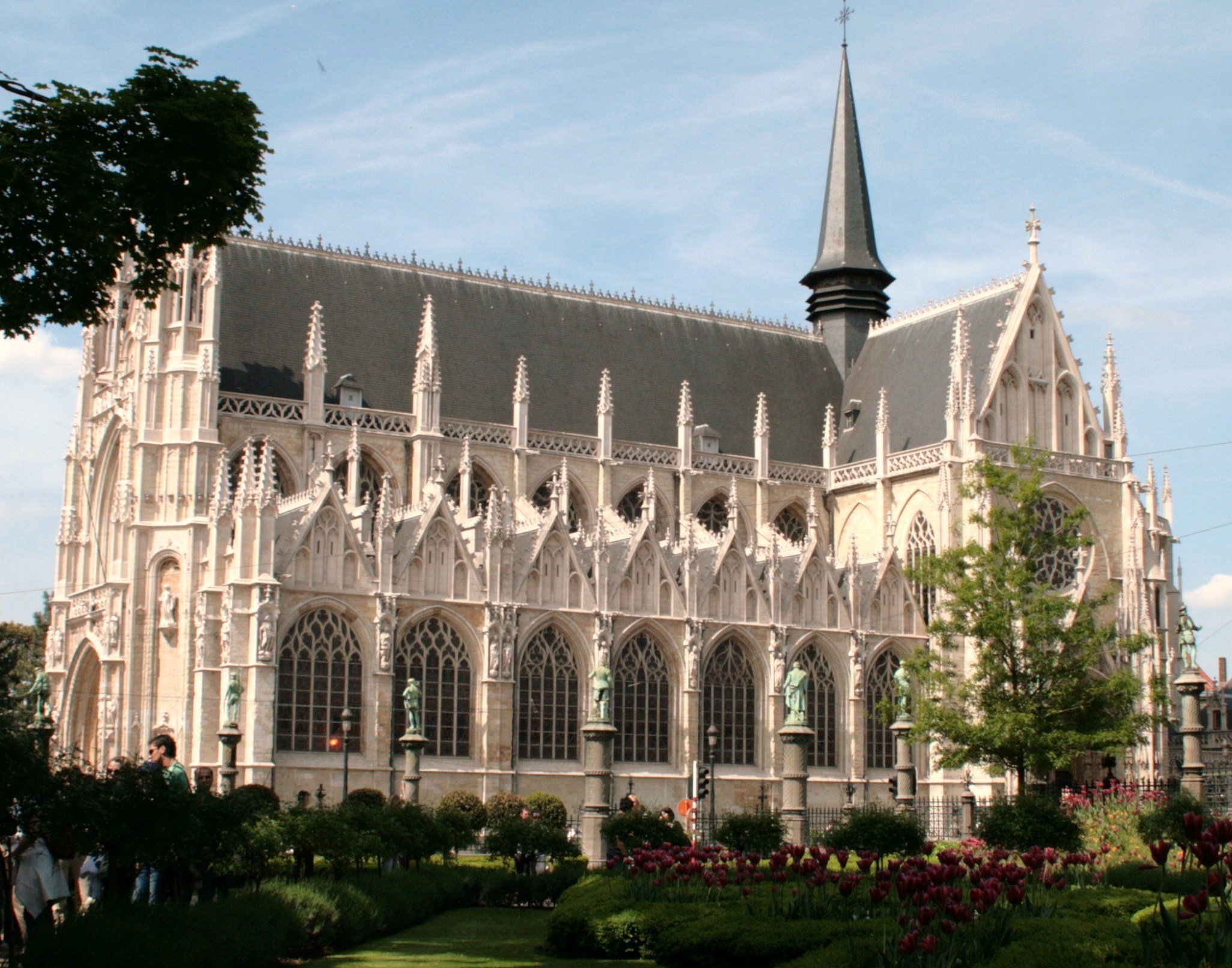
The Sablon is the elegant district of Brussels, and it is where you understand this city has plenty of old money. The main square, the Grand Sablon, is ringed by antique shops and the windows of the finest chocolate makers: Wittamer, there since 1910, Pierre Marcolini, Neuhaus. On weekend mornings an antiques market sets up below the church, stalls under green and red gazebos.
The church of Notre-Dame du Sablon is flamboyant Gothic from the fifteenth century, built by the crossbowmen’s guild. The story behind it goes like this: in 1348 a woman from Antwerp, following a vision, stole a small statue of the Virgin from her city’s cathedral and carried it to Brussels by boat down the river. The statue ended up here and became the object of an annual procession, the Ommegang, still celebrated today in July on the Grand-Place in Renaissance costume. Look inside at the two baroque side chapels belonging to the princes of Thurn und Taxis: they ran the imperial postal service across half of Europe, and their surname is the origin of the word taxi.
Across the street is the Petit Sablon, a fenced garden almost nobody crosses, worth the ten minutes: its railing is topped by forty-eight bronze statuettes, one for each of the city’s medieval guilds, each holding the tool of its trade. At the far end are the statues of the Counts of Egmont and Hoorn, the two Flemish nobles beheaded on the Grand-Place in 1568 on the orders of the Duke of Alba: their execution is the episode that sparked the revolt of the Low Countries against Spain.
7 – The evening: beer
Time the whole evening · A beer €4-8 · Walk 15 minutes downhill toward the centre
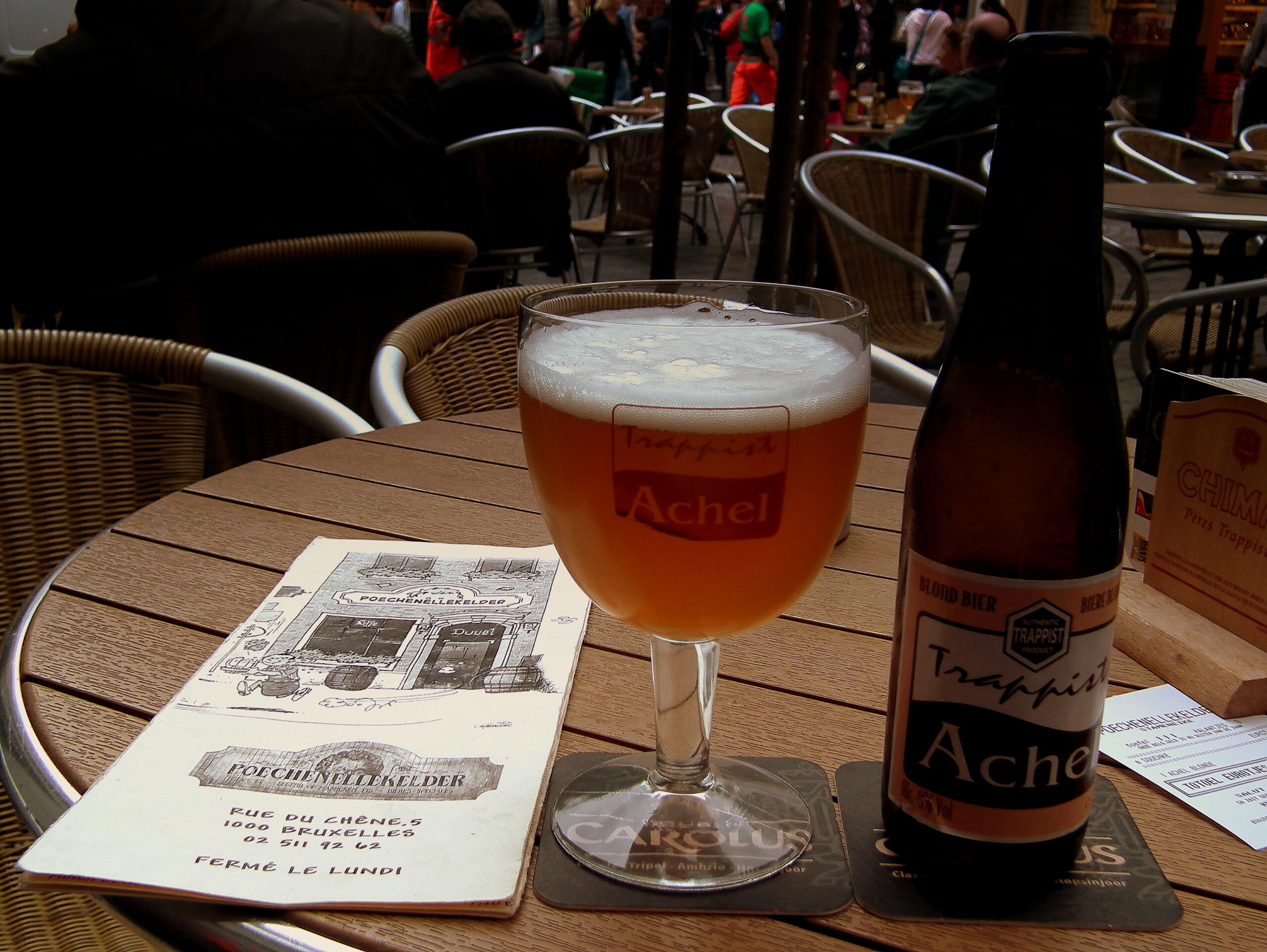
Belgian beer culture is on the UNESCO intangible heritage list, and an evening in Brussels is when you understand why. The country produces over fifteen hundred different beers, and there is no such thing as «a Belgian beer»: there are families of beer that do not resemble one another.
The Trappist beers are the best known, and the term is protected: to earn it, a beer must be brewed within the walls of a monastery, under the monks’ responsibility, with the profits going toward the community’s upkeep and charity. There are about ten worldwide, six in Belgium. The hardest to find, Westvleteren, is sold only at the abbey, by phone reservation.
But the beer that is truly Brussels’ own is another one, lambic. No yeast is added: the wort is left open in flat pans under the roof and ferments with the wild yeasts present in the air of the Senne valley, the river running through Brussels, found nowhere else. It then ages in barrels for years. The result is sour, dry, disorienting: anyone expecting a sweet beer pulls a face at the first sip. Lambic gives rise to gueuze, a blend of different vintages nicknamed «the champagne of Brussels», and kriek, made with cherries. If you want to see how it is made, the Cantillon brewery in Anderlecht is a working brewery you can visit like a museum, using the same wooden equipment as in 1900.
One last surprise: every beer has its own glass, with the right shape and branding, and if a bar does not have it, it often will not serve you that beer at all. This is not folklore for tourists: it is a rule Belgians take seriously.
Where to go: À la Mort Subite, a few steps from the Galeries, keeps its 1928 mirrors and tables and serves its own gueuze; the Poechenellekelder, facing the Manneken Pis, has hundreds of labels and puppets hanging from the ceiling; the Delirium, in an alley behind the Galeries, has over two thousand and is very touristy but the selection is unbeatable.
If it rains
It rains in Brussels about two hundred days a year, so the question is not if but when: this day is built to cope. Of the seven stops, four are indoors or nearly so (the gallery, the cathedral, the museum, the beer hall) and the rest can be done under an umbrella. If it is pouring, the move is to bring forward day two’s museums: the Musées royaux and the Magritte Museum sit side by side at the top of the Mont des Arts and fill an afternoon on their own. Alternatively, the Comic Strip Centre, in a former Victor Horta department store: Tintin, the Smurfs and Lucky Luke are all Belgian, and it tells you more about this city than it seems to.
What the day costs
| Item | Cost |
|---|---|
| Museum of Musical Instruments (MIM) | about €15 |
| GardeRobe MannekenPis | about €5, optional |
| Town Hall with guided tour | about €10, optional |
| Grand-Place, Galeries, cathedral, Manneken Pis, Mont des Arts, Sablon | free |
| Lunch: a cone of chips | €4-6 |
| Dinner with mussels or carbonnade | €22-32 |
| Two beers in a historic beer hall | €8-16 |
| Urban transport, day pass | about €8 (this itinerary does not need it) |
| Total | about €40-70 per person |
Reference figures as of September 2026: check official websites before you travel. Brussels is noticeably cheaper than Paris and Amsterdam, especially for museums. If you plan to visit three or more over the following days, consider the Brussels Card, which covers about forty museums plus transport.
Frequently asked questions
Is one day enough for Brussels?
For the old town, yes: the Grand-Place, the Galeries, the cathedral, the Manneken Pis, the Mont des Arts and the Sablon all fit inside a rectangle a kilometre across and are walkable. Left out are the royal museums with Bruegel and Magritte, Horta’s Art Nouveau, the European quarter and the Atomium, which are day two and three.
Is the Manneken Pis really disappointing?
Yes, and that is part of the point: it is sixty-one centimetres tall, standing behind a railing at a street corner, and what you see is a 1965 copy — the 1619 original is in the city museum. What is genuinely worthwhile is its wardrobe of over a thousand costumes, displayed in a dedicated museum nearby, and the official calendar by which the city dresses him more than a hundred times a year.
What language is spoken in Brussels?
Officially two, French and Dutch, and everything is written in both: street names, stops, signs. In practice French dominates day to day, and English is understood everywhere. Note that many places have two different names: Grand-Place and Grote Markt, Mont des Arts and Kunstberg are the same places.
Why is the Grand-Place so uniform?
Because it was rebuilt all at once. In August 1695 Louis XIV’s artillery bombarded Brussels for thirty-six hours and burned four thousand houses; the trade guilds rebuilt their halls in four years, competing with each other but submitting their designs to the city so the whole would stay harmonious. It is late-seventeenth-century Flemish baroque over a medieval layout.
Which beer should you try in Brussels?
Lambic and gueuze: the only spontaneously fermented beers in the world, made by leaving the wort exposed to the open air so wild yeasts from the Senne valley can attack it, and produced only here. They are sour and dry: expect a grimace on the first sip. If you prefer something easier, the Trappist beers — Chimay, Orval, Rochefort, Westmalle — are strong and rounded.
Where do you get good chips?
At a fritkot, the street kiosk, not at a restaurant: in Belgium the chip stand is recognised as cultural heritage. They are fried twice, and the important choice is the sauce — andalouse, samouraï, tartare, or plain mayonnaise, which here is the norm. A cone costs €4-6 and counts as lunch.
Belgian chocolate: where to buy it without a wrong turn?
At the Galeries Saint-Hubert, where the filled chocolate was invented in 1912, or at the Sablon, home to the historic houses. Avoid the shops around the Manneken Pis, which mostly sell to hurried tourists. The word to look for is praline, which in Belgium means the filled chocolate, not a caramelised almond.
Is Brussels expensive?
Less than Paris, Amsterdam and London, and noticeably cheaper for museums. Hotels have a useful quirk: as a working city, they cost more on weekdays and less at weekends, the opposite of other capitals. A Friday-to-Sunday stay costs considerably less than a Tuesday-to-Thursday one.
When is the best time to visit Brussels?
From April to October for the weather, keeping in mind it rains about two hundred days a year regardless of season. Two dates to note: the flower carpet on the Grand-Place, three days in August of even-numbered years, with eight hundred thousand begonias; and December, when the Christmas market and the lights on the square are among the finest in Europe.
How do you get from the airport to the centre?
From Brussels-Zaventem by train, about 20 minutes to Brussels-Central, four departures an hour: the fastest option, costing around ten euros, airport surcharge included. From Charleroi, which low-cost airlines call «Brussels South» despite being sixty kilometres away, you need a shuttle taking a good hour: factor that in when comparing flight prices.
September 5, 2026