
El Hierro in 3 days: the zero meridian, El Sabinar and diving
El Hierro is the smallest, youngest and most remote of the Canary Islands: for centuries it was considered the edge of the known world, and the prime meridian passed through here before Greenwich claimed it in the nineteenth century. Today it’s the island aiming for full energy self-sufficiency from renewable sources, and one of the purest diving destinations in Europe.
At a glance
- Duration · 3 full days
- How to get there · flight from Tenerife North (40 minutes) or ferry from Los Cristianos (2h30)
- Base · Valverde (the capital) or Frontera/El Golfo
- Budget · €250-400 per person on the ground
- Good to know · the island is aiming for full electrical self-sufficiency with the Gorona del Viento wind-hydro plant, which at times covers 100% of demand using wind and water
- Diving · the Mar de las Calmas marine reserve, at La Restinga, is considered among the best dive sites in Europe
- UNESCO biosphere reserve since 2000, and a Starlight reserve
The numbers follow the order of the visit.
Day 1 — Mirador de la Peña and the golfo
Full day · the island’s great amphitheatre

Mirador de la Peña, designed by César Manrique in 1989, looks out over the Golfo: a semicircle of walls up to a thousand metres tall, all that remains of an enormous prehistoric landslide, when an entire flank of the island slid into the sea, likely triggering a tsunami. Below, the El Golfo plain is the island’s most fertile and inhabited area, with vineyards and natural pools like Charco Azul and the Piscina de La Maceta.
Day 2 — El Sabinar and the far west
Full day · the wind made tree

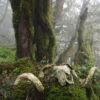
At El Sabinar, on the western plateau, sabina trees (a type of juniper) are bent almost to the ground and twisted around themselves by the constant wind: they’re the island’s symbolic image and one of the most photographed plants in the Canaries. Not far away, the Orchilla lighthouse marks the point where the prime meridian fixed by Ptolemy passed, used by European cartographers until 1884, when the Washington conference adopted Greenwich: for nearly two millennia, then, the world’s longitudes were counted from here.
Day 3 — La Restinga and the Mar de las Calmas
Full day · diving or snorkelling

La Restinga, Spain’s southernmost village, is the base for the Mar de las Calmas marine reserve: waters sheltered from the prevailing winds, mild temperatures year-round, visibility often exceeding thirty metres, and volcanic seabeds with arches, caves and submerged lava flows. It’s considered one of the best diving destinations in Europe, with frequent sightings of barracuda, rays and turtles.
Right off the coast of La Restinga, in October 2011, an underwater eruption created a greenish-brown stain visible from satellite and led to the temporary evacuation of the village: the volcano, informally named Tagoro, created a new underwater cone just a few hundred metres from the coast, now studied by biologists to observe how life recolonises a seabed that’s just been born.
What three days cost
| Voce | Costo |
|---|---|
| Volo o traghetto da Tenerife, andata/ritorno | 60-120 euro |
| Alloggio, 3 notti | 100-180 euro |
| Noleggio auto, 3 giorni | 50-90 euro |
| Immersione guidata (2 tank) | 60-90 euro |
| Pasti, 3 giorni | 55-85 euro |
| Totale | circa 250-400 euro a persona (immersioni escluse) |
Frequently asked questions
Is it worth going to El Hierro if you don’t dive?
Yes, if you’re after an island with almost no mass tourism: volcanic landscapes, trails, natural pools and a very slow pace. But it’s the least “developed” of the Canary Islands, and that’s exactly why you go.
How do you get there?
With short flights from Tenerife North (about 40 minutes) or Gran Canaria, or by ferry from Los Cristianos (about two and a half hours). There are no direct flights from mainland Europe.
Do you need a car?
Yes: public transport is minimal and the distances, though short, involve mountain roads. Rentals should be booked ahead, as availability on the island is limited.
Is it true that the island is energy self-sufficient?
Partly: the Gorona del Viento wind-hydro plant combines wind turbines with a water-pumping system in a crater, and at times covers 100% of the island’s electricity demand. On an annual basis the share is lower, but it remains among the highest in the world for an isolated system.
What’s the most common mistake?
Arriving without having booked a car and lodging: availability on the island is genuinely limited, especially in high season, and improvising here is harder than elsewhere in the Canaries.
September 11, 2026