

Berlin in 5 days: the complete day-by-day itinerary
Five days in Berlin allow the one thing no short itinerary permits: seeing both Potsdam and Sachsenhausen, which with three days are a straight either-or. The first two remain those of the classic itinerary — the line of the Wall, the Berlin of before with Bernauer Straße, and one day out of town. The fourth is the other day out of town. The fifth is the most Berlin day of all: a Nazi-built airport turned public lawn, the largest Soviet memorial outside the former USSR, the lakeside villa where the Final Solution was organised, and the eastern districts where the city is still reinventing itself.
At a glance
- How long · five full days
- How much walking · 7-10 km a day, always flat
- What has to be booked · the Reichstag dome, free but registered days ahead
- Budget · €220-360 per person for the five days, excluding accommodation
- Transport · Potsdam and Sachsenhausen need the zone ABC ticket; in the city AB is enough
- Heaviest day · Sachsenhausen: do not pair it with anything else
- What is still left out · Dresden, Leipzig, Hamburg: reachable in an hour and a half to two hours by train
One colour per day. Potsdam lies to the south-west, Sachsenhausen to the north: opposite directions, not to be combined.
The first two days
These remain those of the three-day itinerary: the right way to get into a city with no historic centre.
Day 1 – The line of the Wall
8 km · the Brandenburg Gate, the Reichstag, the Holocaust Memorial, Unter den Linden, Museum Island, Alexanderplatz, the Topography of Terror, the East Side Gallery, Kreuzberg

The first day follows the line of the Wall, the thread to navigate by. Almost everything is free: the Reichstag with Foster’s dome, where the public walks above the chamber, the Holocaust Memorial with its 2,711 steles, the Topography of Terror built on the ground where the Gestapo and SS once stood. You pay only for one museum on the Island.
Day 2 – The Berlin of before
7 km · Bernauer Straße, the Gendarmenmarkt, Charlottenburg, the Tiergarten and Kulturforum

The Gedenkstätte Berliner Mauer preserves a complete stretch of the Wall with the death strip and the watchtower: the only place where you understand it was a border system dozens of metres deep. Then the Gendarmenmarkt with the Huguenot church, Charlottenburg, and the Gemäldegalerie at the Kulturforum, which holds Vermeer and Caravaggio and gets almost no visitors.
Day 3 — Potsdam
6-7 hours · S-Bahn S7 or regional train, 40 minutes · zone C ticket needed

Potsdam was the residence of the Kings of Prussia, and the park of Sanssouci is a UNESCO site: three hundred hectares and a dozen palaces.
Sanssouci Palace is surprisingly small: ten rooms on one floor. It was Frederick the Great’s private home, where he came without his wife, with his dogs and his books, to play the flute and argue with Voltaire, who lived there for three years before a furious falling-out. Frederick wanted to be buried here beside his greyhounds, and his wishes were honoured only in 1991. Visitors still leave potatoes on his grave: he was the one who forced their cultivation against peasant resistance.
At the other end of the park, the Neues Palais: enormous, built right after the Seven Years’ War when Prussia was exhausted, explicitly to show his enemies the money was still there. He himself called it «a piece of bragging».
In the town: the Dutch Quarter with a hundred and thirty-four red-brick houses built to attract craftsmen from the Netherlands; the Alexandrowka Russian colony; and Cecilienhof, where in the summer of 1945 Stalin, Truman and Churchill divided up Europe — the round table is still in the room.
Day 4 — Sachsenhausen
5 hours · S-Bahn S1 to Oranienburg, 45 minutes, then 20 on foot · free entry · indoor spaces close on Mondays
With five days you do not need to choose between Potsdam and Sachsenhausen, and that is the main reason five days is worth it. It should be said plainly, though: this is not a day trip, and it should not be paired with anything else. Give it the day, and nothing more.
The camp opened in 1936, before the war, and was not an extermination camp: it was the model the others were designed on, and the headquarters of the Concentration Camp Inspectorate, the office that administered the whole system. The SS trained personnel here before sending them elsewhere.
Its layout is a triangle with barracks fanning out around a central point, from which a single machine gun covered the entire camp: engineering applied to imprisonment. On the gate is the phrase Arbeit macht frei, appearing here for one of the first times.
About two hundred thousand people passed through: German political opponents, Jews, Soviet prisoners of war, gay men, Jehovah’s Witnesses, Roma, and in the final phase civilians from half of Europe. Tens of thousands died there. This was also where Operation Bernhard was carried out, the industrial-scale forgery of British banknotes with which the Nazis tried to collapse the pound: the forgers were prisoners, recruited from among the deportees for their skills.
After 1945 the Soviets reused the camp for five years as an internment site, and another twelve thousand people died there: the memorial documents this too, and that double history is part of what makes it important.
Entry is free. Take the audio guide or join a guided tour: without context you risk walking among empty buildings without understanding what you are looking at. Allow three hours on site.
Day 5 — The telling outskirts
The whole day · 4 stops · everything free except transport
Morning – Tempelhofer Feld
2 hours · Free · Metro Tempelhofer Feld or Boddinstraße

It is the most Berlin thing there is. Tempelhof airport was built by the Nazis in the 1930s: the terminal is over a kilometre long and is one of the largest buildings in the world, designed to impress. In 1948-49, when the Soviets cut off land links to West Berlin, the airlift passed through here: for eleven months, a plane every few minutes, day and night, brought coal and flour to two million people. Berliners called those planes Rosinenbomber, raisin bombers, because American pilots dropped sweets on little parachutes to children waiting along the fence.
The airport closed in 2008, and the city opened the runway to the public. In 2014 the city council proposed building housing there; Berliners called a referendum and voted to leave it empty. Today it is 355 hectares of grass and asphalt, larger than the Principality of Monaco, where people cycle and skateboard on the runways, fly kites, tend urban allotments, and see the horizon — a rare thing in a city.
Early afternoon – Treptower Park
1.5 hours · Free · S-Bahn Treptower Park
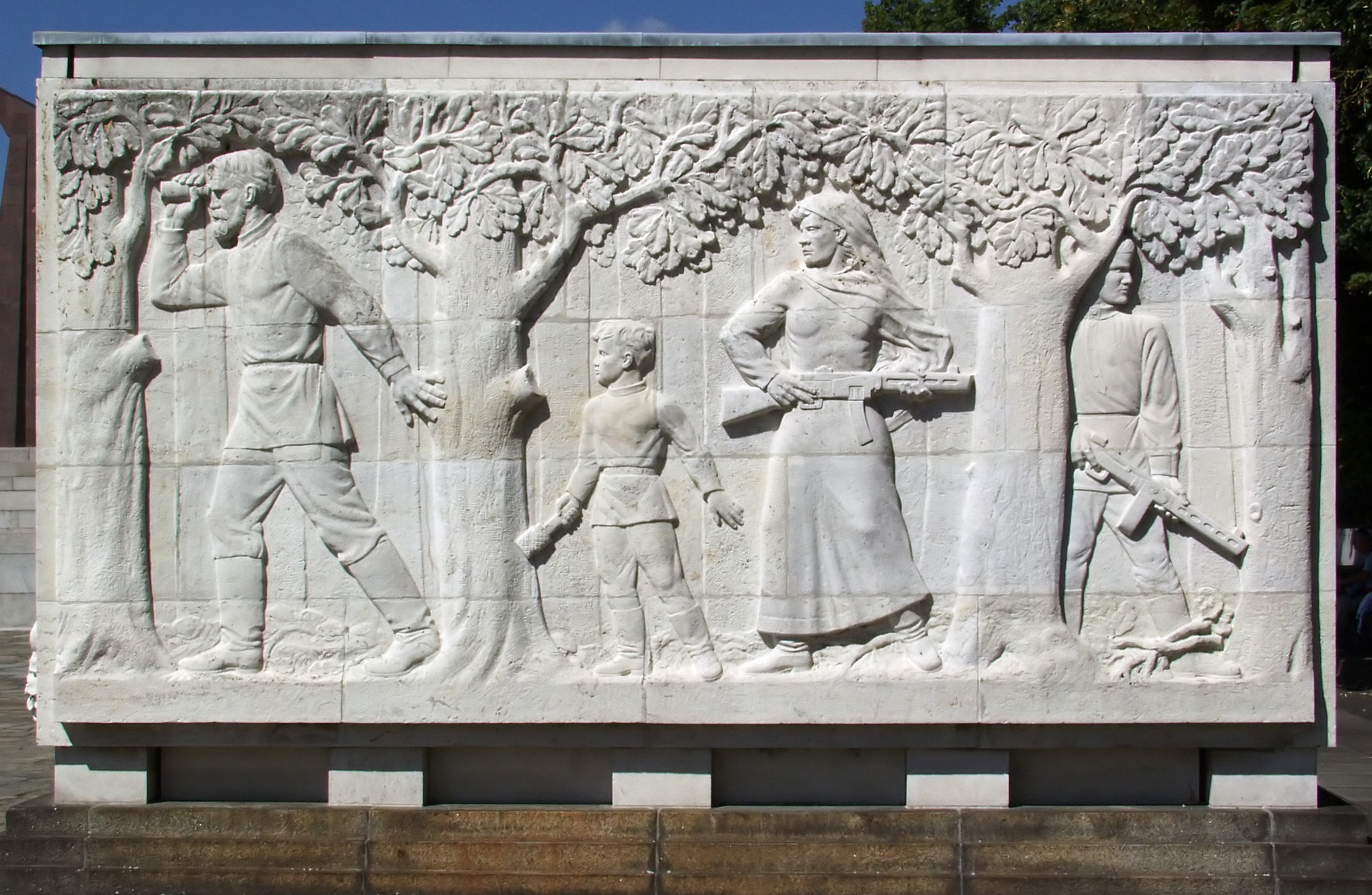
In Treptower Park stands the largest Soviet memorial outside the former USSR, opened in 1949. It is also a cemetery: buried beneath it are about seven thousand of the twenty thousand Red Army soldiers who fell in the Battle of Berlin.
The scale is monumental: two leaning red granite flags — the granite, tradition says, comes from the demolished Reich Chancellery —, sixteen sarcophagi with war scenes and quotes from Stalin in Russian and German, and at the far end a twelve-metre statue of a Soviet soldier holding a German child while breaking a swastika with his sword. It is propaganda, and openly so: that is exactly what makes it worth looking at today, in a Germany that has dismantled almost every other monument of its kind.
The park around it is enormous and quiet, on the Spree, and mostly Berliners go there.
Afternoon – Wannsee
2-3 hours · Conference house free · S-Bahn S1 or S7 to Wannsee, 30 minutes

At the far south-west, Berlin turns to water: lakes, woods, villas, sailing boats. The Wannsee has the largest bathing beach in continental Europe, open since 1907, and in summer tens of thousands of people go there.
In the middle of this ordinariness stands the Haus der Wannseekonferenz. On 20 January 1942, in this villa overlooking the lake, fifteen senior Reich officials met for ninety minutes around a table to coordinate the administrations involved in the Endlösung, the Final Solution. It was not the place where the extermination was decided — it had already begun — but the place where it was organised bureaucratically: who did what, with what expertise, with what transport.
The minutes, drafted by Adolf Eichmann in chillingly administrative language, survive in only one copy out of thirty, found in 1947 in the archives of the foreign ministry. The house is today a memorial and documentation centre, free: you visit the meeting room, read the minutes, and look out through the windows at the lake with its boats. The juxtaposition is exactly the point.
Evening – Prenzlauer Berg
2 hours · Free · Tram M10 or U2 to Eberswalder Straße
You end with the Berlin that is still changing. Prenzlauer Berg was East Berlin: in 1989 it was a district of crumbling, coal-heated houses, home to artists, dissidents and anyone who could not find housing elsewhere, and many of the autumn 1989 demonstrations set off from here. At the Gethsemanekirche, the pacifist opposition met under Stasi surveillance.
Thirty years later it is the most bourgeois, well-kept district in the city, with restored façades, coffee shops and the highest birth rate in Berlin. The transformation was so fast and complete that almost all the old residents left: it is the most studied case of gentrification in Europe, and in Berlin it is still argued about with anger.
Things to see while walking: the Kulturbrauerei, a former red-brick brewery turned cultural centre, with a very well-made free museum inside on everyday life in the GDR; Kollwitzplatz with its Saturday organic market; and the water tower from 1877, used by the SA in 1933 as one of the first sites of detention and torture, today an apartment building.
If it rains
- Day 3, Potsdam · its value lies in the park: if it rains, swap it for a day in the city and save Potsdam for sunshine.
- Day 5 · the most exposed, since Tempelhof and Treptower are outdoors. Indoor substitutes: the Jewish Museum by Daniel Libeskind, a building-as-experience worth half a day; the Museum für Naturkunde with the world’s largest mounted Brachiosaurus; the Stasi Records Archive and the Stasi Museum in the former secret police headquarters, where Minister Mielke’s office has been left intact.
- Always works · the Haus der Wannseekonferenz and the GDR museum at the Kulturbrauerei are both indoors and free.
What the five days cost
| Item | Cost |
|---|---|
| Reichstag, Memorial, Topography of Terror, Bernauer Straße, Sachsenhausen, Wannseekonferenz, Tempelhof, Treptower | free |
| One museum on the Island and the Gemäldegalerie | about €26 |
| Charlottenburg | €12-19 |
| Sanssouci and train to Potsdam | about €25 |
| Train to Oranienburg, return | about €8 |
| City transport, 5 days | about €50 |
| Meals, 5 days | €100-180 |
| Total | about €220-360 per person |
Reference figures as of August 2026: check official websites before you travel. Even over five days Berlin remains the cheapest capital covered on this site, because almost all the places that matter cost nothing. With five days and several state museums, the three-day Museumspass, covering about thirty museums, is worth weighing up.
Frequently asked questions
Is five days too many for Berlin?
No, and there is a precise reason: with five days you fit in both Potsdam and Sachsenhausen, a straight either-or with three, and there is still a day left for the outskirts that tell the city’s story better than the centre does. Berlin is nine times the area of Paris, and its history is scattered, not concentrated.
What is the Tempelhofer Feld?
An airport built by the Nazis, the stage for the 1948-49 airlift with which the Allies supplied West Berlin after the Soviets blockaded it, closed in 2008 and opened to the public. In 2014 the city council wanted to build housing there, and Berliners, through a referendum, voted to leave it empty: it is 355 hectares of grass and runways where people cycle and fly kites. It is the most Berlin thing there is.
Is it worth going to the Wannsee?
Yes, for two opposite reasons that coexist. It is a district of lakes and villas with the largest bathing beach in continental Europe; and in the middle of it stands the Haus der Wannseekonferenz, the villa where on 20 January 1942 fifteen Reich officials bureaucratically organised the Final Solution in ninety minutes. The memorial is free; you visit the meeting room and read Eichmann’s minutes while looking at the lake through the windows.
Potsdam or Sachsenhausen, which is better?
With five days you do not have to choose: do both, on separate days, in this order, with Potsdam first. They lie in opposite directions, and Sachsenhausen is a day in which you do nothing else: do not pair it with anything, and do not rush it.
What is the Treptower Park memorial?
The largest Soviet monument outside the former USSR, from 1949, and also a cemetery: about seven thousand Red Army soldiers who fell in the Battle of Berlin are buried beneath it. At its centre stands a twelve-metre statue of a soldier holding a German child while breaking a swastika. It is openly propaganda, and that is exactly what makes it worth looking at.
Is Berlin suitable for children?
More than it seems: the Museum für Naturkunde has the largest mounted Brachiosaurus in the world, the Tempelhofer Feld is an enormous lawn for running and cycling, Legoland and the aquarium are in the centre, and parks are everywhere. Sites of memory, on the other hand, need to be calibrated to age: the Holocaust Memorial and Sachsenhausen call for preparation.
Can you take day trips from Berlin?
Yes, and they are excellent: Dresden is an hour and a half by train, Leipzig an hour and a quarter, Hamburg two hours. With five days they do not fit, since Potsdam and Sachsenhausen already take up two, but if you extend to six or seven days they are the first thing to add.
What happened to Prenzlauer Berg?
In 1989 it was an East Berlin district of crumbling, coal-heated houses, home to artists and dissidents, and many of the autumn demonstrations set off from here. Thirty years later it is the most bourgeois, well-kept district in the city, with the highest birth rate: almost all the old residents have left. It is the most studied case of gentrification in Europe, and in Berlin it is still argued about with anger.
How much do five days in Berlin cost?
Between €220 and €360 per person excluding accommodation, which for five days in a European capital is not much. The reason is always the same: the Reichstag, the Holocaust Memorial, the Topography of Terror, Bernauer Straße, Sachsenhausen, the Wannseekonferenz, Tempelhof and Treptower are all free, and you eat very well for ten euros.
Do you need to speak German?
No: English is spoken everywhere in Berlin, everything in the museums is translated, and in the central districts you will hear more English than German. As always, a few words help: bitte, danke, Entschuldigung. In neighbourhood Kneipen and in the more outlying east, English is less common.
September 4, 2026


