

Barcelona in 3 days: Gaudí, the old city and Montserrat
Barcelona is a layered city, and three days are enough to see all three layers. The first belongs to Gaudí and modernisme, the reason most people come here in the first place. The second drops into the old city — the Roman and medieval Barri Gòtic, the merchants’ Born, the Raval — and climbs Montjuïc, the hill tourists always look at from below and never climb. The third leaves the city: Montserrat, the monastery on the mountain of rock an hour away by train, or a day between the Gràcia district and the sea. One rule applies to all three days: book before you go.
At a glance
- How long · three full days, from 9am to 11pm
- How much walking · 7-9 km a day, flat except for Park Güell and Montjuïc
- What has to be booked · Sagrada Família weeks ahead; Park Güell, Casa Batlló, La Pedrera and the Palau de la Música a few days ahead
- Budget · €190-300 per person for the three days, excluding accommodation
- Transport · a ten-ride ticket, one per person
- Day to avoid · Monday, when the Museu Picasso, the MNAC and the Fundació Miró are closed
- What is left out · Sitges, Girona, Tarragona, the Ebro Delta: those are a fourth and fifth day
One colour per day. Montserrat is off the map to the north-west, an hour away by train.
Day 1 — Gaudí and modernisme
7 km · 3 stops · 9am to 10pm · the day where everything needs booking
Morning – Sagrada Família
9am-11am · Ticket about €26, €36 with a tower · Book weeks ahead
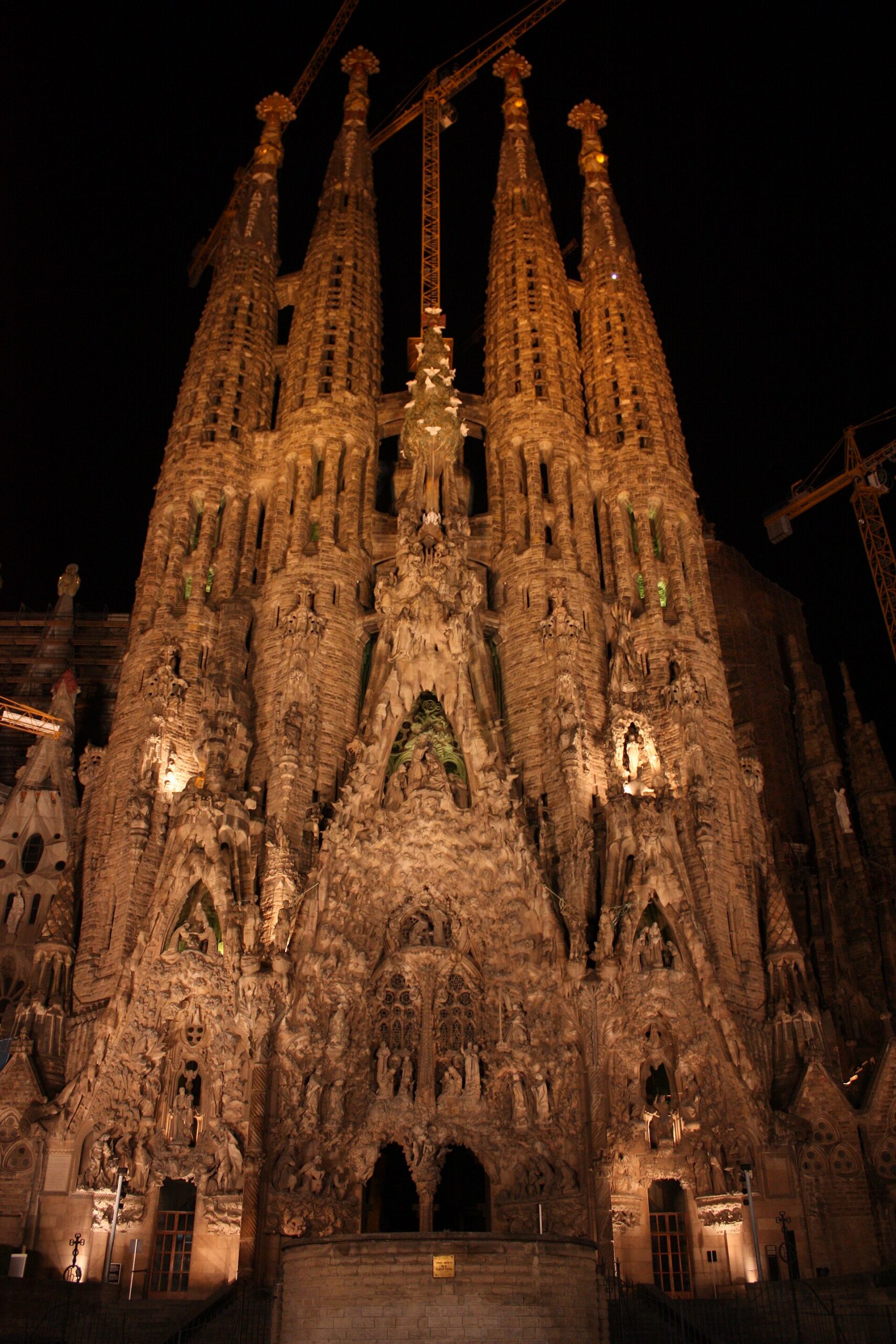
Take the nine o’clock slot: the light enters from the east, through the Nativity façade, and inside there is still no one.
The site has been under construction since 1882; Gaudí directed it for forty-three years, the last twelve exclusively, living inside it, and died in 1926, hit by a tram. He was dressed so shabbily that he was mistaken for a beggar. He is buried in the crypt.
The columns branch like trees to carry the load diagonally, a solution that does away with Gothic flying buttresses — Gaudí called them «crutches». The stained glass is split by colour according to orientation: blues and greens to the east, oranges and reds to the west. Construction continues only through donations and ticket sales, with no public money, by his wish.
Midday – The Eixample and the modernist houses
11:30am-3pm · La Pedrera about €28, Casa Batlló about €35 · Pick one

You walk down through the Eixample, the grid Ildefons Cerdà designed in 1859 with block corners cut at 45 degrees, so trams had room to turn and more light could get in.
Casa Milà, known as La Pedrera, is Gaudí’s last civil work: the undulating stone façade carries no load, the structure rests on internal pillars. If you go in, the highlight is the roof with its warrior-shaped chimneys, which George Lucas borrowed for the imperial stormtroopers in Star Wars.
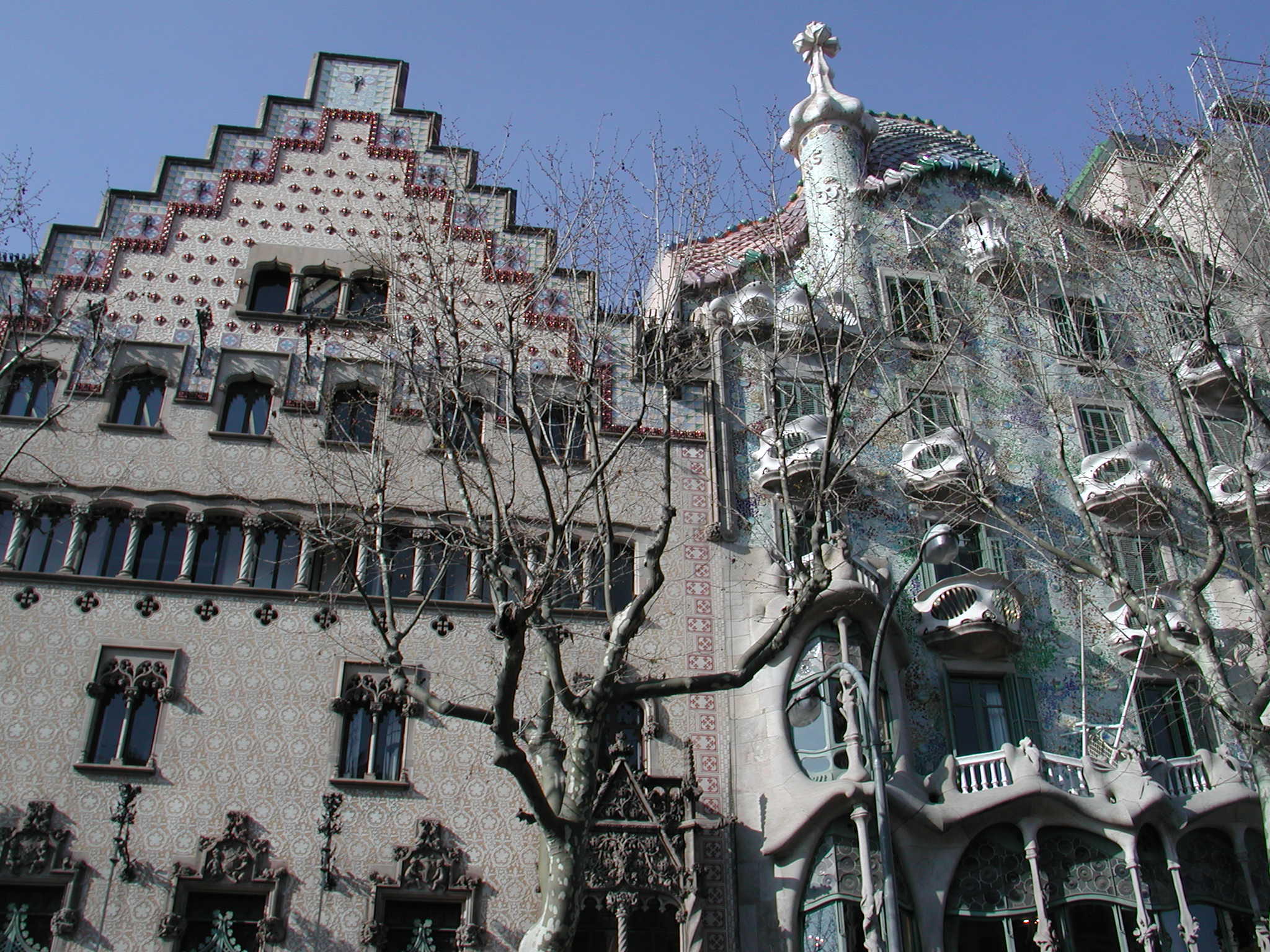
Three blocks down is the Illa de la Discordia: four neighbouring buildings remodelled in the same decade by the four most important modernist architects, in open competition. You can see them for free from the opposite pavement. Gaudí’s Casa Batlló tells the legend of Saint George: the roof is the dragon’s back, the turret with the cross is the lance driven into the beast.
Lunch in the side streets off passeig de Gràcia, with the menú del día at €12-16. Remember lunch starts after half past one.
Afternoon and evening – Park Güell and sunset
4pm-7pm · Monumental zone about €18, rest of the park free · Book ahead

Park Güell began as a property failure: in 1900 the industrialist Eusebi Güell wanted a luxury housing estate of sixty plots here, and in fifteen years he sold two. In 1926 the city council bought it and turned it into a public park.
What remains are the communal areas, the masterpiece itself: the stairway with the ceramic salamander, the hypostyle hall with eighty-six leaning columns, meant to be the neighbourhood market, and the undulating bench, a hundred and ten metres long, covered in trencadís, the mosaic made from broken tile fragments. Below the terrace, the floor collects rainwater and channels it through the hollow columns into a cistern: a working water system, not an ornament.
The monumental zone has a visitor cap; the rest of the park, large and panoramic, is free. Stay until sunset: from here you see the whole city down to the sea, with the Sagrada rising in the middle.
Day 2 — The old city and Montjuïc
8 km · 4 stops · 9:30am to 10pm · half the day free, half on the hill
Morning – Barri Gòtic
9:30am-1pm · Cathedral about €11, the rest free · Metro Jaume I or Liceu
Under the Gothic quarter lies Roman Barcino: fragments of walls and aqueduct poke up between the houses, and in the basement of the Museu d’Història, in Plaça del Rei, you walk through four thousand square metres of ancient city, with vats for salting fish and a wine-making facility.
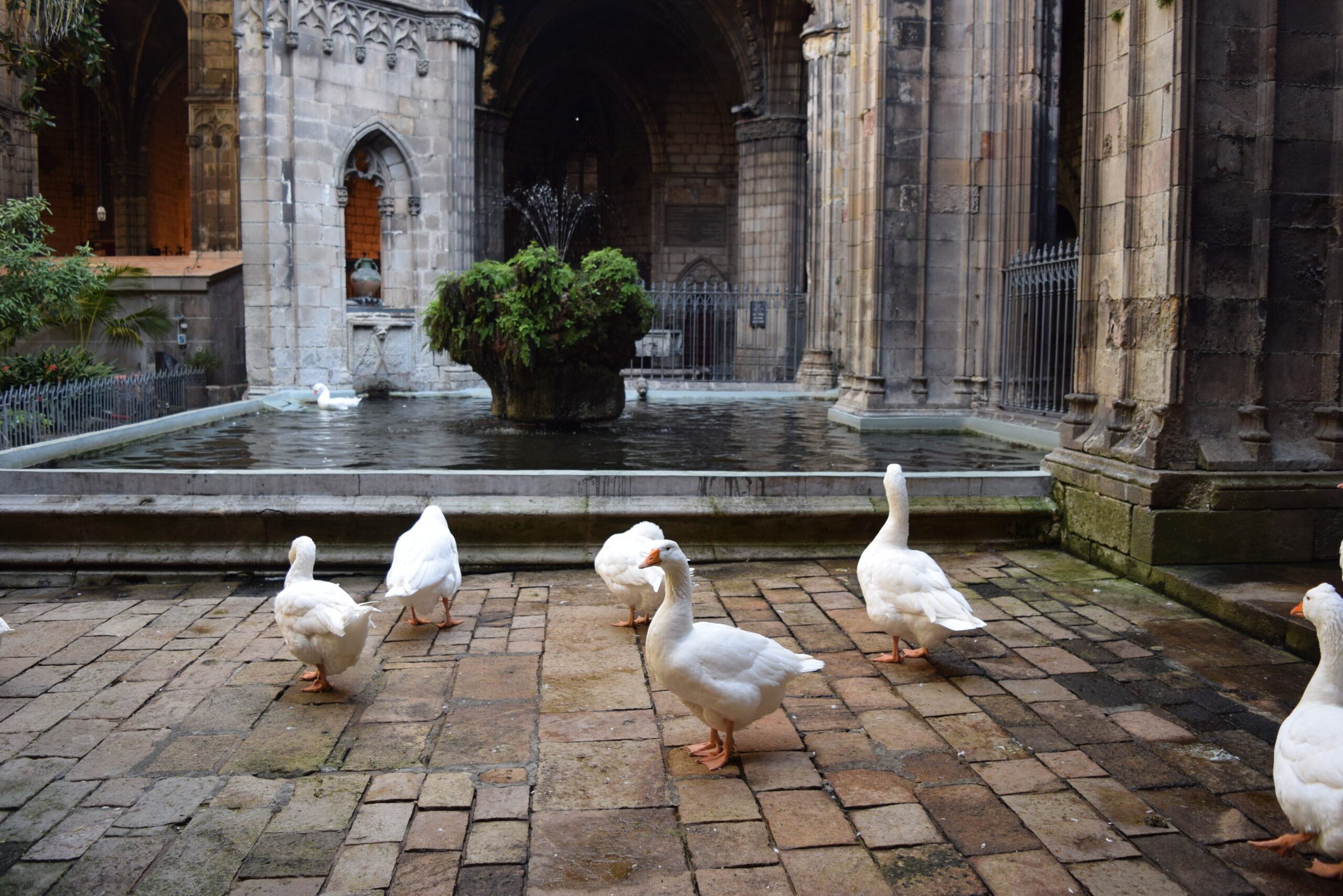
The Cathedral of Santa Eulalia dates from the fourteenth century; the thing to see is the cloister with palm trees and thirteen white geese, as many as the saint’s years when she was martyred. Around it, get lost: the Pont del Bisbe — from 1928, not medieval —, Plaça Sant Felip Neri with walls still pockmarked by shrapnel from a 1938 bomb that killed forty-two people, mostly children, and Plaça Reial with lampposts designed by a young Gaudí, his first public commission.
On the Rambla, the Mercat de la Boqueria: a market since 1217, under an iron roof from 1914. The golden rule: the first stalls at the entrance are for tourists; go to the back, where the restaurateurs buy, and eat at a counter with stools.
Early afternoon – The Born, Santa Maria del Mar, Picasso
2:30pm-5pm · Museu Picasso about €15, closed on Mondays · Santa Maria del Mar free entry outside guided-tour hours
The Born was the district of merchants and sailors, and it holds the most beautiful church in Barcelona, which is not the cathedral: Santa Maria del Mar, built in just fifty-five years between 1329 and 1383. A single style, no second thoughts. It was built by the dockworkers of the district, who carried the stone from the Montjuïc quarry on their backs for free: on the main door two bastaixos, the porters, are carved, the only European Gothic monument dedicated to the people who physically built it.
The columns stand thirteen metres apart, the widest span in medieval Gothic, which is why the space is so broad and bright. An eleven-day fire in 1936 burned all the baroque furnishings, paradoxically returning the church to its original bareness; the blackened stones above the columns were left that way.
Nearby, the Fossar de les Moreres with its eternal flame is the mass grave of those who fell in the 1714 siege, when Catalonia lost its institutions. The anniversary of that defeat is the Catalan national day.
A short walk away, the Museu Picasso occupies five connected medieval mansions and holds mostly his early works: Picasso trained here, arriving at fourteen, and the museum shows the academically brilliant prodigy who existed before Cubism. There is also the complete series of Las Meninas, fifty-eight variations on Velázquez’s painting made in 1957.
Late afternoon – Palau de la Música Catalana
5pm-6pm · Guided tour about €20 · Book ahead: entry is by tour only
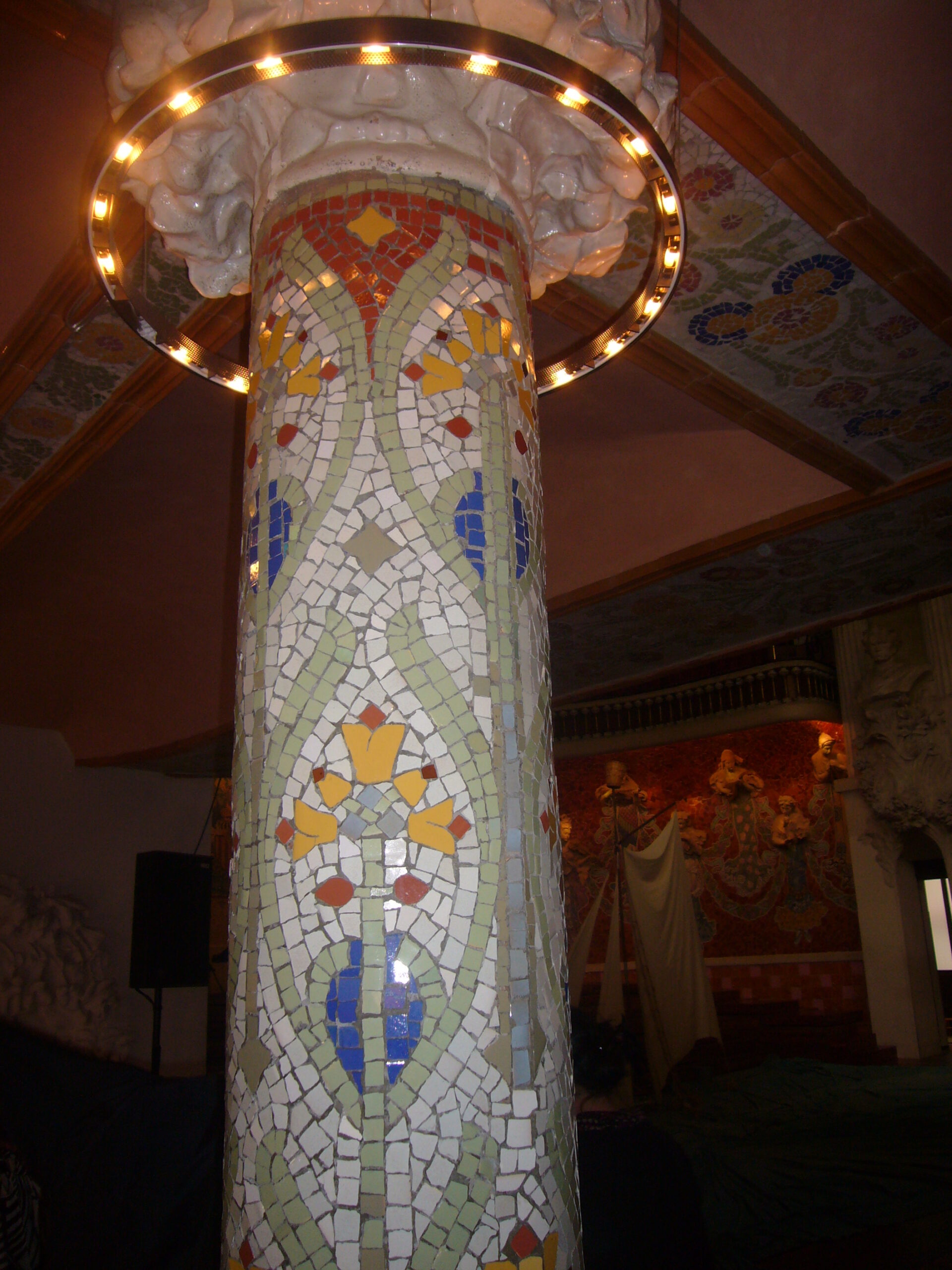
It is the most underrated thing in Barcelona, and it is not by Gaudí: it was built by Lluís Domènech i Montaner between 1905 and 1908 for a workers’ choral society, the Orfeó Català, and it is a UNESCO site.
The concert hall is the only one in Europe lit entirely by natural light: the walls are stained glass, and at the centre of the ceiling an inverted-droplet skylight in yellow and blue glass hangs down into the hall like an upside-down sun. On stage, eighteen female figures in mosaic and relief emerge from the back wall playing different instruments, half flat, half fully sculpted.
If a concert happens to fall on an evening, go: the cheapest ticket costs about the same as the guided tour, and you sit under that skylight for two hours.
Evening – Montjuïc
6:30pm-10pm · MNAC about €12, closed on Mondays · Metro Espanya, then escalators
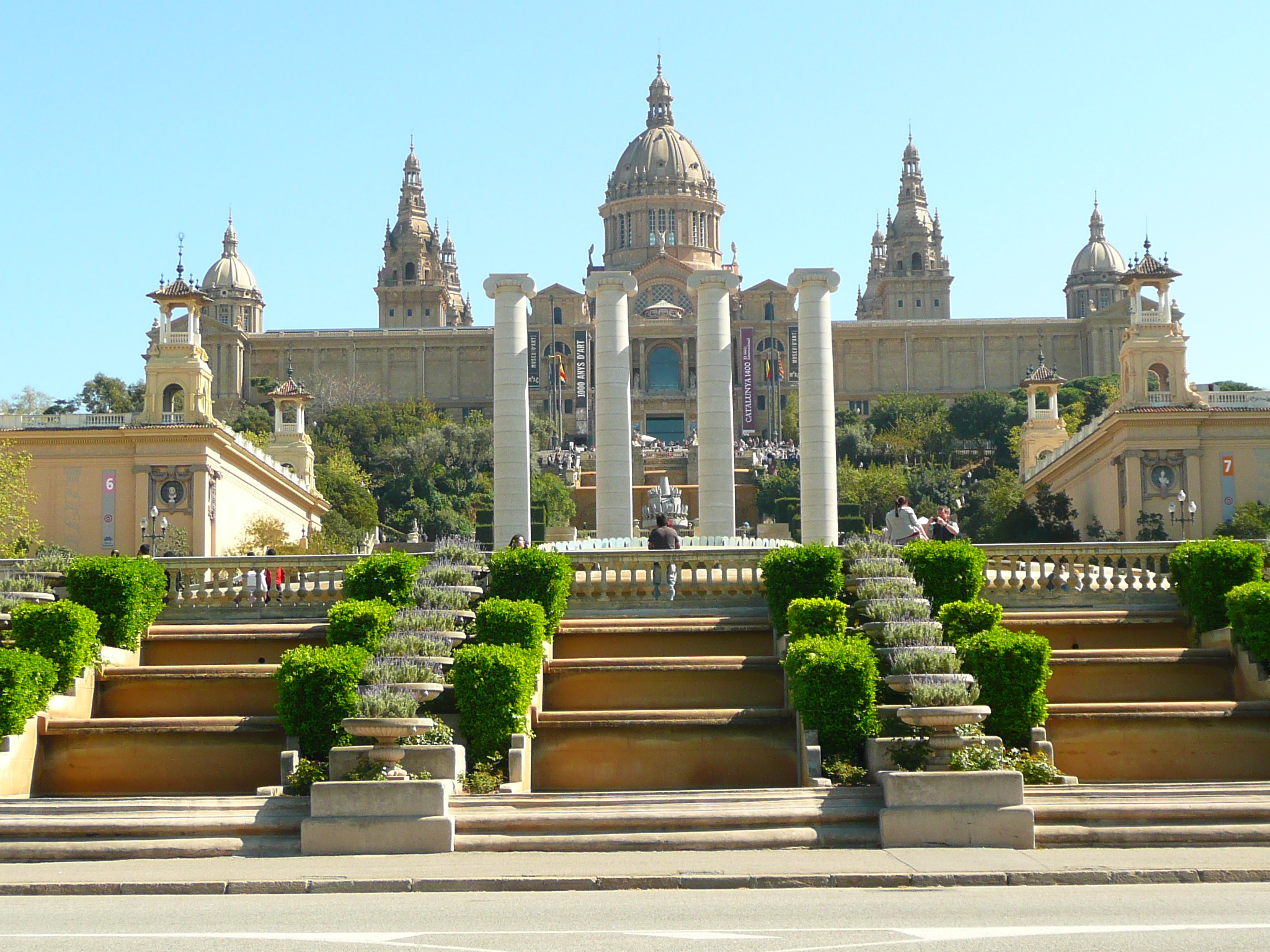
Montjuïc is the hill closing off the city to the south-west, and almost no one climbs it despite half of cultural Barcelona sitting on it. From Plaça d’Espanya public escalators lead up to the Palau Nacional, built for the 1929 International Exposition.
Inside is the MNAC, and its collection of Romanesque frescoes is unique in the world: in the 1920s they were removed from small Pyrenean churches that were crumbling and being stripped by art dealers, then reassembled here inside scaled reconstructed apses. The Christ Pantocrator of Sant Climent de Taüll is the defining image of Catalan medieval art.
The hill also holds the Fundació Joan Miró, in a white building by Josep Lluís Sert, the Mies van der Rohe Pavilion — rebuilt in 1986, one of the manifestos of modern architecture —, the Poble Espanyol and the 1992 Olympic facilities. At the top is the castle, which until the twentieth century served mainly to aim cannons at the city; you reach it by cable car.
At sunset, go down in front of the Palau Nacional for the Font Màgica, the fountain with water, light and music running since 1929: the shows are free and held on set evenings — check the calendar, since they are suspended in winter and during droughts.
Day 3 — Montserrat, or Gràcia and the sea
The whole day out, or 6 km in the city · here you choose between the mountain and the neighbourhood
The out-of-town option: Montserrat
6-7 hours door to door · FGC train from Plaça d’Espanya, one hour, plus rack railway or cable car · Combined ticket about €25-40
Montserrat means «serrated mountain», and the name describes exactly what you see: a conglomerate massif 1,236 metres high, eroded into thousands of rounded spires that look like fingers. It is the strangest range in Catalonia, and also its national symbol.
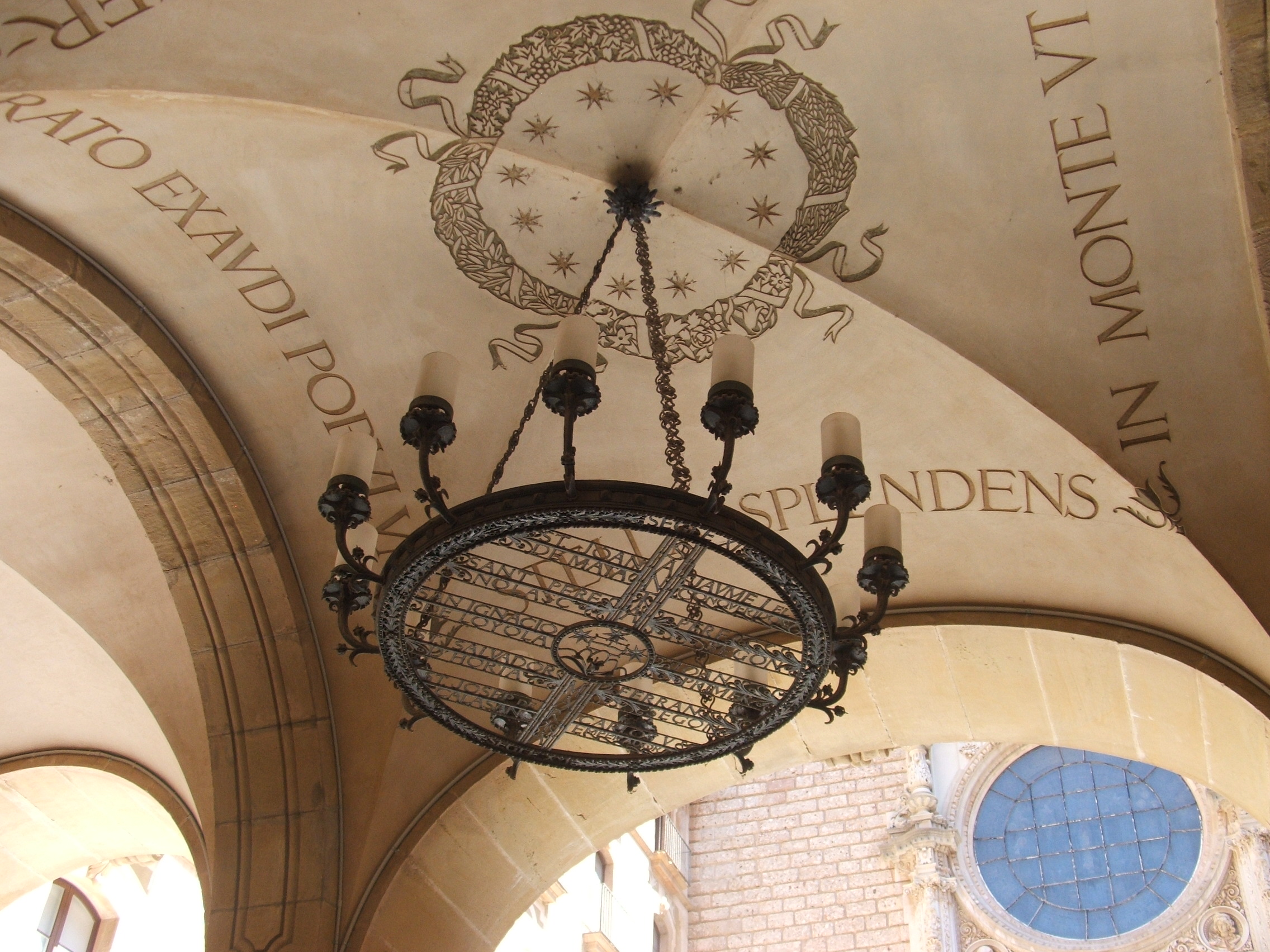
At 720 metres, wedged into the rock, stands the Benedictine abbey of Santa Maria, founded in 1025. Inside is venerated the Moreneta, a Romanesque wooden statue of the Virgin blackened by time and candle soot, patroness of Catalonia: you climb a side staircase to touch the orb she holds, and the queue can be long.
Montserrat’s Escolania is one of the oldest choir schools in Europe, active since the thirteenth century: the boys sing the Virolai in the basilica at midday on weekdays and in the evening; it lasts only a few minutes, and it is worth organising your day around it. The calendar is on the abbey’s website, and there are pauses in summer.
During the Franco dictatorship, Montserrat was one of the few places where mass was celebrated in Catalan and where intellectuals and dissidents found refuge: for Catalans it is not just a shrine, it is a political symbol.
Trails start above the monastery: one to the hermitage of Sant Joan (a funicular plus twenty minutes) and one to Sant Jeroni, the summit, an hour and a half’s climb. From up there, on a clear day, you can see the Pyrenees on one side and the sea on the other.
Buy the combined train + rack railway (or cable car) ticket at the Plaça d’Espanya station: it costs less than buying them separately. The rack railway is slower but more scenic, the cable car is faster and not for those who suffer from vertigo. Leave by nine: in early afternoon the coach tours arrive and everything changes.
The in-town option: Gràcia, the sea and tapas
The whole day · Almost all free · Metro Fontana or Joanic

If you would rather stay in the city, day three is the day of the neighbourhoods. Gràcia was an independent town until 1897, when Barcelona annexed it against the wishes of its residents, and it still has the scale and character of a village: narrow streets, few cars, and a string of small squares with café tables — Plaça de la Vila, Plaça del Sol, Plaça de la Virreina — where people sit at any hour.
The Festa Major de Gràcia, in mid-August, is one of the finest things in Barcelona: streets compete to be the best decorated, each one building a theme from recycled materials, worked on for a whole year.
In the afternoon head down to the sea. Barceloneta is an eighteenth-century grid district with extremely narrow houses, built for those evicted from the neighbourhood razed after 1714. The beach did not exist: until the 1980s the waterfront was a strip of sheds and railway tracks, and the city turned its back on the water. For the 1992 Olympics it was all demolished, sand was brought in by barge, and four kilometres of urban beaches were created: it is considered one of the most successful urban regeneration projects of the twentieth century.

Tapas for dinner, with two warnings: paella is Valencian, not Catalan, and seafront restaurants with photos of it in the window are traps; the local equivalent is fideuà. And dinner is at nine, not before.
If it rains
- Day 1 · the Sagrada is indoors; instead of Park Güell, the Hospital de Sant Pau, a complex of modernist pavilions ten minutes from the Sagrada, far less crowded and almost entirely visitable under cover.
- Day 2 · already almost all indoors: the underground Museu d’Història, the Museu Picasso, the Palau de la Música, the MNAC. Only skip the Font Màgica.
- Day 3 · Montserrat in the fog loses a lot and the trails become dangerous: in that case stay in the city and do Gràcia with the Fundació Miró on Montjuïc, or CosmoCaixa, the science museum with a rebuilt Amazon rainforest inside, the best place in the city with children on a rainy day.
What the three days cost
| Item | Cost |
|---|---|
| Sagrada Família | about €26 |
| Park Güell, monumental zone | about €18 |
| One modernist house (Pedrera or Batlló) | €28-35 |
| Museu Picasso | about €15 |
| Palau de la Música, guided tour | about €20 |
| MNAC | about €12 |
| Montserrat, train and rack railway | €25-40 |
| Santa Maria del Mar, the Barri Gòtic, the Boqueria, the beaches, Gràcia, the Font Màgica | free |
| City transport, 3 days | about €25 |
| Meals, 3 days | €80-120 |
| Total | about €190-300 per person |
Reference figures as of August 2026: check official websites before you travel. In Barcelona tickets weigh more than food, the opposite of what you would expect from Spain. Buy everything online in advance: on-site it costs more and availability often runs out. Many civic museums are free on the first Sunday of the month and on other Sundays from 3pm onward: if your dates line up, build the day around it.
Frequently asked questions
Is three days enough for Barcelona?
Yes, and it is the right length: one day for Gaudí and modernisme, one for the old city and Montjuïc, one for Montserrat or the neighbourhoods and the sea. Sitges, Girona and Tarragona are left out, day trips for a second visit. With two days you stay on the surface, with four you start repeating.
When should you book the Sagrada Família?
As soon as you have your dates, before even the hotel. You can enter only with a timed ticket bought online, and in high season availability runs out weeks ahead. There is no getting in at the ticket office. The same applies, a few days ahead, to Park Güell, Casa Batlló, La Pedrera and the Palau de la Música.
Is Montserrat worth the trip?
Yes, and it is the finest day trip in Catalonia: an hour by train brings you to a Benedictine monastery from 1025 wedged at 720 metres inside a conglomerate mountain eroded into thousands of spires. If you manage to be there when the Escolania sings, the choir school active since the thirteenth century, it is worth the trip on its own. Leave by nine, ahead of the coach tours.
What is the Palau de la Música and why visit it?
It is a 1908 modernist concert hall by Domènech i Montaner, a UNESCO site, and the only concert hall in Europe lit entirely by natural light: the walls are stained glass and an inverted-droplet skylight hangs from the ceiling. Entry is by guided tour only, an hour. If there is a concert in the evening, the cheapest ticket costs about the same as the tour.
Is it worth climbing Montjuïc?
It is the part of Barcelona tourists always look at from below and never visit, and it holds the MNAC with its collection of Romanesque frescoes removed from Pyrenean churches — unique in the world —, the Fundació Miró, the Mies van der Rohe Pavilion and the castle. You go up on public escalators from Plaça d’Espanya or by cable car. The MNAC closes on Mondays.
Casa Batlló or La Pedrera, which is better?
La Pedrera, if you only do one: the roof with the warrior-shaped chimneys, the period apartment and the attic with its parabolic arches are worth more, and it costs less. Look at Casa Batlló’s façade from the opposite pavement anyway: it is free and the finest thing on the block.
Which museums are free in Barcelona?
Many civic museums are free on the first Sunday of the month and other Sundays from 3pm onward: the Museu Picasso, the MNAC, the Museu d’Història, the Museu Frédéric Marès. Always free: Santa Maria del Mar outside guided-tour hours, the Barri Gòtic, the Boqueria, the beaches, the park of Park Güell outside the monumental zone, and the Font Màgica.
What time do you eat, and what should you order?
Lunch between 1:30pm and 3:30pm, dinner from 9pm. At lunch look for the menú del día, €12-16 for a starter, main, bread and a drink. The genuinely Catalan things are pa amb tomàquet, escalivada, calçots in winter, the bombas of Barceloneta, fideuà and crema catalana. Paella is Valencian, and here it is made for tourists.
Is Barcelona safe?
Yes for violence, no for pickpocketing, which is a real, organised problem: the Rambla, the metro toward the Sagrada, the beach. Bag in front in crowds, phone never in a back pocket, bag never hung on the back of a chair at outdoor tables. With these precautions, nothing happens.
Do people speak Catalan or Spanish?
Both. Catalan is the primary language of signs, menus and schools, and it is not a dialect of Spanish but a Romance language in its own right. Everyone also speaks Castilian and no one minds if you use it, but a bon dia and a gràcies get noticed and appreciated.
September 3, 2026


