

Barcelona in 1 day: Gaudí, the old town and the sea
Barcelona works better in one day than almost any other European city, for a geographical reason: the old town is a compact medieval maze, and everything else runs along two straight axes the nineteenth century laid out with a ruler. The problem is not walking, it is booking: the Sagrada Família and Park Güell have time slots that sell out weeks in advance, and anyone who turns up without a ticket does not get in, full stop. This itinerary puts the Sagrada early in the morning, crosses the modernist district, drops into the Barri Gòtic for lunch and ends by the sea.
At a glance
- How long · a full day, from 9am to 10pm
- How much walking · about 8 km on the flat, plus two metro rides
- What has to be booked · Sagrada Família weeks ahead, Park Güell and Casa Batlló at least a few days ahead
- Budget · €55-110 per person excluding accommodation: here tickets weigh more than food
- Starting point · Sagrada Família, metro lines L2 and L5
- Finishing point · Barceloneta, by the sea
- Timing · lunch is at half past one and dinner at nine: try earlier and you will find the kitchens closed
- What is left out · Montjuïc, the Palau de la Música, Gràcia, the MNAC: those are day two
Eight stops. The two metro rides are between stops 6 and 7, and between 7 and 8.
Morning — Gaudí and the Eixample
2.5 km · 3 stops · 9am to 1pm · all along the straight nineteenth-century streets
1 – Sagrada Família
Time needed 1.5 hours · Ticket about €26, €36 with a tower · Book weeks ahead: without a ticket you do not get in
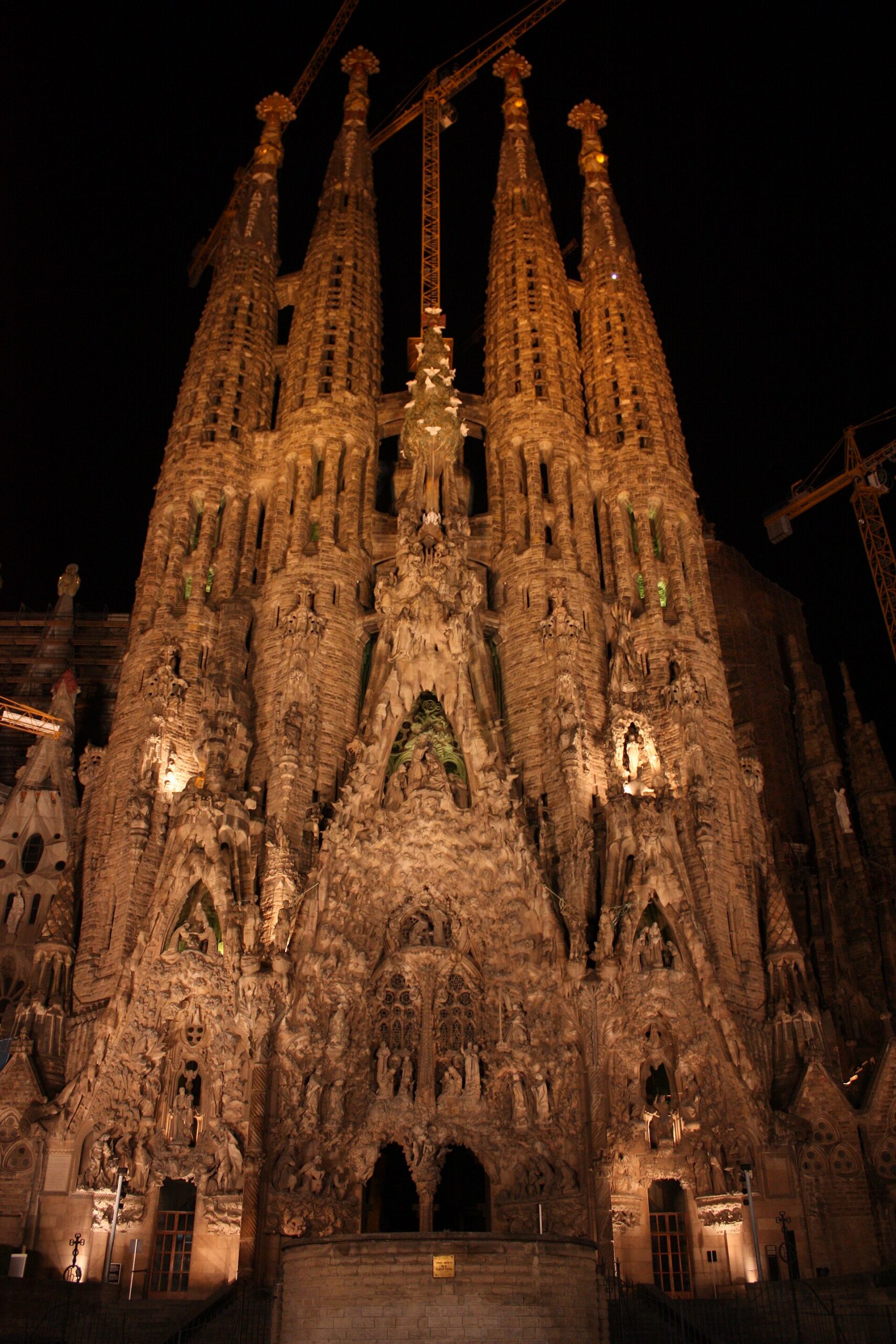
Go here first, with the nine o’clock slot: the morning light comes through the Nativity façade, which faces east, and the interior is still empty.
The site has been under construction since 1882. Antoni Gaudí took over the following year, at thirty-one, and worked on it for forty-three years, the last twelve exclusively, living inside the construction site. He died in 1926, hit by a tram: he was dressed so shabbily that he was mistaken for a beggar and taken to the paupers’ hospital, where he was recognised only the next day. He is buried in the crypt of the church he was building.
At his death it was about a quarter finished. Work has continued ever since, funded only by donations and ticket sales — no public money, by Gaudí’s wish — and it survived the burning of the original drawings in 1936, during the civil war: the plaster models were pieced back together from fragments, a job that took decades. The Tower of Jesus Christ, the tallest, will bring the building to 172.5 metres: a metre and a half short of Montjuïc, because Gaudí believed the work of man should not surpass that of God.
Inside happens the thing the ticket is for. The columns branch like trees to carry the load diagonally — a structural solution Gaudí worked out by observing nature, doing away with Gothic flying buttresses, which he called «crutches» — and the stained glass is split by temperature: blues and greens to the east, which light up in the morning, oranges and reds to the west, which light up at sunset. It is not decoration, it is a light calendar.
The three façades tell three moments: the Nativity, the only one Gaudí finished, full of life and detail carved from casts of real people and animals; the Passion, from the 1980s, angular and stripped bare, which enraged half of Barcelona; and the Glory, still incomplete.
The towers are climbed with a separate ticket and a lift, but you come down on foot via a narrow spiral staircase with no handrail: if you suffer from vertigo or claustrophobia, skip it. From inside you cannot see the church from outside: for the classic photo, go out and cross to the Plaça de Gaudí, where the pond reflects it.
2 – Casa Milà, La Pedrera
Time 15 minutes from outside, 1.5 hours inside · Ticket about €28 · Walk 20 minutes, or metro L5

You walk down through the Eixample, the grid district designed by Ildefons Cerdà in 1859 to let a city suffocating inside its medieval walls breathe. Look at the intersections: the block corners are cut at 45 degrees, and it is not an aesthetic flourish — Cerdà designed them that way so trams had room to turn and more light could get in. It is the most rational nineteenth-century town plan in Europe, and it still works.
Casa Milà, which everyone calls La Pedrera (the stone quarry), is Gaudí’s last civil work, from 1912. The façade is a wave of limestone without a single straight line, and it carries no load: the structure rests on internal pillars, so the walls can be positioned however you like. It was revolutionary, and the neighbours thought it hideous.
If you go in, head for the roof: an undulating surface with chimneys shaped like helmeted warriors, which George Lucas borrowed for the imperial stormtroopers in Star Wars. If you do not go in, the doorway on carrer de Prov&ecedil;a is often open and you can see the atrium for free.
3 – Casa Batlló and the Illa de la Discordia
Time 15 minutes from outside, 1 hour inside · Ticket about €35 · Walk 8 minutes
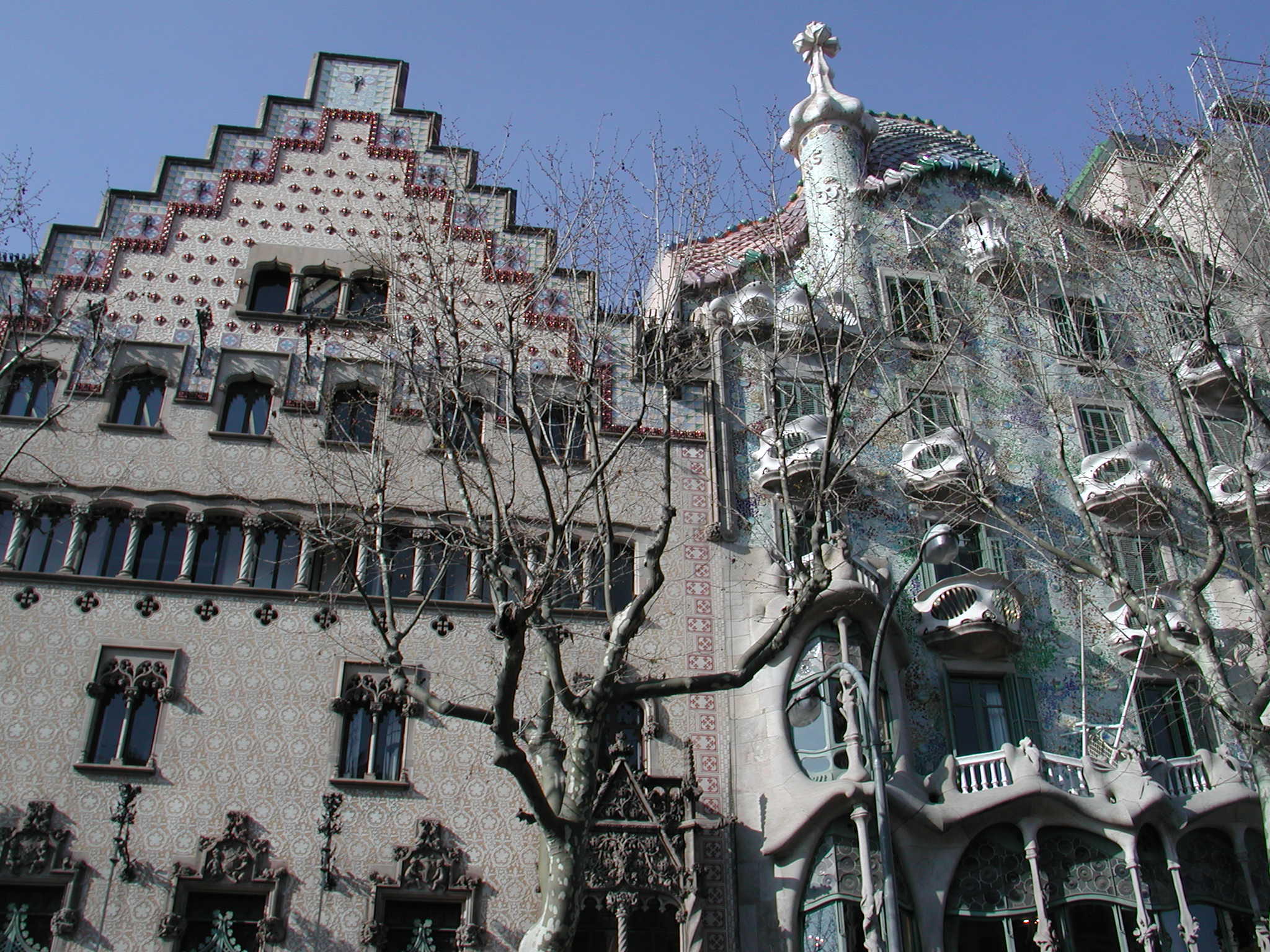
Three blocks further down, on passeig de Gràcia, is a block Barcelonians call the Illa de la Discordia, the block of discord: four neighbouring buildings, remodelled in the same decade by the four most important modernist architects, in open competition with each other. You can see them for free, from the opposite pavement, and it is an open-air lesson in architecture.
Gaudí’s Casa Batlló is the most famous and tells a story: the scaled roof is the dragon’s back, the turret with the cross is Saint George’s lance driven into the beast, and the balconies are masks or skulls. Saint George — Sant Jordi — is the patron saint of Catalonia, and this is his legend built into an apartment block.
The ticket is the most expensive of the three: thirty-five euros for an hour. If you have to choose only one between Batlló and Pedrera, our preference goes to the Pedrera, for the roof and the reconstructed period apartment; but Batlló’s façade from outside is unmissable and costs nothing.
First rule of Spain: at midday the kitchens are closed. Lunch runs between 1:30pm and 3:30pm, and if you walk into an empty restaurant at one o’clock, you are in a tourist trap. Look for the menú del día: starter, main, bread and a drink for €12-16 on weekdays, the best way to eat well cheaply anywhere in Spain. In the Eixample, the side streets off passeig de Gràcia — carrer d’Aragó, carrer del Consell de Cent — have real neighbourhood spots two minutes from the boutique strip. On the Rambla, where you are headed, do not eat: it is the city’s best-known trap.
Midday — The old town
2 km · 3 stops · 1:30pm to 5pm · almost nothing costs money here, and getting lost is the point
4 – La Boqueria and the Rambla
Time 45 minutes · Free · Closed on Sundays · Metro Liceu
The Rambla is the pedestrian avenue running from Plaça de Catalunya down to the sea, one point two kilometres. It was the bed of a seasonal stream — ramla in Arabic means exactly that — covered over in the eighteenth century and turned into a promenade. Today it is expensive, crowded and has a genuine pickpocketing problem: walk through it, do not eat or sit on it.
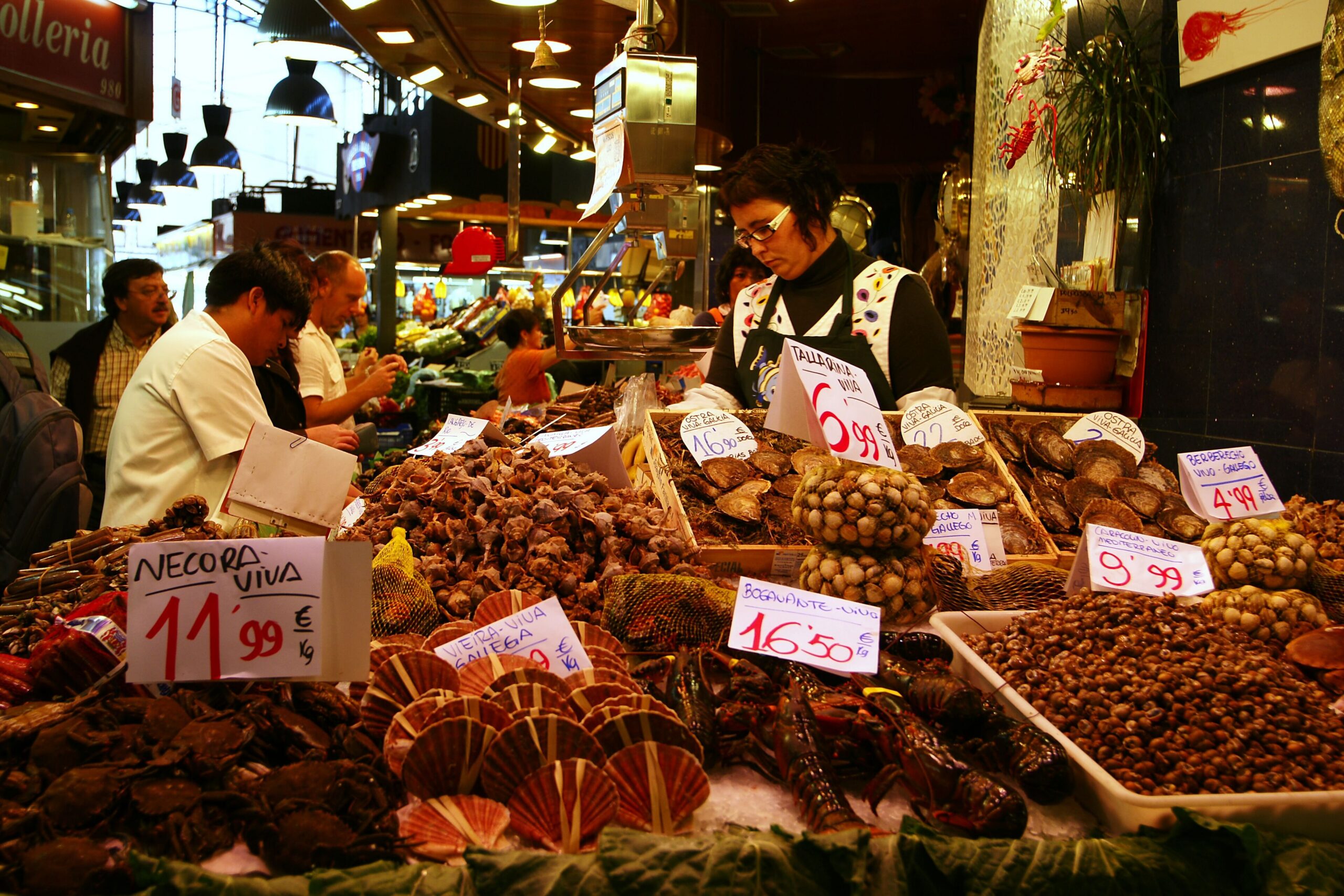
Halfway down, on the right, the Mercat de la Boqueria opens up. The market has existed since 1217, the iron-and-glass roof dates from 1914, and it is the finest food market in Spain: stalls of cut fruit, hanging hams, fish, mushrooms, eggs of every kind. The rule to avoid mistakes: the first stalls at the entrance are for tourists, with absurdly priced fruit cups. Go to the back, where the restaurateurs buy, and sit at a counter with stools — Pinotxo and Kiosko Universal are institutions — and eat whatever is fresh that day.
On the pavement of the Rambla, in front of the Liceu theatre, is a circular Joan Miró mosaic from 1976: thousands of people walk over it daily without noticing. Miró put it there on purpose, at the midpoint of the avenue, as a greeting to those arriving in the city from the port.
5 – Barri Gòtic and the cathedral
Time 1.5 hours · Cathedral about €11 · Walk cross the Rambla
The Barri Gòtic is the old core, and underneath it lies Roman Barcino: fragments of walls and aqueduct still poke up between the houses, and in the basement of the Museu d’Història, in Plaça del Rei, you walk through four thousand square metres of Roman city, with vats for salting fish and a wine-making facility.
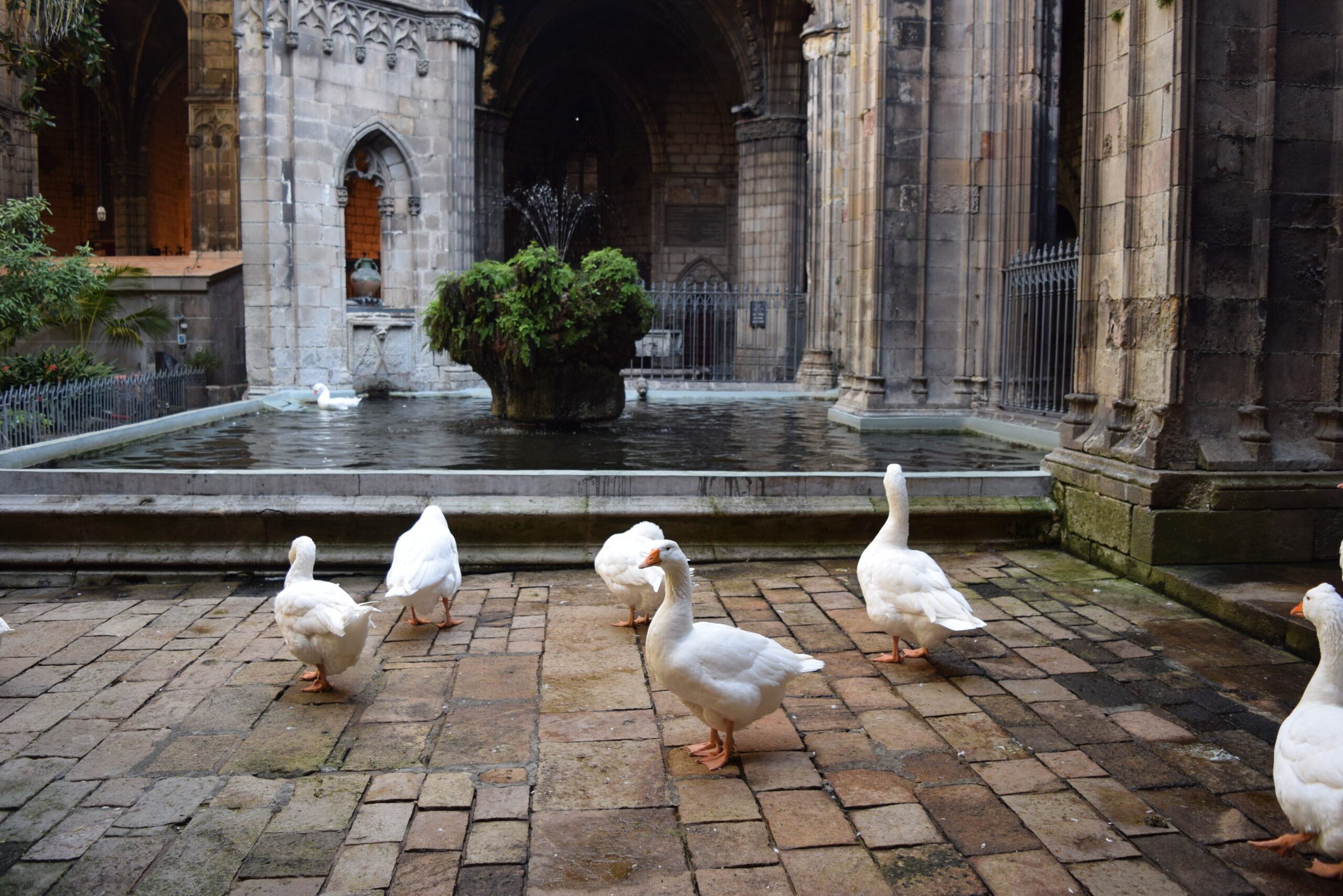
The Cathedral of Santa Eulalia dates from the fourteenth century, with a neo-Gothic façade added in the nineteenth. The thing to see is not the nave: it is the cloister, with palm trees, a fountain and thirteen white geese that have lived there for centuries — as many as Eulalia’s years when she was martyred. In the crypt beneath the altar is her alabaster sarcophagus.
Around it, the best thing to do is get lost: the Pont del Bisbe, the neo-Gothic footbridge between two palaces that everyone photographs and which dates from 1928, not the Middle Ages; the quiet Plaça Sant Felip Neri, its church walls still pockmarked by shrapnel from an Italian bomb in January 1938 that killed forty-two people, mostly children sheltering in the basement; Plaça Reial, with palm trees and lampposts designed by a young Gaudí, his first public commission.
6 – Santa Maria del Mar and the Born
Time 45 minutes · Free entry outside guided-tour hours · Walk 10 minutes east
Cross Via Laietana into the Born, the medieval district of merchants and sailors. Here stands the most beautiful church in Barcelona, and it is not the cathedral: Santa Maria del Mar.
It was built in fifty-five years, from 1329 to 1383, which for a Gothic church is lightning fast, and that explains why it is the way it is: a single style, no second thoughts, no additions from later centuries. It was built by the dockworkers and porters of the district, who carried the stone from the Montjuïc quarry on their backs for free: on the main door two bastaixos, the porters, are carved, the only European Gothic monument dedicated to the people who physically built it.
Inside, the octagonal columns stand thirteen metres apart, the widest span in medieval Gothic, creating a single, broad, bright space without the divisions of northern cathedrals. In 1936 an eleven-day fire burned all the baroque furnishings accumulated over the centuries: paradoxically, it returned the church to its fourteenth-century bareness. The blackened structures above the columns are still scorched, and they were left that way.
Next to it is the Fossar de les Moreres, a red-paved square with an eternal flame: it is the mass grave of Barcelona’s defenders who fell in the siege of 1714, when the city fell to Bourbon troops and Catalonia lost its institutions. 11 September, the anniversary of that defeat, is the Catalan national day: a country that celebrates the day it lost, which says quite a lot.
Afternoon and evening — The park and the sea
3 km · 2 stops · 5pm to 10pm · two metro rides, then you stay put
7 – Park Güell
Time 1.5 hours · Ticket about €18 for the monumental zone, rest of the park free · Book ahead · Metro L3 to Lesseps or Vallcarca, then 15 minutes uphill

Park Güell began as a property failure. In 1900 the industrialist Eusebi Güell, Gaudí’s patron, bought a bare hill outside the city to turn it into an English-style luxury housing estate: sixty plots with gardens, for the well-to-do middle class. He sold two in fifteen years. It was too far out, the hill was steep, and wealthy Barcelonians wanted to live in the Eixample. In 1914 the project was abandoned, and in 1926 the city council bought it and turned it into a public park.
What remained were the communal areas — the masterpiece itself: the stairway with the ceramic salamander — which Barcelonians call el drac and is the city’s emblem on every postcard —, the hypostyle hall with eighty-six leaning Doric columns, meant to be the neighbourhood market, and above it the great terrace with the undulating bench, a hundred and ten metres long.
The bench is covered in trencadís, the mosaic made from broken tile fragments and industrial offcuts: a technique Gaudí made famous, born from reusing waste material. The curve is genuinely ergonomic: legend has it a worker sat naked in wet plaster to get the shape right. Below the terrace, the hypostyle hall has a floor that collects rainwater and channels it through the hollow columns into a cistern: it was a working water system, not decoration.
Since 2013 the monumental zone has been ticketed and capped: you book a time slot, and arrive late and you do not get in. The rest of the park, which is large and has its own viewpoints, remains free. Allow for the climb: twenty minutes uphill from the metro, eased by a few public escalators.
8 – Barceloneta and the sea
Time 2 hours · Free · Metro L4 to Barceloneta, 25 minutes

The day ends by the sea, and it is worth knowing that this beach did not exist. Until the 1980s, Barcelona’s waterfront was a strip of industrial sheds, railway tracks and shacks, and the city turned its back on the water. For the 1992 Olympics it was all demolished, sand was brought in by barge, and four kilometres of urban beaches were created. It is considered one of the most successful urban regeneration projects of the twentieth century, and it changed the city’s identity within a decade.
The Barceloneta district, by contrast, dates from the eighteenth century: built on a grid to house residents evicted from the neighbourhood razed to make way for the Ciutadella fortress after the 1714 siege. The houses are narrow and very low, the streets form a miniature grid, and washing still hangs from the windows.
For dinner: bombas — potato croquettes stuffed with meat, served with spicy sauce, invented here — and paella, with one clear warning: paella is Valencian, not Catalan, and the seafront restaurants with photos of it and per-person prices on the menu are traps. The local dish is really fideuà, the same idea made with short pasta instead of rice. Dinner is at nine, not before.
If it rains
It does not rain much in Barcelona, but when it does, it is sudden and heavy. Easy substitutes:
- Instead of Park Güell · the Palau de la Música Catalana, a 1908 modernist concert hall with a stained-glass skylight shaped like an inverted droplet: visited by guided tour, an hour, and a UNESCO site. Or the Hospital de Sant Pau, a complex of modernist pavilions ten minutes from the Sagrada, far less crowded than everything else.
- Instead of Barceloneta · the Museu Picasso, in the Born, holding mostly his early works — Picasso trained here — housed in five connected medieval mansions.
- Always works · the Roman basement of the Museu d’Història in Plaça del Rei: four thousand square metres of ancient city below street level, while it rains above.
What the day costs
| Item | Cost |
|---|---|
| Sagrada Família | about €26, €36 with a tower |
| Park Güell, monumental zone | about €18 |
| Casa Batlló or La Pedrera, if you go in | €28-35 |
| Cathedral | about €11 |
| Santa Maria del Mar, the Boqueria, Barri Gòtic, the beach | free |
| Metro, 10-ride ticket | about €12 |
| Lunch, menú del día | €12-16 |
| Tapas dinner | €20-30 |
| Total without the modernist houses | about €55-75 |
| Total with everything | about €95-110 |
Reference figures as of August 2026: check official websites before you travel. In Barcelona tickets weigh more than food, the opposite of what you would expect from Spain: the Sagrada, Park Güell and the Gaudí houses alone exceed eighty euros. Buy everything online in advance: on-site it costs more, and availability often runs out.
Getting around
Barcelona is compact and mostly flat, except for the climb to Park Güell and Montjuïc. The metro has eight lines, clean and frequent; the ten-ride ticket (T-casual) pays off, though it needs validating once per person — a shared single-person card does not stretch across a group travelling together, that is a different multi-person pass. A single ride costs around €2.60, the carnet brings it down to just over a euro a ride.
From El Prat airport: the metro’s L9 Sud line reaches the city with one change and is the cheapest option, the Aerobus reaches Plaça de Catalunya in thirty-five minutes, and the Renfe train connects to Sants station. Watch out for flights to Girona and Reus, sold as «Barcelona»: they are an hour and a half away by coach.
Two practical warnings. Pickpocketing in Barcelona is a real, systematic problem, concentrated on the Rambla, on the metro toward the Sagrada, and on the beach: bag in front, never a phone in a back pocket, never a bag hung on the back of a chair at outdoor tables. And the city is bilingual: Catalan is the primary language of signs and menus, and it is not a dialect of Spanish but a language in its own right. Everyone also speaks Castilian, but a bon dia and a gràcies get noticed.
Frequently asked questions
Is one day enough to see Barcelona?
It is enough for the Sagrada Família, the modernist Eixample, the Barri Gòtic with the cathedral and Santa Maria del Mar, Park Güell and the sea. Montjuïc with the MNAC and the Miró Foundation, the Palau de la Música, the Museu Picasso and the Gràcia district are left out. It is a full, well-packed day, but Barcelona is a three-day city.
Do you need to book the Sagrada Família?
Yes, and it is compulsory: you can only enter with a timed ticket bought online, and in high season availability runs out weeks in advance. Anyone who shows up at the ticket office hoping to get in will not. Book as soon as you have your travel dates: it is the first thing to sort out for Barcelona, before even the hotel.
Is Park Güell free?
Partly. Since 2013 the monumental zone — the stairway with the salamander, the hypostyle hall, the terrace with the undulating bench — has been ticketed and capped, with a time slot to book, around €18. The rest of the park, which is large and has fine views over the city, remains free and can be visited freely.
Casa Batlló or La Pedrera, which is better?
If you can only do one, La Pedrera: the roof with the warrior chimneys, the reconstructed period apartment and the attic with its parabolic arches are worth more than the Casa Batlló route, which is very dramatic but shorter and pricier. Look at Batlló’s façade anyway: from outside it is free and the finest thing on the block.
What time do people eat in Barcelona?
Lunch runs between 1:30pm and 3:30pm and dinner from 9pm onward. Walk into a restaurant at 12:30pm or 7:30pm and find it empty, and you are in a tourist spot. At lunch look for the menú del día, which on weekdays costs €12-16 for a starter, main, bread and a drink, the best way to eat well cheaply.
Do you eat paella in Barcelona?
Paella is Valencian, not Catalan: here it is made for tourists, and seafront restaurants with photos of the dish and per-person prices on the menu should be avoided. The local equivalent is fideuà, made with short pasta instead of rice. The truly Catalan things are pa amb tomàquet, escalivada, the bombas of Barceloneta and crema catalana.
Is Barcelona dangerous for pickpocketing?
The risk of violent theft is low, but pickpocketing is high and organised: the Rambla, the metro toward the Sagrada Família and the beach are the hotspots. Bag in front in crowds, never a phone in a back pocket, never a bag hung on the back of a chair at outdoor tables. With these three precautions, nothing happens.
How much does a day in Barcelona cost?
Between €55 and €75 per person with the Sagrada and Park Güell, between €95 and €110 adding a modernist house. The surprise is that tickets weigh more than food: eating is cheap, entering Gaudí’s monuments is expensive. Always buy online in advance, because on-site it costs more and there is often no availability.
When will the Sagrada Família be finished?
The Tower of Jesus Christ, which will bring the building to 172.5 metres, is the last major structure to complete; then remain the Glory façade and the access works, which involve an open planning question because they affect existing buildings. The announced dates have been revised repeatedly over a hundred and forty years of construction: the building continues only through donations and ticket sales, with no public money, by Gaudí’s wish.
Do people speak Spanish or Catalan in Barcelona?
Both, and Catalan is the primary language of signs, menus and schools. It is not a dialect of Spanish but a Romance language in its own right, closer to Occitan. Everyone also speaks Castilian and no one minds if you use it, but a bon dia, a si us plau and a gràcies change the tone of the conversation.
September 3, 2026


