

Vienna in 5 days: Habsburgs, music, lakes, and mountains
Vienna has something no other European capital has: it is an hour by train from another capital. Bratislava is sixty kilometres away, making them the closest pair of capitals on the continent. With five days you cover the three days in the city — the Habsburgs, turn-of-the-century Vienna, the Danube — and then head out twice: a day in Slovakia, and one on the Semmering railway, the first mountain railway in Europe and a UNESCO World Heritage Site. Anyone who prefers Mozart to trains can swap day five for Salzburg. One base, suitcase never reopened.
At a glance
- How long · five full days, with a single base in Vienna
- How much walking · 6-8 km a day in the city; Bratislava has a climb up to the castle
- What has to be booked · Schönbrunn with a time slot and, if you choose Salzburg, the railjet well ahead
- Budget · €300-500 per person for the five days, excluding accommodation
- Documents · Bratislava is another country but it is in Schengen and the euro: you go there like you would go to Graz
- Day to avoid · Monday, when several Viennese museums close
- What is still left out · Graz, Hallstatt, Budapest: those are another trip
One colour per day. Bratislava is east, the Semmering south, the Wachau and Salzburg west: all reachable by train from the same base.
The first three days
These stay the same as the three-day itinerary: the Habsburg day, the turn-of-the-century day and the day on the Danube. If you arrive here from the three-day version, skip straight to day four.
Day 1 – The Habsburgs
7 km · Schönbrunn, Hofburg, Stephansdom, Belvedere, a historic coffee house

Morning at Schönbrunn, the 1,441-room summer residence where a six-year-old Mozart played for Maria Theresa; afternoon between the Hofburg — not a palace but a district grown over seven centuries — and the Stephansdom. Evening at the Belvedere for Klimt’s The Kiss, then a coffee sitting down, which in Vienna is an institution, not just an order.
Day 2 – Turn-of-the-century Vienna
8 km · Kunsthistorisches, the Secession, Loos, Freud, Hundertwasserhaus, a Heuriger

The day almost no one does, and the one that explains the city: the fifteen years in which Freud, Klimt, Schoenberg, Wittgenstein and Loos worked in the same coffee houses. It ends up on the hills at Grinzing, in a Heuriger, drinking the year’s wine in the growers’ courtyards.
Day 3 – The Danube and the Wachau
The whole day · train to Melk, boat to Krems

An hour by train to the Benedictine abbey of Melk, then two hours by boat down the Wachau through terraced vineyards to Krems. A UNESCO World Heritage Site, and in summer it can be done by bicycle on the Danube bike path.
Day 4 — Bratislava, another capital an hour away
The whole day · train from Wien Hauptbahnhof, about one hour · in summer also by hydrofoil on the Danube
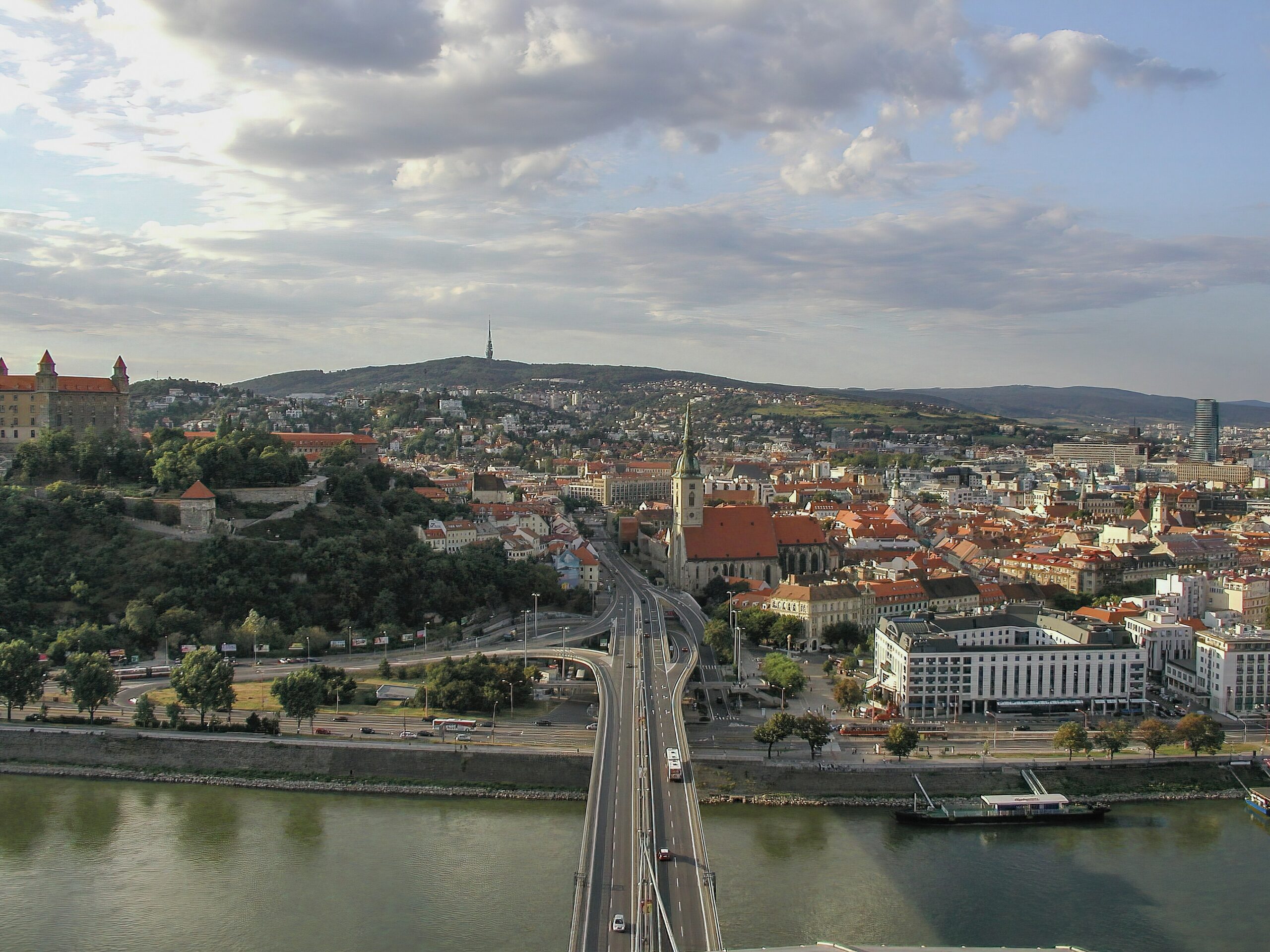
Vienna and Bratislava are the two closest capitals in Europe: sixty kilometres, an hour on a regional train, departures every half hour. It sounds like a quiz fact, but it is actually the best way to understand this part of the continent: until 1918 they were part of the same monarchy, then for forty years the Iron Curtain ran right between them, and today you can go back and forth in a day for a few dozen euros.
The ticket to ask for is called EURegio and usually includes Bratislava’s public transport too: ask for it specifically at the counter or look for it in the Austrian railways’ app, since it costs much less than two separate fares. Slovakia is in Schengen and the euro: no currency to change, no border, you get off and start walking.
The castle and the old town
3-4 hours · Castle grounds free, museum about €12 · Cathedral free will donation · all on foot, with one climb
The castle is the white, four-towered block visible from half the city: it burned down in 1811, stood as a ruin for a century and a half, and was rebuilt in the 1960s, so what you visit today is largely modern. You climb up for the view, which reaches into Austria and Hungary: Bratislava is the only capital in the world bordering two countries.
Below it stands St. Martin’s Cathedral, and here the history gets serious: for almost three centuries, between 1563 and 1830, this was the coronation church of the kings of Hungary, because Buda was in Turkish hands and the kingdom’s capital had moved here. Eleven kings and eight queens were crowned here, including Maria Theresa in 1741. On the spire, in place of a cross, sits a three-hundred-kilogram gilded crown.
The old town takes a couple of hours to walk and is small, pedestrian and cheerful: St. Michael’s Gate, the only one left of the four medieval gates; the pink Primate’s Palace, where the Peace of Pressburg was signed in 1805 after Austerlitz; and the bronze statues scattered around the streets, including Cumil, the worker popping out of a manhole with the look of someone on a break, now the city’s unofficial mascot.
The UFO bridge and, with time to spare, Devín
2 hours · Bridge lift about €12, discounted if you order something · Devín bus 29, 25 minutes
The Most SNP, known to everyone as the UFO bridge, has a disc suspended eighty-five metres up holding a restaurant and observation deck. It is Bratislava’s postcard image, but it carries a bitter history: to build it, between 1967 and 1972, most of the Jewish quarter was demolished, synagogue included. Where the synagogue stood there is now a black stone memorial.
If two hours remain, the bus goes to Devín Castle, a ruin on a crag exactly where the Morava flows into the Danube. For forty years that confluence was the border between the two blocs, guarded and mined: there is a monument to people killed trying to cross the river westward. Today a bike path runs through it all the way to Vienna.
Bratislava has good food for less than Austrian prices: try bryndzové halušky, potato dumplings with sheep’s cheese and bacon, the national dish. The beer is excellent and costs about half what it does in Vienna.
Day 5 — The Semmering, or Salzburg
A clear choice · the Semmering takes half a day and leaves the afternoon in Vienna · Salzburg takes the whole day
Option A – The Semmering railway
Morning · Regional train from Wien Hauptbahnhof, 1 hour 20 · About €30 return · no special ticket needed

The Semmeringbahn was built between 1848 and 1854 to a design by Carl von Ghega, and is the first standard-gauge mountain railway in Europe: forty-one kilometres, fourteen tunnels, sixteen viaducts and more than a hundred curved stone bridges, hand-built by twenty thousand workers in six years. When it was designed, locomotives capable of climbing those gradients did not yet exist: they were built afterwards, specifically for it. Since 1998 it has been a UNESCO World Heritage Site, the first railway in the world to make the list.
The good part is that it is not a tourist train: it is the normal line to Graz, used by regional and railjet services, and you board with an ordinary ticket and get off wherever you like. The spectacular stretch runs between Payerbach-Reichenau and Semmering, twenty minutes in which the line spirals upward, climbing four hundred metres.
If you want to walk, get off at Breitenstein and take the Bahnwanderweg, the path running alongside the tracks: in about two hours, almost entirely flat, you pass above and below the viaducts and reach the «20-Schilling-Blick» viewpoint, named because the view of the Kalte Rinne viaduct was printed on the old twenty-schilling banknote. Take the train back from the next station: services run hourly.
Option B – Salzburg
The whole day · Railjet from Wien Hauptbahnhof, about 2.5 hours · €40-110 return depending how early you book

Salzburg can be done in a day from Vienna, but it is worth being honest about the numbers: it is five hours of train there and back, so you leave at seven and return at nine in the evening. It is worth it if Mozart and the baroque are the reason for the trip; if you are after a relaxed day, the Semmering gives you much more for much less.
The ticket makes all the difference: Sparschiene fares cost a fraction of the full price, but must be bought weeks ahead and are tied to that specific train. Bought on the day, the railjet costs three times as much.
In the city: the Hohensalzburg fortress, begun in 1077 and one of the largest fortresses in Europe still intact, reached by funicular; the Getreidegasse with its wrought-iron signs and Mozart’s birthplace at number 9; the baroque cathedral where Mozart was baptised and worked as organist; and the Mirabell gardens, which almost everyone recognises without knowing why — they were filmed in The Sound of Music. The old town has been a UNESCO World Heritage Site since 1996.
Between late July and August the Salzburg Festival takes over: the city is beautiful and packed solid, hotel prices double, and concert tickets sell out by spring. Worth knowing in advance, not discovering at the station.
Afternoon – The Vienna nobody visits
Only with option A · Everything free except transport · tram 71 and bus 38A
If you did the Semmering, you are back by lunchtime, and the afternoon can go toward the Vienna that never makes the guidebooks.
The Zentralfriedhof is the central cemetery, opened in 1874, and it is not a macabre visit: it is a nearly three-square-kilometre park, with real deer, where about three million people rest — more than the number of Viennese alive today. In group 32A, Beethoven, Schubert, Brahms, Gluck and both Strausses, father and son, lie close together around a monument to Mozart, who is not actually buried there: his mass grave at St. Marx was never identified. A little further on, in group 40, is Falco’s grave. You get there on tram 71, and in Vienna saying someone took the 71 means they died.

Then, heading back north, the Karl-Marx-Hof: a social-housing block over a kilometre long, built between 1927 and 1930 by Red Vienna, with over a thousand flats, laundries, nurseries and clinics. In February 1934 it was fought over during the Austrian Civil War, and the marks are still visible. It is an idea of the city that has survived: in Vienna today, about one resident in four still lives in municipal housing, one reason rents here are not what they are in Paris.
You close the day up on the Kahlenberg, 484 metres, bus 38A from Heiligenstadt: from up there you see the whole city with the Danube and, on clear days, the plain stretching to Slovakia. From this hill, on 12 September 1683, the troops of John III Sobieski descended to break the Ottoman siege, in what is remembered as the largest cavalry charge in history: it is the reason Vienna looks the way it does. If you still have energy, walk down to Grinzing in an hour and have dinner there.
If it rains, or if it is very hot
- Day 3, the Wachau · the boat does not run in winter and makes little sense in the rain. Swap it with day 4: Bratislava is easy to visit even wet, and has museums.
- Day 5, the Semmering · in fog you see nothing and the path gets slippery. It is the first day to swap, or the one to replace with option B.
- Indoors in Vienna · the Albertina, the Leopold Museum with the world’s largest Schiele collection, the Haus der Musik with its interactive floors, or the Technisches Museum if you have children with you.
- In summer · the afternoon goes in the water: the Donauinsel is a twenty-one-kilometre artificial island in the middle of the Danube, with free public beaches, reached by metro.
What the five days cost
| Item | Cost |
|---|---|
| Schönbrunn, Hofburg, Belvedere | €60-70 |
| Kunsthistorisches, Secession, Freud Museum | about €48 |
| Wachau: train, Melk Abbey, boat | about €60 |
| Bratislava: return train with the EURegio | about €20 |
| Semmering: return regional train | about €30 |
| or Salzburg: return railjet | €40-110 depending on booking time |
| Zentralfriedhof, Karl-Marx-Hof, Kahlenberg, the Ring | free |
| Urban transport, 5 days | about €25 |
| Meals, 5 days | €150-250 |
| Total | about €300-500 per person |
Reference figures as of August 2026: check official websites before you travel. The two items that can blow the budget are a last-minute Salzburg railjet and the historic coffee houses, where a cake and a coffee for two can easily reach twenty euros. The Vienna City Card only pays off if you use public transport heavily: the museum discounts are small.
Frequently asked questions
Is five days too many for Vienna?
For the city alone, probably yes; for the region, no. From Vienna, in an hour or a little more, you can reach another capital, a UNESCO World Heritage valley, and the first mountain railway in Europe. Five days from a single base is a trip through Central Europe, not a city break.
How far is Bratislava from Vienna?
Sixty kilometres, about an hour on a regional train from Wien Hauptbahnhof, departing every half hour. They are the two closest capitals to each other in Europe. In summer there is also a hydrofoil up the Danube, slower and more expensive but far more scenic.
Do you need a passport to go to Slovakia?
No: Slovakia is in the European Union, in Schengen and the euro. An ID card is enough, there are no border checks, and there is no currency to change. Ask for the EURegio ticket, which usually includes Bratislava’s public transport too.
What is the Semmering railway?
The first standard-gauge mountain railway in Europe, built between 1848 and 1854 by Carl von Ghega: forty-one kilometres, fourteen tunnels and sixteen viaducts, designed when locomotives capable of climbing it had not yet been built. Since 1998 it has been a UNESCO World Heritage Site, the first railway in the world to make the list.
How do you ride the Semmering railway?
Like any other train: it is the normal line to Graz. Board at Wien Hauptbahnhof, get off at Payerbach-Reichenau or at Semmering, and no special ticket is needed. Walkers take the Bahnwanderweg alongside the tracks, mostly flat.
Can Salzburg be done as a day trip from Vienna?
Yes, but it is five hours of train there and back: you leave early and return late. It makes sense if Mozart and the baroque are the reason for the trip. Book the railjet weeks ahead: the Sparschiene fare costs a fraction of the full price.
Is the Zentralfriedhof worth it?
Yes, and it is one of the most Viennese things you can do. It is a huge park with about three million people buried, and in group 32A Beethoven, Schubert, Brahms and both Strausses lie close together. The Mozart monument is just a monument: his grave at St. Marx was never found. Entry is free.
What is the Karl-Marx-Hof?
A social-housing block over a kilometre long, built by «Red Vienna» between 1927 and 1930, with over a thousand flats and shared facilities. In February 1934 it was one of the fronts of the Austrian Civil War. You view it from outside, it is free, and it explains why one in four Viennese still lives in municipal housing today.
How much do five days in Vienna cost?
Between 300 and 500 euros per person excluding accommodation, with Bratislava and the Semmering included. Swapping in Salzburg for the Semmering pushes it higher, and by how much depends entirely on how early you book the train.
When is the best time to go?
May-June and September-October for the weather and for the Wachau boat, which does not run in winter. December for the Christmas markets, a serious institution here; January and February for ball season, with over four hundred balls across the city.
September 5, 2026


