

Madrid in 5 Days: With Toledo, Segovia and the Escorial
Madrid has a position no other European capital has: it sits exactly at the centre of the peninsula, and it was put there on purpose. The result is that from here, half an hour away by high-speed train, you can reach three cities that are each a UNESCO World Heritage Site. With five days you cover the two days of the city, and then Toledo, Segovia and the Escorial: a thousand years of Spain in three day trips, without ever changing hotel. It is the best way to use Madrid.
At a glance
- How long · five full days, with a single base in Madrid
- How much walking · 7-9 km a day; Toledo and Segovia have real climbs
- What has to be booked · the high-speed trains to Toledo and Segovia, which have assigned seats and rising prices
- Budget · €260-420 per person for the five days, excluding accommodation
- Free time slots · the Prado, Reina Sofía and Thyssen all have them, daily
- Best day for the Rastro · Sunday morning
- What is left out · Cuenca, Salamanca, Ávila, Cordoba: those are a second trip
One colour per day. Toledo is south, Segovia north, the Escorial north-west: all under an hour away.
The first three days
These stay the same as the three-day itinerary: two in the city and one in Toledo.
Day 1 – The Habsburgs, the Prado, Guernica
7 km · Royal Palace, Plaza Mayor, La Latina, Museo del Prado, Retiro, Reina Sofía
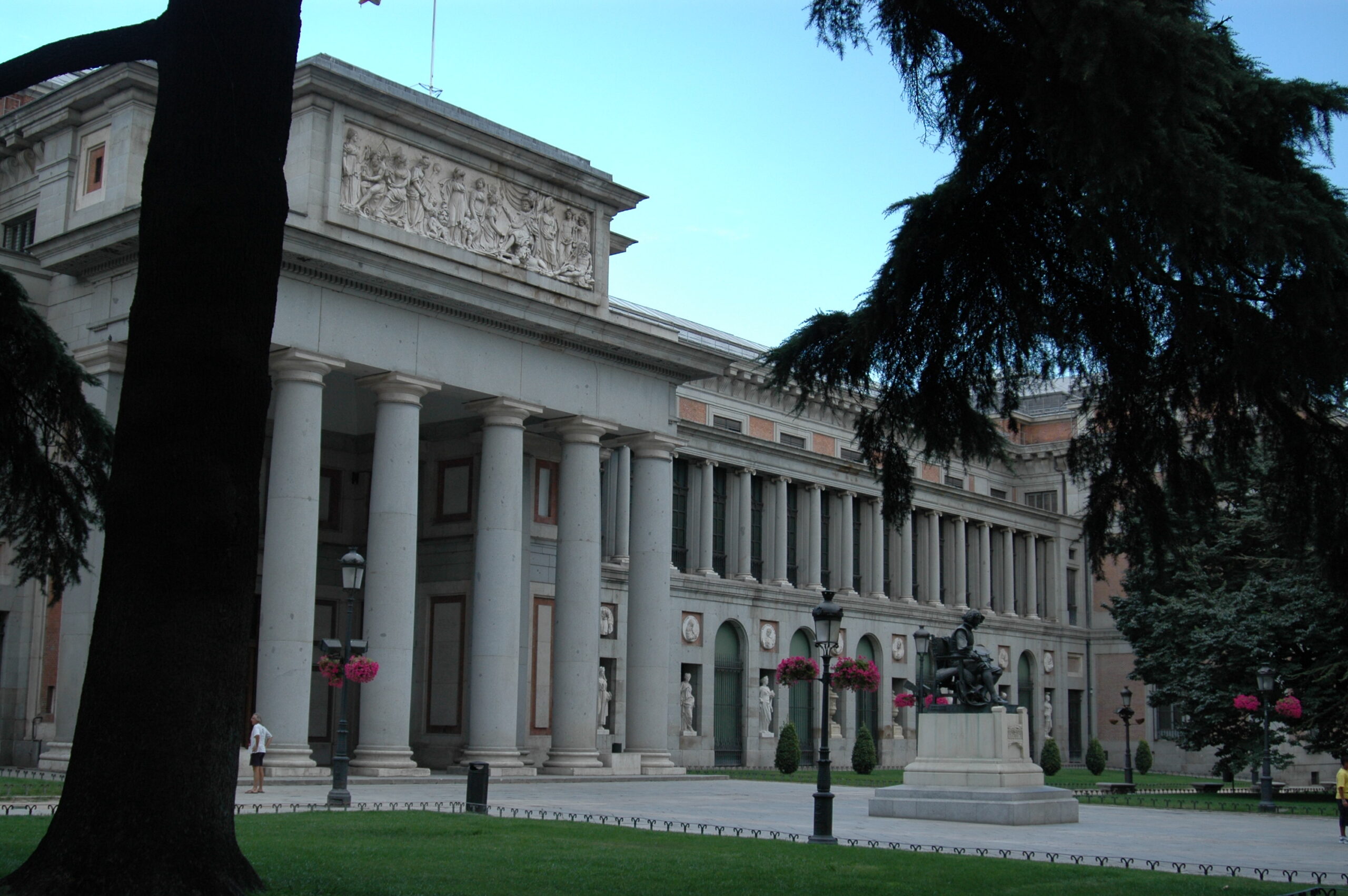
Morning between the Royal Palace — 3,418 rooms, bigger than Versailles — and Plaza Mayor, once a theatre with 237 balconies assigned by rank. Afternoon at the Prado: Las Meninas, the Black Paintings Goya made on the walls of his own house with no commission, The Third of May 1808. Evening at the Reina Sofía for Guernica, and tapas on Cava Baja.
Day 2 – The Thyssen and the districts
8 km · Thyssen-Bornemisza, Templo de Debod, Malasaña, Chueca, the Rastro if it is Sunday

The Thyssen covers everything the Prado lacks, from Italian primitives to Hopper: in three hours you cross eight hundred years. Then the Templo de Debod at sunset, a genuine third-century-BC Egyptian temple saved from the Aswan Dam and given to Spain, and the districts of Malasaña and Chueca, where the Movida was born.
Day 3 – Toledo
The whole day · 33 minutes on the high-speed line from Atocha

An intact medieval city on a crag ringed by the Tagus, a UNESCO World Heritage Site. The cathedral with the Transparente, El Greco’s Burial of the Count of Orgaz in the spot it was painted for, two synagogues with Islamic decoration, and the Mosque of Cristo de la Luz from 999.
Day 4 — Segovia
The whole day · high-speed train from Chamartín, 28 minutes · then a bus or a 25-minute walk from the station

Segovia is twenty-eight minutes by high-speed train north of Madrid, sits at a thousand metres at the foot of the sierra, and has three monuments that alone are worth the day. A UNESCO World Heritage Site since 1985.
The aqueduct
1 hour · Free · you arrive and find yourself standing underneath it
Segovia’s Roman aqueduct is probably the best-preserved Roman work in Spain and one of the most striking in Europe. It was built, most likely, around the first or second century AD to carry water from a spring seventeen kilometres away, and in the urban stretch it has 167 arches in two tiers, up to twenty-eight metres high.
What strikes everyone is this: it is built from granite blocks with no mortar and no clamps, held together only by weight and the balance of thrusts. It has stood like this for about two thousand years and worked until the mid-twentieth century, genuinely carrying water into the city. The worst damage was not done by time but by people: thirty-five arches were torn down in the eleventh century during a siege, and rebuilt four centuries later.
You come up right underneath it and walk through, then climb the stairway alongside to see it from above. Local legend says the devil built it in a single night, in exchange for the soul of a girl tired of carrying water buckets: he was beaten by sunrise by a single stone, which is still missing.
The cathedral and the Alcázar
3 hours · Cathedral about €4, Alcázar about €9 with the tower · all uphill
From the aqueduct square you climb through the old town to the cathedral, the last great Gothic cathedral built in Spain: begun in 1525, when Italy was already in full Renaissance, because the previous one had been destroyed in the comuneros’ revolt against Charles V. Locals call it la dama de las catedrales, the lady of the cathedrals, for its slender profile.
At the tip of the crag is the Alcázar, and here it is worth being honest: the fairy-tale-castle shape, with its cone-topped slate towers, is largely a nineteenth-century reconstruction. The castle, medieval in origin, burned in 1862 and was rebuilt to a romantic idea of what it should look like. The legend that it inspired Disney’s castle is just that, a legend, but the effect is there.
What is true is the history: here, in December 1474, Isabella of Castile proclaimed herself queen, an act that led to the union with Ferdinand’s Aragon and the birth of Spain. Climb the Tower of John II up 152 steps, and the view over the Castilian countryside and the sierra is worth the effort.
In Segovia the dish is cochinillo asado, roast suckling pig: in the historic restaurants they carve it at the table with the edge of a plate, to show how tender it is, and then break the plate. It is a scene put on for tourists but the dish is the real thing, and it costs €25-30 a portion.
Day 5 — The Escorial and the Madrid nobody visits
Half a day out, half in the city · suburban train, 1 hour · Escorial closed on Mondays
Morning – El Escorial
4 hours · Ticket about €14 · C-3 train from Atocha or Chamartín, one hour, then a shuttle or a 20-minute uphill walk
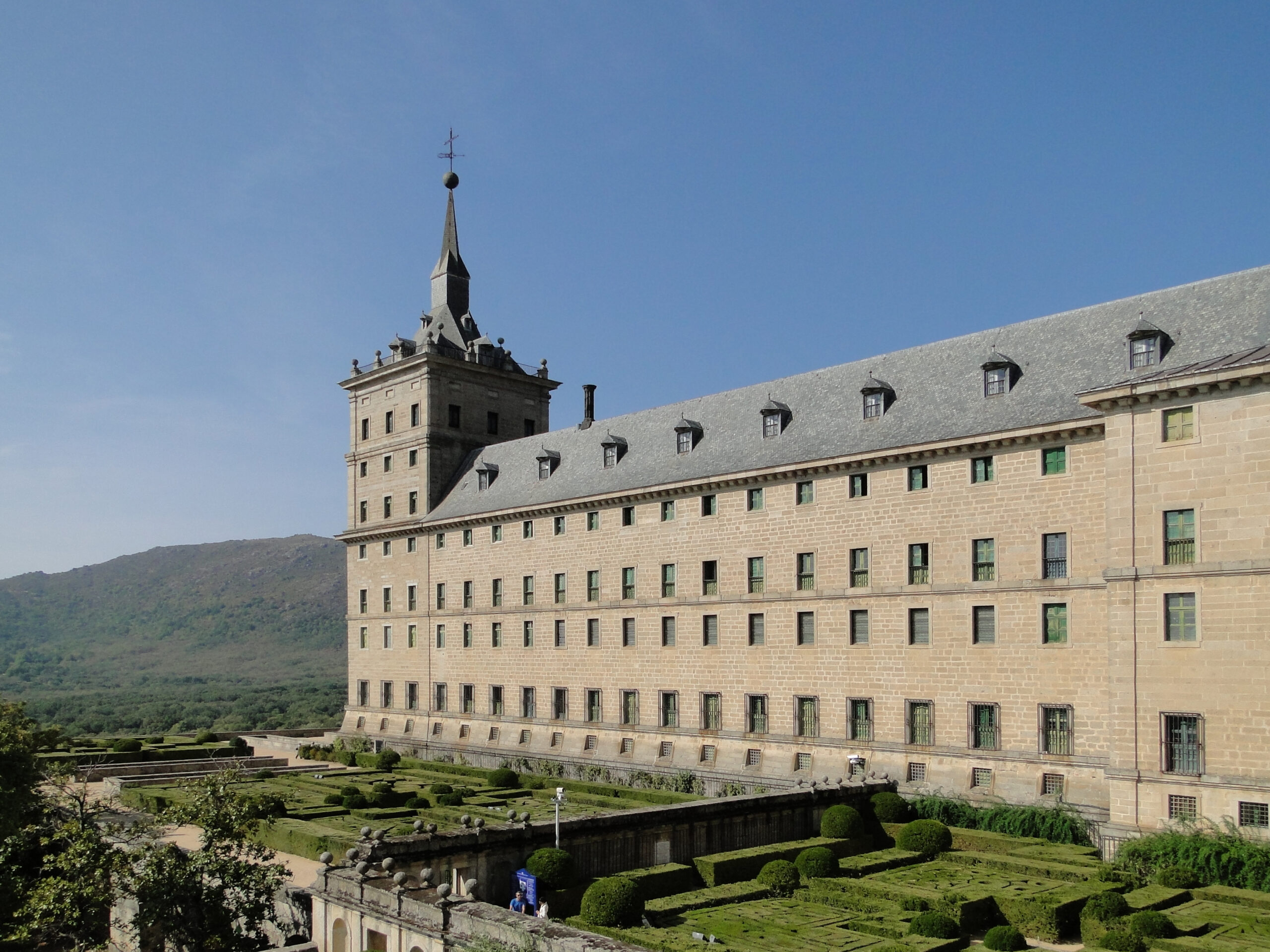
The Real Sitio de San Lorenzo de El Escorial is the building that explains Philip II better than any biography: monastery, royal palace, basilica, library, college and dynastic mausoleum, all in a single block of grey granite with almost no decoration, at the foot of the sierra. It was built between 1563 and 1584, in twenty-one years, an astonishingly short time for a work of that scale.
Philip II built it to fulfil a vow after the victory at San Quentin, won on Saint Lawrence’s day in 1557; the grid plan, tradition says, echoes the gridiron on which the saint was martyred. The king, who ruled an empire on which the sun never set, had a tiny, bare room built for himself with a window looking straight onto the high altar of the basilica: in his final months, immobilised by gout, he followed mass from his bed. He died there in 1598.
What to see:
- The library, a hall fifty-four metres long with a frescoed vault and the books shelved edge outward, spine inward, in the old manner. It holds over forty thousand volumes and thousands of Arabic, Hebrew and Greek manuscripts.
- The Panteón de los Reyes, the octagonal marble-and-bronze crypt where almost every king of Spain since the sixteenth century is buried, in twenty-six identical sarcophagi on five levels. Next to it is the pudridero, the chamber where the bodies rest for decades before final burial: not open to visitors.
- The basilica and the picture galleries: works by Titian, Tintoretto, Bosch and El Greco, including the one Philip II rejected — the reason El Greco settled in Toledo.
In the woods around it, the Silla de Felipe II is a rock formation with seats carved into it from which, it is said, the king watched the building site progress. It is half an hour’s walk away and free.
Afternoon – Modern Madrid
4 hours · Almost all free · Metro Núñez de Balboa, Bernabéu, Chamberí
You come back into the city in the afternoon and see the Madrid no tourist itinerary includes, which is where madrileños actually live.
The barrio de Salamanca is the elegant nineteenth-century grid district, built when the city tore down its walls: it is the street for serious shopping and art galleries, and is worth a walk for the architecture alone. Chamberí, next door, has something curious: the Chamberí ghost station, a metro stop from 1919 closed in 1966 because the platforms were too short, left untouched with its original tiled adverts and reopened as a museum. It is free and you enter through a lift in the middle of the square.
For football fans, the Santiago Bernabéu can be visited: the stadium was completely rebuilt in the 2020s, with a retractable roof and a pitch that folds up and descends underground. The tour costs around thirty euros. The far cheaper alternative is Atlético’s Metropolitano.
And if you would rather close the day outdoors: Madrid Río, the ten-kilometre linear park along the Manzanares created in the 2000s by burying the urban motorway that once ran along the river — one of the most radical urban regeneration projects in Europe. There are new bridges, urban beaches with water play areas, and views of the Royal Palace from below.
If it rains, or if it is very hot
- Day 4, Segovia · is the most exposed day and sits at a thousand metres: it can snow in winter. In bad weather swap it with the Escorial, which is an almost entirely indoor visit.
- Day 5 afternoon · instead of the walk, the Museo Arqueológico Nacional with the Lady of Elche and the reproduction of the Altamira caves, or the Museo Sorolla, the painter’s house and studio left as he kept it, with an Andalusian garden: small, little-visited and beautiful.
- In summer · the hours from 2pm to 6pm are not for the outdoors. Toledo and Segovia should be started at eight in the morning.
What the five days cost
| Item | Cost |
|---|---|
| Royal Palace | about €14 |
| Prado, Reina Sofía, Thyssen | about €41, much less with the free slots |
| Toledo: train and monuments | about €50 |
| Segovia: train, cathedral, Alcázar | about €45 |
| Escorial: train and ticket | about €25 |
| Chamberí ghost station, Madrid Río, Retiro, Debod, the districts | free |
| Urban transport, 5 days | about €25 |
| Meals, 5 days | €125-200 |
| Total | about €260-420 per person |
Reference figures as of August 2026: check official websites before you travel. The high-speed trains to Toledo and Segovia have assigned seats and prices that rise as the date approaches: buy them ahead. The combined Paseo del Arte ticket for the three museums costs less than buying them separately, but if you use the free slots you will not need it.
Frequently asked questions
Is five days too many for Madrid?
For the city alone, maybe; for the region, no. Madrid sits at the exact centre of the peninsula, and from here, in under an hour, you can reach Toledo, Segovia and the Escorial, all three UNESCO World Heritage Sites. Five days from a single base is a trip through Castile, not a city break.
What is the Segovia aqueduct?
A Roman aqueduct about two thousand years old with 167 arches in its urban stretch, up to twenty-eight metres high, built from granite blocks with no mortar: it stands purely on weight and balanced thrust, and carried water into the city until the mid-twentieth century. It is probably the best-preserved Roman work in Spain.
Is the Escorial worth it?
Yes, if you want to understand imperial Spain. It is a monastery, palace, library and mausoleum in a single block of grey granite with no decoration, built by Philip II in twenty-one years. Worth seeing: the library with the books shelved backwards and the Pantheon of the Kings, an octagonal crypt with twenty-six identical sarcophagi. The king’s bedroom is tiny and has a window looking onto the altar: from there he followed mass while ill. Closed on Mondays.
Toledo or Segovia, which is better?
Toledo if you only do one: it is richer, more layered — Visigothic, Muslim, Jewish and Christian — and has El Greco. Segovia has the Roman aqueduct, which is unforgettable, Spain’s latest Gothic cathedral and the Alcázar on its crag. With five days, do both, on different days: they are in opposite directions.
Did Segovia’s Alcázar inspire the Disney castle?
It is a widespread legend and it is not proven. What is certain is that its current shape, with cone-topped slate towers, is largely a nineteenth-century reconstruction: the castle burned in 1862 and was rebuilt to a romantic idea of what it should look like. Its real history is more interesting than the legend: here, in 1474, Isabella of Castile proclaimed herself queen.
What is the Chamberí ghost station?
A Madrid metro stop from 1919, closed in 1966 because the platforms were too short for the new trains, and sealed off for forty years. It has been reopened as a museum with its original tiled adverts: entry is free through a lift in the middle of the square, and trains still pass by without stopping.
How much do five days in Madrid cost?
Between 260 and 420 euros per person excluding accommodation, with three day trips included. The item that shrinks the most is museums, thanks to the daily free slots; the one that weighs most is the high-speed trains, which should be bought ahead as prices rise.
Do you need to change hotel to see Castile?
No, and that is Madrid’s advantage: Toledo is 33 minutes away, Segovia 28, the Escorial an hour by regional train. Changing base would waste more time than it would save. Salamanca and Cuenca, two hours away, are the point beyond which it is worth stopping overnight.
What is Madrid Río?
A ten-kilometre linear park along the Manzanares, created in the 2000s by burying the urban motorway that once ran along the river: one of the most radical urban regeneration projects in Europe. There are new bridges, urban beaches with water play for children, and views of the Royal Palace from below. It is free and mostly used only by madrileños.
What is the best time to visit Madrid?
May-June and September-October. Summer is very hard — forty degrees is not unusual, and the city sits at 650 metres on a plateau with no sea — and in August many places close, though the city empties out and prices drop. Winter is cold and dry, with clear days: perfectly fine for museums.
September 4, 2026


