Warsaw in 3 days: the Uprising, POLIN and the other bank of the Vistula
Three days is the right amount of time for Warsaw, and the reason is that this city has two museums that are worth the trip on their own and can’t be rushed. One tells the story of the sixty-three days in 1944 when the city rose up and was wiped out; the other tells the thousand years in which Warsaw was one of the Jewish capitals of the world, and tells it starting from life, not from the end. These are demanding days, which is why the third day is for breathing: a park with peacocks and Chopin concerts, a baroque palace that survived intact, and the district on the other bank of the river that the Germans never demolished and which is therefore the one truly authentic piece of Warsaw.
At a glance
- Duration · 3 full days
- How much walking · 7 km the first day, 5 the second, 6 the third · all flat
- To book ahead · the Warsaw Rising Museum and POLIN, which sell out their time slots during peak months
- Budget · 450-750 złoty per person, accommodation excluded — around 105-175 euros
- Transport · from day two you’ll need the day pass: about 15 złoty
- The day not to move · the third, if it falls on a Sunday: in Łazienki Park there are free Chopin concerts, at noon and at 4pm, from mid-May to the end of September
- What’s left out · Kraków, which is 2 hours 20 by train: that’s the day trip for the five-day version
The first day is entirely on foot. The second and third use the metro, trams and buses: the network is good and cheap.
Day 1 — The rebuilt city
7 km · all on foot · from 9am to evening · a straight axis from north to south
The first day is what you’d do with just a single day: we sum it up here, and the details and dedicated map are in the Warsaw in one day itinerary.

You start at the Royal Castle, blown up with dynamite in 1944 and rebuilt between 1971 and 1984 with donations from citizens, because the government didn’t want to pay for it. Inside is the Canaletto Room, with Bernardo Bellotto‘s twenty-two eighteenth-century cityscapes, which served the architects as a technical record for rebuilding the city’s facades. Then the market square, rebuilt between 1949 and 1953 and added to the UNESCO list in 1980 not for its age but as an example of reconstruction.
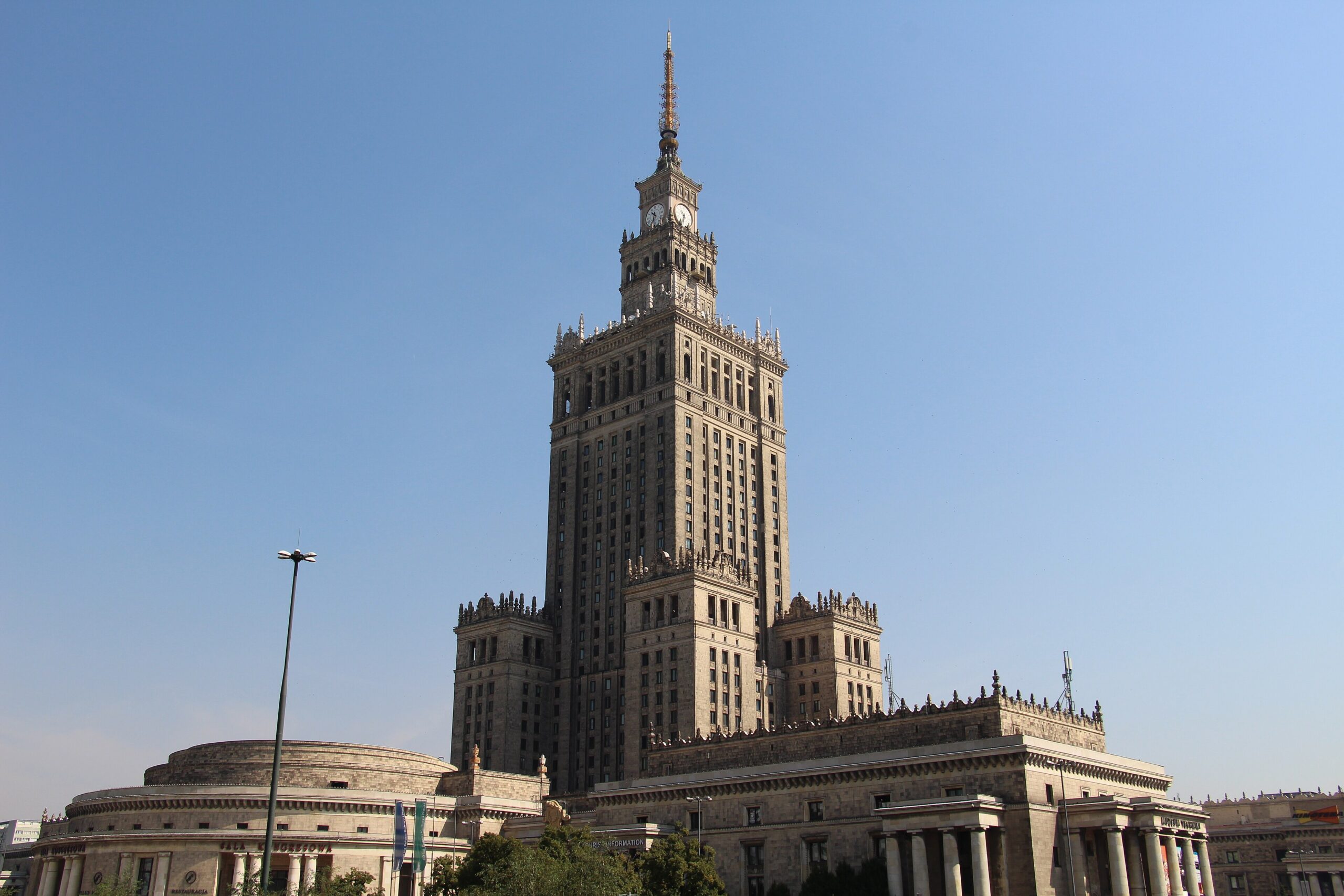
In the afternoon, the Royal Route: the Church of the Holy Cross, where Chopin’s heart, brought from Paris by his sister, is sealed inside the second pillar; the Tomb of the Unknown Soldier, beneath the three surviving arcades of the Saxon Palace, with the changing of the guard every hour; and the walk down Nowy Świat. Close the day at sunset on the terrace of the Palace of Culture, the 1955 Stalinist skyscraper that nobody asked for and which is today a national monument.
Day 2 — The twentieth century
5 km · 3 stops · from 9:30 to 18:00 · the heaviest day, and the most important
Questo giorno mette in fila due musei sulla distruzione della città e sull’annientamento della sua comunità ebraica. Sono fatti benissimo e sono la ragione principale per venire a Varsavia, ma sono pesanti: non incastrateli in mezza giornata e non aggiungeteci altro dopo. Se viaggiate con bambini piccoli, valutate di farne uno solo. E lasciate il pomeriggio libero da impegni: da questi musei si esce con la voglia di camminare in silenzio, non di andare a cena.
3 – The Warsaw Rising Museum
Time 3 hours · Ticket about 30 złoty · Book your time slot · Closed Tuesdays · Tram to Muzeum Powstania Warszawskiego

On 1 August 1944, at five in the afternoon, the Polish resistance rose up against the German occupation. The uprising was meant to last a few days, while waiting for the Red Army, which had reached the other bank of the Vistula. It lasted sixty-three days. The Soviets stopped and didn’t intervene. By the end, around sixteen thousand insurgents were dead, along with between one hundred and fifty thousand and two hundred thousand civilians, and Hitler ordered the city razed to the ground in reprisal.
The museum opened in 2004, sixty years later, in a former tram power station, and it isn’t a museum of display cases. It’s built as a physical journey: you walk on a floor that beats like a heart, pass through a reconstruction of the sewers the insurgents used to move between districts — narrow, low, to be crossed bent double — and there’s a full-scale replica of the Liberator bomber that carried Allied supplies.
The thing not to miss is the film Miasto Ruin, ‘City of Ruins’: five minutes of computer-reconstructed aerial footage over Warsaw in March 1945, based on real photographs. There’s no commentary, only the sound of the engine. You see a European capital of one million three hundred thousand people reduced to a desert of rubble stretching to the horizon. It’s the one thing that truly makes you understand what you’re talking about.
One last piece of information, if you happen to be in Warsaw on 1 August: at 5pm sharp, sirens sound across the whole city, and for one minute the city genuinely stops — cars stop in the middle of the road, people stand up on the pavements, trams come to a halt. Anyone caught in the middle of it doesn’t forget it.
4 – POLIN and the Monument to the Ghetto Heroes
Time 3 hours · Ticket about 45 złoty · Book ahead · Closed Tuesdays · One day a week the permanent exhibition is free: check which

POLIN — the museum of the history of Polish Jews — stands amid a district of 1950s apartment blocks, and that district is built on the rubble of the ghetto: the ground beneath the buildings is raised by several metres because the ruins weren’t removed, just flattened and covered over.
The important thing to know before going in is that this isn’t a Holocaust museum. It’s a museum of a thousand years of life: Jews arrived in Poland in the Middle Ages because it was the country that welcomed them when Western Europe was expelling them, and for centuries this was the largest Jewish community in the world. Before the war, around three hundred and seventy thousand Jews lived in Warsaw: a third of the city’s population, the second-largest Jewish community in the world after New York. The exhibition passes through merchants, wooden synagogues — one has been rebuilt full-scale, with a painted ceiling, and it’s magnificent — printers, Hasidism, Yiddish theatre. The destruction comes at the end, after you’ve understood what exactly was destroyed. That narrative choice is what makes this museum different from all the others.
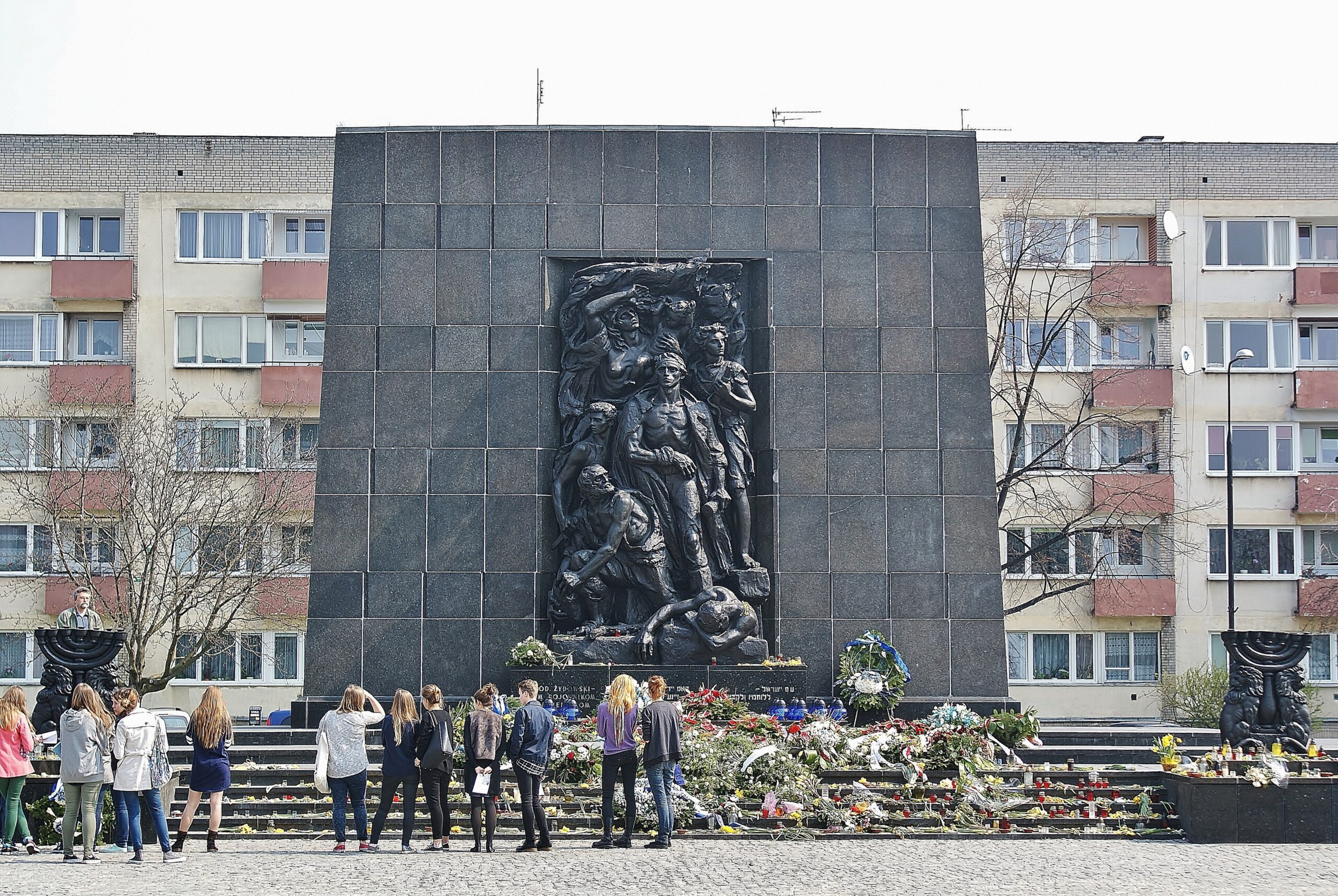
Outside the entrance stands the 1948 Monument to the Ghetto Heroes, made from granite that — according to a much-repeated story — the Germans had brought to Warsaw intending to build a monument to their own victory. In this square, on 7 December 1970, West German Chancellor Willy Brandt, on an official visit, laid a wreath and then did something no protocol had called for: he knelt and stayed there in silence, in the rain. He had warned no one. In Germany at the time, half the country criticised him; today that gesture is considered one of the founding moments of European reconciliation. A small monument in the square behind commemorates it.
5 – Umschlagplatz and traces of the ghetto
Time 1 hour · Free · 15-minute walk from POLIN
Almost nothing remains of the Warsaw Ghetto, and that’s the point. It was established in October 1940 and held up to four hundred thousand people within three and a half square kilometres. In the summer of 1942, in just a few weeks, around three hundred thousand were deported to Treblinka. On 19 April 1943 those who remained rose up, knowing they had no chance; the revolt lasted nearly a month and the Germans responded by burning the district house by house.
What you can see today is little, and has to be sought out, which is exactly why it’s worth doing. The Umschlagplatz, the loading square from which trains departed, is marked by a white monument shaped like an open freight car, engraved with hundreds of first names only — no surnames, because there were too many. The ghetto’s perimeter is marked in the pavement by a strip of cast iron running across streets and sidewalks, engraved with the word Getto and the dates 1940-1943: people walk over it without noticing. Two fragments of the wall survive in private courtyards, on ulica Sienna and ulica Złota, with a plaque; you enter through the gateway, and people actually live there.
If you have an extra hour and want a place almost no tourist visits, the Jewish cemetery on ulica Okopowa is twenty minutes away: over two hundred thousand graves in a wood that’s slowly reclaiming them, dating from the eighteenth century to today. It survived because it lay outside the ghetto’s boundaries, and it’s one of the largest in Europe.
Day 3 — The parks, the palace, the other bank
6 km · 3 stops · from 10am to 8pm · the light day, and it’s needed
6 – Łazienki Park
Time 2-3 hours · Park free, Palace on the Water about 30 złoty · Free Chopin concerts on Sundays, at noon and 4pm, mid-May to end September · Bus along Aleje Ujazdowskie

Łazienki Królewskie is seventy-six hectares of park a kilometre and a half from the centre, and it was the summer residence of Stanisław August Poniatowski, the last king of Poland — the one under whose reign Poland was dismembered and wiped off the map for one hundred and twenty-three years. He built this park while the country was falling apart around him, and it’s a melancholy place once you know that.
The Palace on the Water sits literally on an island in the middle of the pond, connected by two bridges, and mirrors itself in the water. A little further on is something you won’t find anywhere else: an amphitheatre with the stage on a separate island, so that the audience watches the actors across a stretch of water. It was built in 1791 on the model of the theatre at Herculaneum, and performances still take place there in summer.
Peacocks and red squirrels roam free in the park, and the squirrels will come right up to your hand. But the real reason to go on a Sunday is different: beneath the great Chopin monument — the willow bent by the wind — free piano concerts are held outdoors at noon and four o’clock from mid-May to the end of September, with the audience seated on the grass. These are real concerts, with skilled pianists. The monument, incidentally, was melted down by the Germans in 1940 and rebuilt in 1958 from the original casts.
7 – Wilanów Palace
Time 2 hours · Palace about 40 złoty, garden separate · Bus 30-40 minutes from the centre · Closed Tuesdays
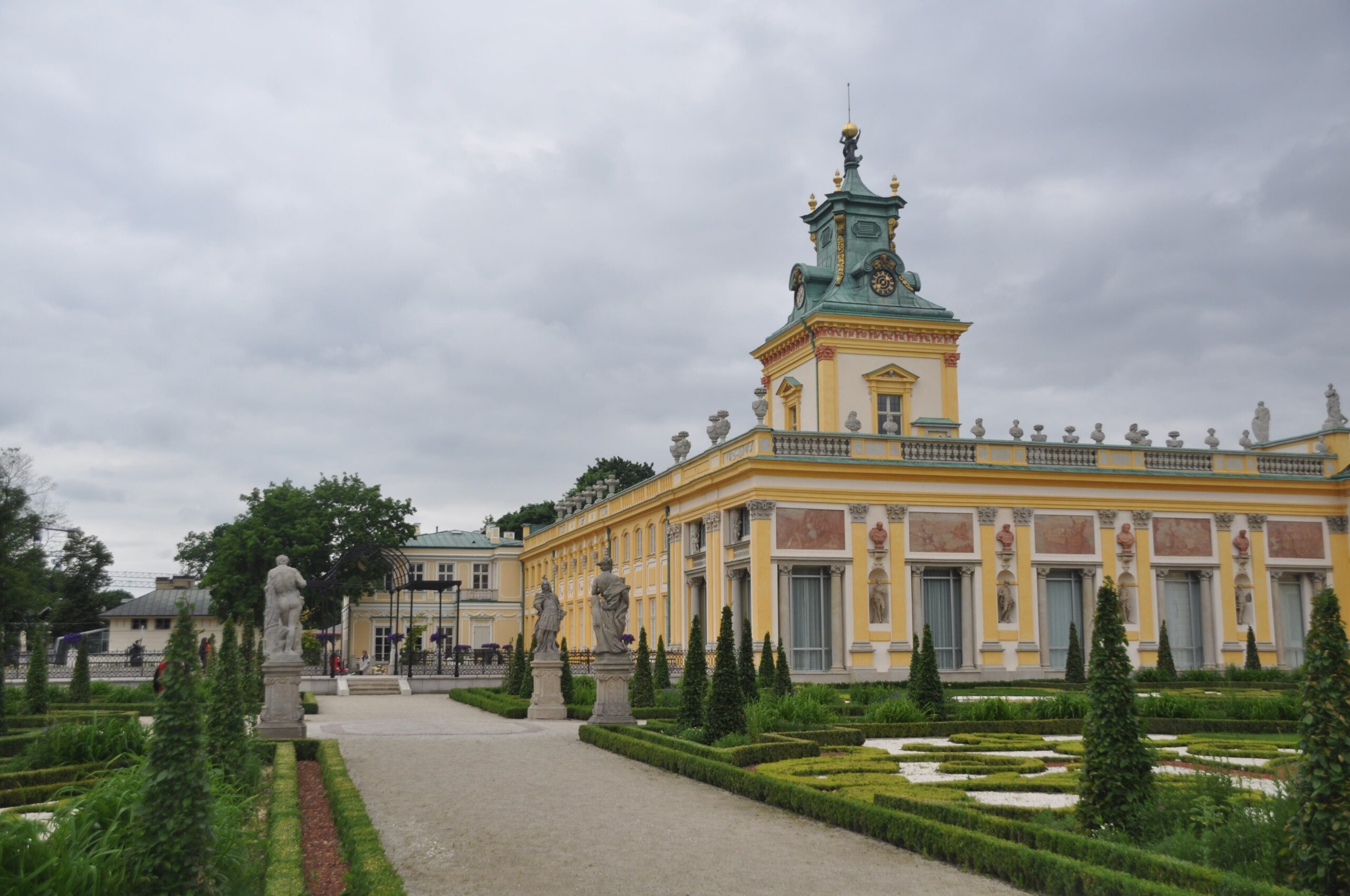
Wilanów is the baroque residence of Jan III Sobieski, the King of Poland who in 1683 arrived beneath a Vienna besieged by the Ottomans and, with a charge of the Polish cavalry — the winged hussars, with great feathered wings on their backs — broke the siege. It’s an episode that’s taught in Polish schools and that almost nobody in Italy knows about, and this palace is the monument to that moment.
What makes Wilanów different from everything else in Warsaw is that it’s authentic: it survived the war almost intact, because it stood outside the city and the Germans used it as a storage depot. The furnishings were partly looted and partly recovered, but the walls, the frescoes and the ceilings are the real thing. After three days spent among extremely faithful reconstructions, walking into a genuine building feels strange.
The Italian-style terraced garden descends toward the lake and can be visited separately. In the former stables is the Poster Museum, which is a surprise: the Polish school of poster art, between the 1950s and 1980s, was a graphic phenomenon recognised the world over — real artists designing posters for films and circuses, often more beautiful than the films themselves. It’s the first poster museum ever opened in the world.
8 – The Praga district
Time 2-3 hours · Free, museums separate · Metro Dworzec Wileński · The right place for dinner on the last evening

Praga — nothing to do with the Czech city: it’s pronounced the same way but it’s the name of the district on the right bank of the Vistula — has one feature that makes it unique: it wasn’t destroyed. In 1944 the Red Army reached this far and stopped, and while Warsaw on the other side of the river was demolished house by house, this bank stayed standing.
The result is that Praga is the one truly authentic piece of Warsaw: late-nineteenth-century tenement buildings with exposed brick, inner courtyards, worn staircases, peeling plaster. For decades it was the rough district nobody went to; for the last fifteen years or so it’s been the district people go to in the evening. Filmmakers shoot period films here: whenever pre-war Warsaw is needed, they film here — and even the ghetto scenes in Polanski’s The Pianist were shot on these streets.
Look inside the courtyards: many have a kapliczka, a small sacred shrine built by residents during the occupation, when churches were dangerous and people prayed at home. There are dozens of them, still tended with fresh flowers, and no guidebook mentions them.
The two things worth seeing are close together. The Koneser, a former red-brick vodka factory, has been turned into a complex of bars, restaurants and offices and houses the Polish Vodka Museum, which is far more serious than it sounds: you learn that vodka has been distilled in Poland since the Middle Ages, that the word means ‘little water’, and that there’s a long-running historical dispute with Russia over who invented it. Not far away, in the Soho Factory, is the Neon Muzeum: a collection of neon signs from the socialist era, rescued from building walls before demolition and switched back on. In the 1960s the government launched a campaign to ‘illuminate’ the cities and put real graphic designers and artists in charge of the signs: they’re beautiful, and lit up all together in a dark room they’re quite a sight.
Il primo giorno, il bar mleczny: mense popolari sovvenzionate dallo stato dove un pasto completo costa 20-35 złoty, si ordina al banco e si mangia con la gente del posto. Il secondo, sia il Museo dell’Insurrezione sia il POLIN hanno una caffetteria decente, e quella del POLIN fa cucina ebraica polacca — è una delle poche a Varsavia. Il terzo, la cena a Praga: attorno a ulica Ząbkowska e nella Koneser ci sono i locali migliori della città per rapporto qualità-prezzo, 50-90 złoty a persona. Cose da provare almeno una volta: i pierogi, lo żurek servito dentro una pagnotta scavata, l’anatra con le mele, e i pączki ripieni di confettura di rosa. La vodka si beve liscia, gelata, in bicchierini, e non si sorseggia.
If it rains
The second day is rain-proof: it’s two indoor museums, and the only thing you’ll lose is the walk to the Umschlagplatz, which can be done with an umbrella in twenty minutes. The third day, on the other hand, suffers quite a bit, since it’s made up of parks and gardens: if the forecast looks bad, swap the second and third days. In the rain, instead of Łazienki and Wilanów, good options are the National Museum, with its section on nineteenth-century Polish painting and photographs of destroyed Warsaw, and the Vodka Museum at the Koneser, which is indoors and sits in the district where you’ll be having dinner afterwards. A note on the climate: Polish winters are long and temperatures drop well below zero, but the museums are warm and the city is empty.
What three days cost
| Voce | Spesa |
|---|---|
| Castello Reale | circa 50 złoty |
| Terrazza del Palazzo della Cultura | circa 25 złoty |
| Museo dell’Insurrezione | circa 30 złoty |
| POLIN | circa 45 złoty (gratis un giorno a settimana) |
| Palazzo sull’Acqua nei Łazienki | circa 30 złoty |
| Wilanów, palazzo e giardino | circa 50 złoty |
| Neon Muzeum e Museo della Vodka | circa 60 złoty per entrambi |
| Old Town, Royal Route, Umschlagplatz, parks, Praga | free |
| Trasporti, 2 giornalieri | circa 30 złoty |
| Pasti, 3 giorni | 200-350 złoty |
| Totale | circa 450-750 złoty a persona, sui 105-175 euro |
Figures as of September 2026: check official sites before leaving. Payment is in złoty, at an exchange rate of around 4.3 to the euro. Almost all state museums have a free day each week, different from museum to museum: look them up beforehand and build your days around them, since you’ll save quite a bit. Watch out for Tuesdays, the closing day for many museums, POLIN and the Rising Museum included.
Frequently asked questions
Is three days enough for Warsaw?
Yes, and it’s the right amount: one for the rebuilt city, one for the two great museums of the twentieth century, one for the parks and the Praga district. If you have a fourth and fifth day, the thing to do isn’t to stretch out Warsaw but to take the train to Kraków, which is two hours twenty away.
Which museum should you not miss?
There are two, and they’re different. The Warsaw Rising Museum tells the story of the sixty-three days of 1944 through a physical journey — the sewers, the floor that beats like a heart — and features the film City of Ruins, five minutes of reconstructed aerial footage over razed Warsaw. POLIN tells a thousand years of Jewish life in Poland starting from the Middle Ages, not from the Holocaust. If you have to pick one, it depends on what you want to understand.
What’s left of the Warsaw Ghetto?
Almost nothing, and that’s the point. What remains is the Umschlagplatz, the loading square from which trains left for Treblinka, marked by a white monument engraved with hundreds of first names; a strip of cast iron in the pavement marking the perimeter with the word Getto and the dates 1940-1943; and two fragments of wall inside private courtyards, on ulica Sienna and ulica Złota. The 1950s apartment blocks were built on top of the rubble, which was flattened rather than removed.
What is Willy Brandt’s kneeling gesture?
On 7 December 1970 the West German Chancellor, on an official visit to Warsaw, laid a wreath at the Monument to the Ghetto Heroes and then, without it being planned and without warning anyone, knelt and remained in silence in the rain. In Germany, half the country criticised him; today it’s considered one of the founding gestures of European reconciliation. A small monument in the square behind the museum commemorates it.
Why is the Praga district different from the rest of the city?
Because it wasn’t destroyed: in 1944 the Red Army reached the right bank of the Vistula and stopped, and while Warsaw on the other side was demolished, the buildings here stayed standing. It’s the one truly authentic piece of Warsaw, with its late-nineteenth-century tenement buildings and courtyards. Filmmakers shoot period films here, including the ghetto scenes from Polanski’s The Pianist.
When are the Chopin concerts in the park?
Every Sunday from mid-May to the end of September, at noon and at 4pm, beneath the Chopin monument in Łazienki Park. They’re free, outdoors, with skilled pianists and the audience seated on the grass. If your stay includes a Sunday, put it on the third day.
Is Wilanów worth the trip out of the centre?
Yes, for one precise reason: it’s authentic. It survived the war almost intact because it lay outside the city, so the walls, frescoes and ceilings really are from the seventeenth century. After three days spent among extremely faithful reconstructions, walking into a genuine building feels strange. It was the residence of Jan III Sobieski, the king who in 1683 broke the siege of Vienna.
Is Warsaw suitable for children?
The first and third days, yes, very much: the Old Town, the peacocks at Łazienki, the lit-up neon signs at the Praga museum, the Copernicus Science Centre with its hands-on experiments. The second day, no: the two museums are heavy going, and so is the ghetto memorial. If you’re travelling with young children, swap that day out or do only part of it.
How much do three days in Warsaw cost?
Between 450 and 750 złoty per person without accommodation, that’s around 105-175 euros: it’s one of the cheapest capitals in the European Union. You save quite a bit by taking advantage of the state museums’ free weekly day and eating at least once at a bar mleczny.
Do the museums need booking?
Yes for POLIN and the Warsaw Rising Museum, which sell out their time slots days in advance during peak months. Both are closed on Tuesdays. The Royal Castle has time slots in high season but you can usually find space on the day.
September 11, 2026