
Warsaw in 1 day: the Old Town rebuilt from scratch and Stalin’s skyscraper
Warsaw is the only European capital where the old town is younger than its elderly residents. In 1944, after the Uprising, the Germans demolished it block by block with dedicated squads: eighty-five per cent of the city was razed to the ground, and what visitors walk through today was rebuilt from nothing between 1949 and 1963, brick by brick, partly using as a model the paintings of an 18th-century Venetian painter. Knowing this changes everything: the coloured façades of the market square aren’t a historic centre, they’re an act of will. And then there’s the other Warsaw, the one of skyscrapers and the Stalinist tower nobody wanted. Both fit into a single day.
In brief
- Duration · a full day, 9am to 10pm
- How much you walk · about 7 km, all flat, along a straight axis
- To book ahead · nothing, but the Royal Castle has timed-entry slots in peak months
- Budget · 150-280 złoty per person, accommodation excluded — around €35-65: it’s an affordable capital
- Starting point · Castle Square
- Ending point · the terrace of the Palace of Culture, at sunset
- Good to know · the changing of the guard at the Tomb of the Unknown Soldier happens every hour; the big ceremony is on Sunday at noon
- What’s left out · the Warsaw Rising Museum, POLIN, Łazienki Park and Wilanów: those are the second and third day
The itinerary follows a nearly straight line from north to south: you always walk in the same direction.
Morning — The rebuilt old town
2 km · 3 stops · 9:00 to 13:30 · all on foot
1 – Castle Square and the Royal Castle
Time: 2 hours · Castle about 50 złoty · Free one day a week: check which · Metro Ratusz-Arsenał, 8-minute walk
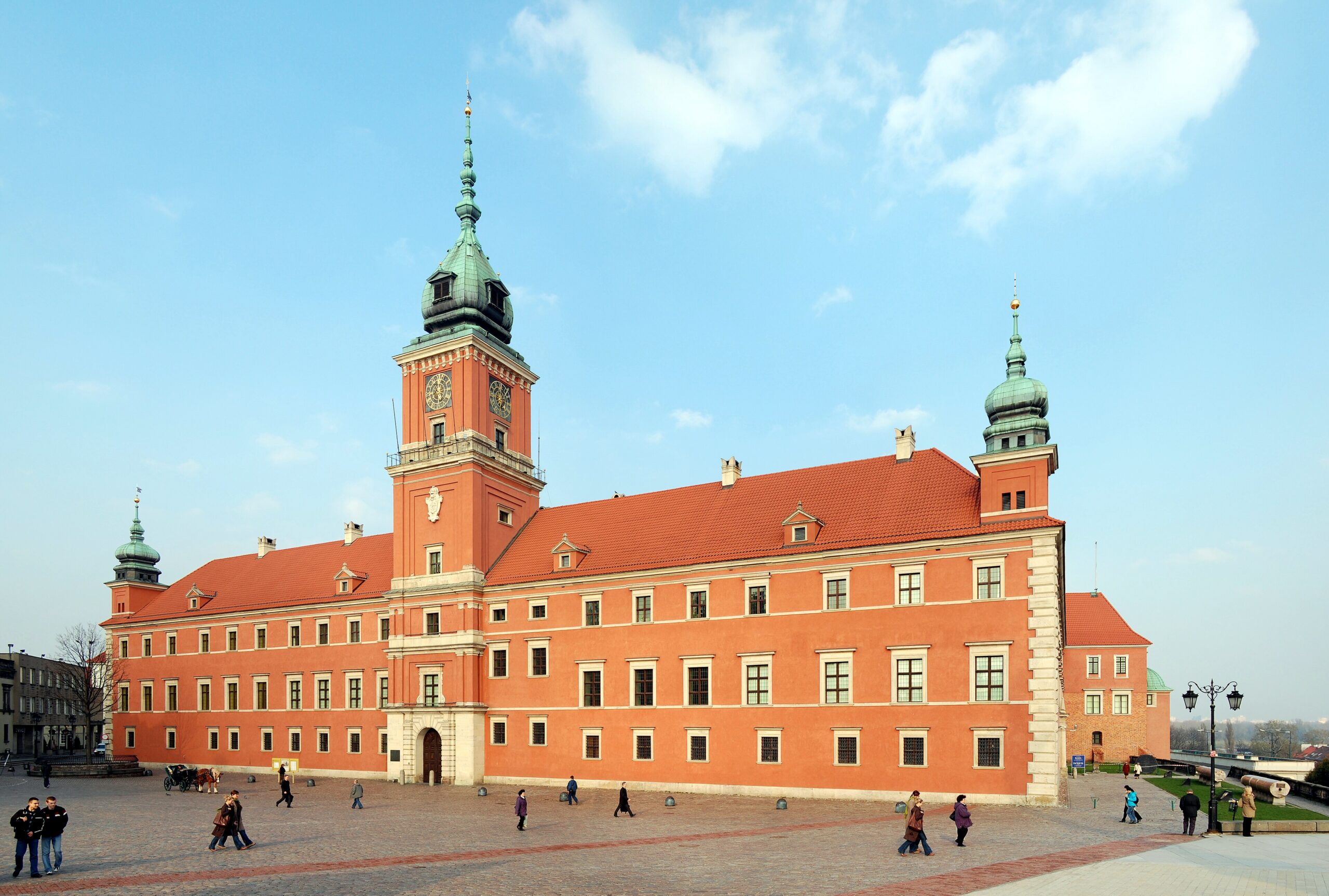
You start at Castle Square, with the column at its centre and the red palace at the far end, and the first thing to know is that in 1945 there was nothing here: a flat expanse of rubble several metres high.
The Royal Castle was the seat of the kings of Poland and later of parliament. The Germans bombed it in 1939, looted it, and in 1944, after the Uprising, blew it up with dynamite: workers had already drilled the walls with holes for the charges the year before. What you visit today was rebuilt between 1971 and 1984, and the remarkable part is how: the communist government didn’t want to fund it, and the reconstruction was paid for largely by donations from private citizens, Poles at home and emigrants worldwide, who sent money for their own castle.
Inside are two Rembrandts and, above all, the Canaletto Room. Here lies Warsaw’s most beautiful short circuit. The painter is Bernardo Bellotto, nephew of the real Canaletto, who used his uncle’s name while working in Poland; he was court painter to King Stanisław August and painted twenty-two views of the city in the 1770s, with almost photographic precision. Two centuries later, those paintings were used by architects as a technical document to rebuild the façades. You stand inside a rebuilt building looking at the paintings it was rebuilt with.
Sigismund’s Column, in the middle of the square, dates from 1644 and is Warsaw’s oldest secular monument. It celebrates the king who moved the capital from Kraków to Warsaw in 1596: that’s why Poles call Kraków “the old capital” and why the kings are buried there and not here. The column too was torn down in 1944: the original shaft, broken, lies on the ground next to the castle wall, and it’s worth looking for.
2 – The old town and the Mermaid
Time: 1 hour · Free · 5-minute walk

The Rynek Starego Miasta, the market square, is a square of narrow, colourful houses with cafés underneath. It’s beautiful, and entirely fake in the noblest sense of the word: in 1945, three walls were all that remained standing of this square. It was rebuilt between 1949 and 1953, and the restorers didn’t stop at the outline: they recreated the stone doorways, the cornices, the signs, the paintings on the façades, using Bellotto’s paintings, pre-war photographs and the surveys that architecture students at the Polytechnic had made in the 1930s as an exercise — drawings saved and hidden during the occupation.
That’s why UNESCO placed Warsaw’s old town on the World Heritage List in 1980, with a citation unique of its kind: not for its age, but as an exceptional example of reconstruction and proof that a people’s identity can survive physical destruction.
At the centre of the square stands the statue of the Mermaid, the Syrenka, with sword and shield. It’s been the city’s coat of arms since the 14th century, and legend says she swam up the Vistula, stopped here and promised to defend the place. The statue you see is a copy; the original, from 1855, is in the museum. There’s also a second mermaid, larger and in bronze, on the riverbank.
If you feel like it, climb the bell tower of St John’s Cathedral: a few złoty, a steep staircase, and from the top you see the old town from above with the river behind it. The cathedral itself was pounded to dust and rebuilt: on the outer wall, facing the street, is embedded a piece of a German tank’s tread, from a tracked explosive-laden vehicle launched against the church during the Uprising. It’s there, a metre off the ground, and almost nobody notices it.
3 – The Barbican and the new town
Time: 30 minutes · Free · 5-minute walk
Leaving the square heading north, you pass under the Barbican, the round red-brick fortification from 1540 that defended the city gate. This too is rebuilt, and it’s a curious case: it had already been demolished in the 19th century as useless, and in the 1950s it was rebuilt older than it had been, restored to its 16th-century appearance. Along the wall are the stalls of painters and souvenir sellers.
Beyond the Barbican begins Nowe Miasto, the new town — which has been “new” since the 15th century. It’s quieter, without tourists, with a lovely square and the domed Sacramentine church. At number 16 ulica Freta is the house where Maria Skłodowska was born in 1867, known to the world by her married name, Marie Curie: two Nobel Prizes in two different fields, and the first woman to teach at the Sorbonne. Today it’s a small museum, and the fact that it’s so uncrowded says something.
Cercate un bar mleczny, letteralmente «bar del latte»: sono mense popolari nate negli anni Venti e diventate un’istituzione nell’epoca comunista, tuttora sovvenzionate dallo stato e ancora aperte. Si ordina al banco leggendo il menù appeso al muro, si mangia con gente del posto, e si spende 20-35 złoty, cioè sui 5-8 euro, per un pasto completo. Cose da chiedere: i pierogi, i ravioli polacchi, ruskie con patate e formaggio o con la carne; lo żurek, zuppa acida di segale fermentata con salsiccia e uovo sodo, che sorprende al primo cucchiaio; i placki ziemniaczane, frittelle di patate; il bigos, lo stufato di crauti e carne. Se preferite un locale normale, un piatto costa 40-60 złoty. E lasciate spazio per i pączki, i bomboloni ripieni di confettura di rosa: quello storico di Varsavia è da Blikle, su Nowy Świat.
Midday — The Royal Route
3 km · 3 stops · 14:30 to 18:00 · a single straight road heading south
4 – Krakowskie Przedmieście
Time: an hour and a half · Free · Restart from Castle Square
From Castle Square begins the Royal Route, the road the kings travelled to reach their country residences: it’s four kilometres that change name three times and can be walked today in half a day. The first stretch, Krakowskie Przedmieście, is the most solemn: palaces, churches, the university, the presidential palace, the monument to Copernicus.
There’s one thing worth seeking out specifically, inside Holy Cross Church, on the left. In the second pillar of the nave, behind a plaque, is walled up the heart of Fryderyk Chopin. The composer died in Paris in 1849 at thirty-nine and asked for his body to remain in France but his heart to return to Poland: his sister carried it to Warsaw inside a jar of cognac, hidden under her skirt to get past the Russian checkpoints. During the war it was taken away and hidden in the countryside to protect it, and brought back here in 1945. It’s still there.
A little further on is the University of Warsaw, with its baroque gate and courtyards, and the Presidential Palace, in front of which the Warsaw Pact was signed in 1955. In summer, on Sundays, free Chopin concerts are held in the nearby gardens.
5 – The Tomb of the Unknown Soldier
Time: 45 minutes · Free · Changing of the guard every hour, solemn ceremony Sunday at noon · 5-minute walk
On the vast Piłsudski Square stands a fragment of colonnade with three arches, and under those arches burns an eternal flame with two motionless guards on watch. It’s the Tomb of the Unknown Soldier, and the colonnade is all that remains of the Saxon Palace, the great royal residence that once closed off the square and that the Germans blew up in December 1944. It wasn’t spared: those three arches stayed standing by chance, because the tomb was already underneath.
It’s Poland’s most important monument, and the changing of the guard takes place every hour, all year round, in any weather. On Sunday at noon the ceremony is longer and includes a band. On the slabs around it are carved the names of the battles fought by Poles all over the world: there are very many, and reading that list is the quickest way to understand this country’s history.
A practical note: the square has been a building site for years, because Poland has decided to rebuild the Saxon Palace as it was. Check the state of the square when you go: it may be partly fenced off.
6 – Nowy Świat
Time: 1 hour · Free · Continue on foot southward

The Royal Route continues and changes name to Nowy Świat, the “New World”: here the buildings get lower, all turning white and yellow, two or three storeys, and the street fills with cafés with tables outside. It’s the stretch of Warsaw where it feels good to do nothing.
Even this uniformity has an explanation: the street was rebuilt after the war choosing a single style, early-19th-century Neoclassical, and lowering the buildings that had grown taller in the meantime. It’s not as it was in 1939: it’s as it was in 1830, because that version was preferred. Warsaw’s reconstruction is full of choices like this one.
It’s the right place for a break: the historic cafés, the pączki pastry shops, the record stores. If you have an extra half hour, detour left to the riverfront: the Vistula’s bank has been redeveloped in recent years with promenades and kiosks, while the opposite shore has stayed wild — a beach of sand and trees inside a capital city, which fills with people in summer.
Afternoon and evening — Stalin’s skyscraper
2 km · 1 stop · from 18:00 onward · best at sunset
7 – The Palace of Culture and Science
Time: an hour and a half · Panoramic terrace about 25 złoty · Open late · Metro Centrum · Go at sunset
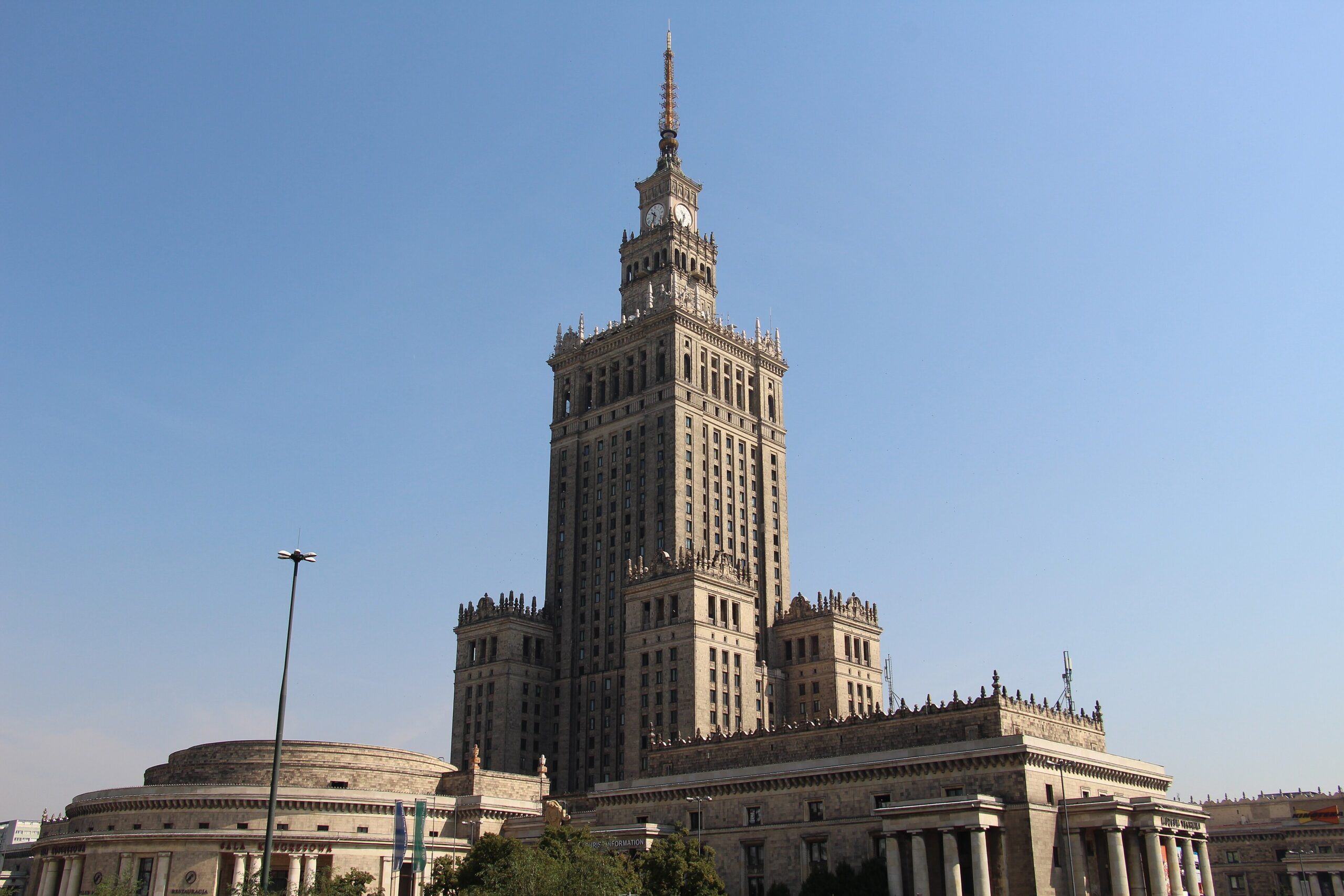
It’s visible from all over the city and nobody likes it, which is part of its charm. The Palace of Culture and Science was built between 1952 and 1955 as a “gift from the Soviet people to the Polish people”: it was designed by Russian architect Lev Rudnev, who toured Poland to copy its architectural details and put them on the façade, and it was built by three thousand five hundred Soviet workers housed in a purpose-built district. Nobody had asked for it and nobody could refuse it.
It stands 237 metres tall with the spire and was for decades Poland’s tallest building, overtaken only in the 2020s by the glass skyscrapers that now surround it. Inside are three theatres, two museums, a cinema, a swimming pool and a university: it’s a vertical city.
Varsovians have given it many nicknames, almost all unrepeatable: “Stalin’s syringe”, “the Russian wedding cake”, “the drunkard’s nightmare”. The most famous joke says the terrace has the finest view in Warsaw, because it’s the only spot in the city from which you can’t see the Palace of Culture. After 1989 there was long debate over whether to demolish it; the idea that it too is a piece of history won out, and in 2007 it was declared a national monument.
Go up to the terrace on the thirtieth floor, at a hundred and fourteen metres, around sunset: from up there the whole city clicks into place at once — the new skyscrapers all around, the old town far off like a red smudge, the housing estates stretching to the horizon, the Vistula cutting through it all. It’s a skyline unlike any other in Europe, and the reason is that there was nothing here to preserve.
If it rains
Warsaw copes well with rain because it has first-rate museums, and they’re all on the itinerary for the following days: the Warsaw Rising Museum and POLIN each fill half a day and are both indoors. If it rains on your only day, the move is to do the old-town morning as planned — the distances are short — and swap the whole afternoon for one of the two. The Palace of Culture only makes sense under a clear sky: with low cloud you see nothing and the twenty-five złoty are wasted. Third backup, the National Museum, which has a section of 19th-century Polish art little known abroad and quite surprising.
How much the day costs
| Voce | Spesa |
|---|---|
| Castello Reale | circa 50 złoty (gratis un giorno a settimana) |
| Torre della cattedrale | circa 15 złoty, facoltativo |
| Terrazza del Palazzo della Cultura | circa 25 złoty |
| Old town, Barbican, Royal Route, Tomb of the Unknown Soldier, riverfront | free |
| Pranzo in un bar mleczny | 20-35 złoty |
| Cena in un ristorante | 60-110 złoty |
| Trasporti urbani, biglietto giornaliero | circa 15 złoty |
| Totale | circa 150-280 złoty a persona, sui 35-65 euro |
Reference figures as of September 2026: check official websites before leaving. Payment is in złoty, not euros: Poland is in the European Union but not the eurozone. The rate is around 4.3 złoty per euro, but check it. Cards are accepted everywhere, even for a coffee. Almost all state museums have one free day a week: look it up beforehand, since it varies from museum to museum.
Frequently asked questions
Is one day enough for Warsaw?
For the old town and the Royal Route, yes: they lie along a straight four-kilometre axis and can be walked in a day. But Warsaw has two museums that alone are worth a trip — the Warsaw Rising Museum and POLIN — and with just one day you have to skip both. If you can, give it three days.
Is it true the old town is entirely rebuilt?
Yes, entirely. In 1944, after the Uprising, the Germans demolished Warsaw block by block with specialised squads: eighty-five per cent of the city was destroyed. The old town was rebuilt between 1949 and 1963 using Bernardo Bellotto‘s 18th-century paintings, pre-war photographs and architecture students’ surveys. UNESCO listed it in 1980 precisely as an extraordinary example of reconstruction.
Why are “Canaletto’s” paintings in Warsaw?
Because they’re not by the famous Canaletto: they’re by his nephew Bernardo Bellotto, who used his uncle’s name while working in Poland and was court painter to King Stanisław August. He painted twenty-two views of Warsaw in the 1770s, with almost photographic precision, and two centuries later those paintings served architects as documentation to rebuild the façades. They’re on display in the Canaletto Room of the Royal Castle.
Where is Chopin’s heart?
In Holy Cross Church, on Krakowskie Przedmieście, walled into the second pillar of the nave behind a plaque. Chopin died in Paris in 1849 and asked that his body remain there but his heart return to Poland: his sister carried it to Warsaw hidden under her skirt. During the war it was moved to safety in the countryside and brought back to the church in 1945.
What is a bar mleczny?
A “milk bar”: a working-class canteen that emerged in the 1920s, became an institution during the communist period and is still state-subsidised today. You order at the counter, eat alongside locals, and a full meal costs 20-35 złoty, about €5-8. It’s the best and cheapest way to eat Polish food: pierogi, żurek, bigos, potato pancakes.
Is it worth going up the Palace of Culture?
Yes, but only under a clear sky and ideally at sunset: you go up to the thirtieth floor, at a hundred and fourteen metres, and from there you understand how Warsaw is laid out. With low cloud you see nothing. Varsovians say it’s the city’s finest view because it’s the only spot from which you can’t see the Palace of Culture.
Is Warsaw expensive?
No: it’s one of the most affordable capitals in the European Union. A meal at a milk bar costs five euros, one at a restaurant fifteen, transport very little. Payment is in złoty — Poland doesn’t use the euro — and cards are accepted everywhere, even for tiny amounts.
What time is the changing of the guard?
Every hour, all year round and in any weather, at the Tomb of the Unknown Soldier in Piłsudski Square. The solemn ceremony, longer and with a band, is on Sunday at noon. The square has long been a building site as the Saxon Palace is being rebuilt: check the state of the works.
When is the best time to go to Warsaw?
From May to September: the city lives outdoors, the Vistula riverbank fills up, and on Sundays there are free Chopin concerts in Łazienki Park. Winter is long and harsh, with temperatures well below zero, but the museums are warm and the city costs even less.
How do you get from the airport to the centre?
From Chopin, the main airport, by urban train or bus: twenty to twenty-five minutes to the central station, and the ticket costs just a few złoty. From Modlin, used by low-cost airlines, you need a shuttle plus the train, about an hour: keep this in mind when comparing flight prices.
September 11, 2026