

Seattle in 1 day: Pike Place, the underground city and the ferry
Seattle sits on a narrow strip of land between a lake and an inlet, with two mountain ranges on either side and a volcano that appears on the horizon like a painted backdrop on clear days. It’s a young city—founded in 1851—that grew first with timber, then with the Klondike gold rush, then with airplanes and finally with software: Boeing, Microsoft, Amazon, and Starbucks were all born here. In one day you can see America’s oldest market, the neighborhood buried beneath the city, a 1962 tower, and a sunset ferry crossing.
In brief
- Duration · a full day, from 9 AM to 10 PM
- Walking · 7-8 km, with some hills: the center sits on a hill
- Transportation · light rail, monorail, and buses; day pass around $8
- Budget · $100-150 per person, lodging excluded
- Car needed · no, and downtown it’s inconvenient
- When · July to September: the dry months. October to May it rains little at a time but most days
- What’s left out · Mount Rainier, the islands, the museums: those are the second and third days
Everything is within three kilometers along the coast, except Kerry Park which is on the hill across.
Morning — Pike Place Market
2 km · 1 stop · 9 AM to 12:30 PM · start early, before the crowds
1 – America’s Oldest Market
Time 3 hours · Free · Open daily · the flying fish are at the stand at the north corner

Pike Place Market opened on August 17, 1907, and is America’s oldest continuously operating public market. It was created for a specific reason: the price of onions had increased tenfold in a year because of middlemen, so the city decided to have farmers sell directly. On the first day eight farmers arrived and ten thousand people came; the goods sold out within a few hours.
The motto is still the same as back then: Meet the Producer. By law, many stalls can only be occupied by those who sell what they produce or make by hand, and concessions are awarded through a daily lottery.
Things to see:
- the flying fish: at the fishmongers’ stand at the north entrance, when someone buys a salmon, the staff throw it to each other yelling across the counter. It started in the 1980s for fun and became the most filmed attraction in the city
- the first Starbucks, at 1912 Pike Place, opened in 1971: it still has the sign with the original mermaid, the brown one that was more explicit before being toned down. There’s always a line, and the coffee is identical to any other Starbucks
- the Gum Wall, an alley under the market where for thirty years people stick chewed gum on the walls: it’s repulsive and very famous. In 2015 they cleaned it with steam—an operation involving five hundred kilos of gum—and within a few months it was covered again
- the lower levels, which almost no one goes down to see: under the market floor are three levels of historic little shops, antique maps, magic, records
You arrive at nine, when the stalls open and there’s still no one around. After eleven the market becomes a river of people and the alleyways are navigated at a crawl.
Noon — The Underground Neighborhood
2 km · 1 stop · 12:30 PM to 3:30 PM · lunch included
2 – Pioneer Square and Underground Seattle
Time 2.5 hours · Underground tour about $25, with guide · Book on weekends
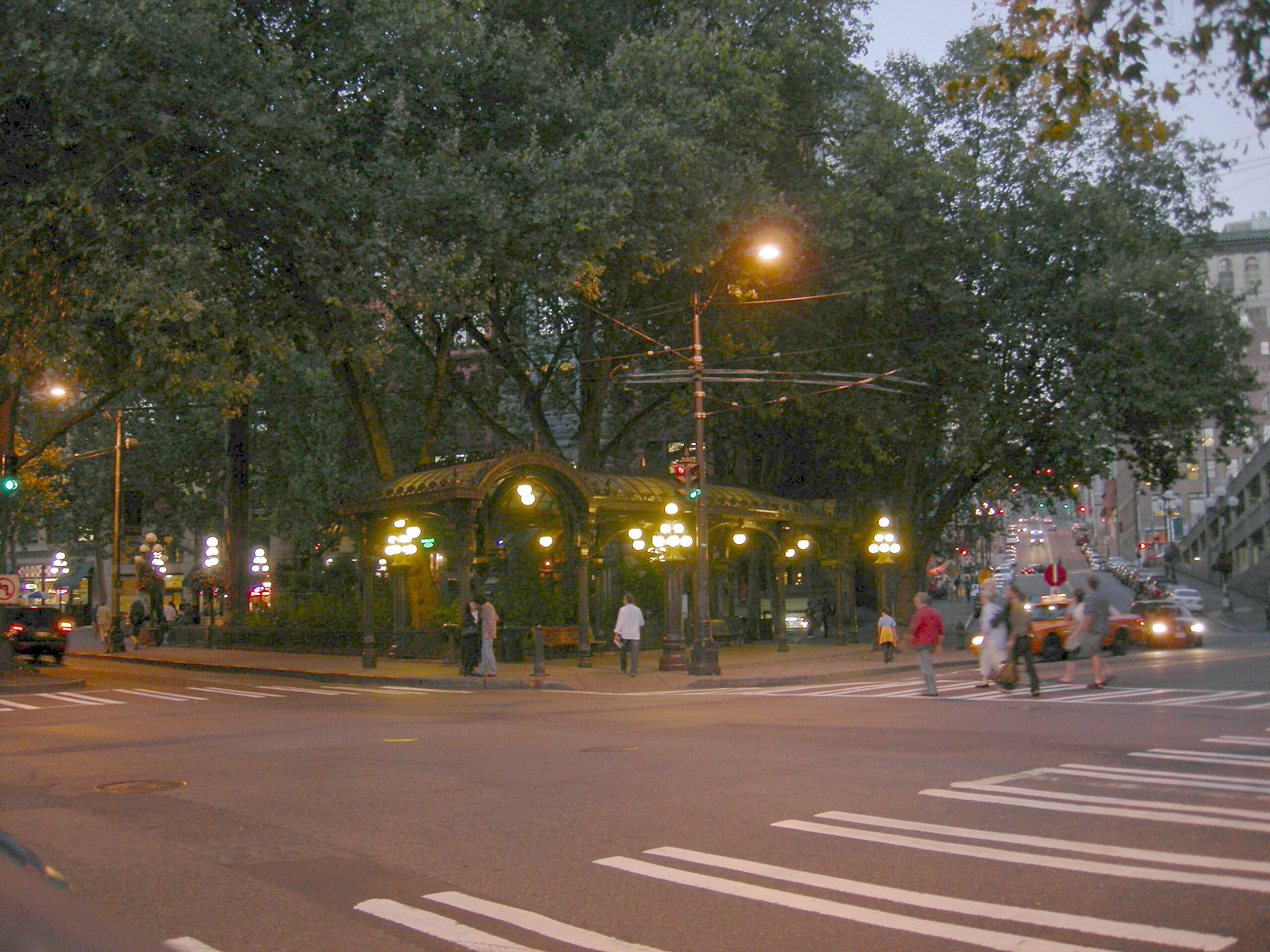
Pioneer Square is Seattle’s oldest neighborhood and has a history worth spending the afternoon on. On June 6, 1889, an apprentice woodworker knocked glue onto a stove: the great fire that followed destroyed thirty-one blocks, the entire commercial center of the city. No one died, but nothing remained standing.
The reconstruction was an opportunity to solve a problem the city had always had: the center was built in an area too low, and at high tide the sewers would back up—the toilets, according to reports, functioned like geysers twice a day. So they decided to raise the streets by one or two stories. But the property owners didn’t wait, and rebuilt immediately at the old levels. The result was that for years the streets ran one story above the sidewalks, with ladders to descend into shops, and several people died falling.
Eventually the ground floors were abandoned and sealed up, and the second floors became the new ground floors. Those old ground floors are still there, under the current sidewalks, with the storefronts, signs, and purple glass skylights set into the pavement—the glass was transparent, the sun has colored it over a century. You visit them with a guide, and it’s the most distinctive thing about Seattle.
Above ground, the neighborhood is the only one with a homogeneous architectural look, because it was all rebuilt together in brick and stone: there’s the cast-iron pergola from 1909, the Klondike Gold Rush Museum—free, and it tells how in 1897 Seattle got rich not by seeking gold but by selling pickaxes and supplies to the hundred thousand people leaving for the Yukon—and the Smith Tower from 1914, which for half a century was the tallest skyscraper west of the Mississippi.
Afternoon — The Tower and the View
2 km · 2 stops · 3:30 PM to 7 PM · take the monorail
3 – Space Needle and Seattle Center
Time 2 hours · Space Needle about $40 · Monorail about $4, 2 minutes from downtown
Space Needle was built for the 1962 World’s Fair, dedicated to the future and space, at a moment when the United States was losing the space race to the Soviet Union. The idea came from a sketch made on a napkin in a café; it was built in less than a year and stands 184 meters tall. The foundation is a cement block nine meters deep that weighs as much as the tower itself: it stands by counterweight, and is designed to withstand earthquakes and winds up to 300 kilometers per hour.
In 2018 the observation deck was renovated with a rotating glass floor, the only one of its kind in the world: you sit on a ring that turns slowly and look down through the glass. Not for everyone.
At its base is Seattle Center, the former fairgrounds, with the Chihuly Garden and Glass—blown glass sculptures by Dale Chihuly, who is from here—and MoPOP, the museum of pop culture in a wavy building by Frank Gehry inspired by a smashed electric guitar: inside are the sections on Jimi Hendrix and grunge, both of which were born in this city.
For the view there’s an alternative that almost no one considers: the Sky View Observatory at Columbia Center is higher than Space Needle, costs less, and has the decisive advantage of framing Space Needle in the photograph. The same reasoning that works in New York between Empire State and Top of the Rock.
4 – Kerry Park
Time 1 hour · Free · Bus 13 or twenty minutes walking uphill steeply
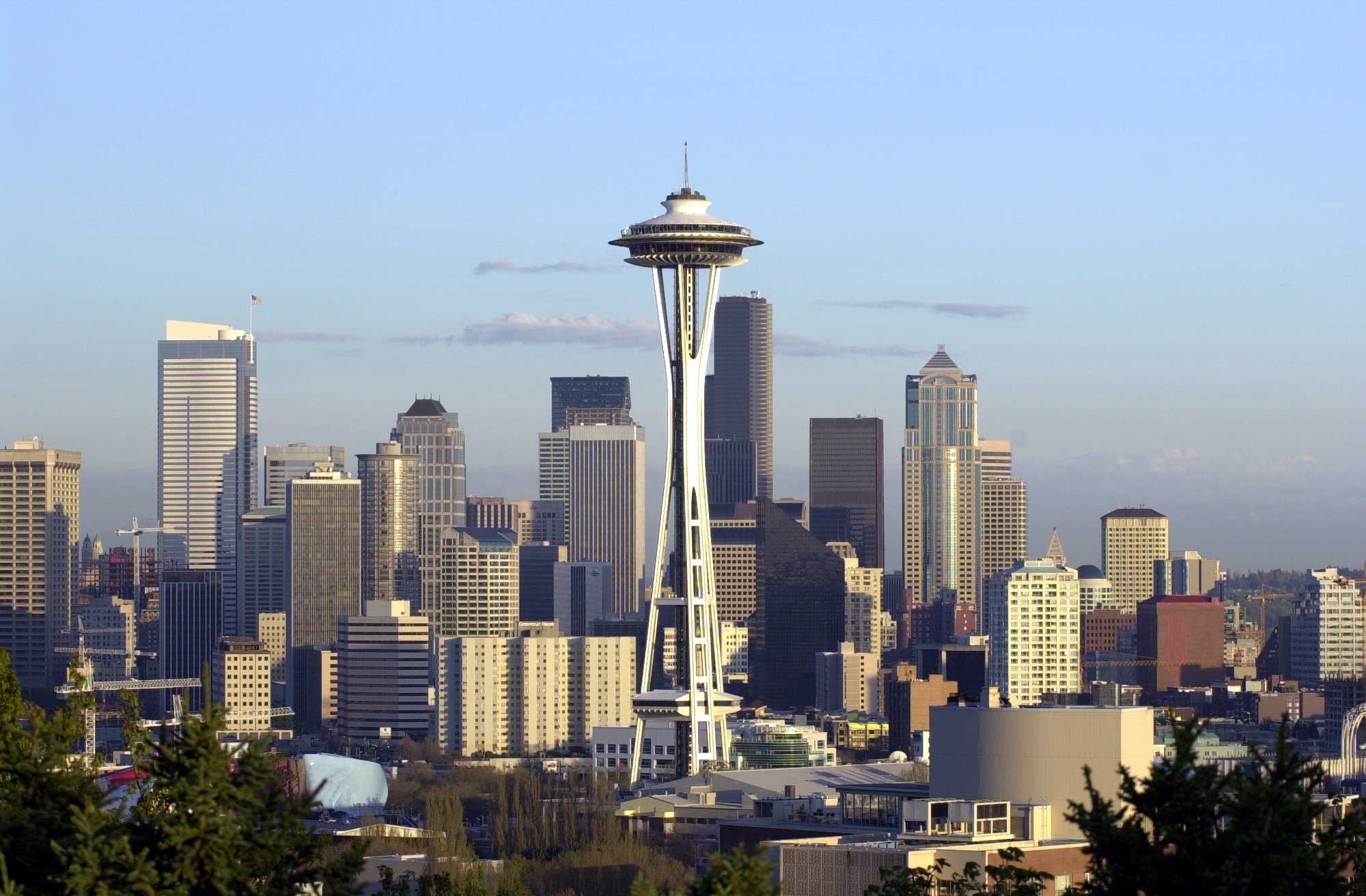
Kerry Park is a patch of grass on the side of Queen Anne Hill, and from here comes the photograph of Seattle: Space Needle in the foreground, skyscrapers behind, the bay to the left, and if the sky is clear, Mount Rainier floating above the city.
It’s free, you get there by bus, and you go at sunset: the light comes from the west and illuminates the facades. On summer evenings there are twenty or thirty people with tripods, all lined up on the same low wall.
Evening — The Ferry
1 km · 1 stop · 7 PM to 10 PM
5 – Crossing Puget Sound
Time 2.5 hours · Pedestrian ticket about $10, return is free · 35 minutes each way
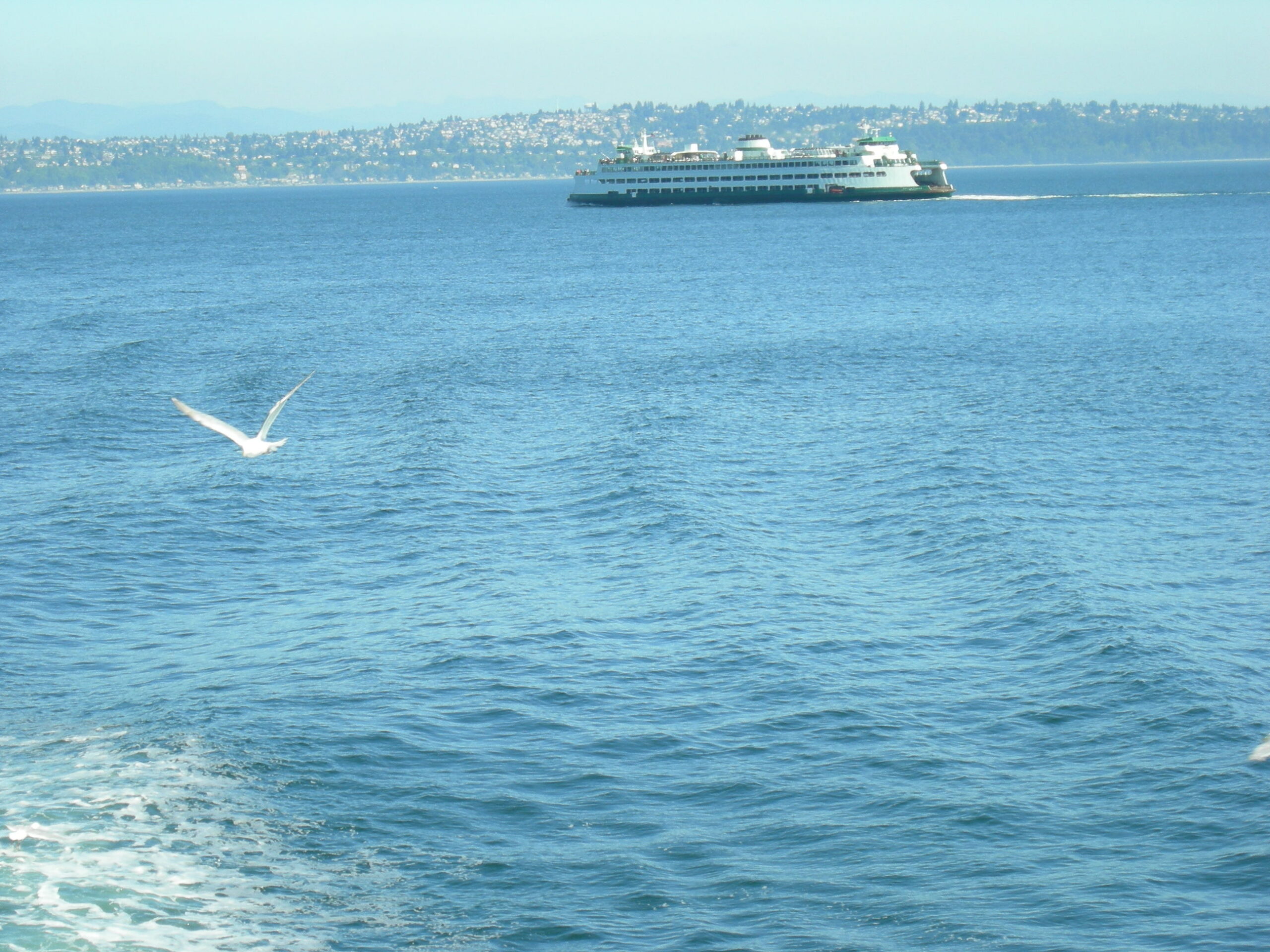
The State of Washington operates the largest ferry fleet in the United States: twenty-one ships, twenty thousand sailings a year, twenty-four million passengers. For those who live on the islands of Puget Sound they are not an attraction but the way home, and the ferry to Bainbridge Island leaves downtown Seattle approximately every fifty minutes.
It’s the thing I recommend most readily of the whole day, for a practical reason: if you walk on, you pay only for the outbound, and the return is free, so with ten dollars you get a seventy-minute cruise in the bay. Leaving the harbor the city recedes and you see it whole, with the Olympic mountains ahead and the Cascades behind; on the way back, in the evening, the skyline is lit up.
At Bainbridge you land in a town of a few thousand inhabitants: the main street, Winslow Way, has bookstores, restaurants, and a brewery, all five minutes from the dock. Just enough time between ferries.
Check the schedule of the last sailing before boarding, especially off-season, and get out on the stern deck on the outbound: that’s where you see Seattle shrink away.
If it rains
- It rains often, but little · Seattle has more rainy days than almost all American cities, but fewer millimeters than New York: it’s a persistent drizzle more than a downpour. Locals don’t use umbrellas, they use hoodies, and that’s good advice.
- Indoors · the market is almost entirely covered, the underground city by definition, and MoPOP, the Chihuly, and the Seattle Art Museum fill an afternoon.
- The ferry · goes anyway and the interior cabin is heated, with big windows: in the rain it’s actually quite nice.
- Mount Rainier · is visible on only about a third of the days of the year. When it’s out locals say the mountain is out, and it’s news.
How much the day costs
| Voce | Spesa |
|---|---|
| Underground city tour | About $25 |
| Space Needle | circa 40 $ (Sky View Observatory circa 35 $) |
| Ferry to Bainbridge, on footAbout $10, return | free |
| Pike Place Market, Kerry Park, Pioneer Square, museo del Klondike | gratis |
| Transportation, day pass | About $8 |
| Breakfast at market and lunch | $25-40 |
| Dinner | $30-55 |
| Total | About $140-180 per person |
Figures current as of August 2026, in dollars. Washington State has no income tax but has one of the highest sales taxes in the country: about 10% is added to the price shown at the register. Combined with the 18-20% tip, the restaurant bill increases by about a third.
Getting around
Downtown Seattle can be walked, but it’s built on a hill and the north-south streets are steep: the elevation from the waterfront to the center is about sixty meters. There are public elevators and escalators that help, and the light rail (Link) connects the airport to downtown in forty minutes.
The monorail between downtown and Seattle Center is also from the 1962 fair: two minutes of travel, a mile and a half of elevated track. It’s the only American monorail from that era still in service, and costs four dollars.
A car is not needed for this itinerary and is inconvenient downtown, with one-way streets and expensive parking. It is needed instead for Mount Rainier and the peninsulas, which are the subject of other days.
Frequently Asked Questions
Is one day in Seattle enough?
For downtown yes: the market, Pioneer Square, Space Needle, and ferry fit in one day, because everything is concentrated in a few kilometers. Left out are Mount Rainier, the islands, and the museums, which are the second and third days.
What is Underground Seattle?
The old ground floors of downtown, sealed and abandoned after 1889, when rebuilding the burned city, the streets were raised one or two stories to solve the problem of sewers backing up at high tide. They’re still there under the current sidewalks, with storefronts and signs, and you visit them with a guide.
Why are the skylights in the pavement purple?
Because the glass contained manganese, which colors with ultraviolet light over the course of decades. They were transparent when laid, at the turn of the century, to light the underground spaces: the color is the sign of time passed.
Is it worth going up Space Needle?
The view is worth it, but consider the alternative: Sky View Observatory at Columbia Center is higher, costs less, and most importantly frames Space Needle in the photograph, something you obviously can’t do from Space Needle itself. The best free view is still Kerry Park.
Is it true they throw fish at the market?
Yes, at the fishmongers’ stand at the north entrance of Pike Place: when someone buys a salmon, the staff throw it back and forth across the counter yelling. It started in the 1980s for fun and became the most filmed attraction in the city.
Is the first Starbucks really the first?
It’s the oldest still open, from 1971, even though the original store was a few dozen meters away and was moved in 1976. It keeps the sign with the original mermaid. There’s always a line, and the coffee is the same as at any other Starbucks.
Is it worth taking the ferry to Bainbridge?
Very much: if you walk on you pay only the outbound, about ten dollars, and the return is free. It’s seventy minutes round trip with views of the city, the Olympic mountains, and the Cascades. It’s the best value for money view in all of Seattle.
Can you always see Mount Rainier?
No: it’s visible on about a third of the days of the year, especially in summer. When it appears, locals say the mountain is out, and they really mean it. It’s ninety kilometers away, 4,392 meters high, and is an active volcano considered one of the most dangerous in the United States because of its glaciers.
Does it always rain in Seattle?
It rains often but little: more rainy days than the American average, but fewer millimeters than New York or Miami. It’s persistent drizzle from October to May. Locals don’t use umbrellas but hoodies. From July to September it’s almost always dry.
Do you need a car?
No for downtown, where in fact it’s inconvenient with one-way streets and expensive parking. The light rail connects the airport in forty minutes and the 1962 monorail goes to Seattle Center. A car is only needed for Mount Rainier and the peninsulas.
September 6, 2026


