What to see in Florence: a guide to the places that really count
Florence has one advantage and one drawback, and they are the same thing: it is small. Everything that matters sits inside a square kilometre, so you see a lot in little time — but that square kilometre takes sixteen million visitors a year, and without a plan you spend the day in queues. This guide lists the places in order of importance rather than as an itinerary, saying for each how long it takes, what it costs and whether it has to be booked. At the bottom you will find how to fit them into the time you have.
At a glance
- The five things not to miss · Brunelleschi’s dome, the Uffizi, the David at the Accademia, Piazza della Signoria, an evening in the Oltrarno
- What has to be booked · the dome (compulsory), the Uffizi and the Accademia (in practice), the Brancacci Chapel
- The day to avoid · Monday: almost all state museums are closed
- The finest thing that is free · Gregorian vespers at San Miniato al Monte, at sunset
- The most underrated museum · the Museo dell’Opera del Duomo, large and half empty
- Best time to go · April-May and September-October
Five thematic layers, not days: switch on only the ones you care about, from the box at the top right.
The landmarks, the reason people come to Florence
There are five of them and they are all within ten minutes’ walk of each other. If you have a single day, this is the right selection.
Brunelleschi’s dome
Time 1 hour · Ticket about €30 combined, valid 3 days · Booking compulsory

When Brunelleschi won the competition in 1418 nobody knew how to close a hole forty-five metres wide without centring, that is, without the wooden scaffolding then thought indispensable. He built it double, with four million bricks laid in a herringbone pattern, and never really explained how. It is still the largest masonry dome in the world.
You climb inside the gap between the two shells: 463 steps, no lift, the last stretch a very narrow one-way spiral. Halfway up you come out onto the internal walkway with Vasari’s Last Judgement an arm’s length away. Anyone with claustrophobia should climb Giotto’s bell tower instead: 414 steps but wide staircases, landings to stop on, and the dome itself in the view.
Baptistery of San Giovanni
Time 30 minutes · Ticket included in the Duomo combined ticket

It is the oldest building on the square and for centuries Florentines — Dante among them, who was baptised here — were convinced it was a converted Roman temple. Inside is a thirteenth-century dome entirely in gold mosaic, with a Christ eight metres tall and a Hell full of detail that repays the visit on its own.
The Ghiberti doors you see outside are copies: the originals of the so-called Gates of Paradise are in the Museo dell’Opera del Duomo. On the north side, looking up, you can still see the marks left by the Arno flood of 1966, which reached more than four metres here.
Piazza della Signoria
Time 45 minutes · Free

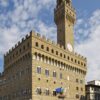
It has been the city’s political drawing room for seven hundred years and works as a free museum. Under the Loggia dei Lanzi stand Cellini’s Perseus holding the head of Medusa and Giambologna’s Rape of the Sabine Women, which has to be walked around because it was built without a front. In front of Palazzo Vecchio is a copy of the David, where the original stood from 1504 to 1873.
Set into the pavement in front of the Neptune fountain, a marble disc marks the spot where Savonarola was hanged and burned in 1498 — four years after having books, paintings and mirrors burned on that same square in the «bonfire of the vanities».
Ponte Vecchio
Time 20 minutes · Free

It is the only bridge to survive 1944, when the retreating Germans blew up all the others; here they confined themselves to demolishing the buildings at either end to block it. The shops have been there since the fourteenth century: butchers and tanners first, who dumped their waste straight into the river, then goldsmiths by decree of Ferdinando I in 1593, because the smell rose into the Vasari Corridor.
What almost nobody does: look at it from the next bridge along, Ponte Santa Trinita, rather than walking over it. That is the only place from which you see it whole, with the shops jutting out over the water.
The museums
They are the main reason people come to Florence and also why the trip has to be planned: almost all state museums are closed on Mondays, and the two main ones cost an hour or two of queuing without a booking from April to October.
Uffizi Gallery
Time 3 hours · Ticket about €25 in high season · Booking strongly advised, closed Mondays

The first modern museum in Europe, opened to the public in 1769, and the most important collection of Renaissance painting in existence. The route is chronological and worth following: you start with the panels of Giotto and Cimabue, reach Botticelli with the Primavera and the Birth of Venus in the same room, then Leonardo, Michelangelo’s Doni Tondo, Titian’s Venus of Urbino and finally the Caravaggios, among them the Medusa painted on a parade shield.
With two hours rather than three you do only those rooms and walk through the rest. The third-floor corridor with its windows over the Arno is worth a pause: from there the Ponte Vecchio is seen from above.
Galleria dell’Accademia
Time 1 hour 30 · Ticket about €16 · Booking advised, closed Mondays
You go for the David: five metres twenty, carved from a block two sculptors before Michelangelo had roughed out badly and abandoned for twenty-five years. It was moved here in 1873 because it was deteriorating outdoors.
The surprise is the corridor leading to it, with the four unfinished Prisoners: figures emerging halfway from the raw marble, intended for the tomb of Julius II and never completed. Many find them more striking than the finished statue. The museum is small: an hour and a half is enough.
Museo dell’Opera del Duomo
Time 2 hours · Ticket included in the combined one · Almost always half empty
It is the most underrated museum in Florence and stands behind the apse of the cathedral. Inside is the medieval facade of the Duomo rebuilt full size in a room thirty metres high, with the original statues put back where they stood before the facade was demolished in the sixteenth century. There are the authentic Ghiberti doors, Donatello’s wooden Magdalene and the Bandini Pietà, Michelangelo’s last sculpture, which he tried to destroy and in which he portrayed himself as Nicodemus.
Bargello Museum
Time 1 hour 30 · Ticket about €10
If the Uffizi is the museum of painting, the Bargello is the museum of sculpture, and it has far fewer people. It holds Donatello’s bronze David, the first free-standing male nude since antiquity; Michelangelo’s youthful Bacchus; and the two competition panels of 1401 by Ghiberti and Brunelleschi, displayed side by side, which decided who would make the Baptistery doors. It is the episode from which the Renaissance is usually dated, and you can take it in in five minutes.
Palazzo Pitti and the Palatine Gallery
Time 2 hours, plus 1 for Boboli · Ticket about €16 the palace, €10 the garden

The Palatine Gallery hangs its paintings three rows deep as was done in the seventeenth century, with no labels on the walls: eleven Raphaels and fourteen Titians, seen exactly as the Grand Duke saw them. It is the opposite of a modern museum experience, and worth it precisely for that.
Museum of San Marco
Time 1 hour · Ticket about €8 · Almost always empty
A Dominican convent in which Fra Angelico frescoed every single friar’s cell, one by one, each with a different scene. You walk the first-floor corridor looking into forty rooms, and at the top of the stairs is the Annunciation. At the end of the corridor is Savonarola’s cell; he was prior here.
The churches, which in Florence are museums
Santa Croce
Time 1 hour 30 · Ticket about €8

It holds the tombs of Michelangelo, Galileo, Machiavelli and Rossini, and a monument to Dante which is empty because Ravenna never returned the bones. In the chapels at the far right are Giotto’s frescoes, and in the cloister the Pazzi Chapel by Brunelleschi, a room so measured that architects come specially to see it.
Brancacci Chapel
Time 40 minutes · Ticket about €10 · Limited entry, booking compulsory
In the Carmine church, in the Oltrarno. Masaccio’s frescoes of 1425 are the precise point at which European painting discovers perspective and figures begin to have weight and shadow. The Expulsion from Paradise, with Adam covering his face and Eve howling, was copied on the spot by the young Michelangelo and Raphael. Entry is in small groups and for a limited time.
Medici Chapels
Time 1 hour · Ticket about €9
Behind San Lorenzo. The New Sacristy is entirely Michelangelo’s, architecture and sculpture together: the allegories of Day, Night, Dawn and Dusk reclining on the Medici sarcophagi. The Chapel of the Princes next door is the opposite: an octagon lined with semi-precious stones and rare marbles, built over two centuries and never finished.
Santa Maria Novella
Time 1 hour · Ticket about €7
The church near the station, with a facade in white and green marble completed by Alberti. Inside is Masaccio’s Trinity, the first painting in history built with mathematically exact perspective: the painted chapel appears to open a hole in the wall. In the Green Cloister are Paolo Uccello’s frescoes, damaged by the flood of 1966.
Quarters and markets
Oltrarno · cross the bridge and Florence stops being a museum. It is the quarter of gilders, restorers and wood carvers, and the workshops on Via Toscanella, Via Santo Spirito and Via dei Serragli work with their doors open. The centre is Piazza Santo Spirito, with a basilica whose white facade is completely bare — it was never finished — and inside Brunelleschi’s last piece of architecture.
Mercato Centrale · north of the Duomo. The upper floor is a food hall open late, the ground floor is still a real food market with tripe and lampredotto stalls. It is the right place for lunch without spending what the centre charges.
Sant’Ambrogio · east of Santa Croce, the quarter where Florentines do their shopping. The covered market is small and untouristy, and the trattorias around it have the prices the centre has forgotten.
The views from above

Piazzale Michelangelo · the classic panorama, with the whole centre in a single frame. Twenty minutes on foot up the Poggi ramp, or bus 12. In the half hour around sunset there are a lot of people.
San Miniato al Monte · five minutes higher, and hardly anyone gets there. An eleventh-century Romanesque church with a facade inlaid in green and white marble, a floor showing the zodiac and a crypt where at sunset the monks sing vespers in Gregorian chant. It is free and it is the finest thing you can do in Florence without paying.
The Arnolfo tower, at Palazzo Vecchio · 223 steps, and from the top the dome is at eye level rather than above you. It is the view people miss if they only go up to the Piazzale.
Forte Belvedere and Boboli · from the upper part of the garden you look at the city over the roofs of the Oltrarno, and on a hot day it is the only viewpoint with shade.
Out of town, if you have an extra day
Fiesole · twenty minutes by bus, with its Roman theatre, archaeological museum and a view of Florence different from the Piazzale, because it comes from the north and takes in the hills behind.
The Chianti · begins twenty kilometres to the south. Greve, Panzano, Castellina: done by car or on organised tours, and it is a full day.
Siena, Pisa, Lucca · all little more than an hour by train. Siena repays the trip most, and wants a full day.
When to go
April-May and September-October are the right months: good weather, long days, and the city still breathes. They are also the months when museum bookings run out first.
July and August are hard: Florence is enclosed by hills and gets no air, and the historic centre regularly passes 35 degrees. On the other hand, in August many Florentines leave.
November to February the queues disappear and the museums are genuinely enjoyable. The price is that it is dark by five and sunset at the Piazzale has to be brought well forward.
What it costs to get in
| Place | Price | Booking |
|---|---|---|
| Duomo combined ticket (dome, Baptistery, bell tower, museum) | about €30 | Compulsory for the dome |
| Uffizi Gallery | about €25 | Strongly advised |
| Galleria dell’Accademia | about €16 | Advised |
| Palazzo Pitti | about €16 | No |
| Palazzo Vecchio | about €12 | No |
| Boboli garden | about €10 | No |
| Bargello Museum | about €10 | No |
| Brancacci Chapel | about €10 | Compulsory |
| Medici Chapels | about €9 | No |
| Museum of San Marco | about €8 | No |
| Santa Croce | about €8 | No |
| Santa Maria Novella | about €7 | No |
| San Miniato al Monte | free | — |
Reference figures as of August 2026: Florentine museums change their prices between high and low season, check the official websites before you travel. Entry to state museums is free for under-18s.
How to choose, according to the time you have
One day · the dome and the Baptistery in the morning, one of the two major museums, Piazza della Signoria, the Ponte Vecchio and sunset from the Piazzale. The full route is in Florence in 1 day.
Three days · a day for the Duomo and medieval Florence, a day for the Uffizi and the Accademia without having to choose, a day for the Oltrarno and the hills: that is Florence in 3 days.
Frequently asked questions
What should I see in Florence if it is my first time?
Brunelleschi’s dome with the Baptistery, the Uffizi or the Galleria dell’Accademia, Piazza della Signoria with the Loggia dei Lanzi, the Ponte Vecchio and an evening in the Oltrarno. Those are the five nobody wants to have skipped and they fit into two days without rushing.
What has to be booked in Florence?
The dome climb has a compulsory time slot and the Brancacci Chapel admits limited groups. The Uffizi and the Accademia are not formally compulsory, but without a booking from April to October you queue for one or two hours. Everything else is bought at the door.
Which museums are closed on Mondays in Florence?
The Uffizi, the Galleria dell’Accademia, Palazzo Pitti and Boboli — that is, almost all the state museums. Palazzo Vecchio, the Opera del Duomo museum and the churches stay open, and so does the Bargello, which however closes on alternate weeks: check first.
The dome or Giotto’s bell tower?
The dome, if your legs and nerves hold: 463 steps in a passage that narrows at the top and is one-way, but you pass right beside Vasari’s frescoes. The bell tower has 414 steps, wide staircases, landings to stop on and the dome itself in the view. With the combined ticket you can do both within three days.
What can you see for free in Florence?
Piazza della Signoria with the Loggia dei Lanzi, which is an open-air sculpture museum; the Ponte Vecchio; the facades of the Duomo, the Baptistery and the bell tower; San Miniato al Monte with its sung vespers; Piazzale Michelangelo; and the churches without a ticket, such as Santo Spirito.
How many days do you need for Florence?
Two are enough for the landmarks and one of the major museums; three is the right length, because it allows the Uffizi and the Accademia without having to choose and leaves a day for the Oltrarno. With a single day you still see a great deal, because everything is inside one kilometre.
Is the David in the square the original?
No, it is a copy placed in 1910 where the original stood from 1504 to 1873. The original is in the Galleria dell’Accademia. A third copy, in bronze, stands at Piazzale Michelangelo.
Is the Firenze Card worth it?
It costs a good deal and runs for 72 hours from the first entry. It pays off if in three days you visit at least five or six paying museums, including the more expensive ones; if you mainly want the Duomo and one or two museums, single tickets cost less. The Duomo combined ticket is separate and needed anyway.
August 22, 2026