
Florence in 1 day: a walking itinerary in the centre
Florence is the art city that works best in a single day, and the reason is geographical: the historic centre fits inside a rectangle a mile by half a mile, and it takes eight minutes to walk from the Duomo to the Uffizi. The problem is not distance, it is queues and opening times: two of the three museums that matter have to be booked, and anyone who does not book spends in line the time they should have spent in front of the paintings. This itinerary is built around that constraint.
At a glance
- Length · one full day, from 8:15 am until after dinner
- Walking distance · about 6 km, all inside the historic centre
- Bookings · Galleria dell’Accademia and the dome climb, both with timed entry
- Budget · €75-105 per person, accommodation excluded
- Starting point · Piazza del Duomo
- Ending point · Piazzale Michelangelo at sunset, then dinner in the Oltrarno
- The hard choice · Uffizi or Accademia: one day comfortably holds one of the two
Three parts of the day, seven stops in order. It is all walked, except the last climb if you prefer the bus.
Morning — Duomo, the dome and the Accademia
2 km · 3 stops · 8:15 am to 1 pm · start from Piazza del Duomo

The morning has to be built around one fixed constraint: the dome climb has a compulsory time slot, and the earliest ones are the only ones where you are not queuing inside the corridor. Book 8:15 or 8:30 am on the official Opera del Duomo website, which sells a single ticket covering the dome, the bell tower, the Baptistery, the crypt and the museum: it costs around €30 and is valid for three days, though in one day you will only use part of it.
1 – Brunelleschi’s dome, the Baptistery and Piazza del Duomo
Visit 2 hours for all of it · Ticket about €30 combined · Dome booking compulsory
It is 463 steps and there is no lift. You climb inside the gap between the two shells — the dome is double, which is the trick that let Brunelleschi build it without centring — and halfway up you come out onto the internal walkway, forty metres above the floor, with Vasari’s Last Judgement an arm’s length away. Then you carry on to the lantern. Anyone with claustrophobia or a fear of heights finds out precisely there: the final stretch is a very narrow spiral staircase and it is one-way.
Once down, the Baptistery is opposite and takes twenty minutes: inside is a thirteenth-century ceiling entirely in gold mosaic, with a Christ eight metres tall. Ghiberti’s doors on the outside are copies: the originals are in the Museo dell’Opera del Duomo, behind the apse, which also holds Michelangelo’s Bandini Pietà.
The cathedral itself is free to enter but has the longest queue on the square, and inside it is surprisingly bare. With one day only, skipping it is no crime.
2 – Galleria dell’Accademia
Visit 1 hour 30 · Getting there 8 minutes on foot · Ticket about €16 booked, closed Mondays
You go for the David, and the David genuinely delivers: five metres twenty of marble, carved from a block two sculptors before Michelangelo had ruined and abandoned. But what almost nobody expects is the corridor leading to it, with the four unfinished Prisoners, figures that seem to be emerging halfway out of the raw stone: many people find them more striking than the finished statue.
The visit is short because the museum is small. Book the 11 am slot and you will be out for lunch.
3 – Piazza della Signoria
Visit 40 minutes · Getting there 10 minutes on foot · Entry free

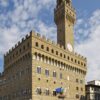
It has been the city’s political drawing room for seven hundred years and it works as a free museum: under the Loggia dei Lanzi stand Cellini’s Perseus holding the head of Medusa and Giambologna’s Rape of the Sabine Women, which has to be walked around because it was built without a front. In front of Palazzo Vecchio is a copy of the David, on the exact spot where the original stood until 1873.
Set into the pavement in front of the Neptune fountain, a marble disc marks the place where Savonarola was hanged and burned in 1498 — four years after he had books and paintings burned on that same square.
The streets between the Duomo and the Signoria are the worst in the city for eating. Walk to the Mercato Centrale, ten minutes north, where the upper floor is a food hall and the ground floor is still a real market; or get a lampredotto roll from one of the historic street stalls, which is the genuine Florentine street food.
Afternoon — Uffizi, Ponte Vecchio and the Oltrarno
2.5 km · 3 stops · 2:30 pm to 7 pm · you cross the Arno

Here comes the choice that decides the day. The Uffizi want three hours done properly, and if you have already spent an hour and a half at the Accademia that means five hours of museum in a single day: for many people that is too much. There are two honest options and neither of them is wrong.
4 – Uffizi Gallery
Visit 3 hours, 2 for the main rooms · Ticket about €25 in high season · Booking strongly advised, closed Mondays
The first modern museum in Europe, opened to the public in 1769, and the most important collection of Renaissance painting in existence. If you have two hours rather than three, this is the route that works: the Giotto and Cimabue room first, to see where it all starts; then Botticelli — the Primavera and the Birth of Venus in the same room; then Leonardo’s Annunciation; Michelangelo’s Doni Tondo, the only panel he painted in Florence; and Titian’s Venus of Urbino. The rest you look at while walking.
The third-floor corridor with its windows over the Arno is where it is worth stopping for five minutes: you see the Ponte Vecchio from above, and almost nobody photographs it from there.
5 – Ponte Vecchio
Visit 20 minutes · Getting there 5 minutes on foot · Entry free

It is the only bridge in Florence to survive 1944, when the retreating Germans blew up all the others. The shops have been there since the fourteenth century: butchers and tanners first, who dumped their waste straight into the river, then goldsmiths by decree of Ferdinando I in 1593, because the smell rose up into the corridor the Grand Duke used to cross the river.
That corridor is still there, above the shops: the Vasari Corridor, a covered kilometre linking Palazzo Vecchio to Palazzo Pitti and passing over the bridge. Look at it from the bank: the row of irregular little windows above the shops is it.
6 – Oltrarno and Santo Spirito
Visit 1 hour 30 · Getting there you are already on the other bank · Entry free

Cross the bridge and the city changes. The Oltrarno is the craftsmen’s quarter: gilders, restorers, wood carvers, workshops with their doors open along Via Toscanella and Via Santo Spirito. There is nothing to visit in the strict sense, and that is exactly why it is the place where Florence stops being a museum.
The centre of it is Piazza Santo Spirito, with a basilica whose white facade is completely bare — it was never finished — and inside Brunelleschi’s last piece of architecture, plus a small wooden crucifix attributed to an eighteen-year-old Michelangelo. If you still have time, five minutes away is the Brancacci Chapel with Masaccio’s frescoes, which has to be booked and is worth the detour: it is the point where painting discovers perspective and figures start to have weight.
In the Oltrarno, no hesitation: the trattorias around Santo Spirito and on Via dei Michelozzi cost a third less than those on the other bank and are full of Florentines. If you want the steak, it is ordered by weight and you do not ask for it well done: bistecca alla fiorentina is eaten rare or not at all.
Sunset — Piazzale Michelangelo
1.5 km uphill · 1 stop · from half an hour before sunset · on foot or bus 12

You climb from Ponte alle Grazie up the Poggi ramp, twenty minutes on foot with some steps, or take bus 12 from Piazza San Marco. From up there the whole centre fits into one frame: the dome, Giotto’s bell tower, the tower of Palazzo Vecchio, the bridges in a line along the Arno. In the half hour around sunset there are a lot of people, and it is worth it anyway.
If you want the same view without the crowd, climb five minutes further to San Miniato al Monte: an eleventh-century Romanesque church with a facade inlaid in green and white marble and a floor showing the zodiac. At sunset the monks sing vespers in Gregorian chant in the crypt, and it is free.
Three things not to do
Do not turn up at the Uffizi or the Accademia without a booking in peak months. The queue without a ticket can exceed two hours, which on a single day means losing one of the three stops.
Do not buy anything from the sellers under the Loggia or outside the Duomo. The «skip the line» tickets sold in the street are inflated guided tours: the official sites are uffizi.it and duomo.firenze.it, and there are no others.
Do not eat inside the quadrilateral between the Duomo, the Signoria and the Ponte Vecchio. It has the worst value for money in Italy. Five minutes’ walk in any direction halves the bill.
What it costs
| Item | Indicative cost |
|---|---|
| Duomo combined ticket (dome, Baptistery, museum) | about €30 |
| Galleria dell’Accademia with booking | about €16 |
| Uffizi Gallery in high season | about €25 |
| Palazzo Vecchio, instead of the Uffizi | about €12 |
| Lunch at the Mercato Centrale | €10-18 |
| Dinner in the Oltrarno | €25-40 |
| Total per person | €75-105 depending on the museums chosen |
Reference figures as of August 2026: Florentine museums change their prices between high and low season, check the official websites before you travel.
Getting around
On foot, throughout. The historic centre of Florence is barely a kilometre across and most of it is pedestrian: eight minutes from the Duomo to the Uffizi, five from the Uffizi to the Oltrarno. The only stretch where a bus makes sense is the climb to Piazzale Michelangelo, on line 12 or 13.
Arriving by train you get off at Santa Maria Novella, which is inside the centre: ten minutes on foot to the Duomo. Arriving by car, you need to know that the whole centre is a restricted traffic zone with active cameras: park in the garages outside the walls, and the fines arrive at home months later.
As in Rome, the streets are paved with uneven stone: wear shoes you have already broken in.
Frequently asked questions
Can you see Florence in one day?
Better than almost any other Italian art city, because everything is inside one kilometre. A full day holds the Duomo with the dome, one of the two major museums, Piazza della Signoria, the Ponte Vecchio, the Oltrarno and sunset from the Piazzale. The other museum stays out, and so do the minor churches.
Uffizi or Galleria dell’Accademia?
The Accademia if you want the David and are short of time: it takes an hour and a half. The Uffizi if you care about painting and are willing to give it three hours. Doing both in one day means five hours indoors, and halfway through the second one you stop looking at anything.
What has to be booked in Florence?
The climb up Brunelleschi’s dome has a compulsory time slot. The Accademia and the Uffizi are not compulsory, but without a booking, from April to October, you queue for one or two hours. Everything else is bought at the door.
How much does a day in Florence cost?
Between €75 and €105 per person excluding accommodation. Museums are the heaviest item: the Duomo combined ticket alone is €30. It comes down a lot if you eat at the market and choose Palazzo Vecchio over the Uffizi.
How many steps is the dome climb?
463 steps, no lift, in a passage that narrows near the top to little more than half a metre and is one-way. There is no comfortable place to turn back: anyone with claustrophobia or a heart condition should climb Giotto’s bell tower instead, which has 414 steps but wide staircases and landings to stop on.
When is the best time to visit Florence?
April to May and September to October. July and August are very hot and the city, closed in by hills, gets no air. In winter the queues disappear and the museums are genuinely enjoyable, but it is dark by five and sunset at the Piazzale has to be brought forward.
Is the David in the square the real one?
No, it is a copy placed in 1910 where the original stood from 1504 to 1873. The original is in the Galleria dell’Accademia, under cover. A third copy, in bronze, stands at Piazzale Michelangelo.
August 22, 2026