

Verona in 3 days: the city, San Zeno and a day in the Valpolicella
Verona is small, and anyone who spends a single day here already knows it. The point of three days is not to add monuments: it is that this city sits at the centre of a very rich and very tight circle. Twenty minutes by car and the Amarone hills begin; half an hour by train and there is Lake Garda; forty minutes and there is Mantua, with two Gonzaga palaces. Two days in the city and one outside it is the right proportion, and the third day is the one people remember.
At a glance
- How long · three full days, two in the city and one out of it
- How much walking · about 5 km a day in town, all flat apart from Castel San Pietro
- What has to be booked · the opera at the Arena in summer, and the Valpolicella wineries
- Budget · €190-310 per person for the three days, excluding accommodation
- Where to stay · inside the bend of the Adige, between Piazza Bra and Piazza delle Erbe
- When to go · April to June and September to October; summer brings the opera, but also heat and crowds
- What is left out · the Lessinia uplands, Soave, the Trentino end of Lake Garda: those are a fourth day
Three layers, one per day. The third opens out north towards the vineyards and west towards the lake.
Day 1 — The Roman and medieval centre
4 km · 4 stops · all inside the bend of the Adige

The first day is the one anybody with a single day would do: the line between Piazza Bra and the cathedral, with everything that lies in between.
Morning – the Arena and Piazza delle Erbe
Time 4 hours · Spend about €20 · Look for the Ala and the view from the tower
The Arena dates from the first century AD, so it predates the Colosseum, and it is the third largest amphitheatre in Italy: it held thirty thousand people. Of the outer wall only a fragment of four arches remains, the Ala: the rest came down in the earthquake of 1117 and ended up in the palaces of the city.
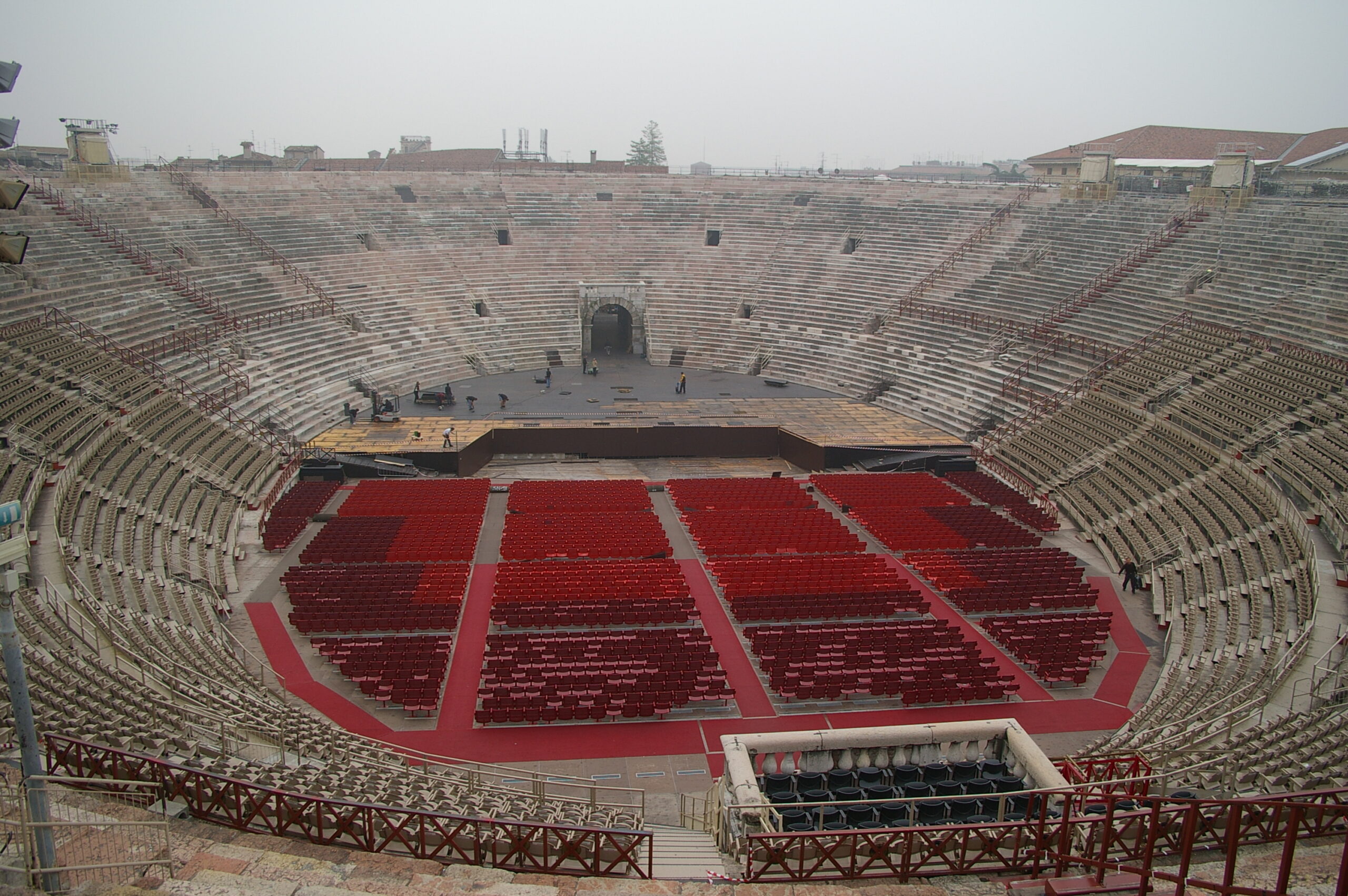
What sets it apart from every other amphitheatre is that it never stopped working. Since 10 August 1913, with Aida for the Verdi centenary, it has held an opera festival every summer: thirteen thousand people, no amplification, and small candles lit by the audience as the performance begins.
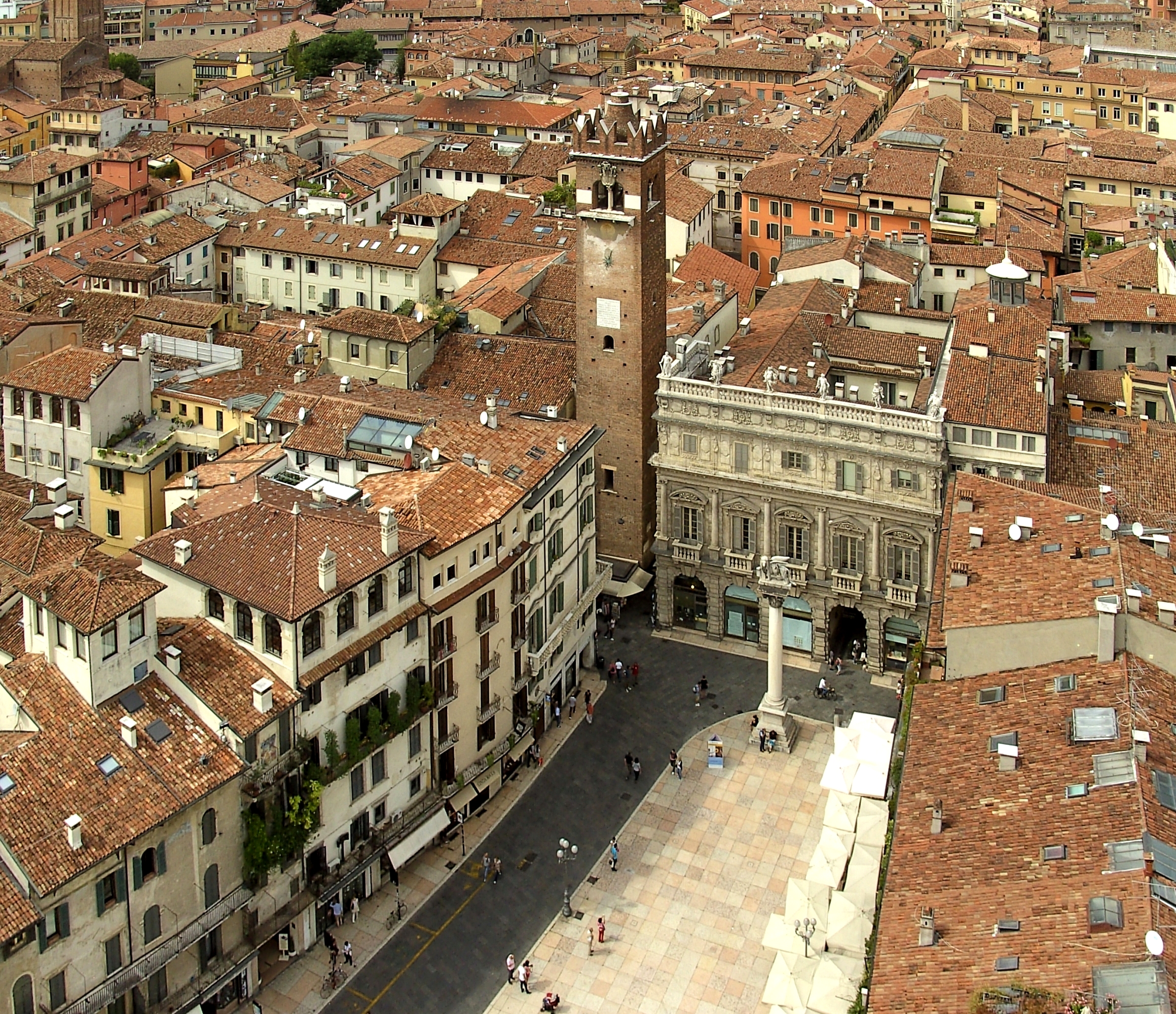
From Piazza Bra you walk up via Mazzini — halfway along is Juliet’s House, whose balcony was fitted in 1936: five minutes in the courtyard, which is free, and on you go — as far as Piazza delle Erbe, which sits on top of the Roman forum and has kept its shape. The fountain of the Madonna Verona is from 1368, but the statue is Roman, fourth century, adapted a thousand years later.
From the square you climb the Lamberti Tower, eighty-four metres, by lift or by its 368 steps: from up there the plan of the city, the bend of the river and the position of the Arena all make sense.
Not at the tables out on Piazza delle Erbe, which charge for the view: two side alleys away the prices halve. A plate of bigoli costs between ten and fourteen euros, risotto all’Amarone around fifteen.
Afternoon – the Scaligers and the churches
Time 4 hours · Spend about €8 · Walks all under five minutes
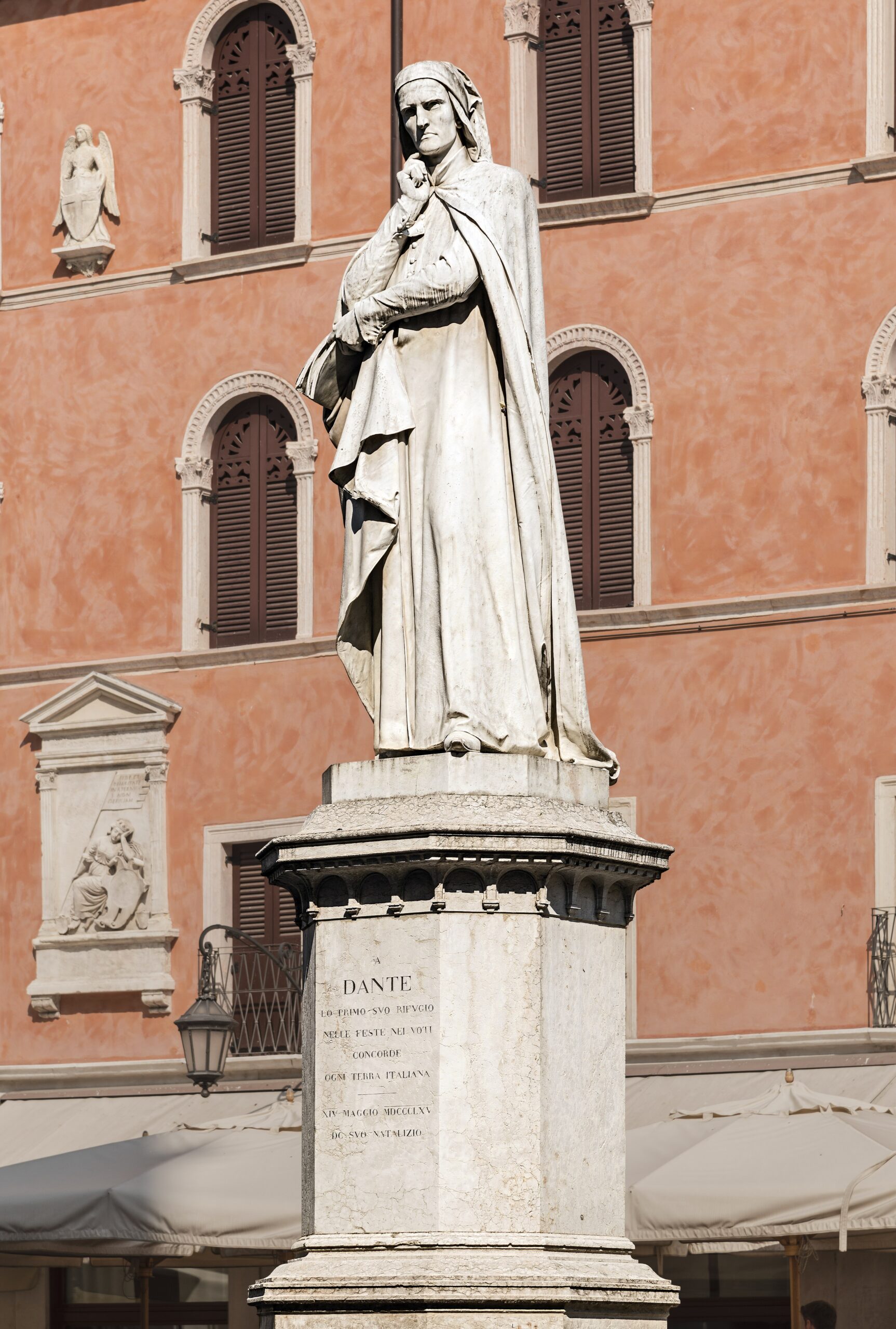
Under the Arco della Costa — from which hangs a whale’s rib nobody can explain — you pass into Piazza dei Signori, small and quiet, closed in by buildings of government. In the middle, the statue of Dante: driven out of Florence, he was taken in here by Cangrande della Scala, and in the Paradiso he calls Verona “your first refuge and your first inn”.
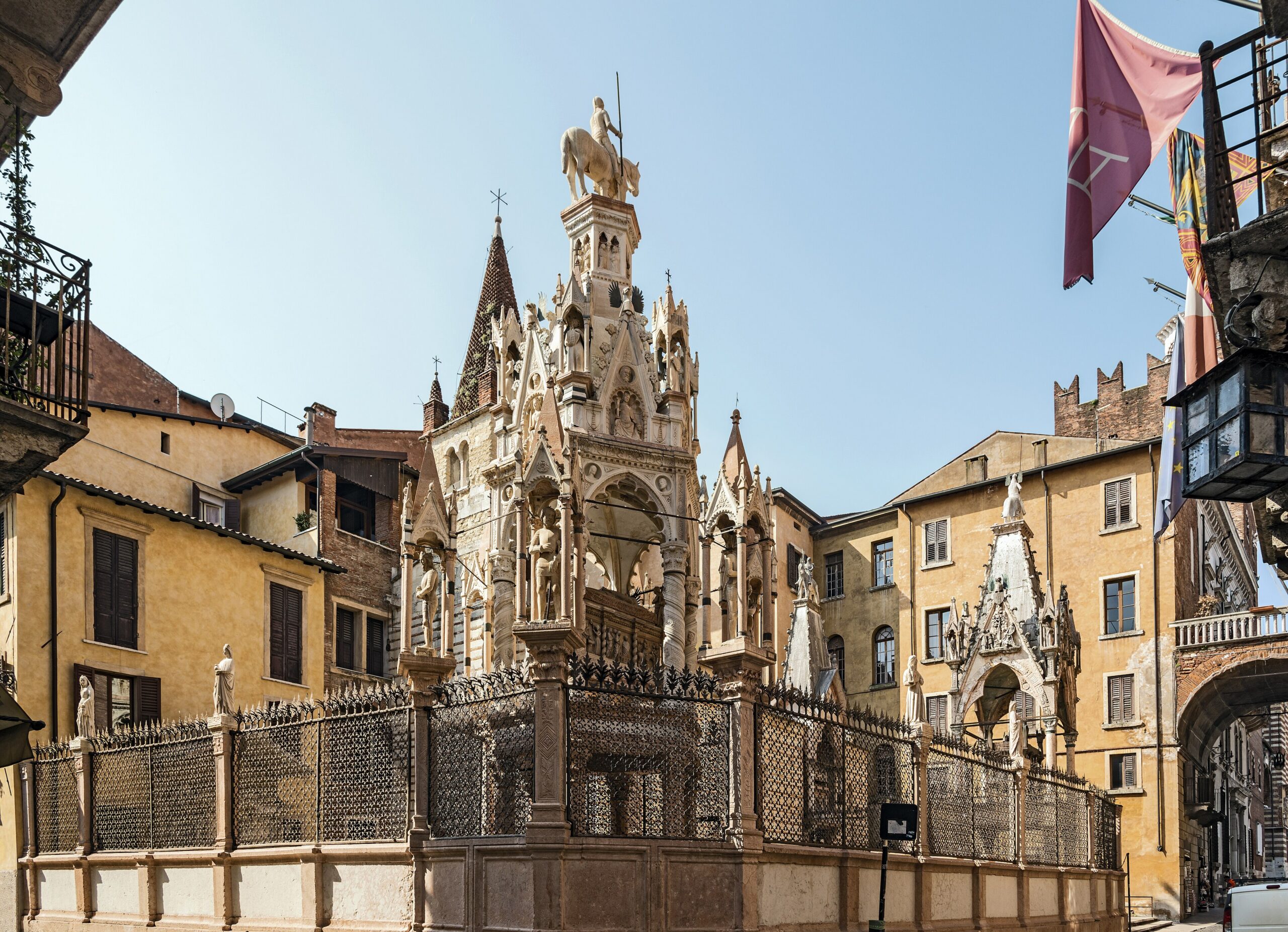
Beside it, inside a wrought-iron enclosure worked with the family’s ladder motif, are the Scaliger Tombs: the graves of the fourteenth-century lords, suspended in the air under Gothic canopies with equestrian statues on top. Cangrande’s, above the doorway, is a copy: the original is in Castelvecchio and that is tomorrow’s stop.
Sant’Anastasia is the largest church in the city. At the entrance are i gobbi, two statues bent under the holy water stoups; high up in a chapel, Pisanello’s Saint George and the Princess, International Gothic at its finest. The Cathedral, five minutes further up, has the Romanesque doorway by Nicolò and an Assumption by Titian in the first chapel on the left.
Day 2 — Castelvecchio, San Zeno and the far bank
6 km · 4 stops · west in the morning, across the river in the afternoon
Morning – Castelvecchio, Carlo Scarpa and San Zeno
Time 4 hours · Spend about €13 · Castelvecchio closed on Monday mornings

Castelvecchio was built by Cangrande II between 1354 and 1376, and it was not there to keep out enemies from abroad: it was there to keep out the Veronese, with the battlemented Scaliger Bridge letting the family escape northwards. In 1945 the retreating Germans blew it up; it was rebuilt by dredging the stones from the bed of the Adige and putting them back in their original order.
Inside is the museum, with Mantegna, Bellini, Veronese and Tintoretto. But the real reason to go in is Carlo Scarpa’s installation, carried out between 1958 and 1964: Scarpa rebuilt the interior leaving the layers of each period on show, hung the works on supports of iron and concrete, and opened unexpected routes through it. It is regarded as one of the masterpieces of twentieth-century museum design and architects come from all over the world to study it. The most famous point is the equestrian statue of Cangrande, set on a cantilevered concrete shelf over the void, in the open air: the rider is smiling, and nobody has ever worked out why.
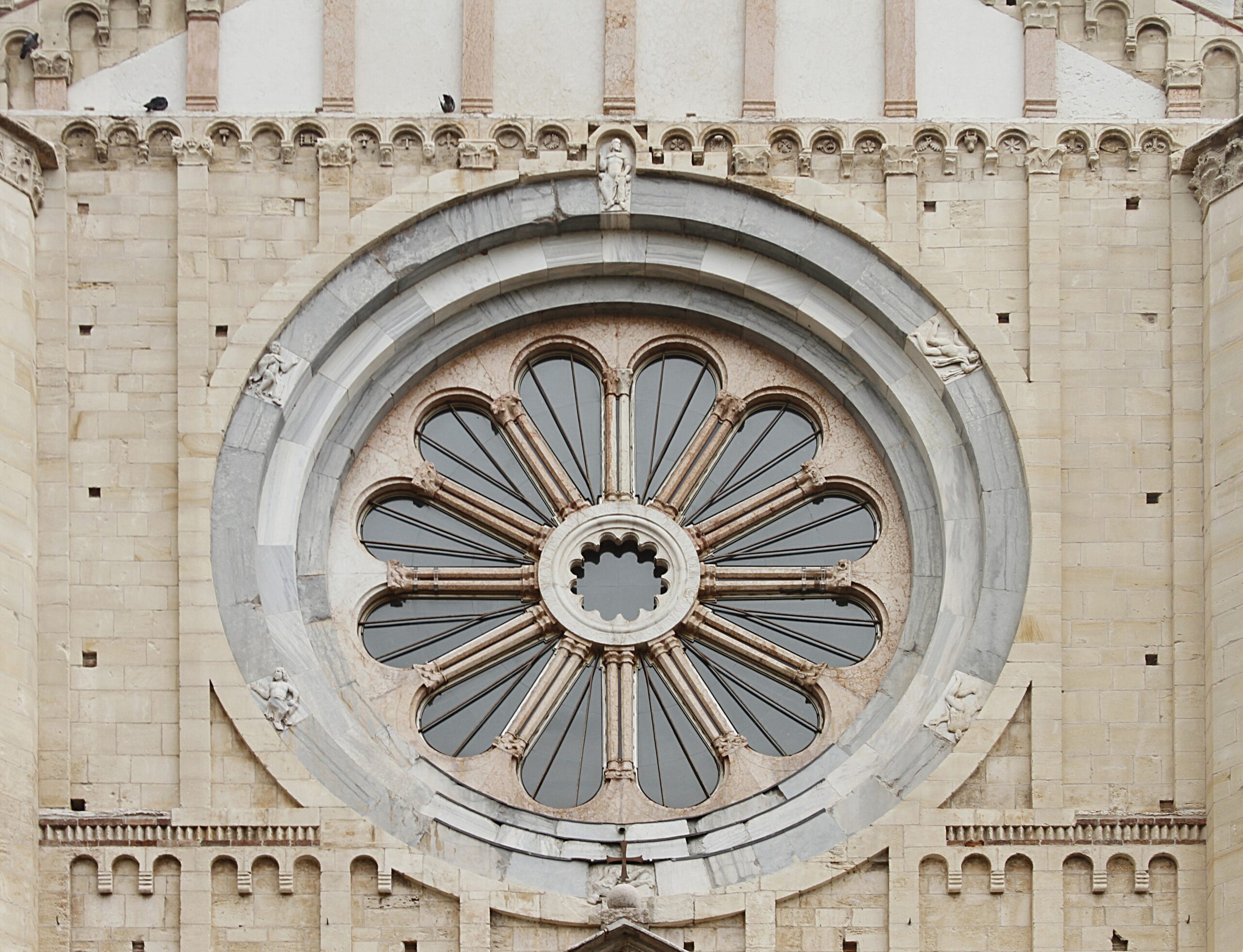
A kilometre further west stands San Zeno Maggiore, which is the best thing in Verona after the Arena and which almost no day visitor reaches. The golden tufa facade carries Brioloto’s rose window, known as the Wheel of Fortune, with six human figures rising and falling around the circle.
The bronze doors are forty-eight panels cast between the eleventh and twelfth centuries, with biblical scenes and the saint’s miracles, of a rough expressive force that makes them unforgettable: they are not elegant and are not trying to be. Inside, on the high altar, is Mantegna’s triptych of 1459 — the three predella panels were carried off by Napoleon and never came back: two are in the Louvre, one in Tours. And in the right-hand aisle, a Saint Zeno who is smiling, which is very rare in Romanesque sculpture.
The San Zeno quarter is residential and has neighbourhood osterie at sensible prices: the groups do not come this far. Otherwise walk back towards Castelvecchio and eat along the Adige.
Afternoon – across the Adige
Time 4 hours · Spend about €12 · The sunset from Castel San Pietro
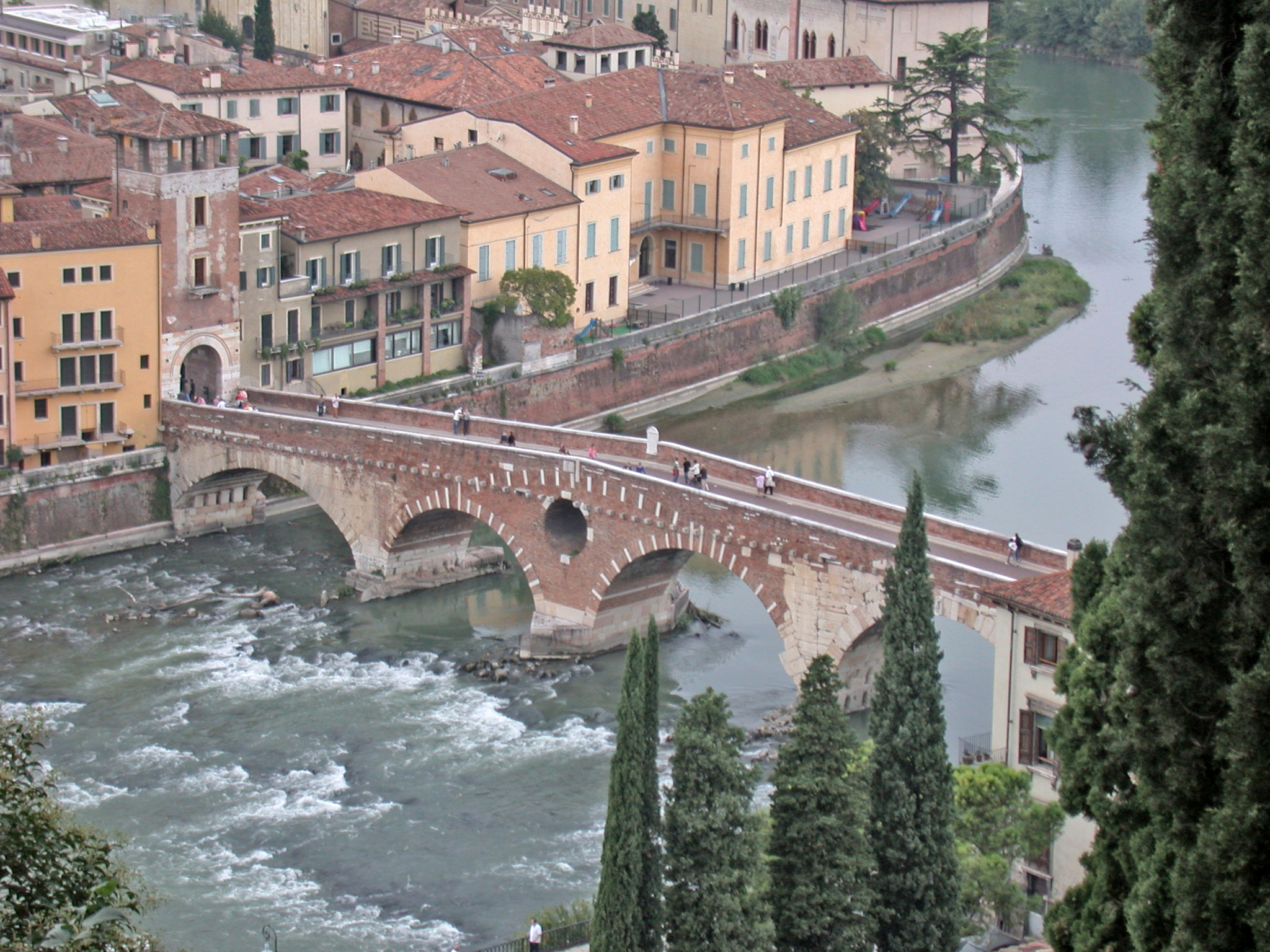
You cross Ponte Pietra, the oldest bridge in the city: the two arches on the left-bank side are Roman, first century BC, the others were rebuilt later, and you can see it with the naked eye. This one too was blown up in 1945 and rebuilt by fishing the blocks out of the river.

On the left bank, built into the hill, is the Roman Theatre of the first century BC, buried under houses for centuries and brought back to light in the nineteenth century by a private citizen who bought the whole quarter in order to pull it down. Above the tiers, a former monastery houses the Archaeological Museum. In summer the Estate Teatrale Veronese is staged here: Shakespeare performed inside a Roman theatre.
Ten minutes further east, the Giusti Garden is one of the best-preserved Italian formal gardens in Europe, laid out in the sixteenth century: an avenue of very tall cypresses climbs the hillside to a stone mask that breathes fire on feast days, and from there you look out over the city. Goethe came through in 1786 and writes about it in his Italian Journey; Mozart visited it too.

You finish by going up to Castel San Pietro, by the stepped path or by the funicular, reopened in 2017. The terrace is the point from which you see the whole of Verona with the bend of the Adige and the bridges. At sunset the stone of the city turns pink.
Day 3 — Out of town: the Valpolicella, Lake Garda or Mantua
A whole day · the wineries 20 minutes away, Sirmione 40, Mantua 45
Verona sits at the centre of a tight, rich circle, and the third day is there to use it. Three directions, three very different days: the Valpolicella if you care about wine, Lake Garda if you want water and walking, Mantua if you would rather have another city of art.
The Valpolicella and Amarone
Journey 20-30 minutes by car · Winery visit €20-40 · Always by appointment
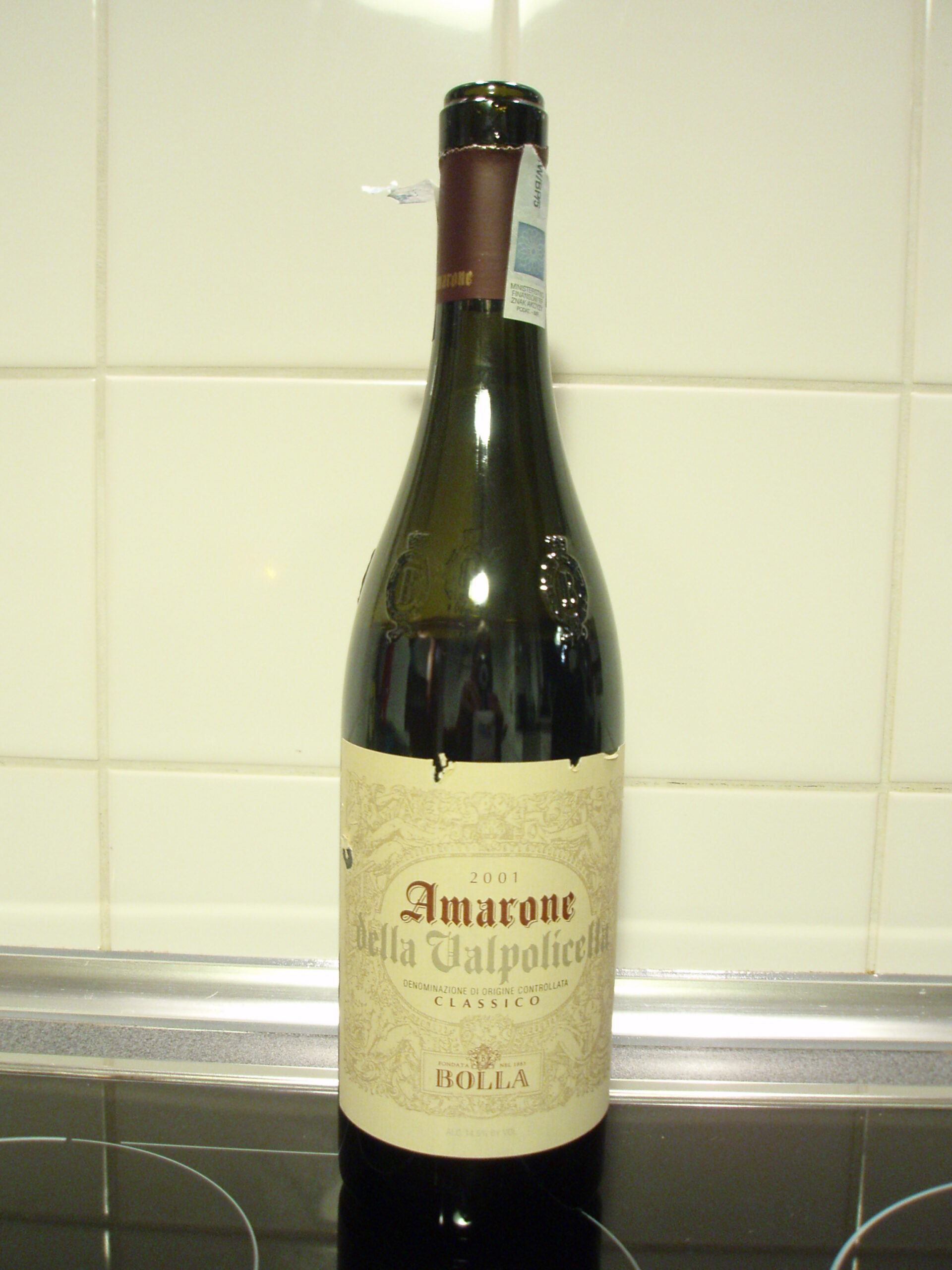
North of the city the hills of the Valpolicella begin immediately, and the reason to go is to understand how they make a wine that resembles no other. Amarone comes from appassimento: the grapes are picked and left to rest on racks or in crates for three or four months, lose half their weight in water, and only then are they pressed. What comes out is a wine of fifteen or sixteen degrees, concentrated, that ages for decades.
The fruttaie, the rooms where the grapes dry, are the thing to ask to see: between October and January you find them full, and it is a sight you get nowhere else. The same process produces Recioto, the sweet version, which is the oldest wine of the area.
There are dozens of wineries open to visitors, from famous names to family growers, and a visit is always booked in advance: it costs between twenty and forty euros with the tasting. If you go by car, remember that whoever drives does not drink; most wineries provide a spittoon and water without making a fuss. Without a car there are organised tours from Verona, and that is the sensible answer.
The same area has things to see that involve no drinking: the Romanesque Pieve di San Giorgio di Valpolicella, with its cloister and its view down the valley, and the Venetian villas scattered among the vineyards.
Lake Garda and Sirmione
Journey 30 minutes by train to Peschiera · Grotte di Catullo about €8 · In summer very crowded
Lake Garda is the largest lake in Italy and the Verona shore is half an hour away: Peschiera del Garda is on the Milan-Venice line and is itself a UNESCO site for its Venetian fortifications.
From Peschiera you take a boat or a bus to Sirmione, which sits at the end of a peninsula four kilometres long and is entered across the drawbridge of the Scaliger castle, surrounded by water. At the tip of the point are the Grotte di Catullo, which are not caves at all but the remains of a large first-century Roman villa, among olive trees with the lake all around: it is the best-preserved Roman villa in northern Italy.
The other stops on the Verona shore are Lazise, with its Scaliger walls on the water, Bardolino, which gives its name to the wine, and Malcesine further north, from where a rotating cable car climbs Monte Baldo to 1,760 metres.
A warning: from June to August Sirmione is extremely crowded and the boats fill up. In spring and autumn it is another thing entirely.
Mantua, the third option
Journey 45 minutes by train · Palazzo Ducale about €15 · Closed on Mondays
If you would rather have another city of art, Mantua is three quarters of an hour away and is a UNESCO site. Surrounded on three sides by artificial lakes, it was the capital of the Gonzaga, and the Gonzaga left two things that justify the trip on their own.
In the Palazzo Ducale, a city within the city with five hundred rooms, is Mantegna’s Camera degli Sposi: a room painted from floor to ceiling, with the court portrayed from life and a false oculus in the ceiling over which cherubs and servants lean — the first sotto in su in the history of painting. Visits are limited to a few minutes at a time.
Outside the centre, Palazzo Te is the pleasure villa built by Giulio Romano for Federico II Gonzaga: in the Room of the Giants the fresco covers walls and ceiling without a break, showing collapse and ruin so completely that anyone walking in feels the weight of the stones coming down.
Where to stay
It is worth staying inside the bend of the Adige, in the block between Piazza Bra, Piazza delle Erbe and the river: everything is walkable and you can walk home from any dinner.
The Piazza Bra area is the most convenient and the most expensive, and in summer it is noisy on performance nights. Veronetta, on the left bank beyond Ponte Pietra, is the university quarter: it costs less, has real osterie and is still ten minutes from the centre. Near Porta Nuova station prices drop, which is handy if you are taking a train on the third day.
Two periods to watch: the opera season, June to September, and Vinitaly in April, when the hotels fill and prices climb steeply. Verona in Love, around Valentine’s Day, also fills the city.
What it costs
| Item | Approximate cost |
|---|---|
| Arena, daytime visit | about €12 |
| Lamberti Tower with the lift | about €8 |
| Castelvecchio Museum | about €9 |
| Sant’Anastasia, Cathedral, San Zeno | about €4 each |
| Roman Theatre and Archaeological Museum | about €5 |
| Giusti Garden | about €10 |
| Funicular to Castel San Pietro | about €2 |
| Winery visit with tasting in the Valpolicella | €20-40 |
| Train to Peschiera del Garda, return | €8-12 |
| Train to Mantua, return | €10-14 |
| Lunches, three days | €45-75 |
| Dinners, three days | €90-135 |
| Total per person, three days | €190-310 |
Accommodation excluded. Reference figures for August 2026: check the official sites before you travel. The Verona Card covers almost every monument in the city and pays for itself from three admissions upwards. Opera tickets at the Arena run from a few tens of euros on the stone tiers to several hundred in the stalls.
Getting around
The centre is done on foot: it all sits inside the bend of the Adige and can be crossed in twenty minutes. The only transport you need is the funicular up to Castel San Pietro, if you would rather not take the steps.
From Porta Nuova station to Piazza Bra is twenty minutes on foot, or a few minutes by bus; a city ticket costs around €1.50.
For the third day: Peschiera del Garda is half an hour by train on the Milan-Venice line, and boats and buses for Sirmione and the other lakeside towns leave from there. Mantua is three quarters of an hour by regional train. For the Valpolicella, though, you need a car or an organised tour: there is no public transport between one winery and the next.
By train Verona is an hour and ten from Milan and from Venice, an hour from Bologna, an hour from Trento. Catullo airport is ten kilometres out, with a shuttle to the station.
Frequently asked questions
Are three days in Verona too many?
Not if the third is used to get out of town. The centre fits into one day; the second is for Castelvecchio with Carlo Scarpa’s installation, for San Zeno and for the left bank with the Roman Theatre and the Giusti Garden; the third gives far more if it is spent in the Valpolicella, on Lake Garda or in Mantua.
Valpolicella, Garda or Mantua as a day trip from Verona?
The Valpolicella if you care about wine: the Amarone wineries are twenty minutes away, but you need a car or an organised tour and the visit has to be booked. Lake Garda if you want water and walking: Peschiera is half an hour by train and from there you reach Sirmione with its Scaliger castle and the Grotte di Catullo. Mantua if you would rather have another city of art: three quarters of an hour by train, Mantegna’s Camera degli Sposi and Palazzo Te.
What is Amarone and why is it different?
It comes from appassimento: the grapes rest on racks for three or four months before pressing, lose half their weight in water and give a wine of fifteen or sixteen degrees that ages for decades. If you visit a winery, ask to see the fruttaie, the drying rooms: between October and January they are full, and it is a sight you get nowhere else.
How much does a long weekend in Verona cost?
Between 190 and 310 euros per person for three days excluding accommodation, day trip included. The Verona Card covers almost every monument in the city and pays for itself from three admissions upwards. Piazza delle Erbe, Piazza dei Signori, the Scaliger Tombs, the bridges and the view from Castel San Pietro are free.
Why is Castelvecchio famous among architects?
For the museum installation carried out by Carlo Scarpa between 1958 and 1964, regarded as one of the masterpieces of twentieth-century museum design: Scarpa left the layers of each period visible instead of hiding them, hung the works on supports of iron and concrete and opened unexpected routes through the building. The most famous point is the equestrian statue of Cangrande on a cantilevered shelf over the void.
Is the opera at the Arena worth it?
Yes, and it is an experience you cannot repeat elsewhere: thirteen thousand people in a first-century amphitheatre, no amplification, and the small candles the audience lights as the lights go down. The festival has run since 1913. Seats on the stone tiers cost a few tens of euros but you sit on the stone: bring a cushion, or hire one at the entrance.
Which area is best to stay in?
Inside the bend of the Adige, between Piazza Bra and Piazza delle Erbe: everything is walkable. Piazza Bra is the handiest area and the dearest, and noisy on opera nights. Veronetta, beyond Ponte Pietra, is the university quarter: cheaper, with real osterie, ten minutes from the centre. Watch the prices during Vinitaly in April and through the summer opera season.
When is the best time to go to Verona?
April to June and September to October. Summer has the opera at the Arena but also heat and crowds, and Sirmione becomes impossible. Autumn coincides with the Valpolicella harvest and with the drying rooms at their fullest. Avoid the week of Vinitaly, in April, unless that is what you are coming for.
September 3, 2026


