
Verona in 1 day: the Arena, the Scaligers and the truth about the balcony
Verona has two opposite problems, and a single day solves both. The first is that almost everyone comes for a story that was made up — Juliet’s balcony was put there in 1936 — and misses a Roman amphitheatre still in use, a Romanesque basilica with bronze doors, and a museum that is a masterpiece of twentieth-century design. The second is that the centre sits inside a bend of the river Adige and can be crossed in twenty minutes, so there is time for everything: you only need to know where to look.
At a glance
- How long · a full day, from 9am until dinner
- How much walking · about 5 km on the flat, plus the climb to Castel San Pietro
- What has to be booked · nothing, except the opera at the Arena if you come in summer
- Budget · €55-95 per person excluding accommodation
- Starting point · Piazza Bra, in front of the Arena
- Finishing point · Castel San Pietro at sunset
- What is left out · San Zeno if you are in a hurry, and Lake Garda and the Valpolicella: those are a second day
Eight stops inside the bend of the Adige. You finish on the far bank, up on the hill, for the sunset.
Morning — The Arena, Juliet and Piazza delle Erbe
1.5 km · 3 stops · 9am to 1pm · along the line of via Mazzini

You begin with the one thing Verona does not have to prove to anyone. Piazza Bra is the city’s drawing room, with the liston — the wide pink marble pavement people stroll along — and the amphitheatre at the end of it.
1 – The Arena
Time needed 1 hour · Ticket about €12 · Closed while the opera sets are going up
The Arena dates from the first century AD, which makes it a few decades older than the Colosseum, and it is the third largest Roman amphitheatre in Italy. It held thirty thousand people.
Look at the outer wall: only a fragment of four arches is still standing, and the Veronese call it the Ala, the wing. That was the outermost ring, thirty metres high, and it came down in the earthquake of 1117; the stones ended up in the palaces of the city. What you see today is the inner ring, and on its own it is impressive enough.
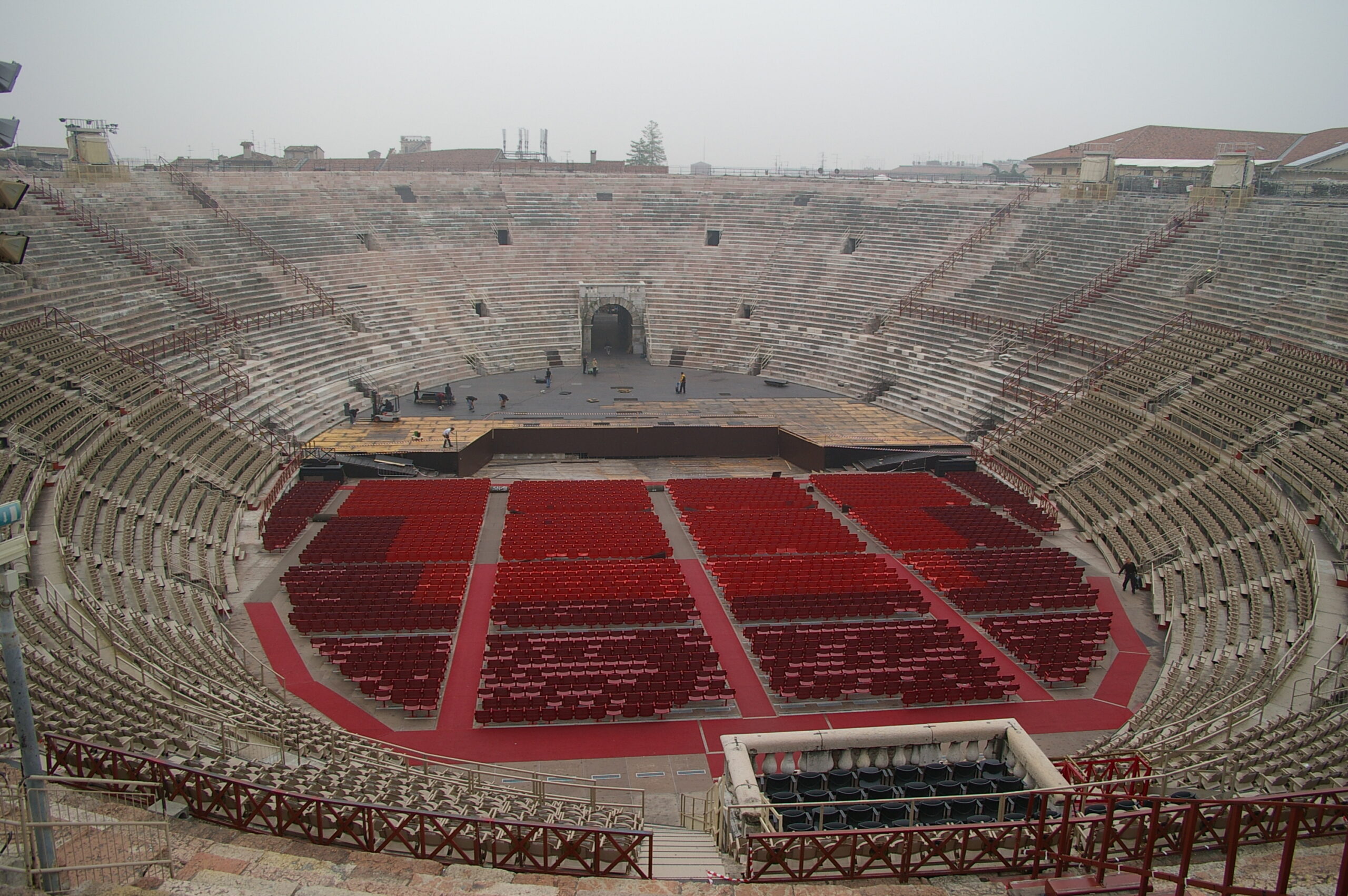
What makes the Arena different from every other amphitheatre is that it never stopped working. Since 10 August 1913, when Aida was staged here for the centenary of Verdi’s birth, it has held an opera festival every summer: around thirteen thousand people, no amplification, the Roman acoustics doing all the work. Anyone with a ticket on the stone tiers brings a cushion, because you sit on the stone, and at the start of the performance the audience lights small candles: when the lights go down, the bowl fills with points of flame.
If you come between June and September, the interior may be closed or partly taken up by the sets. In that case the daytime visit is worth less — and the evening ticket is worth a great deal more.
2 – Juliet’s House, and the truth about the balcony
Time needed 30 minutes · Courtyard free, house about €6 · Always packed

Via Mazzini runs from Piazza Bra, all shops, and halfway along it you turn into a narrow passageway: inside is a courtyard with a balcony and a bronze statue, and five hundred people taking photographs.
It is worth knowing how things really stand. The house is fourteenth-century and belonged to the Cappello family, which was convenient, because it sounds like Capulet. The balcony was not there: it was fitted in 1936 out of a fragment of a fourteenth-century sarcophagus, when the city council decided to give tourists what they were coming to look for. Shakespeare never set foot in Verona and took the plot from an Italian novella. The statue of Juliet dates from 1969; the polished breast is the work of millions of hands, and the cracked original was withdrawn in 2014 and replaced with a copy.
Having said all that: the courtyard is free, it takes five minutes, and it is the most successful piece of invented tourism in Italy. Take it for what it is and do not get annoyed. If you want real Scaliger architecture, it starts a hundred metres further on.
3 – Piazza delle Erbe and the Lamberti Tower
Time needed 1 hour 30 · Tower about €8 with the lift · 368 steps on foot
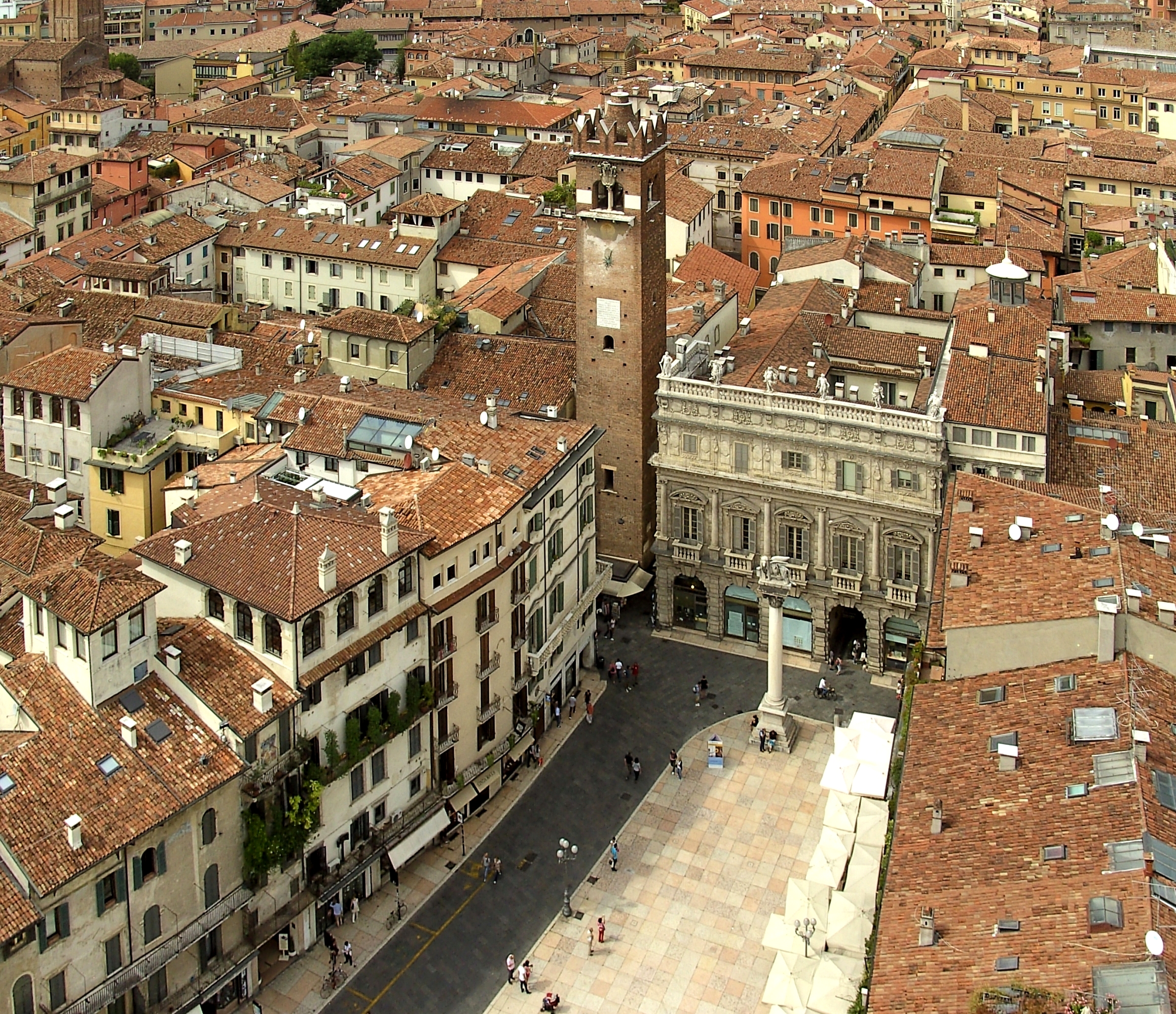
Piazza delle Erbe sits exactly on top of the Roman forum and has kept its elongated shape. It is one of the finest squares in Italy, not because of any single building but because every building is different: the crenellated Casa dei Mercanti, the Baroque Palazzo Maffei with statues of the gods along its cornice, the Gardello Tower, and the frescoed houses.
In the middle stands the fountain of the Madonna Verona, from 1368: the statue, however, is Roman, fourth century, adapted a thousand years later by adding arms and a head. Under the arch that leads through to Piazza dei Signori a whale’s rib hangs on chains: it has been there for centuries, nobody quite knows why, and the legend says it will fall on the first just person to walk beneath it. It has not fallen yet.
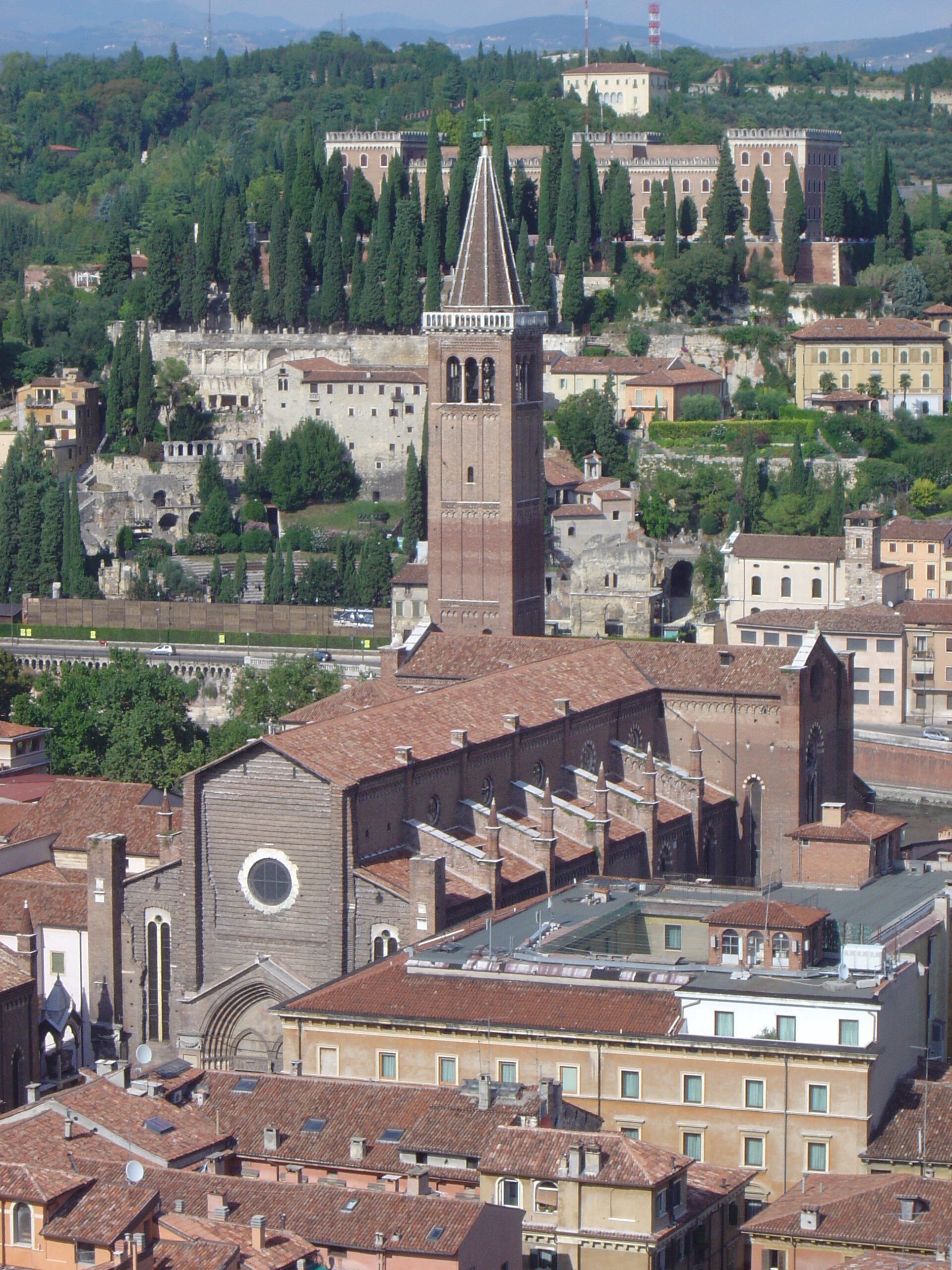
From the square you climb the Lamberti Tower, eighty-four metres, the tallest in the city: 368 steps, or a lift that saves you half of them. At the top are the two historic bells, the Rengo, which summoned the people, and the Marangona, which marked working hours and rang for fires. And there is the view: red roofs, the bend of the Adige, the Arena and the hills.
Avoid the tables out on Piazza delle Erbe, which charge for the view. Two side alleys are enough to find real osterie: a plate of bigoli costs between ten and fourteen euros, risotto all’Amarone around fifteen. The quick Veronese alternative is a glass of Valpolicella at the counter with a plate of cured meats and polenta.
Afternoon — The Scaligers, the churches and Castelvecchio
2.5 km · 3 stops · 2.30pm to 6.30pm · up towards the river, then back
4 – Piazza dei Signori and the Scaliger Tombs
Time needed 45 minutes · Free from outside · Walk two minutes
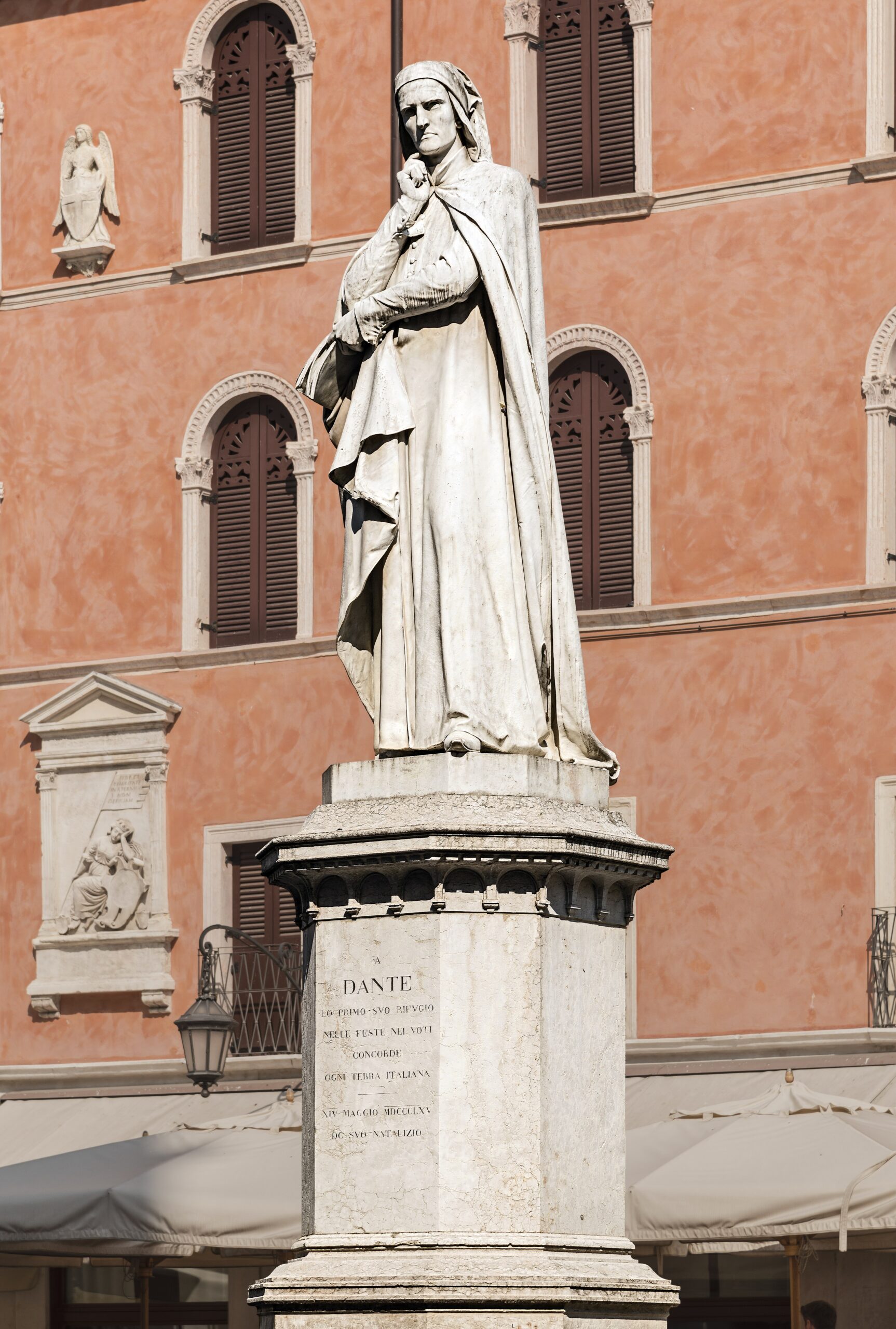
Under the arch with the whale’s rib you pass into Piazza dei Signori, which the Veronese call Piazza Dante. It is the reverse of the square you have just left: small, quiet, closed in by buildings of government — the Palazzo del Capitanio, the Palazzo della Ragione with its Gothic staircase in the courtyard, the Renaissance Loggia del Consiglio.
In the centre stands the statue of Dante, and it is deserved: driven out of Florence, the poet was taken in at Verona by Cangrande della Scala, and in the Paradiso he thanks him by calling Verona “your first refuge and your first inn”. Verona is the first city of his exile.
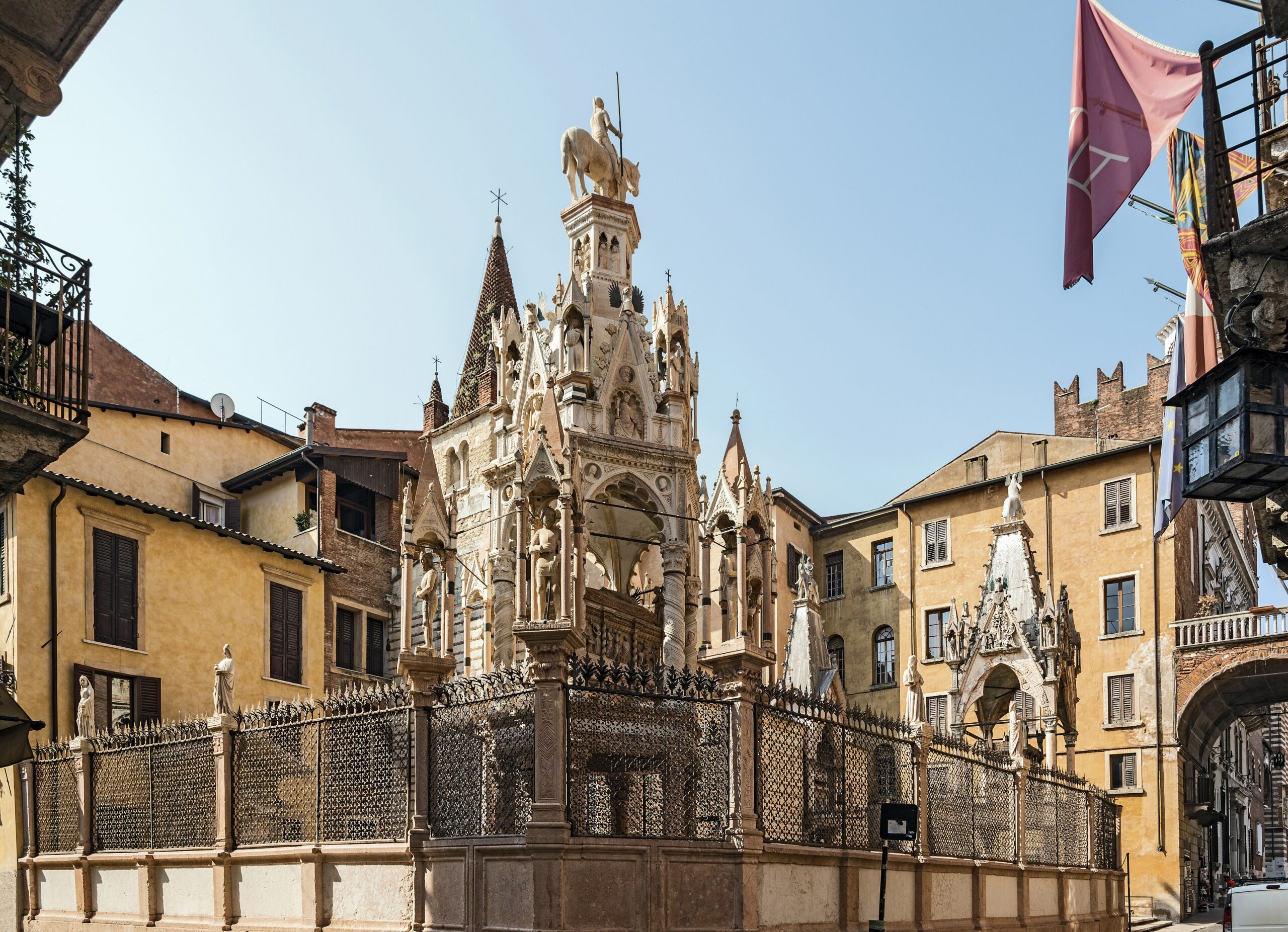
Next to it, inside a wrought-iron enclosure worked with the family’s ladder emblem, are the Scaliger Tombs: the graves of the lords who ruled Verona in the fourteenth century, held up in the air on columns, under Gothic canopies with equestrian statues on top. Cangrande’s stands above the church doorway: the statue you see is a copy, and the original — with that unsettling smile everybody notices — is in Castelvecchio.
5 – Sant’Anastasia and the Cathedral
Time needed 1 hour 30 · About €4 each, or a combined ticket · Walk five minutes
Sant’Anastasia is the largest church in Verona, Gothic, with a facade that was never finished. Two things to look for. At the entrance, two statues of men bent under the weight of the holy water stoups: the Veronese call them i gobbi, the hunchbacks, and children have been climbing on them for centuries. And high up in a chapel, Pisanello’s Saint George and the Princess, a detached fifteenth-century fresco in which the knight is mounting his horse while two hanged men dangle in the background: it is International Gothic at its finest, and it needs looking at slowly, because it is set well above eye level.

The Cathedral is five minutes further up, towards the bend in the river. The Romanesque doorway is by Nicolò, the same sculptor as San Zeno, with the paladins Roland and Oliver carved either side of it. Inside, in the first chapel on the left, there is an Assumption by Titian. The complex also takes in the baptistery of San Giovanni in Fonte, with a single-block font carved in the thirteenth century.
6 – Castelvecchio, the Scaliger Bridge and Carlo Scarpa
Time needed 2 hours · Ticket about €9 · Closed on Monday mornings

At the other end of the centre, on the Adige, Castelvecchio was built by Cangrande II between 1354 and 1376, and it was not a defence against enemies from outside: it was a fortress to be defended from the Veronese themselves, with a fortified bridge that let the family escape northwards. The Scaliger Bridge is that escape route, with its swallowtail battlements.
In 1945 the retreating Germans blew it up. It was rebuilt after the war by fishing the stones out of the bed of the Adige and putting them back in their original order: you walk across it and would never guess. The same was done with the Ponte Pietra.
But the real reason to go into Castelvecchio is the museum, and not so much for the paintings — though they are there: Mantegna, Bellini, Veronese, Tintoretto — as for the way they are shown. Between 1958 and 1964 Carlo Scarpa rebuilt the interior of the castle leaving the scars of each period visible, hanging the works on supports of iron and concrete, opening unexpected passages. It is regarded as one of the masterpieces of twentieth-century museum design and architects come from all over the world to study it.
The most famous point is the equestrian statue of Cangrande, the original from the tombs, set on a cantilevered concrete shelf over the void, in the open air, to be looked at from several heights as you walk around it. The rider is smiling, and nobody has ever worked out why.
Evening — The far bank and the sunset
1.5 km · 2 stops · from 6.30pm onwards · across the river and up
7 – Ponte Pietra and the Roman Theatre
Time 1 hour · Bridge free, theatre about €5 · Walk ten minutes from the cathedral
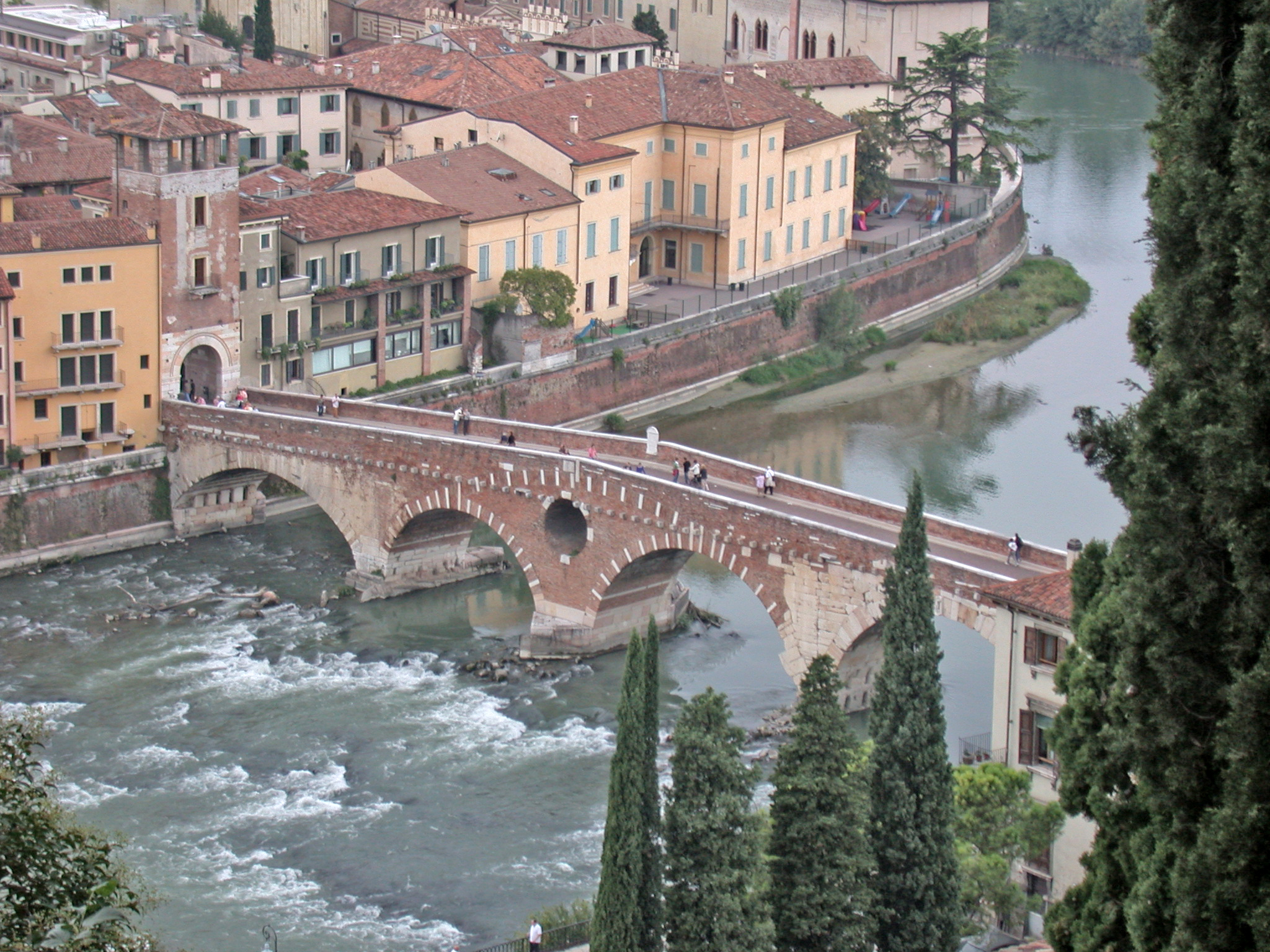
Ponte Pietra is the oldest bridge in Verona: the two arches on the left-bank side are Roman, first century BC, while the others were rebuilt in the Middle Ages and in the sixteenth century. You can see the difference in stone and colour with the naked eye.
This one too was blown up in 1945, and this one too was rebuilt by dredging the original blocks out of the riverbed and putting them back one by one. It is the most photographed spot in the city, and at sunset, with the light catching the brick, you understand why.

On the far bank, built into the hillside, is the Roman Theatre, first century BC, which lay buried under houses for centuries and was brought back to light in the nineteenth century by a private citizen who bought the whole quarter in order to demolish it. Above the tiers is a former monastery housing the Archaeological Museum, and from its terrace you look down over the city.
In summer the Estate Teatrale Veronese is staged here: Shakespeare performed in a Roman theatre. The coincidence is too good to waste, if you happen to be here at the right time.
8 – Castel San Pietro at sunset
Time 1 hour · Free on foot, funicular about €2 · Go for the sunset

Above the Roman Theatre, at the top of the hill, stands Castel San Pietro, a nineteenth-century Austrian barracks built where a fortress had stood. The building cannot be visited, but that is not why you climb: the terrace in front of it is the point from which you see the whole of Verona, the bend of the Adige, the bridges, the bell towers and the hills behind.
You go up on foot by a stepped path — ten steep minutes — or by the funicular, reopened in 2017, which takes a minute and a half and costs a couple of euros. Go at sunset: it is the moment when the stone of the city turns pink, and it is the reason this is the last stop and not the first.
San Zeno, which deserves more than it gets
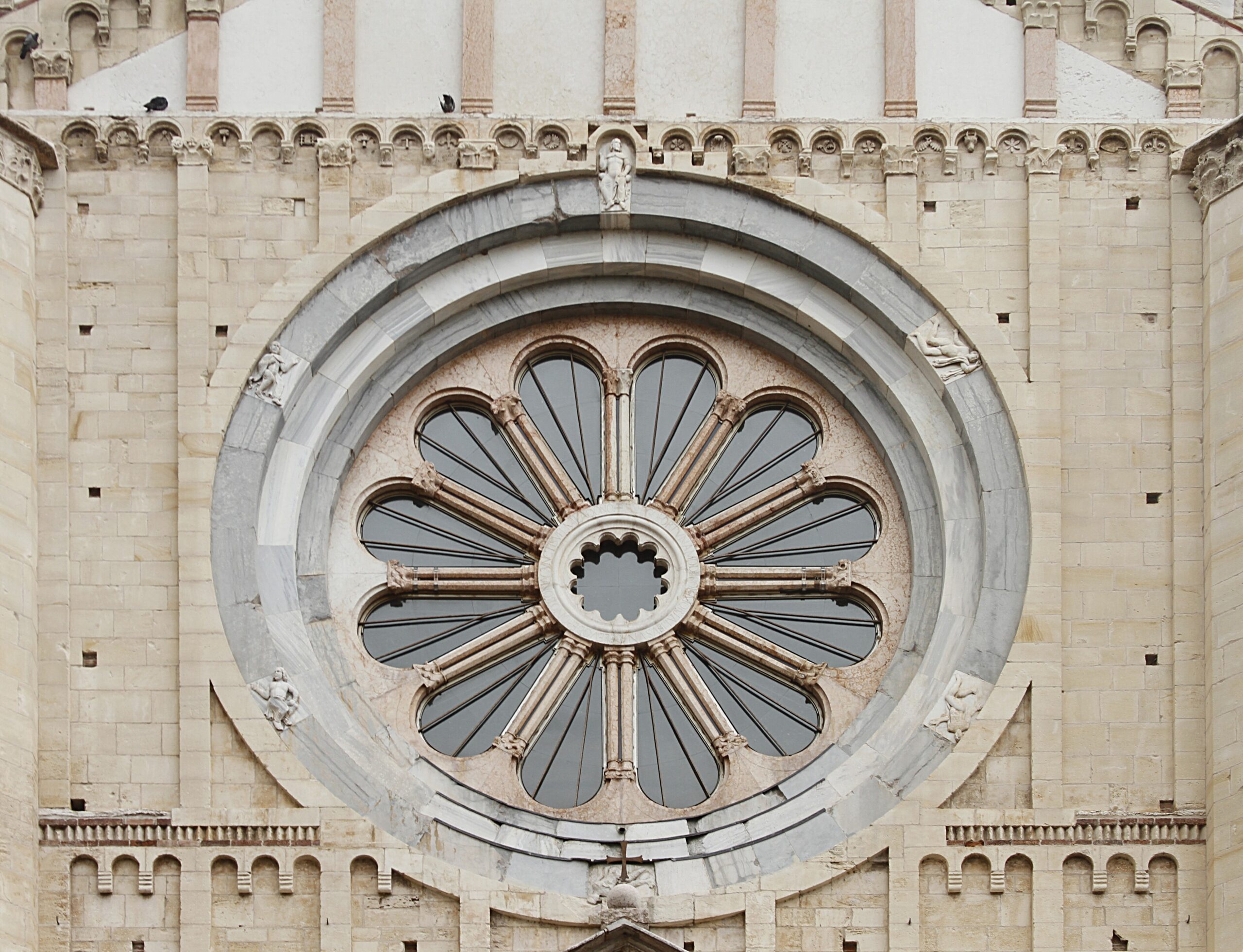
A kilometre west of Castelvecchio, outside the day-visitor circuit, stands the basilica of San Zeno Maggiore, one of the most important Romanesque churches in Italy.
The facade is of golden tufa with a rose window by Brioloto known as the Wheel of Fortune, six human figures rising and falling around the circle. The doorway is by Nicolò, flanked by reliefs of the story of Genesis and the legend of Theodoric.
But the thing to see is the bronze doors: forty-eight panels cast between the eleventh and twelfth centuries, with biblical scenes and the miracles of Saint Zeno, of a rough expressive force that makes them extraordinary. They are not elegant and are not trying to be.
Inside, on the high altar, is Mantegna’s triptych of 1459. The three predella panels were carried off by Napoleon and never came back: two are in the Louvre and one in Tours, and copies stand in their place. In the right-hand aisle there is a statue of Saint Zeno who is smiling, which is very rare in Romanesque sculpture. And in the crypt, tradition has it, Romeo and Juliet were married: this too is invention, but at least here it is set in the right place.
The three things to know
The centre sits in a river bend and is walked end to end. The Arena to Piazza delle Erbe is ten minutes, to Castelvecchio fifteen, to Ponte Pietra twenty. You never need transport, except the funicular if you would rather not take the steps.
Juliet’s balcony dates from 1936. Knowing that in advance changes the mood of the visit: you spend five minutes in the courtyard, which is free, and move on. The real Verona begins a hundred metres further along.
In summer the Arena changes function. Between June and September the daytime visit can be restricted by the stage sets, but you can go to the opera instead. Tickets on the stone tiers cost little and you sit on the stone: bring a cushion.
What it costs
| Item | Approximate cost |
|---|---|
| Arena, daytime visit | about €12 |
| Lamberti Tower with the lift | about €8 |
| Castelvecchio Museum | about €9 |
| Juliet’s House | about €6, courtyard free |
| Sant’Anastasia, Cathedral, San Zeno | about €4 each |
| Roman Theatre and Archaeological Museum | about €5 |
| Funicular to Castel San Pietro | about €2 |
| Piazza delle Erbe, Piazza dei Signori, the tombs, the bridges, the view | free |
| Lunch in an osteria | €15-25 |
| Dinner with wine | €30-45 |
| Total per person | €55-95 |
Reference figures for August 2026: prices change, so check the official sites before you travel. The Verona Card covers almost everything and pays for itself from three admissions upwards. Opera tickets at the Arena run from a few tens of euros on the stone tiers to several hundred in the stalls.
Getting around
The centre is done on foot and there is no alternative: it all sits inside the bend of the Adige and can be crossed in twenty minutes. This itinerary is walked in its entirety, apart from the funicular at the end.
From Porta Nuova station to Piazza Bra is a twenty-minute walk along corso Porta Nuova, or a few minutes by bus. A city ticket costs around €1.50.
By train Verona is extremely convenient: Milan an hour and ten, Venice an hour and ten, Bologna an hour, Trento an hour. That is why it works so well as a stop on a longer trip, or as a base for Lake Garda.
Lake Garda is half an hour away: Peschiera del Garda is on the Milan-Venice line and the lake boats leave from there. The Valpolicella, for the wineries, begins twenty minutes by car to the north.
Catullo airport is ten kilometres out, linked to the station by shuttle bus.
Frequently asked questions
Is one day enough to see Verona?
Yes. The centre sits inside a bend of the Adige and can be crossed in twenty minutes: the Arena, Piazza delle Erbe with the Lamberti Tower, Piazza dei Signori with the Scaliger Tombs, Sant’Anastasia, Castelvecchio and sunset from Castel San Pietro all fit into one day. With an extra hour, San Zeno fits too.
Is Juliet’s balcony genuine?
No. The house is fourteenth-century and belonged to the Cappello family, but the balcony was fitted in 1936 using a fragment of a fourteenth-century sarcophagus, to give tourists what they were coming to find. Shakespeare never went to Verona. The bronze statue dates from 1969 and the one on show today is a copy. The courtyard is free and takes five minutes.
Can you visit the Verona Arena?
Yes, for about twelve euros, but between June and September the daytime visit can be limited by the opera festival sets. In that period it is better to see a performance instead: the festival has run since 1913, holds around thirteen thousand people with no amplification, and seats on the stone tiers cost a few tens of euros. Bring a cushion: you sit on the stone.
What is Castelvecchio and why is it famous?
It is the fortress built by Cangrande II between 1354 and 1376, with the battlemented Scaliger Bridge over the Adige. The museum inside is famous above all for the way Carlo Scarpa laid it out between 1958 and 1964: it is regarded as one of the masterpieces of twentieth-century museum design and architects come from all over the world to study it. It also holds the original equestrian statue of Cangrande.
How much does a day in Verona cost?
Between 55 and 95 euros per person excluding accommodation. Piazza delle Erbe, Piazza dei Signori, the Scaliger Tombs, the bridges and the view from Castel San Pietro are all free. If you visit three or more monuments, the Verona Card pays for itself.
Is San Zeno worth the walk?
Yes, and it is the best thing in Verona after the Arena. It stands a kilometre west of Castelvecchio, off the day-visitor circuit: a Romanesque basilica with the Wheel of Fortune rose window, forty-eight bronze panels of the eleventh and twelfth centuries on its doors and Mantegna’s triptych on the altar. Admission is about four euros.
What do you eat in Verona?
Risotto made with Amarone, bigoli pasta with sardines or with donkey ragù, gnocchi — the Veronese carnival is actually called Venerdì Gnocolar — and pastissada de caval, which is stewed horsemeat and is worth knowing about in advance. The local cake is pandoro, invented here in 1894. To drink: Valpolicella, Amarone, Soave and Bardolino, all made within half an hour of the city.
Is Verona a good base for Lake Garda?
An excellent one. Peschiera del Garda is half an hour by train on the Milan-Venice line, and the boats for Sirmione, Lazise and Bardolino leave from there. The Valpolicella, with the Amarone wineries, begins twenty minutes by car to the north. Verona is also an hour from Milan, Venice and Bologna.
Why is there a whale’s rib hanging in Piazza delle Erbe?
Nobody knows for certain. It has hung for centuries under the Arco della Costa, the passage between Piazza delle Erbe and Piazza dei Signori, and it is probably the sign of an old apothecary’s shop or an exotic trophy. Legend says it will fall on the first just person to pass beneath it: it has not happened yet.
September 3, 2026