

San Diego in 1 day: Balboa Park, the aircraft carrier and the La Jolla seals
San Diego is the city where Europeans first arrived in California, in 1542, and where in 1769 the first of twenty-one Spanish missions was founded: it is the place where California, as an idea, begins. Today it is a coastal city with the most consistent climate in the United States — twenty-two degrees average year-round, sunshine three out of every four days — an enormous naval base and an urban park that is larger than Central Park and looks like a Spanish city. In one day you can fit the park, the historic center, an aircraft carrier and a beach with seals.
In summary
- Duration · one full day, from 9 to 22
- How much you walk · 7-8 km, flat
- You need a car · useful but not essential: the light rail covers downtown, Old Town and the border
- Budget · 80-130 dollars per person, accommodation excluded
- Climate · the most consistent in the United States: you can come all year. However, from May to June there is the June Gloom, low clouds in the morning
- Mexico · Tijuana is half an hour by tram, but to return you need a passport and the queue can last for hours
- What’s left out · the zoo, the missions, the desert: they are the second and third day
From the park to the sea: Coronado is reached by ferry, La Jolla by car or bus.
Morning — Balboa Park
3 km · 1 stop · from 9 to 12:30 · the park is large, you choose
1 – The park that looks like a Spanish city
Time 3 and a half hours · Park free, museums 15-25 $ each · Zoo about 70 $, requires half a day

Balboa Park is four hundred fifty acres, one third larger than Central Park, and is not a natural park but a collection of pavilions in Spanish colonial style along a monumental avenue. They were built for the Panama-California Exposition of 1915, which San Diego organized to celebrate the opening of the Panama Canal and to get noticed: it was a city of forty thousand inhabitants that wanted to become something.
The pavilions were supposed to be temporary — they were made of plaster and fiber on wooden frameworks — and were supposed to be demolished at the end of the exposition. The citizens opposed this, and in subsequent decades they were rebuilt in masonry one by one, maintaining the original appearance. This is why today San Diego has a monumental center that looks like Salamanca.
Inside are seventeen museums and it’s worth choosing one or two:
- the Botanical Building, from 1915, one of the largest wooden lattice structures in the world, with the water lily pool in front: it is free and it is the photograph of the park
- the Museum of Us, anthropology museum, in the California Tower: you go up the bell tower for the view
- the San Diego Museum of Art, with a decent collection of Spanish painting
- the Spreckels organ outdoors, the largest outdoor pipe organ in the world: free concerts Sunday afternoon, for over a hundred years
In the park there is also the San Diego Zoo, one of the most famous in the world: it was born by chance, from animals abandoned after the 1915 exposition. However, it requires a full half day and costs seventy dollars: in a single day alone it doesn’t fit, and it is part of the second day.
Noon — Downtown and the harbor
2 km · 2 stops · from 12:30 to 16 · lunch included
2 – The Gaslamp Quarter
Time 1 and a half hours with lunch · Free · Tram to Fifth Avenue

The Gaslamp Quarter is the historic center: sixteen blocks of Victorian brick buildings, with reconstructed gas lamps. In the nineteenth century it was the city’s red light district, called Stingaree because it was said you could get stung there like by the rays in the bay: there were over a hundred gambling dens and brothels.
In the seventies it was degraded and the master plan provided for demolishing it to make offices. A group of citizens instead obtained historic landmark status, and today it is the area of restaurants and venues. Walking around you still see the original facades above the modern storefronts: it’s worth looking up.
3 – The USS Midway and the waterfront
Time 2 hours · Ticket about 36 $ with audioguide · 15 minutes on foot

The USS Midway is an aircraft carrier three hundred meters long in service from 1945 to 1992: it was the largest warship in the world for ten years, and over two hundred thousand sailors worked on it. It was the flagship of the first Gulf War, and in 1975 participated in the evacuation of Saigon, when South Vietnamese helicopters landed on deck and were pushed into the sea to make room for the next ones.
The visit is excellent even for those not interested in military things, because it tells the story of daily life on board: the bunks, the mess, the laundry, the brig, the engine room. The audioguide is read by former crew members. On the deck there are about thirty aircraft.
Next to it, on the waterfront, is the giant statue that reproduces the photograph of the Times Square kiss of 1945: here they call it Unconditional Surrender, and it is one of the most photographed things in the city and also one of the most debated.
Afternoon — Coronado
2 km · 1 stop · from 16 to 18:30 · ferry from the dock
4 – The island that isn’t an island
Time 2 and a half hours · Ferry about 8 $, 15 minutes · Beach free

Coronado is called an island but is a peninsula, connected to the mainland by an eleven-kilometer-long strip of sand. You get there by ferry from downtown, and it’s the best way: the crossing takes a quarter of an hour and has a view of the skyline.
The Hotel del Coronado is from 1888 and is one of the largest entirely wooden buildings in the United States, with red turrets and white porches. When it opened it was the largest hotel in the world lit by electricity, and the system was designed under the supervision of Thomas Edison himself. Some Like It Hot was filmed there in 1958, with Marilyn Monroe; and according to a local tradition, it was here that Edward VIII met Wallis Simpson, the woman for whom he would have given up the throne of England.
The beach in front of the hotel is regularly at the top of American rankings and has a peculiarity: the sand contains golden mica and in the low sun hours it glimmers. It is public and free, like all California beaches.
Evening — La Jolla
2 km · 1 stop · from 18:30 to 22 · 20 minutes by car to the north
5 – The cliffs, the seals and the sunset
Time 3 hours with dinner · Free · Car or bus 30
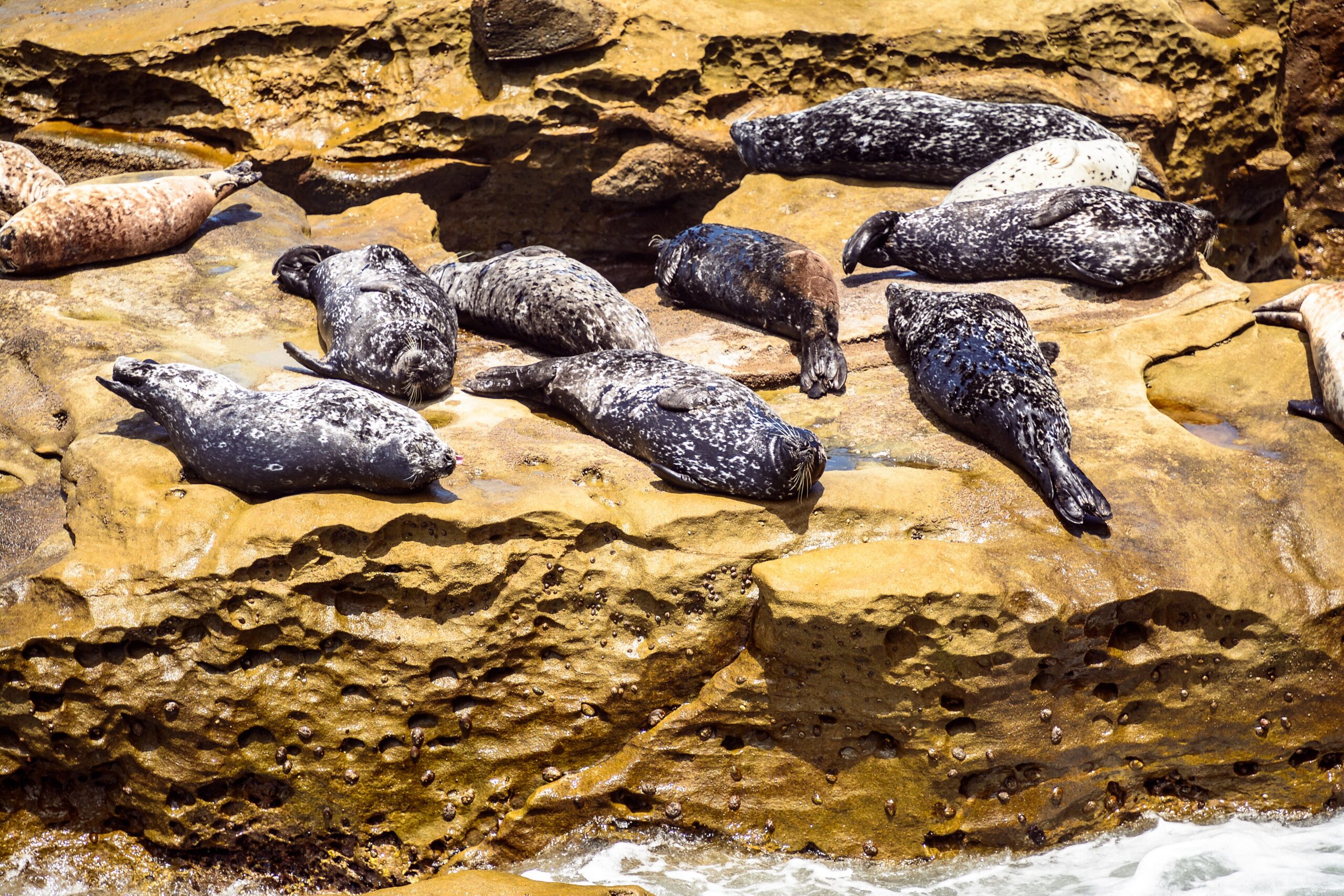
La Jolla — pronounced “la hoya” — is a residential neighborhood north of downtown, on a promontory of yellow cliffs. The name probably comes from the Spanish la joya, the jewel, or from a word of the Kumeyaay natives that indicated caves.
What everyone comes to see are the pinnipeds. At the Children’s Pool, a small bay protected by a breakwater built in 1931 as a natural pool for children, seals arrived in the nineties and didn’t leave. Since then the city has been divided: those who want the beach for swimmers and those who want to protect the animals. There have been lawsuits, sentences and ordinances; today the beach is closed to the public during breeding season. A little further on, at the Cove, are sea lions, which are larger and much louder.
The rules are simple and must be respected: you look from above, you don’t get close, you don’t touch. They are wild animals protected by a federal law, and every year someone gets a bite for trying to take a photograph too close.
You dine in one of the restaurants on the main street — here you eat better than on the touristy waterfront downtown — and you watch the sunset from the cliffs.
If it rains, or if it’s foggy
- It rains little · San Diego has an average of less than thirty days of rain a year, almost all between December and March: it is the place in the United States where you are least likely to need a plan B.
- The June Gloom · from May to June low clouds cover the coast until noon. It doesn’t affect the interior: Balboa Park is often sunny while La Jolla is gray.
- Indoors · the seventeen museums of Balboa Park are enough for a full day, and the USS Midway is almost entirely indoors.
- With children · the zoo in the park or the Birch Aquarium in La Jolla, which belongs to the Scripps oceanographic institute.
Cost of the day
| Voce | Spesa |
|---|---|
| USS Midway | about 36 $ |
| A museum in Balboa Park | 15-25 $ |
| Ferry to Coronado, round trip | about 8 $ |
| Balboa Park, Botanical Building, Gaslamp, beaches, La Jolla | free |
| Transportation or parking | 15-30 $ |
| Lunch | 18-28 $ |
| Dinner | 30-55 $ |
| Total | about 105-165 $ per person |
Reference figures for August 2026, in dollars. If you think you’ll visit more museums in Balboa Park, look at the park pass, which includes admission to various museums and pays for itself from the third onward. The zoo remains separate and costs seventy dollars on its own.
How to get around
San Diego has a light rail, the Trolley, with three lines that connect downtown, Old Town, the stadium area and the Mexican border: the south terminus is in San Ysidro, the busiest land crossing in the western hemisphere. The daily ticket costs about six dollars and is also valid on buses.
For Balboa Park, Coronado and downtown you don’t need a car: the park has a bus, Coronado has a ferry. You need one instead for La Jolla and for the beaches to the north, where there is a bus but it takes twice as long.
On Tijuana: it’s half an hour by tram and many go there for the day. Things to know first: to return to the United States you need a passport and, for Europeans, a still-valid ESTA — and the queue at re-entry can take two or three hours on foot. If you have only one day in San Diego, it’s not worth it.
Frequently asked questions
Is one day in San Diego enough?
For a taste yes: Balboa Park, the historic center, the aircraft carrier, Coronado and La Jolla fit in one day. Left out are the zoo, which by itself requires half a day, the Spanish missions and the beaches to the north: they are the second and third day.
Why does Balboa Park look Spanish?
Because its pavilions were built for the Panama-California Exposition of 1915 in Spanish colonial style, and were supposed to be temporary: they were made of plaster on wooden frameworks. Citizens opposed the demolition, and over the decades they were rebuilt in masonry while maintaining the original appearance.
Is the San Diego Zoo worth it?
It’s one of the most famous in the world and was born by chance, from animals abandoned after the 1915 exposition. However, it requires a full half day and costs about seventy dollars: in a single day in the city it doesn’t fit, and should be counted as a separate stop.
Is the USS Midway interesting even for those who don’t like military things?
Yes, because it tells mainly the story of daily life on board — bunks, mess halls, laundry, brig — and the audioguide is read by former crew members. The ship is three hundred meters long, has served from 1945 to 1992 and over two hundred thousand people worked on it.
Is Coronado an island?
No, it’s a peninsula connected to the mainland by a strip of sand eleven kilometers long, although everyone calls it an island. You get there by ferry from downtown in a quarter of an hour, and it’s the best way for the skyline view.
What’s special about the Hotel del Coronado?
It’s from 1888 and is one of the largest entirely wooden buildings in the United States. When it opened it was the largest hotel in the world lit by electricity, with the system supervised by Thomas Edison. Some Like It Hot was filmed there, and according to local tradition Edward VIII and Wallis Simpson met there.
Can you get close to the seals in La Jolla?
No: they are wild animals protected by a federal law and should be watched from above, without getting close or touching them. At the Children’s Pool the beach is closed to the public during breeding season. Every year someone gets a bite for wanting to take a photograph too close.
Can you go to Tijuana for the day?
Yes, the tram reaches the border in half an hour, but you need a passport and, for Europeans, a valid ESTA. The problem is the return: the queue at the San Ysidro crossing, the busiest in the western hemisphere, can last two or three hours. With just one day in the city it’s not worth it.
When is it best to go?
All year: San Diego has the most consistent climate in the United States, about twenty-two degrees average and less than thirty days of rain a year. The only caveat is the June Gloom from May to June, with low clouds in the morning on the coast.
Do you need a car?
Useful but not essential. The light rail covers downtown, Old Town and the border, Coronado is reached by ferry and Balboa Park by bus. You need one instead for La Jolla and for the beaches to the north, where the buses take twice as long.
September 6, 2026


