

What to see in Matera: a guide by theme
This is not a day to be followed in order: it is a reasoned list of what there is in Matera, arranged by theme, for anyone who wants to build their own itinerary. There is one thing to have in mind before arriving, and it changes everything: these districts were emptied by law. In 1952 the state ordered sixteen thousand people out of the Sassi, which had been called in Parliament “the national shame”; they stood empty for thirty years; they have been a UNESCO World Heritage Site since 1993 and European Capital of Culture in 2019. No other Italian city has taken a comparable road, and walking through them knowing that is a different experience.
At a glance
- The thing not to miss · walking in the Sassi with no itinerary, getting lost
- The surprise · the Palombaro Lungo, a cistern 15 metres high beneath the main square
- The half hour that changes how you look · a cave house furnished as it was in 1952
- The hidden masterpiece · the Crypt of Original Sin, frescoes from around the year 1000, by appointment only
- The view · the Murgia Timone viewpoint, at sunset
- If you have half a day · the Palombaro, the Sasso Caveoso, a cave house, a viewpoint
- Trap number one · the wrong shoes: there are no flat streets here, only stairways of polished limestone
The colours here are not days but themes: switch on the one that interests you and build your own route.
The Sassi: what they actually are
UNESCO World Heritage since 1993 · continuously inhabited for around nine thousand years

The Sassi are two districts — Barisano and Caveoso — built on the walls of a canyon. The houses are partly cut into the rock and partly extended forward with the stone taken out by digging, and they are stacked down the slope: the feature with no equal is that the roof of one house is the street or the courtyard of the one above. There are no streets in the normal sense: there are routes that run over rooftops.
The Barisano faces towards Bari and is the richer: worked facades, carved doorways, and the more restored — this is where the scattered hotels and the restaurants are. The Caveoso drops towards the ravine in the shape of a theatre cavea and is the poorer and more excavated: it has stayed closer to what it was.
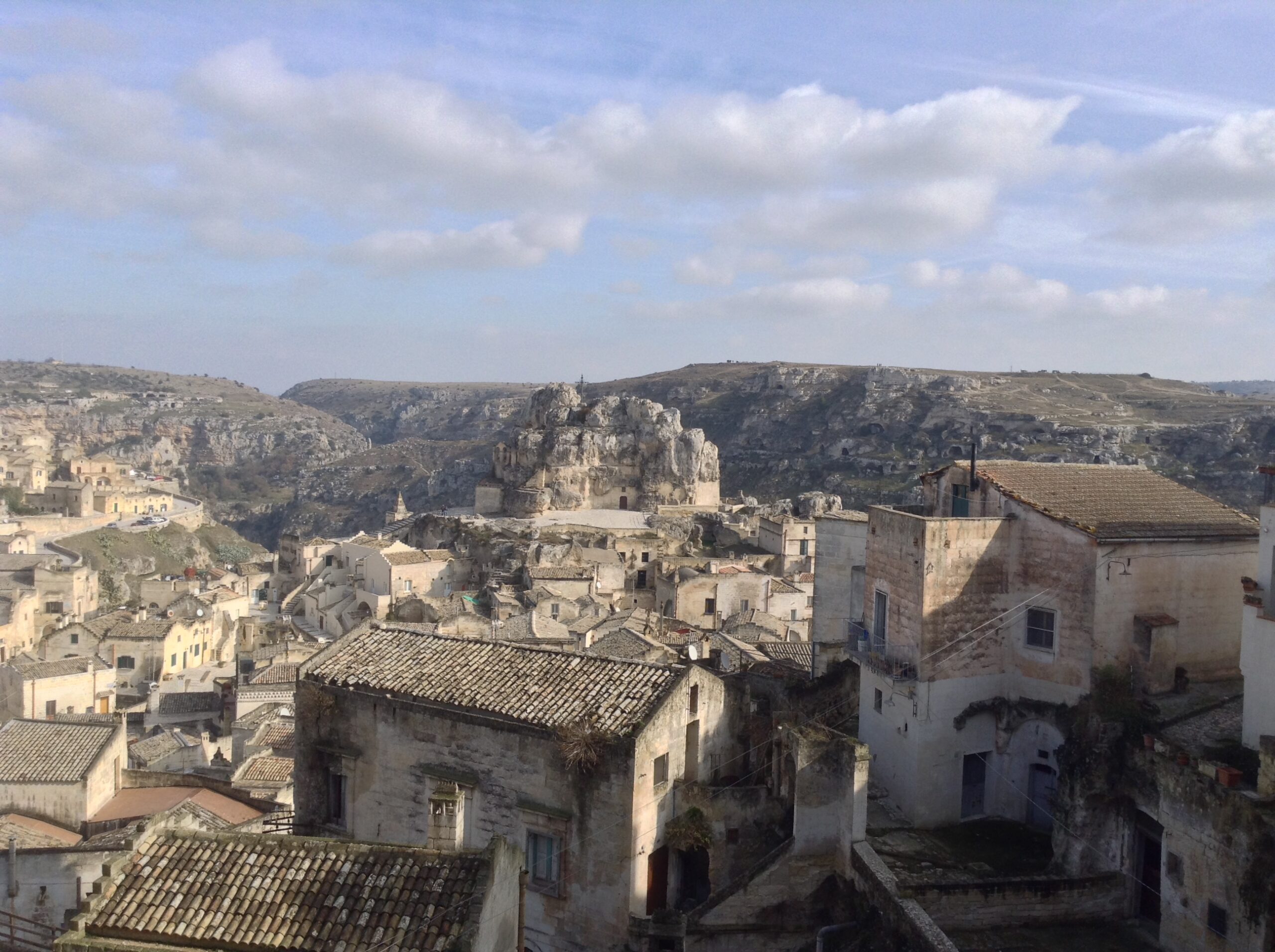
Between them is the Civita, the spur of rock with the Cathedral of 1270 on top, where the noble families lived and where the original fortified settlement stood. Restoration has brought a fourteenth-century Last Judgement back to light from under the Baroque decoration.

The right way to visit the Sassi is to get lost: there is no set route and the best things are found by turning a corner. Look at the chimneys, which in the poorest houses are the only opening besides the door, and the circular covers in the courtyards: under each one is a cistern.
The evacuation: the story that explains everything
In 1945 Carlo Levi’s Christ Stopped at Eboli appeared, describing the Sassi as his sister saw them: families of ten in a single room, animals indoors, no sewers, infant mortality close to fifty per cent. The book caused a scandal. In 1950 prime minister De Gasperi came to see for himself; in Parliament the Sassi were called “the national shame”.
In 1952 an act of the state ordered their forced evacuation: sixteen thousand people were moved into new districts built for the purpose, some designed by famous planners. Some went willingly, many did not: the neighbourhood community of the Sassi, with its shared courtyards, was broken up.
The Sassi stood empty for thirty years, and into that emptiness came collapses, thieves and sheep. Recovery began with a law of 1986, UNESCO followed in 1993, and the arc closes, in a sense, with European Capital of Culture in 2019. That is why a luxury hotel today stands next to a cave that is still empty: the recovery is not finished, and not everyone agrees on how it should end.
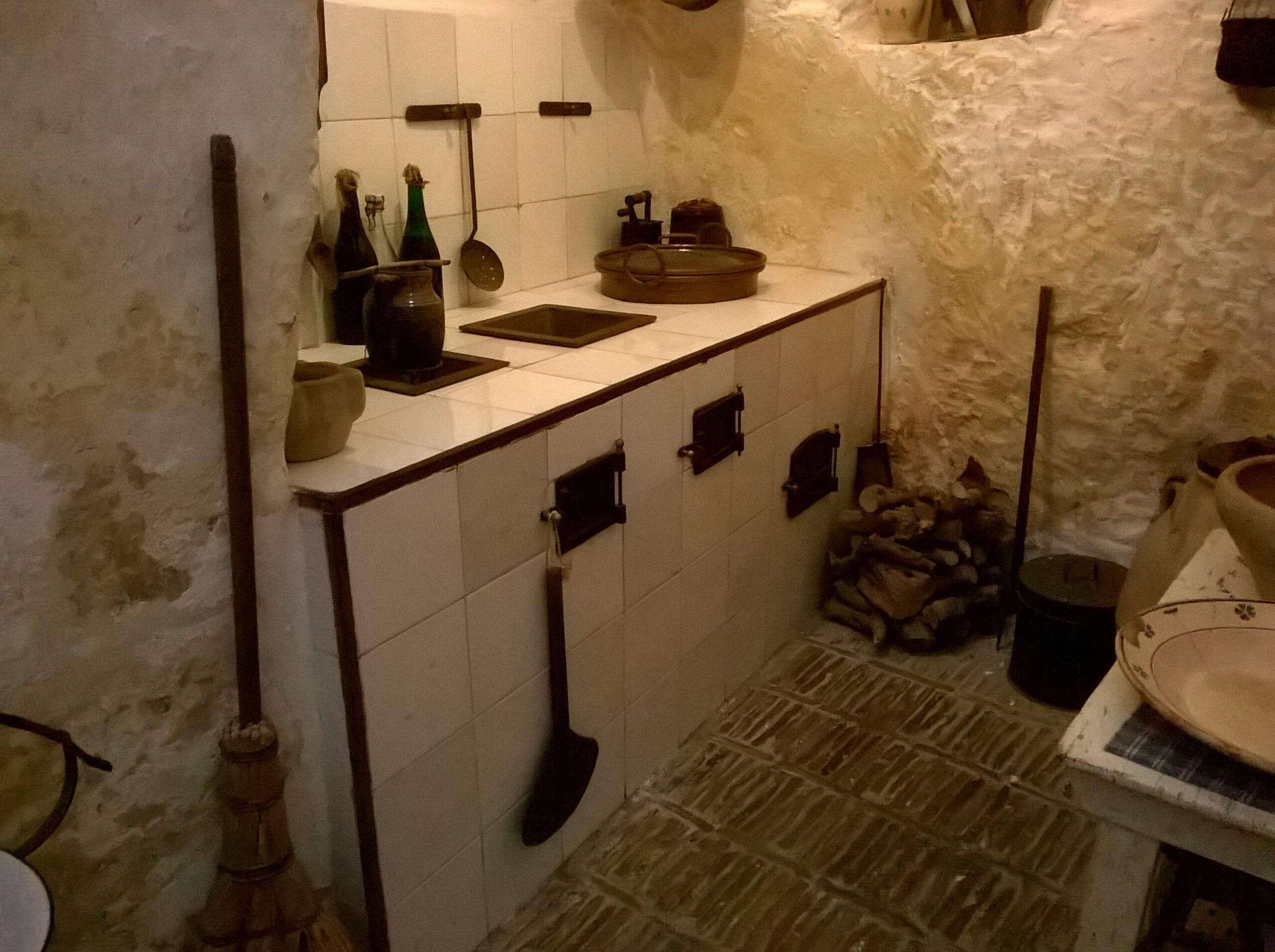
The cave house open to visitors — there are several, all similar, €3-5 — is the half hour that makes this story concrete: a single room of thirty square metres, the bed raised on chests with the hens underneath, the mule’s manger in the same room, small children sleeping in the drawers of the chest of drawers.
Underground: the water
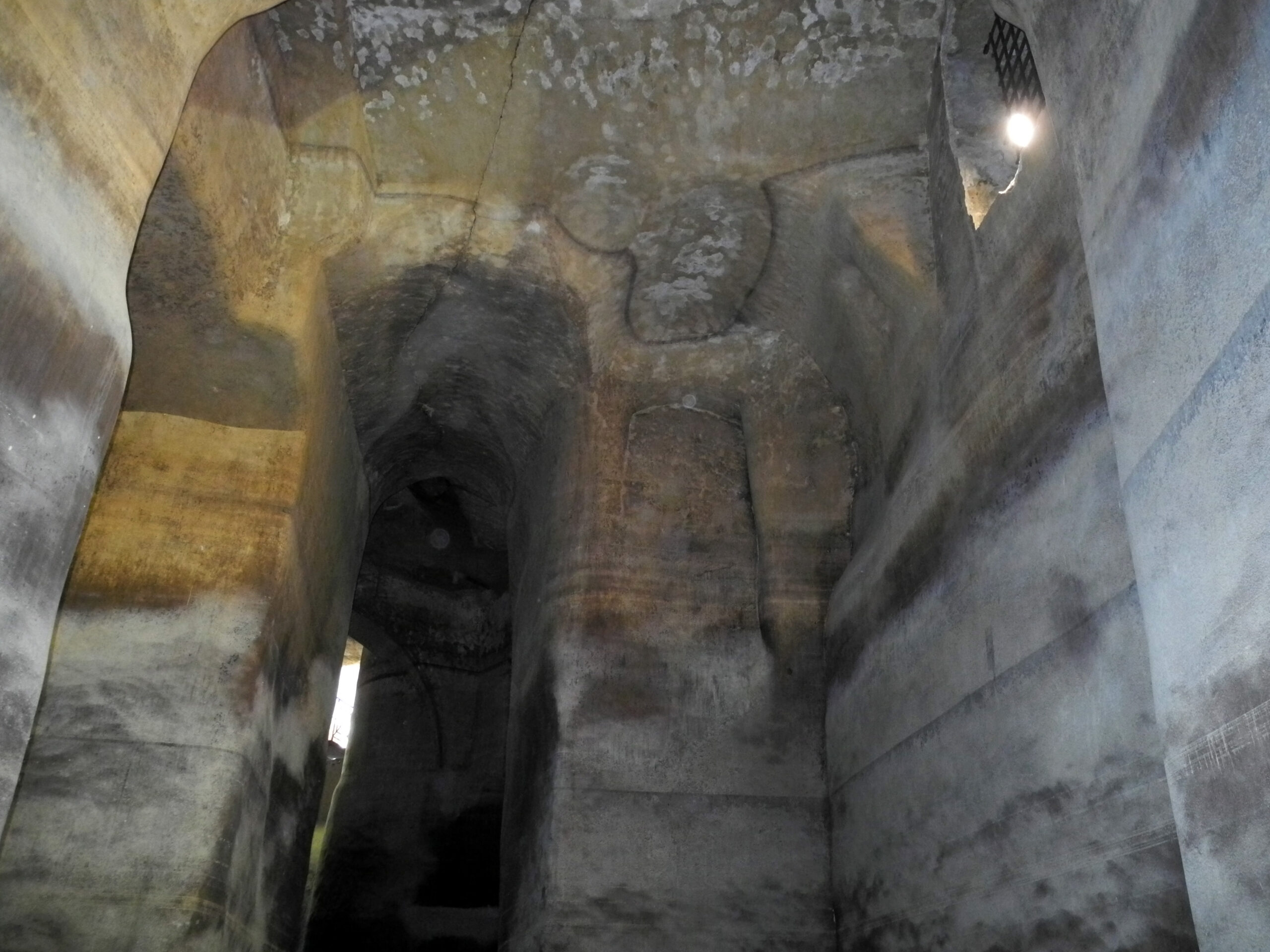
Matera lies in an area with no usable rivers, and for nine thousand years life here depended on a rainwater harvesting system that is one of the great works of vernacular engineering in the Mediterranean: channels cut in the rock, a cistern under every house, settling tanks, sand filters.
The largest piece is the Palombaro Lungo, under Piazza Vittorio Veneto: fifteen metres high, holding five thousand cubic metres, its walls rendered with waterproof cocciopesto in the Roman tradition. It was built in the nineteenth century by joining smaller cisterns and was rediscovered by accident only in 1991, during work on the square. It is visited with a guide, walking on gangways above the water, and costs €3-5: the best ratio of price to astonishment in the whole city.
The rock churches
Over a hundred and fifty in the territory · from the eighth century onwards

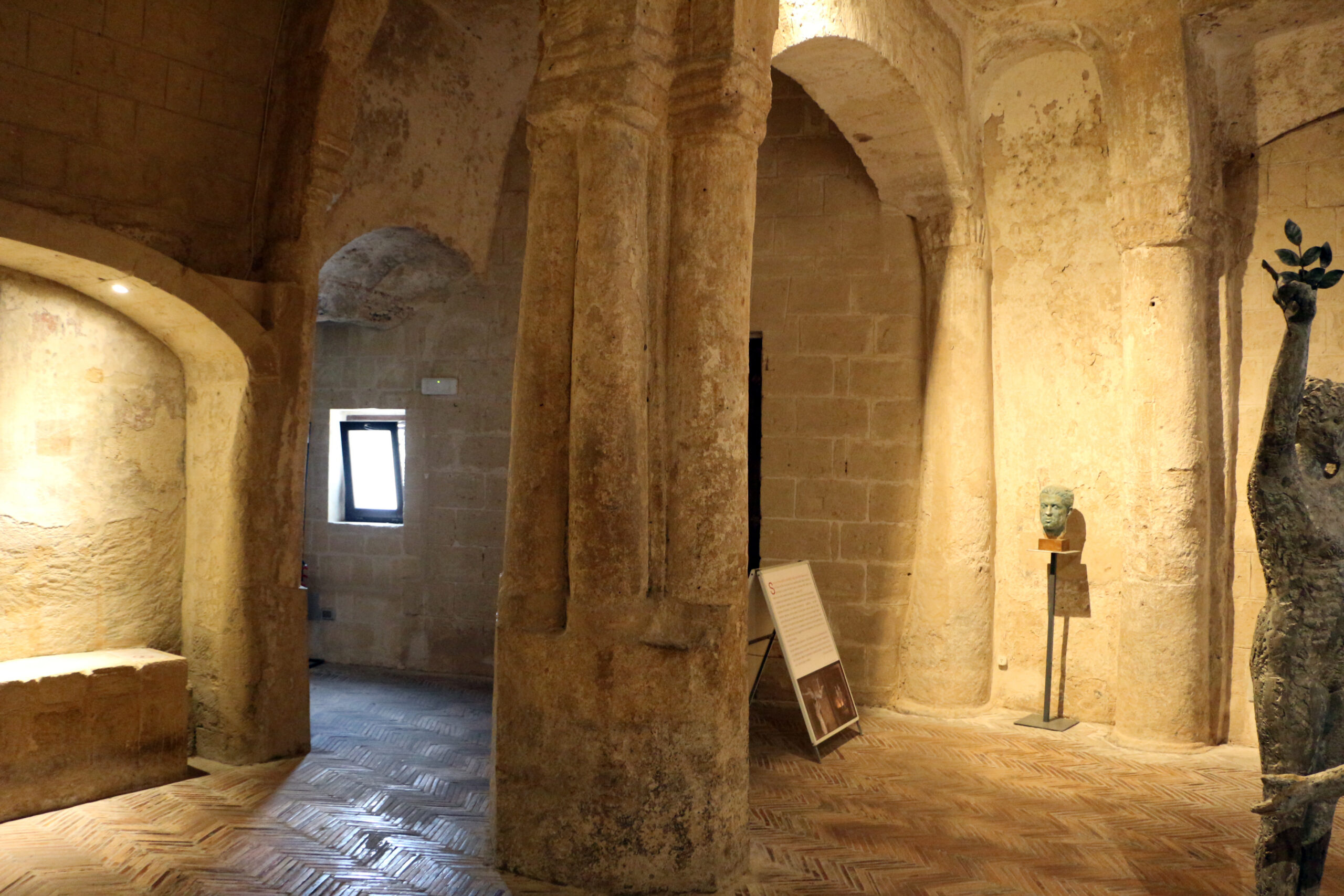
They were cut from the eighth century by monks of the Greek rite arriving from the East, many fleeing the iconoclast persecutions, and later by the Benedictines: inside they reproduced by digging what elsewhere was built — naves, columns, apses, false domes — and frescoed the walls in the Byzantine manner.
In town: Santa Maria de Idris, inside the great spur of the Caveoso, linked by a corridor to the crypt of San Giovanni in Monterrone with frescoes from the twelfth to the seventeenth century; Santa Lucia alle Malve, the first Benedictine women’s settlement, with a Madonna of the Milk of 1270; the complex of the Madonna delle Virtù and San Nicola dei Greci, on two levels at the edge of the ravine. There is a combined ticket that pays off from three churches upwards.
On the Murgia plateau, on the other side of the canyon, there are dozens more, often open and empty, with no custodian and no ticket: the Madonna delle Tre Porte, San Falcione, the Madonna della Vaglia. Many, after being abandoned, were used as stalls by shepherds: which is why a good many frescoes are damaged.
The outright masterpiece is outside the city: the Crypt of Original Sin, 14 km away, frescoed around the year 1000 by the so-called Painter of the Flowers of Matera, with the Genesis cycle and a rare separation of light from darkness. They call it the Sistine Chapel of rock painting and for once the comparison holds. It was a sheep stall until the 1960s; it opened to the public in 2005 and is visited by appointment only, in limited numbers.
The museums
Three of them, and all unusual. MUSMA is the museum of contemporary sculpture housed inside the caves of Palazzo Pomarici: twentieth-century works stand in rooms cut out of the rock, and the contrast between container and content makes it one of the most unusual museums in Italy. The Museo Ridola gathers the prehistoric finds of the Murgia, including those from the Neolithic ditched villages of the plateau. Palazzo Lanfranchi holds, among other things, the paintings of Carlo Levi, including the great eighteen-metre canvas Lucania ’61: the painter who denounced the Sassi, exhibited two hundred metres from the Sassi.
The ravine and the Murgia
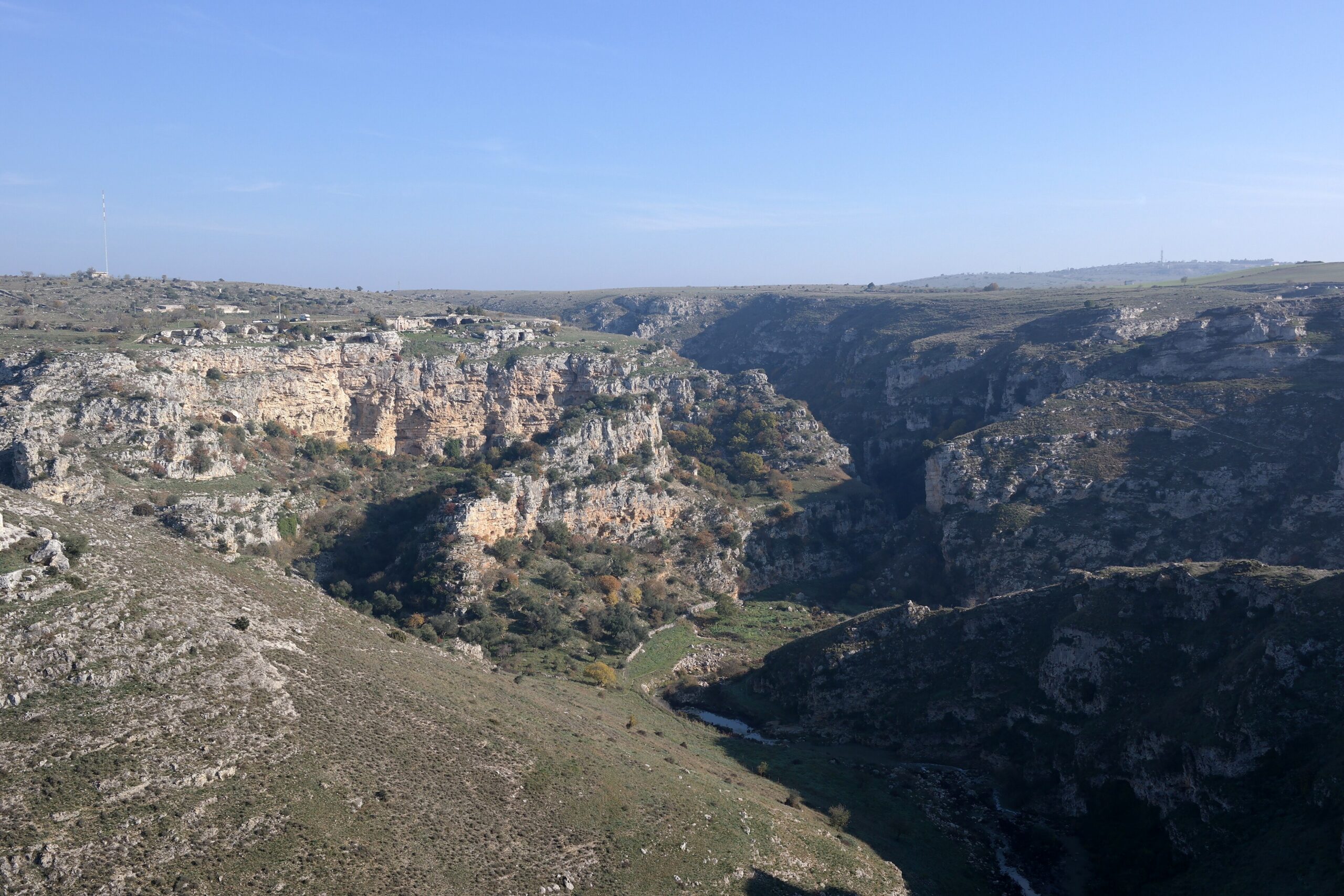
The Gravina torrent has cut a canyon into the limestone up to two hundred metres deep: the city sits on one side, and on the other begins the Murgia Materana Park, eight thousand hectares of rock, scrub, sheep and wind, containing the rock churches, the Neolithic villages and the Bronze Age tombs.
You cross on foot, going down from the Caveoso and up the other side over a suspended rope bridge (check that it is open: it has been closed and reopened several times): an hour and a half to two hours. Or you drive or take a shuttle round in a quarter of an hour.
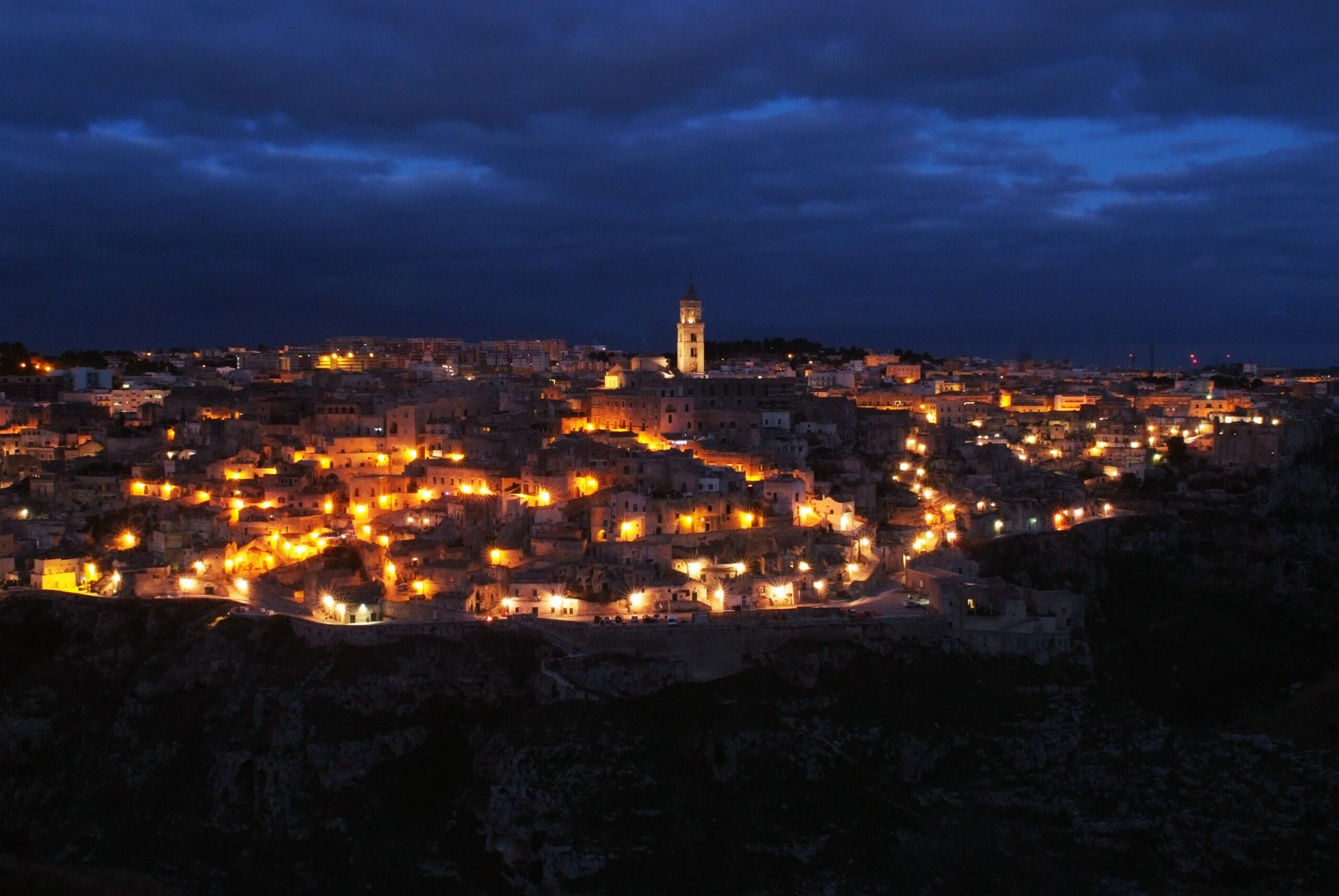
From the Murgia Timone viewpoint you look at the city from outside, and it is the spot from which almost every scene of the films set here was shot: Pasolini’s Gospel According to St Matthew, The Passion, Ben-Hur, Wonder Woman, the opening chase of No Time to Die. The reason is always the same: it is the place in Europe that most resembles ancient Jerusalem. Go half an hour before sunset and stay until the lights come on.
Around it: the stone towns
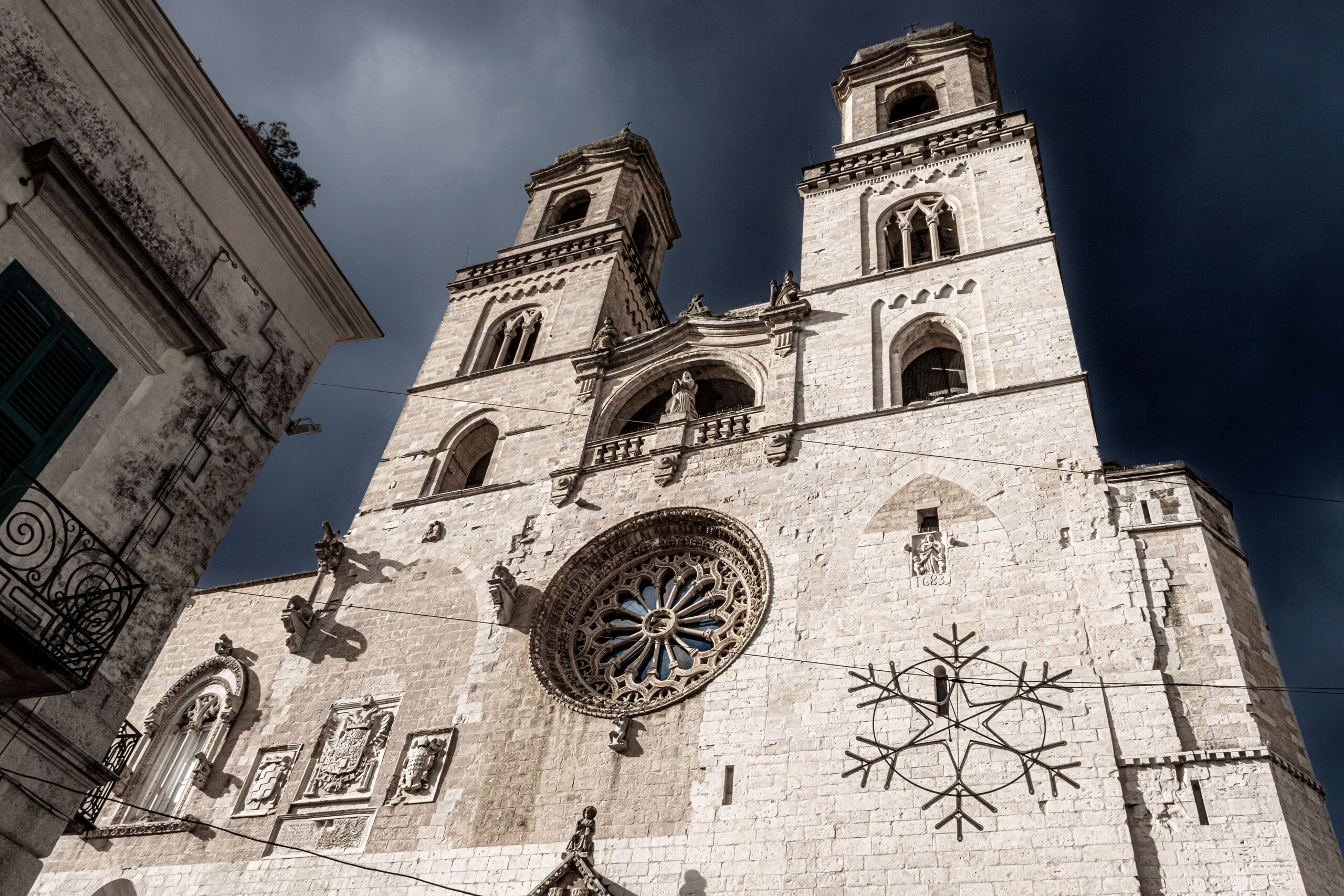
Altamura, 20 km away, has the cathedral of 1232, the only one founded directly by Frederick II, an old town of claustri — closed courtyards with a single entrance — the DOP bread already praised by Horace in the first century BC, and the Altamura Man: a Neanderthal skeleton 130,000 to 170,000 years old, found in 1993 and left where it lies because extracting it would destroy it.
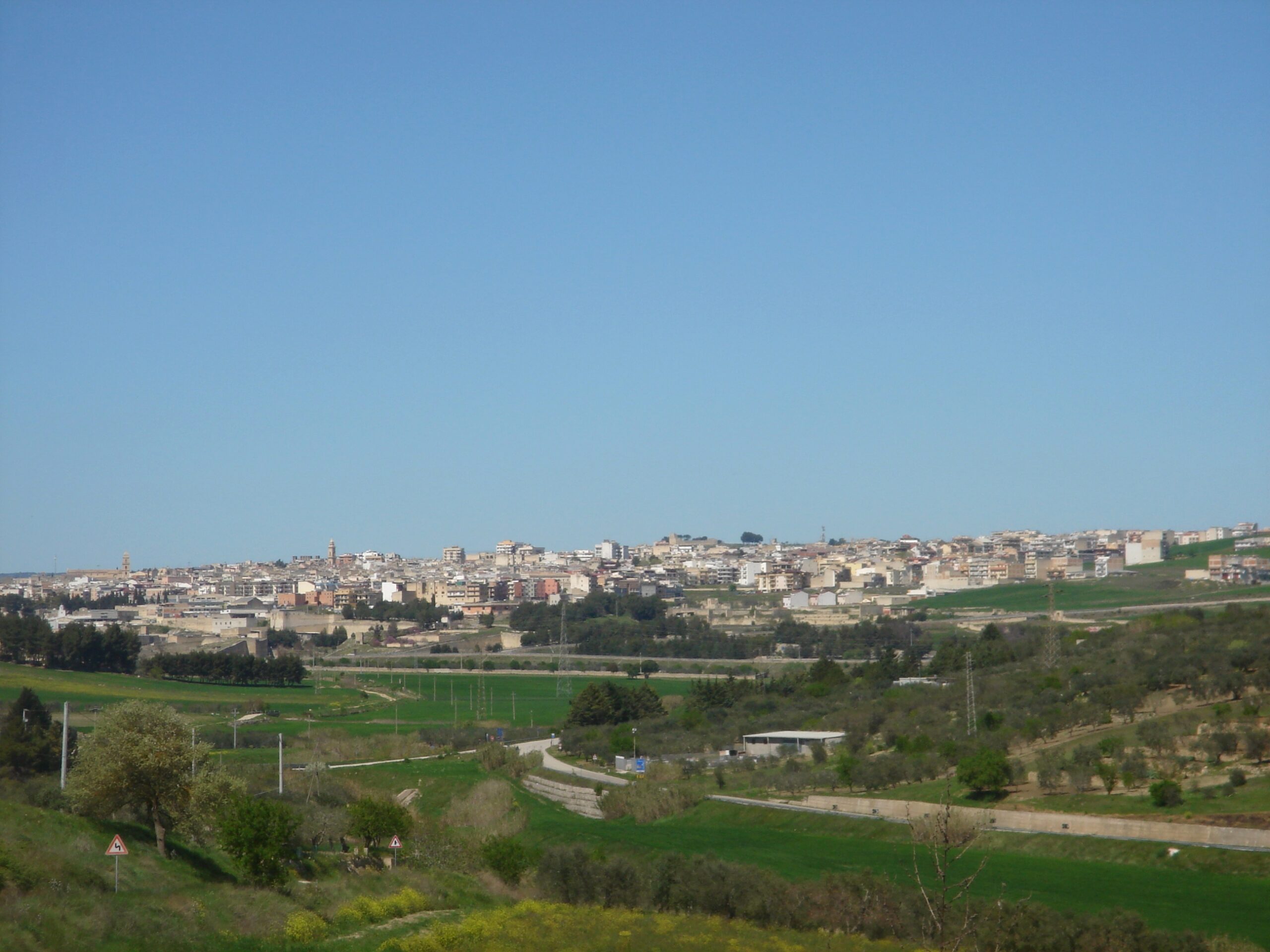
Gravina in Puglia, 30 km away, is the lesser-known variant of the same story: another town on the edge of a canyon, with a rock quarter and cave houses. The thing to see is the eighteenth-century aqueduct bridge, seven arches thirty-seven metres up, crossed on foot — anyone who has seen No Time to Die will recognise it.
Matera bread, IGP, of semolina and sourdough, in a tall horn shape: it lasted a week because it was baked once in the communal oven, and each family stamped it with a wooden mark bearing their initials. Peperoni cruschi from Senise, dried and fried for a few seconds, snapping like a crisp and excellent on their own. Cialledda, stale bread with tomato, onion and oregano, which was the farm workers’ breakfast. Orecchiette with turnip tops. Pignata, lamb cooked slowly in a terracotta pot. Caciocavallo podolico. The wine is Aglianico del Vulture, grown on an extinct volcano an hour away. A trattoria: €25-35.
1. The shoes. There are no flat streets: there are stairways, and limestone polished by centuries is slippery, especially wet. Closed shoes with good soles are needed. The city is hard work, and many routes are not accessible with pushchairs and wheelchairs: the tourist office can point out alternatives.
2. The heat. In July and August the white stone reflects the sun and the Sassi go above 38 degrees with no shade at all. Walk early in the morning and keep the caves and rock churches — which are cool — for the middle of the day.
3. Getting there. Matera has no mainline railway station: it is served by the Ferrovie Appulo Lucane from Bari (an hour and a half, but not on Sundays) and by coaches. The handiest airport is Bari, 65 km away, with direct buses.
Frequently asked questions
If I am short of time, what should I see?
The Palombaro Lungo, a walk in the Sasso Caveoso, a cave house and a viewpoint at sunset. That is three or four hours and costs under fifteen euros. With a whole day, add the Civita with the Cathedral, the Sasso Barisano and the rock churches in town.
What exactly are the Sassi?
Two districts of houses partly cut into the rock and partly built forward with the stone taken out by digging, stacked down the slope of a canyon, in which the roof of one house is the street of the one above. They have been continuously inhabited for around nine thousand years, which makes them one of the oldest settlements in the world, and they have been a UNESCO site since 1993.
Why were they emptied?
Because after the war families of ten lived in a single room, with animals indoors and no sewers, and infant mortality approached fifty per cent. After Carlo Levi’s Christ Stopped at Eboli and De Gasperi’s visit, a law of 1952 ordered sixteen thousand people to be moved. The Sassi stood empty for thirty years; recovery began in 1986 and is not finished.
How much does it cost to visit Matera?
Little: the best thing — walking in the Sassi — is free, and the tickets cost €3-9 each. A full day comes in under €30 of admissions. What weighs is the accommodation, because sleeping in a restored cave costs a good deal: anyone wanting to save sleeps in the new town, five minutes away on foot.
Is the Crypt of Original Sin worth it?
Yes, and it is perhaps the most extraordinary thing in the area: frescoes from around the year 1000 in a cave used as a stall until the 1960s, with a rare separation of light from darkness. It is 14 km away, visited by appointment only and in limited numbers, with progressive lighting and a recorded commentary. Book as soon as you have your dates: it is the most frequent disappointment for those who leave it late.
Do you need a car?
In town no, and it is in the way: you park above and walk down. You need one for the Crypt of Original Sin, for Altamura and for Gravina in Puglia, because public transport is sparse or non-existent. Otherwise there are organised tours from Matera.
When is the best time to come?
April-June and September-October. July and August are very hot and shadeless; winter is cold and windy but the city is empty and the light is superb. The particular date is 2 July, the feast of the Madonna della Bruna: it ends with the crowd tearing the triumphal float of papier-mâché to pieces to carry a fragment home for luck. The float is rebuilt every year in order to be destroyed.
How many films have been shot here?
Over seventy, among them Pasolini’s Gospel According to St Matthew (1964), Mel Gibson’s The Passion (2004), Ben-Hur, Wonder Woman and the opening chase of No Time to Die (2021). The reason is always the same: it is the place in Europe that most resembles ancient Jerusalem, and it is two hours from an airport.
What is Matera bread?
An IGP bread of durum wheat semolina and sourdough, shaped like a tall horn, with a thick crust and yellow crumb. It comes from being baked once a week in the district’s communal oven and having to last until the next time: each family stamped it with a wooden mark bearing their initials. Try it with peperoni cruschi.
Is Matera a one-day visit or does it need more?
One day is enough for the Sassi, a cave house, the Palombaro and the sunset. Two or three are needed to cross the ravine and see the Murgia Park with the rock churches on the plateau, the Crypt of Original Sin and the nearby Apulian towns. The difference between one day and three is large: on the first you see Matera, in the other two you understand it.
September 3, 2026


