

Milan in 3 days: the Last Supper and a day out of town
Three days is the right length for Milan, and not because the centre is large: because the best things run to a timetable. The Last Supper lasts fifteen minutes at an hour decided months in advance, the cathedral roof is sold in timed slots, and on Mondays half the museums close. Three days let you fit it all in without rushing, and leave a day to get out of the city: Lake Como is an hour away by train, and so is the walled upper town of Bergamo.
At a glance
- How long · three full days, the third outside the city
- How much walking · 6-7 km a day, always on the flat
- Book straight away · the Last Supper, as soon as you have your dates
- Budget · €230-330 per person for the three days, excluding accommodation
- Where to stay · between Porta Romana, the Navigli and Brera: all walkable or one metro stop out
- The day to avoid · Monday, when Brera and the castle museums close
- The day trip · Como, Bergamo or the Certosa di Pavia: pick one
The third layer shows the three alternative day trips: you do only one.
Day 1 — The Duomo and the monumental centre
4 km · 4 stops · everything within twenty minutes’ walk of the Duomo

Morning — The Duomo and the roof terraces
Time 2 hours · Ticket about €16 by stairs, €20 by lift · Timed entry, book online
Work began in 1386 and the facade was only considered finished in the 1960s, which is where the Milanese saying “as long as the building of the Duomo” comes from. The marble is pink Candoglia and came by boat from Lake Maggiore along the canals: the cathedral and the city of water are the same story.
Inside, fifty-two pillars forty-five metres high, one for each week of the year. Set into the floor by the entrance is the meridian line of 1786: at solar noon a beam enters through a hole in the wall and falls on the brass strip, and for a century that gave the city its official time. In the right transept, the flayed Saint Bartholomew by Marco d’Agrate, carrying his own skin over his shoulders.
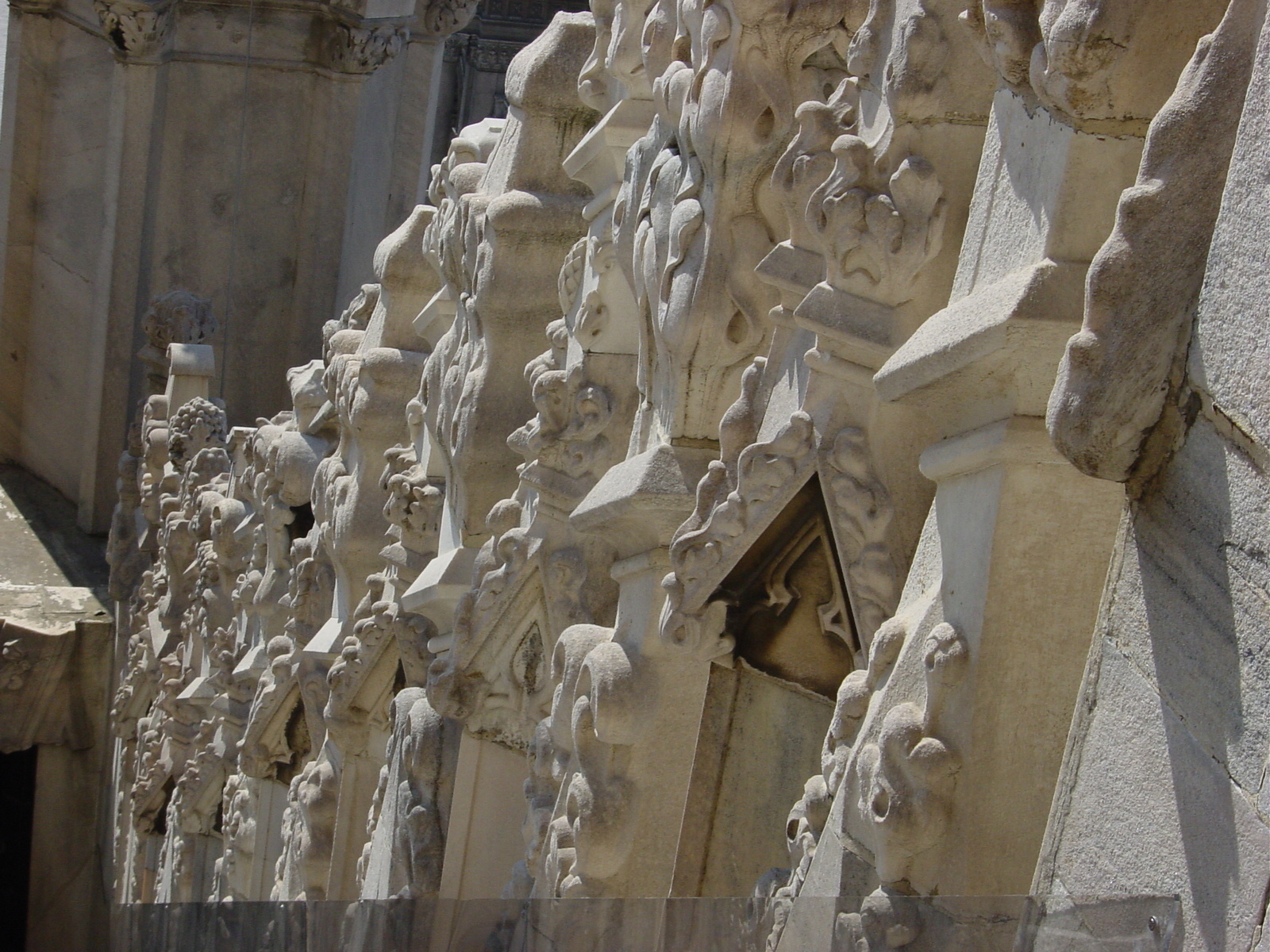
The roof terraces are the reason to arrive early. You walk on the roof among the spires and more than three thousand statues, and on clear winter days you see the whole arc of the Alps. At the top the gilded Madonnina, a hundred and eight metres up: by tradition no building in Milan could rise above her, and the towers that did now carry a copy of her on their spire.
Late morning — Museo del Novecento
Time 1 hour 30 · Ticket about €10 · It is on Piazza Duomo, inside the Palazzo dell’Arengario
Cross the square and you are at the museum almost everyone skips, and which tells the story of the century when Milan mattered most. You climb a spiral ramp and begin with The Fourth Estate by Pellizza da Volpedo, shown alone in one room: six metres of canvas with striking workers advancing towards the viewer, the image Italy uses to describe the start of the twentieth century.
Then the Futurists, Boccioni above all, who lived in Milan and painted its building sites; Morandi; Fontana, with his slashed canvases and a neon ceiling. On the top floor, the room with a window looking straight at the cathedral facade from a height no other point on the square gives you: worth going in for that alone.
On Piazza Duomo you eat badly and pay well, but five minutes towards Brera or Via Torino finds you real trattorias. Risotto alla milanese — yellow with saffron, finished with bone marrow — costs twelve to eighteen euros; a cotoletta on the bone, thick and cooked in butter, twenty to thirty. The thin, wide breaded escalope is a different recipe, not a Milanese one.
Afternoon — Galleria, La Scala and Brera

The Galleria Vittorio Emanuele II, from 1877, takes ten minutes to cross: an iron and glass vault at thirty-two metres, four mosaics with the arms of the capital cities on the floor of the octagon. Turin’s has a bull, and tradition says you spin on your heel on it for luck: the mosaic is worn to the cement and remade every few years.
You come out the other side facing the Teatro alla Scala, deliberately plain on the outside. The theatre museum ticket — about fifteen euros — gives access to a box, and from there you see the auditorium: six tiers, nearly two thousand seats. If rehearsals are running the box stays shut, which happens often: ask before paying.
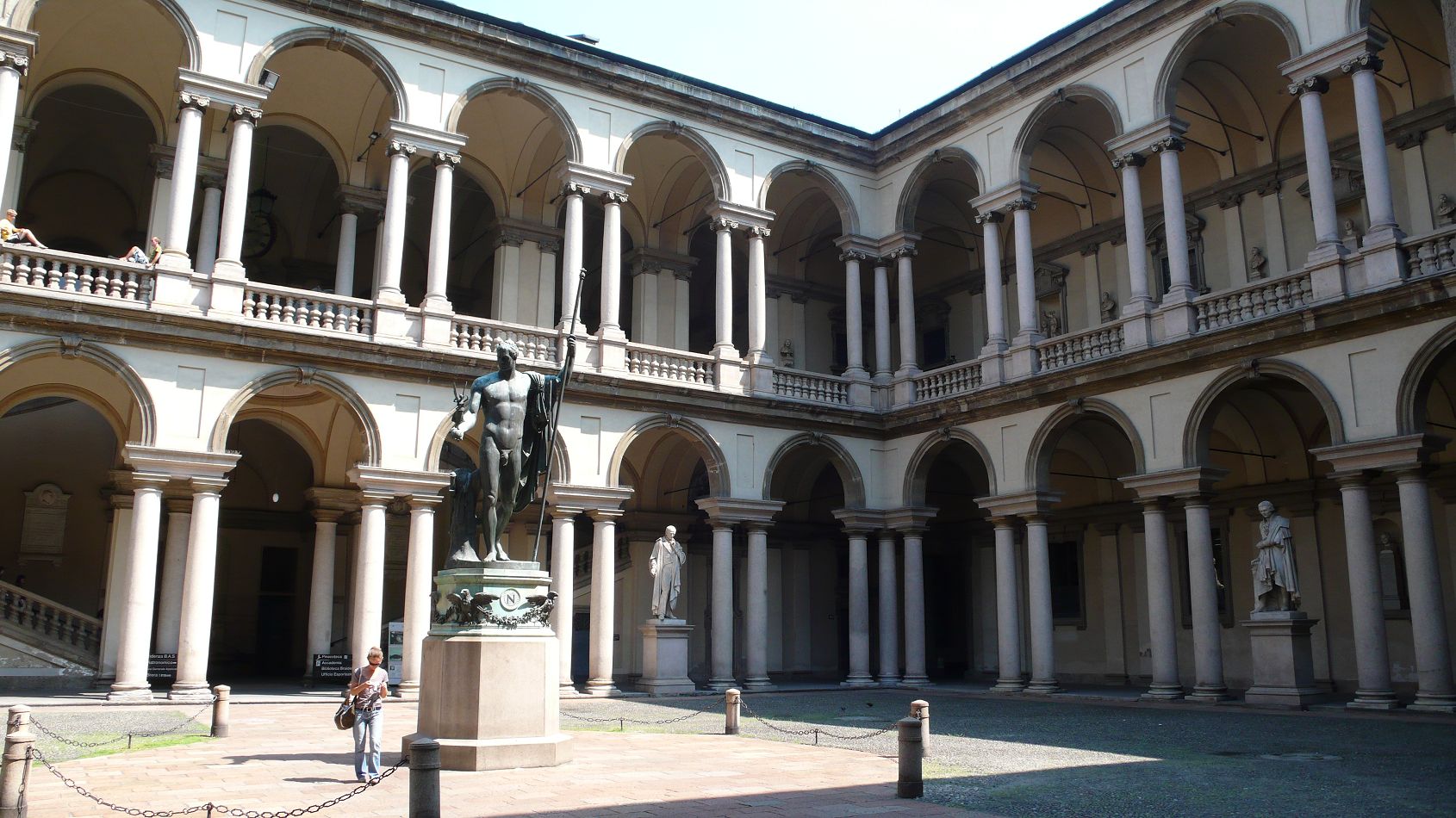
Ten minutes on foot and you are at the Brera Picture Gallery, in a seventeenth-century palace that still houses the fine arts academy. In the courtyard, Canova’s Napoleon as Mars the Peacemaker. Inside, four paintings that justify the journey: Mantegna’s Dead Christ, seen from the feet in a foreshortening that still looks impossible; Raphael’s Marriage of the Virgin, painted at twenty-one; Caravaggio’s Supper at Emmaus, the second version, painted on the run from Rome; and Hayez’s The Kiss, the image of the Risorgimento, much smaller than everyone imagines.
On the way out, the Brera district: narrow streets, open courtyards, workshops. It is the part of Milan that most resembles an old city, and the right place for a first aperitivo.
Day 2 — Leonardo, the castle and the canals
7 km · 5 stops · starts at your Last Supper slot and ends on the water
Morning — The Last Supper and Santa Maria delle Grazie
Time 15 minutes for the painting, 45 for the church · Ticket about €15 · Booking compulsory, months ahead
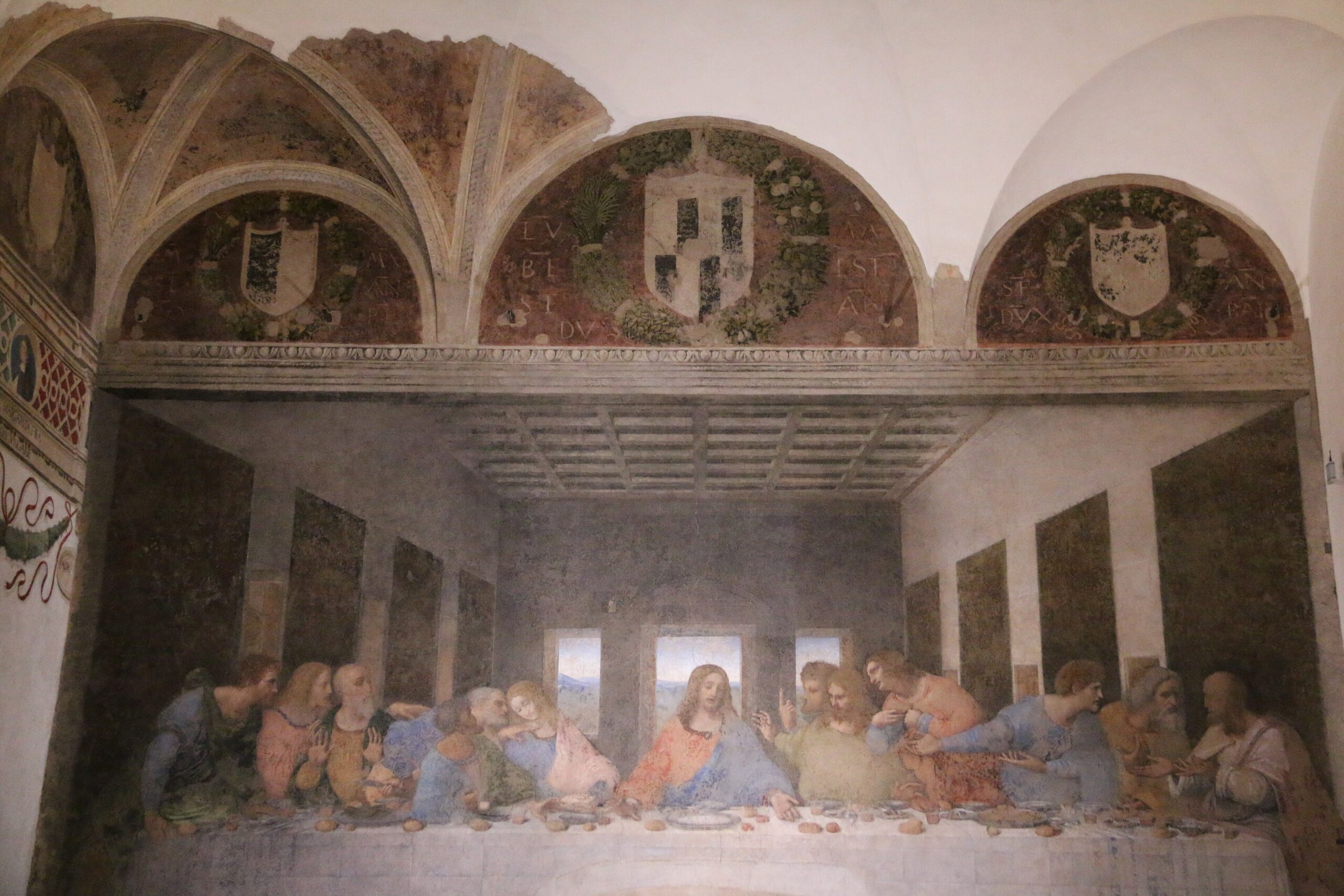
The Last Supper is on the refectory wall, where Leonardo painted it between 1495 and 1498. It is not a fresco: he used a dry technique that let him go back over details, and for exactly that reason the paint began to lift while he was still alive. What survives is the result of a restoration that took twenty-one years, finished in 1999.
The visit lasts fifteen minutes, in groups of thirty-five, after two humidity-controlled antechambers. Watch the hands: Leonardo froze the instant Jesus says that one of them will betray him, and all twelve react at once, in four groups of three. On the facing wall is a Crucifixion by Montorfano, almost intact, that nobody looks at.
The church is free and worth it on its own: the apse and sacristy are by Bramante, and among the finest things in Lombard Renaissance architecture.
Late morning — Sant’Ambrogio
Time 40 minutes · Free · Closes in the early afternoon, check

A quarter of an hour south on foot. It is the oldest church in Milan, founded by Ambrose himself in 379 and rebuilt in Romanesque form in the eleventh century. You enter across a four-sided portico: from the street into a silent courtyard, and only then into the church.
Inside, the ninth-century golden altar by Vuolvinius, a masterpiece of Carolingian goldsmithing. In the crypt, the bodies of Ambrose and the martyrs Gervasius and Protasius, clothed and visible. At the end of the right aisle, the chapel of San Vittore in Ciel d’Oro, with fifth-century mosaics holding the oldest portrait of Ambrose we have, made by people who could have known him.
Afternoon — Sforza Castle and Parco Sempione
Time 2 hours 30 · Courtyards free, museums about €5 · Closed on Mondays

It has been a Visconti fortress, a Sforza palace and Spanish and Austrian barracks; at the end of the nineteenth century the city voted on demolishing it, and it was saved to house the civic museums. The courtyards are free to cross, but five euros gets you into a collection that in another city would be the main museum.
The thing to see is the Rondanini Pietà, Michelangelo’s last sculpture, which he was working on days before dying at eighty-eight. It is unfinished: the body of Christ is barely blocked out and the arm from the first version is still there, detached, beside it. It stands alone in a bare room, the former Spanish hospital, and it is the strongest thing the city has.
In the Sala delle Asse is the decoration of interlaced branches painted by Leonardo in 1498, visible again after a very long restoration: not the Last Supper, but Leonardo, and no booking needed. There are also the picture gallery, the musical instruments museum and the applied arts collection.

Behind the castle opens Parco Sempione, forty-seven hectares that were Sforza hunting grounds and later a Napoleonic parade ground. Cross it in a quarter of an hour to the Arch of Peace, begun in 1807 to celebrate Napoleon and finished in 1838, when he was gone: it was rededicated to peace between nations and the reliefs rewritten. The park also holds Giò Ponti’s Torre Branca, with a lift to the top for a few euros.
Evening — Darsena and the Navigli

Milan was a city of water and hardly anyone notices, because the inner canals were covered in the 1930s. What remains is the Naviglio Grande, dug from 1179 and older than the cathedral, and the Naviglio Pavese; they meet at the Darsena, which until the 1960s was one of the busiest ports in Italy by tonnage. The cathedral marble came through here.
Leonardo worked on the lock system that let boats climb between levels: the conca dell’Incoronata, restored, is the last piece of that mechanism left in the city.

In the evening you walk the Ripa di Porta Ticinese looking into the courtyards: halfway along is the Vicolo dei Lavandai, with the covered wooden wash-house where laundry was done until the 1950s. The aperitivo here is not a tourist habit: between seven and nine you pay for a glass, ten to fifteen euros, and eat from the buffet. Move away from the Darsena and the prices drop.
Day 3 — Out of town: Como, Bergamo or the Certosa
Three alternative trips, all by train from the city. You do one: these are full days.
Lake Como — the one most people choose
Length a full day · Train one hour from Centrale · Cost €25-40 with the boats
The best version is not to stop at Como town but to go up to where the lake forks. Train from Milano Centrale to Varenna, exactly an hour: a village of coloured houses dropping into the water, with a walkway suspended over the lake and two open villas, Monastero and Cipressi. From the jetty, boats cross to Bellagio in twenty minutes, on the point between the two arms, with its stone stairways between the houses.
The same boat runs to Menaggio on the opposite shore, closing the triangle. If you prefer villas, get off at Tremezzo for Villa Carlotta and its botanical garden. Check the boat timetable before you go: out of season the crossings thin out a great deal.
Bergamo — a walled town on a hill
Length a long half day · Train 50 minutes from Centrale · Cost €15-25
From the station a bus and then a funicular take you in ten minutes from the modern lower town into an intact medieval town enclosed by the Venetian walls, a UNESCO site. On Piazza Vecchia stand the Palazzo della Ragione and the civic tower, which still rings a hundred strokes at ten at night; behind them the cathedral and the Colleoni Chapel, a facade of inlaid marble that looks like an enlarged jewel box.
You can walk the walls the whole way round, the plain on one side and the foothills of the Alps on the other. It is the trip for anyone who wants to be back in Milan for dinner.
The Certosa di Pavia — the least visited
Length half a day · Train 35 minutes · Free entry, guided by the monks
A monastery founded by the Visconti in 1396, with an inlaid marble facade that is the masterpiece of the Lombard Renaissance: statues, medallions and marquetry layered until no surface is left plain. Inside, the great cloister has twenty-four cells, each a little house with its own garden: the Carthusians lived as hermits, one to a house.
The visit is led by a monk, free, with a donation. If you still have time, carry on by train to Pavia, ten minutes further south, for the covered bridge and the university.
If you would rather stay in the city
Milan has enough for a third day without trains. The Monumental Cemetery is free and is an open-air sculpture museum, with the tombs of the industrial families and the Famedio of illustrious Milanese. San Maurizio al Monastero Maggiore, on Corso Magenta, is frescoed from top to bottom by Bernardino Luini and gets called the Sistine Chapel of Milan: entry is free. The Fondazione Prada, in an old distillery converted by Rem Koolhaas, has a white tower and the Bar Luce designed by Wes Anderson.
And for anyone with only an hour: San Bernardino alle Ossa, two steps from the Duomo, has a chapel entirely lined with human bones arranged as decoration. It is free and almost nobody finds it.
Three things to know
Book the Last Supper the moment you have your dates. Tickets are released in quarterly blocks on the official site and sell out within hours. Without a booking you do not get in: there is no standby queue, and agency packages cost three or four times as much.
Monday closes half the city. Brera and the castle museums shut; the Duomo, the terraces, Sant’Ambrogio and the Navigli stay open. If your Monday falls in the middle of the three days, put the day trip on it.
The aperitivo is a meal. Between seven and nine, ten to fifteen euros buys a drink and the buffet. On the Navigli it is the city’s evening habit, not an attraction: understand it and you save the price of dinner.
What it costs
| Item | Indicative cost |
|---|---|
| Duomo with roof terraces | about €16 |
| Museo del Novecento | about €10 |
| La Scala, theatre museum | about €15 |
| Brera Picture Gallery | about €15 |
| The Last Supper | about €15 |
| Sforza Castle museums | about €5 |
| Lake Como day trip, train and boats | €25-40 |
| City transport, three days | about €15 |
| Meals, three days | €110-180 |
| Total per person | €230-330 |
Reference figures as of August 2026, accommodation excluded: museums and transport change their prices, check the official websites before you travel.
Where to stay
Brera and the centre · you step out of the hotel and you are already inside the itinerary. The dearest and the most convenient.
Navigli and Porta Genova · the best balance of price and evening life: you sleep where you eat, and the centre is two metro stops away.
Porta Romana and Porta Venezia · residential districts with better prices and a direct metro. Porta Venezia has the Liberty-style buildings and the public gardens.
Near Centrale station · worth it only if you arrive late or leave early: handy for trains, not pleasant in the evening.
Getting around
The centre is walkable and flat. The metro has five lines and covers the longer hops: a single ticket about €2.20 for ninety minutes, a day ticket about €7.60. You can also tap a credit card at the gates.
The historic trams of 1928, orange and wooden, run in ordinary service: line 1 crosses the centre and costs the same as any ticket.
For the day trips: trains for Como and Varenna leave from Centrale, those for Bergamo from Centrale and Porta Garibaldi, those for the Certosa di Pavia from Rogoredo and Porta Genova. Buy regional tickets at the station or in the app, and validate them.
If you arrive by car, find a park-and-ride outside Area C, the restricted traffic zone covering the centre, which is charged on weekdays.
Frequently asked questions
Are three days enough for Milan?
They are the right length: two days for the city and one to get out, to Lake Como or Bergamo. The historic centre is covered in two days, because the distances are short and everything is flat.
When should I book Leonardo’s Last Supper?
The moment you have your dates. Tickets are released in quarterly blocks on the official site and go within hours. The visit lasts fifteen minutes in groups of thirty-five, and without a booking you cannot get in.
Lake Como or Bergamo as a day trip from Milan?
Como if you want a full day and the boats: train to Varenna, then boat to Bellagio and Menaggio. Bergamo if you want to be back for dinner: fifty minutes by train and an intact walled medieval town, with a funicular up to the old quarter.
What do you eat in Milan?
Saffron risotto finished with bone marrow, a veal cutlet on the bone cooked in butter, cassoeula in winter, ossobuco. And panettone, which was invented here. The real cotoletta is thick and on the bone: the thin, wide one is a different recipe.
When is the best time to visit Milan?
April to June and September to October. Winter is cold and damp, but on clear days the cathedral roof shows you the Alps, which almost never happens in summer. August is hot and half the city closes.
Is Milan expensive?
It is the dearest Italian city for accommodation and eating out, but museums cost what they cost elsewhere and many important things are free: the Galleria, Sant’Ambrogio, San Maurizio, the Monumental Cemetery, Parco Sempione and the Navigli. Three days run €230-330 per person before accommodation.
Is it worth going up onto the cathedral roof?
It is the best thing you can do in the city: you walk on the roof among the spires and statues. The stairs are two hundred and fifty steps and cost less, the lift a few euros more. Entry is by timed slot: book at least the day before.
Where is the best place to stay in Milan?
The Navigli and Porta Genova for value and evening life, Brera if you want everything on foot and do not mind the price, Porta Romana and Porta Venezia for better rates with a direct metro. The area around Centrale station only makes sense for awkward travel times.
August 25, 2026


