

Milan in 1 day: from the Duomo to the Navigli
Milan in one day works better than its reputation suggests, because almost everything that matters sits inside the ring of the old canals and can be walked. The centre is a spiral: you start at the Duomo, widen out towards the castle, and come down to the Navigli for the evening. The difference from the other art cities is that here the most famous masterpiece — Leonardo’s Last Supper — cannot be improvised: either you booked it months ago or you will not see it. This itinerary is built to work without it.
At a glance
- How long · a full day, from 9am to aperitivo hour
- How much walking · about 6 km on the flat, plus two stretches of metro
- What has to be booked · the Last Supper, months ahead; the cathedral roof, the day before
- Budget · €90-140 per person excluding accommodation: Milan costs more than Naples or Palermo
- Starting point · Piazza del Duomo
- Finishing point · the Darsena and the Navigli at aperitivo hour
- What is left out · the twentieth-century museums, the Monumental Cemetery, the lakes: those are a second day
Three parts of the day, eight stops. The route circles the Duomo, widening out, and ends on the water.
Morning — The Duomo, the Galleria and La Scala
1 km · 3 stops · 9:00 to 13:00 · all within Piazza Duomo and just off it

Start where Milan is most itself. You cross the square and the facade grows as you approach: that is deliberate, the square was widened in the nineteenth century precisely for the effect.
1 – The Duomo and the roof terraces
Time 2 hours with the roof · Ticket about €16 by stairs, about €20 by lift · Booking advised
Work started in 1386 and the facade was only considered finished in the 1960s: nearly six centuries, which is why Milanese still say something slow is “as long as the building of the Duomo”. The marble is pink Candoglia and came by boat from Lake Maggiore along the canals to a point a few hundred metres from here: the cathedral and the city of water are the same story.
Inside, five naves and fifty-two pillars forty-five metres high, one for each week of the year. Look for the meridian line set into the floor by the entrance, from 1786: at solar noon a beam of light enters through a hole in the wall and falls on the brass line, and for a century that was Milan’s official time. In the right transept, the flayed Saint Bartholomew by Marco d’Agrate, carrying his own skin over his shoulders like a cloak; the inscription on the base points out that the sculptor is not Praxiteles.
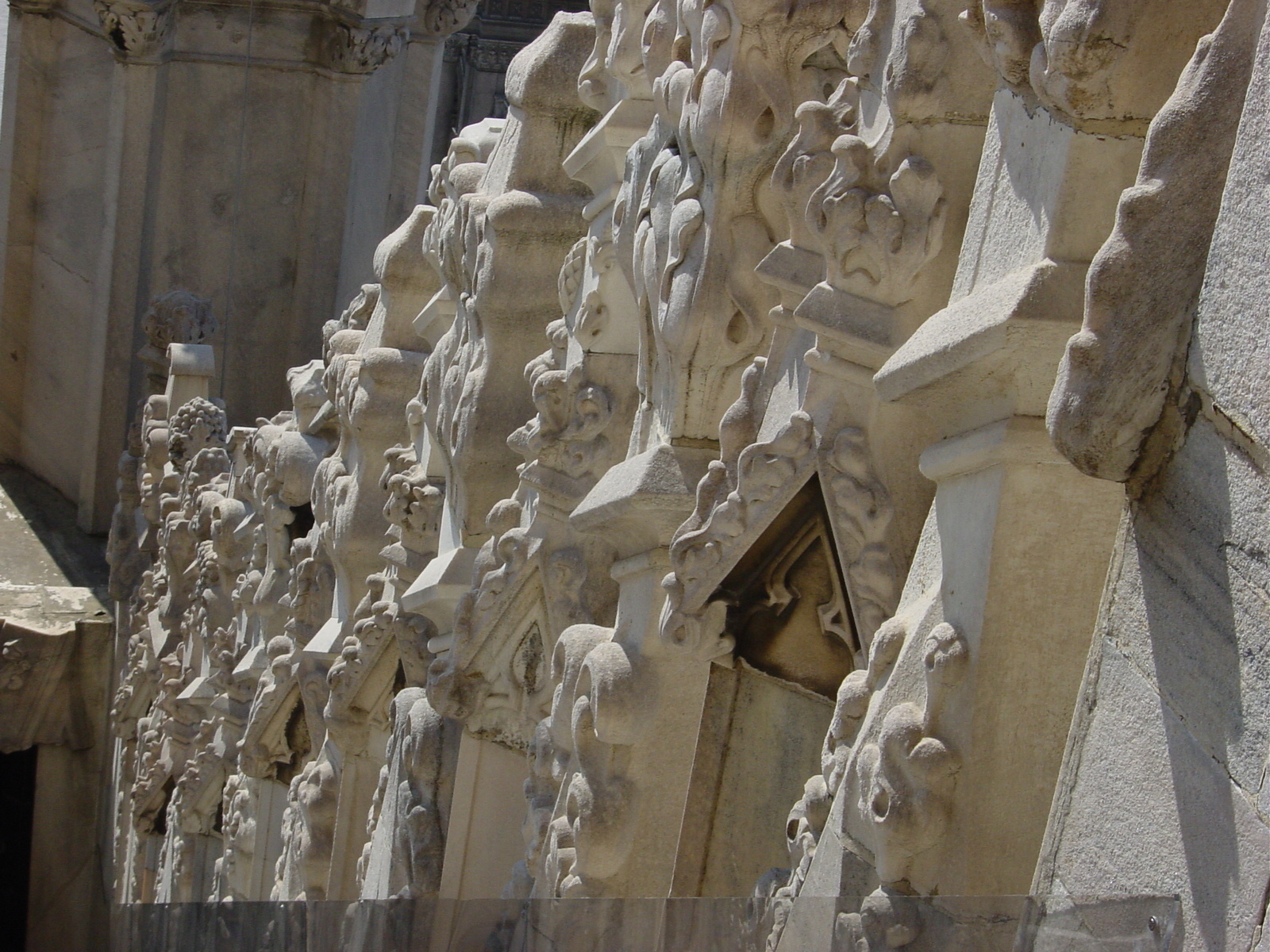
The roof terraces are the part nobody expects, and the real reason to come. You go up onto the roof and walk among the spires — a hundred and thirty-five of them — and the statues, of which there are more than three thousand. From up there you see the city and, on clear winter days, the whole arc of the Alps. At the top stands the gilded Madonnina at a hundred and eight metres: by tradition no building in Milan could rise above her, and the skyscrapers that did now carry a copy of her on top.
By stairs it is two hundred and fifty steps and cheaper; the lift takes two minutes. Either way, buy online: entry is by timed slot and weekend slots sell out.
2 – Galleria Vittorio Emanuele II
Time 30 minutes · Free · Two minutes’ walk

This is Milan’s drawing room and the first covered shopping arcade in Europe, opened in 1877: two arms in a Latin cross, an octagon at the crossing, an iron and glass vault thirty-two metres high. The architect, Giuseppe Mengoni, fell from scaffolding a few days before the inauguration and never saw it finished.
The floor of the octagon carries mosaics with the arms of the four capital cities. Turin’s has a bull, and tradition says you plant your heel on its more delicate parts and spin all the way round for luck: the mosaic is worn down to the cement and gets remade every few years. It is the silliest and most Milanese thing you will do today.
3 – Teatro alla Scala
Time 1 hour with the museum · Ticket about €15 · You see the auditorium from a box, unless there are rehearsals

Leaving the Galleria at the far end you face a building so plain it disappoints: this is La Scala, and the disappointment is part of the point. It was built in 1778 on the site of the church of Santa Maria alla Scala, which gave it its name, and the modest front was a choice: the theatre is on the inside.
The theatre museum holds instruments, costumes and portraits, but the real reason for the ticket is that it gives access to a box, from which you see the auditorium: six tiers, nearly two thousand seats, red velvet and a chandelier of three hundred and sixty-two bulbs. If rehearsals are running the box stays shut, which happens often: ask at the ticket desk before paying.
The season opens on 7 December, Saint Ambrose’s day, and it is the social event of the Italian year. Proper seats cost hundreds of euros, but the gallery has places for a few tens, sold on the day: people queue from early morning.
Around Piazza Duomo you eat badly and pay well; five minutes on foot fixes it. Towards Brera and in the streets behind La Scala there are old trattorias where risotto alla milanese costs between twelve and eighteen euros and a proper cotoletta — on the bone, thick, cooked in butter — between twenty and thirty. The quick Milanese lunch is a fried panzerotto or a plate at the counter of one of the covered markets.
Afternoon — Brera, the castle and the park
3 km · 3 stops · 14:30 to 18:30 · heading north-west out of the centre
4 – Brera Picture Gallery
Time 1 hour 30 · Ticket about €15 · Closed on Mondays
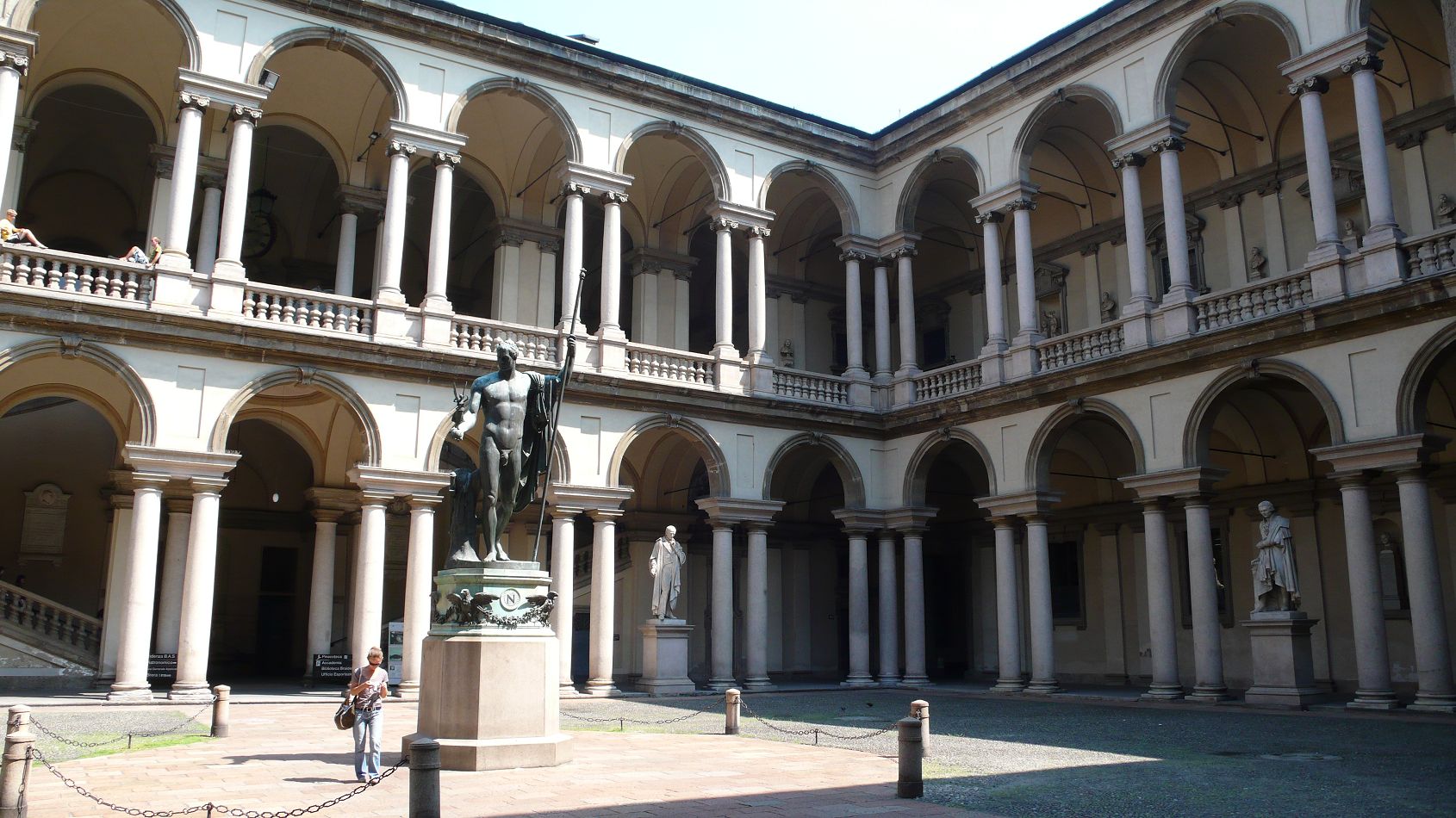
Ten minutes on foot from La Scala, inside a seventeenth-century palace with an arcaded courtyard and, at its centre, Canova’s Napoleon as Mars the Peacemaker, naked and in bronze. The gallery began as a study collection for the fine arts academy, which still occupies the same building: that is why you pass students with portfolios under their arms.
Four paintings justify the ticket on their own. Mantegna’s Dead Christ, seen from the feet in a foreshortening that still looks impossible. Raphael’s Marriage of the Virgin, painted at twenty-one, in which the domed temple steals the scene from the figures. Caravaggio’s Supper at Emmaus, the second version, painted on the run from Rome and far darker than the first. And Hayez’s The Kiss, the image of the Italian Risorgimento, much smaller than everyone imagines.
If you have time left, the Brera district around the gallery is made of narrow streets with workshops and open courtyards: it is the part of Milan that most resembles an old city.
5 – Sforza Castle
Time 1 hour 30 · Courtyards free, museums about €5 · Closed on Mondays

A quarter of an hour on foot from Brera. The castle has been a Visconti fortress, a Sforza palace, and Spanish and Austrian barracks; at the end of the nineteenth century the city voted on whether to demolish it. It was saved and turned into the home of the civic museums. The courtyards are free to cross and make the easiest route to the park.
For five euros, though, you get into a collection that anywhere else would be the city’s main museum. The thing to see is the Rondanini Pietà, Michelangelo’s last sculpture, which he was still working on days before dying at eighty-eight. It is unfinished, the body of Christ is barely blocked out, and the arm from the first version is still there, detached, beside it. It stands alone in a bare room, the former Spanish hospital, and it is one of the strongest things Milan has to offer.
In the Sala delle Asse there is also the decoration of interlaced branches painted by Leonardo in 1498, visible again after a very long restoration: it is not the Last Supper, but it is Leonardo, and it needs no booking.
6 – Parco Sempione and the Arch of Peace
Time 45 minutes · Free · Fifteen minutes to cross

Behind the castle opens Parco Sempione, forty-seven hectares that were the Sforza hunting grounds and later a Napoleonic parade ground. You cross it in a quarter of an hour and reach the Arch of Peace, begun in 1807 to celebrate Napoleon and finished in 1838, when Napoleon was gone: it was simply rededicated to peace between the European nations, and the reliefs were rewritten to match.
The park also holds the Torre Branca by Giò Ponti, eighty years ago the tallest structure in the city: a lift takes you up for a few euros and you get Milan from above without the Duomo queue. Its opening hours are irregular, so check before crossing the park.
Evening — Sant’Ambrogio, the Darsena and the Navigli
2 km · 2 stops · from 18:30 onwards · heading down to the water
7 – Basilica of Sant’Ambrogio
Time 40 minutes · Free · Closes in the early afternoon, check the hours

It is the most important church in Milan after the cathedral and the oldest: founded by Ambrose himself in 379 and rebuilt in Romanesque form in the eleventh century. You enter across a four-sided portico, and that changes everything: you pass from the street into a silent courtyard and only then into the church.
Inside, the ninth-century golden altar by Vuolvinius is one of the masterpieces of Carolingian goldsmithing. In the crypt lie the bodies of Ambrose and the martyrs Gervasius and Protasius, clothed and visible. At the end of the right aisle, the chapel of San Vittore in Ciel d’Oro has fifth-century mosaics on a gold ground holding the oldest portrait of Ambrose we possess, made by people who could have known him.
8 – Darsena and the Navigli
Time the whole evening · Free to walk · Metro two stops from the basilica

Milan was a city of water and hardly anyone notices, because the inner canals were covered over in the 1930s. What remains is the Naviglio Grande, dug from 1179 and therefore older than the cathedral, and the Naviglio Pavese; they meet at the Darsena, which until the 1960s was one of the busiest ports in Italy by tonnage. The cathedral marble came through here.
Leonardo worked on the system of locks that let boats climb between levels: the conca dell’Incoronata, restored and visible, is the last piece of that mechanism left in the city.

In the evening this is where Milan stops. The aperitivo here is not a tourist habit: between seven and nine you pay for a glass — ten to fifteen euros — and eat from the buffet, and for many it replaces dinner. Walk along the Ripa di Porta Ticinese on the Naviglio Grande, look into the open courtyards (the Vicolo dei Lavandai, with its covered wooden wash-house, is halfway along) and pick a place away from the Darsena, where prices drop and the crowd is local.
The Last Supper, which has to be booked months ahead
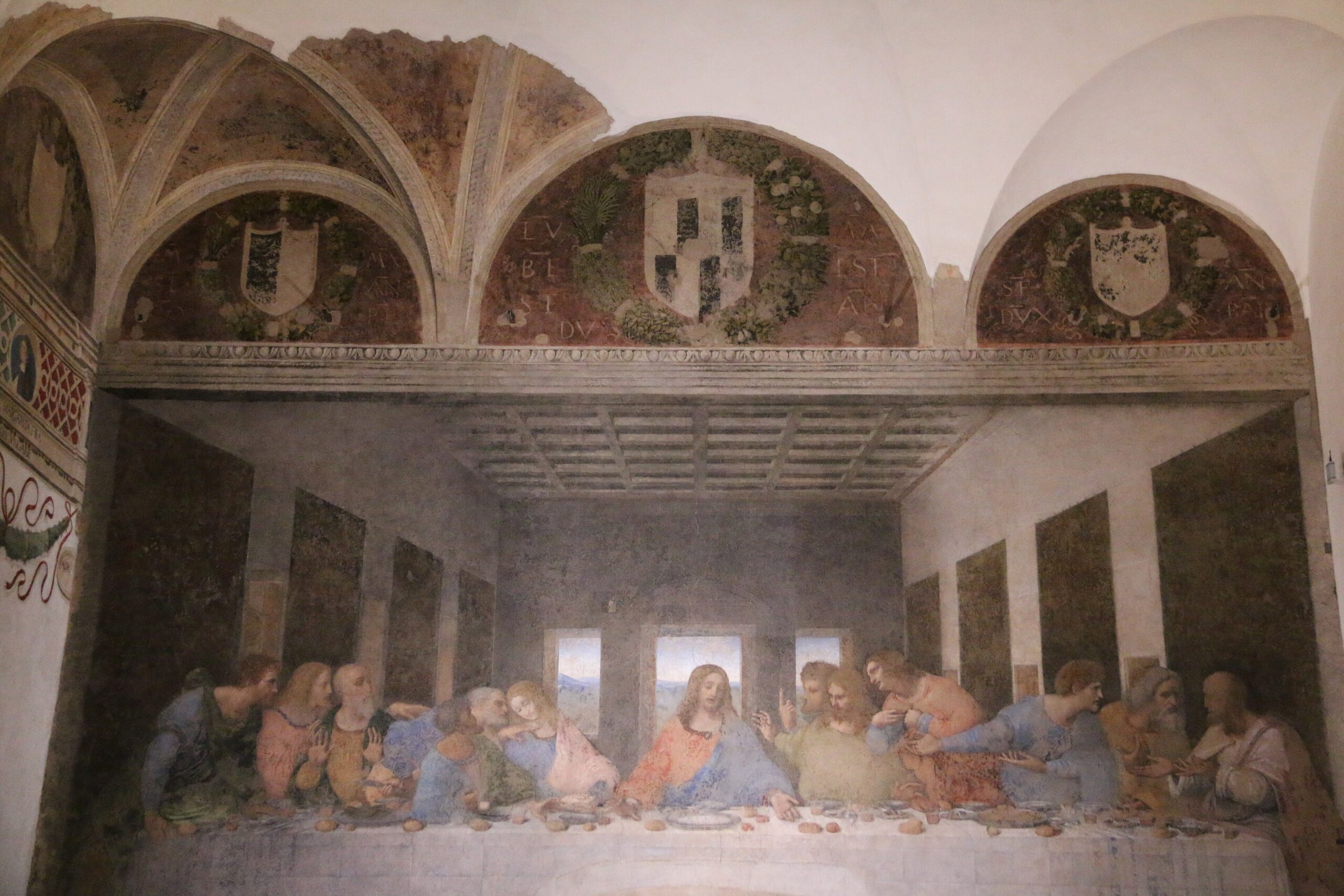
Leonardo’s Last Supper is on the refectory wall of Santa Maria delle Grazie, where it was painted between 1495 and 1498. It is not a fresco: Leonardo used a dry technique that let him go back over the detail, and for that reason the paint began to lift while he was still alive. What you see today is the result of a restoration that took twenty-one years.
Visits last fifteen minutes, in groups of thirty-five, through two humidity-controlled antechambers. Tickets — about fifteen euros — are released in quarterly blocks on the official site and sell out within hours. If you have not booked, you will not get in: there is no standby queue, and agency packages cost three or four times as much.
The church itself is free and worth it on its own: Bramante’s apse is one of the finest things in Lombard Renaissance architecture. If you do have the Last Supper booked, slot it in place of Brera in the afternoon: it is a quarter of an hour on foot from the castle.
Three things to know
Milan is visited with a calendar in hand. The Last Supper wants months, the cathedral roof a day, and on Mondays both Brera and the castle museums close. A Monday with nothing booked is the worst possible day.
The distances are shorter than they look. On the map the centre seems large, but it is twenty minutes on foot from the Duomo to the castle and twenty-five from the castle to the Navigli. The metro is for the long hops, not for getting round the centre.
The aperitivo is a meal. Between seven and nine, ten to fifteen euros buys a drink and the buffet. People who understand that save the price of dinner; people who do not eat twice.
What it costs
| Item | Indicative cost |
|---|---|
| Duomo with roof terraces, by stairs | about €16 |
| Brera Picture Gallery | about €15 |
| La Scala, theatre museum | about €15 |
| The Last Supper, if booked | about €15 |
| Sforza Castle museums | about €5 |
| Galleria, Sant’Ambrogio, Parco Sempione, Navigli | free |
| City transport, day ticket | about €7.60 |
| Lunch in a trattoria | €18-30 |
| Aperitivo with buffet | €10-15 |
| Total per person | €90-140 |
Reference figures as of August 2026: museums and transport change their prices, check the official websites before you travel. Entry to state museums is free for under-18s.
Getting around
The centre is walkable and flat: twenty minutes from the Duomo to the castle, twenty-five from the castle to the Navigli. Almost all of this itinerary is on foot.
The metro has five lines and is for the longer hops: a single ticket costs about €2.20 and lasts ninety minutes, the day ticket about €7.60 and pays off after three rides. You can also tap a credit card at the gates, which is the easiest way.
The historic trams of the 1928 series, the orange wooden ones, are still in ordinary service: line 1 crosses the centre and costs the same as any other ticket. Riding one is among the best and cheapest things you can do here.
Watch out for Area C, the restricted traffic zone covering the centre: drivers pay a daily charge on weekdays. Better to leave the car at a park-and-ride and take the metro.
Frequently asked questions
Can you see Milan in one day?
The historic centre, yes: the Duomo with its roof terraces, the Galleria, La Scala, Brera, the Sforza Castle and the Navigli in the evening fit into one full day. What is left out is the Last Supper if you have not booked, the twentieth-century museums, the Monumental Cemetery and day trips to the lakes.
How do you book Leonardo’s Last Supper?
On the official Cenacolo Vinciano website, where tickets are released in quarterly blocks and sell out within hours. The visit lasts fifteen minutes in groups of thirty-five. Without a booking you cannot get in: there is no standby queue. Agencies resell guided packages at three or four times the price.
Is it worth going up onto the cathedral roof?
It is the best thing you can do in Milan. You walk on the roof among the spires and statues, not below them, and on clear days you see the Alps. The stairs are two hundred and fifty steps and cost less; the lift is a few euros more. Either way entry is by timed slot, so buy online.
What is the worst day to visit Milan?
Monday: the Brera Picture Gallery and the Sforza Castle museums are closed, and with them half the indoor itinerary. The Duomo and its terraces stay open, and so do the Navigli.
How much does a day in Milan cost?
Between €90 and €140 per person excluding accommodation, tickets and meals included. It is dearer than Naples or Palermo and in line with Florence and Venice. You can cut it a long way by sticking to the Duomo and walking: the Galleria, Sant’Ambrogio, Parco Sempione and the Navigli cost nothing.
What is the Milanese aperitivo?
Between 7pm and 9pm you pay for a drink, ten to fifteen euros, and eat from a buffet included in the price. For many it replaces dinner. It started here, and on the Navigli it is the city’s evening habit rather than a tourist attraction.
Are the Navigli worth it?
Yes, and they are the right way to end the day. The Naviglio Grande dates from 1179, older than the cathedral, and carried the marble that built it. Walk along the Ripa di Porta Ticinese and move away from the Darsena: prices drop and the bars turn local.
Is Milan worth a trip, or is it just a business city?
It has Leonardo’s Last Supper, Michelangelo’s final sculpture, four masterpieces at Brera and a cathedral you can walk on. The point is that it does not put them on display: you have to go and find them, which is why the city looks less touristic than what it holds.
August 25, 2026


