

Thailand in 1 week: Bangkok, Chiang Mai and the sea of Krabi
A week in Thailand isn’t much, and the way to waste it is to want everything. The choice that works is to take three different pieces of the country and accept that they are three: Bangkok, a megacity of ten million people holding the royal temples and a two-hundred-year-old old town on the river; the north, with Chiang Mai, which was a separate kingdom until 1892 and has a different culture, cuisine and even language; and the south, with limestone walls rising out of the sea. That’s two domestic flights in seven days, and there’s no way around them: Thailand is sixteen hundred kilometres long.
At a glance
- Duration · 7 full days, plus the two intercontinental flights
- Route · Bangkok (3 nights) → Chiang Mai (2 nights) → Krabi (2 nights)
- Domestic flights · two, each an hour and a half: €40-80 each if booked in advance
- Budget · €550-900 per person on the ground, excluding the intercontinental flight
- Book ahead · the two domestic flights and the elephant sanctuary, which has limited spots
- Season · November to February is the dry, cool period. May to October brings rain, but almost always as brief downpours
- Good to know · temples require covered shoulders and knees, and shoes come off. This applies to men too
- What’s left out · Chiang Rai, the Gulf islands, the Khao Sok jungle: that’s the second week
It’s 700 km from Bangkok to Chiang Mai, and 1,400 km from Chiang Mai to Krabi: looking at the map, it’s clear why the two flights can’t be avoided.
Day 1 — Bangkok: the royal temples and the river
6 km on foot · 3 stops · 8:30 am to 10:00 pm · on foot and by boat
1 – The Grand Palace and the Emerald Buddha
Time 3 hours · Admission 500 baht · Arrive at 8:30 am, when it opens: by 10 it’s a furnace of heat and crowds · Closes at 3:30 pm

The Grand Palace is Thailand’s symbolic centre, built in 1782 when Rama I moved the capital to the eastern bank of the river after the destruction of Ayutthaya. It’s a city within the city: two hundred and eighteen thousand square metres of pavilions, gilded spires and mirror mosaics, containing the country’s most important temple.
The Wat Phra Kaew houses the Emerald Buddha, a rare case of a sacred object smaller than its fame suggests: just 66 centimetres of jade — not emerald — on a very tall altar, barely visible from below. The statue is the palladium of the kingdom: it was found in 1434 inside a cracked stucco figure in Chiang Rai, travelled through Laos and Thailand following the wars, and whoever possessed it claimed the legitimacy to rule. Three times a year, at the change of seasons, the king himself changes its robes: one for summer, one for the rainy season, one for winter.
Around it, on the cloister walls, is a fresco almost two kilometres long telling the Ramakien, the Thai version of the Ramayana. It’s worth walking at least part of it: it’s the most direct way to understand how much Thai culture owes to India by way of Cambodia.
Davanti al Grande Palazzo qualcuno vi dirà, con l’aria gentile e magari in divisa, che oggi è chiuso per una cerimonia e che vi accompagna volentieri a un altro tempio «molto migliore» con un tuk-tuk a venti baht. Finisce sempre in un negozio di gioielli o di abiti su misura, dove il guidatore prende la percentuale. Il Grande Palazzo è aperto tutti i giorni dalle 8:30 alle 15:30, festività comprese. Camminate dritti verso l’ingresso e non rispondete.
2 – Wat Pho, the Reclining Buddha
Time 1.5 hours · Admission 300 baht, including a bottle of water · 10-minute walk

Wat Pho is Bangkok’s oldest temple and houses the Reclining Buddha: 46 metres long and 15 metres high, inside a building that hugs it so closely you never see it all at once — you walk along its side and it appears in pieces. It depicts the Buddha at the moment of parinirvana, the final entry into nirvana at death. The feet, three metres tall, are inlaid with mother-of-pearl showing the hundred and eight characteristics that identify a Buddha.
Along the wall are a hundred and eight bronze bowls: you buy a cup of small coins and drop one into each, as a gesture of merit. The sound of people doing this is the sound of Wat Pho.
The temple is also, in effect, the country’s first public university: Rama III had a compendium of medicine, astronomy, literature and massage carved on marble tablets there, so that knowledge would remain accessible to those who couldn’t read books. That’s where the Thai massage school was born, and it’s still inside the complex: an hour costs around 480 baht, and it’s not a relaxing massage but a session of stretching and pressure that can hurt. After an eleven-hour flight, it works.
3 – The river and Wat Arun, in the evening
Time 3 hours · Wat Arun 200 baht · Ferry 5 baht · Chao Phraya Express boat, 16-30 baht
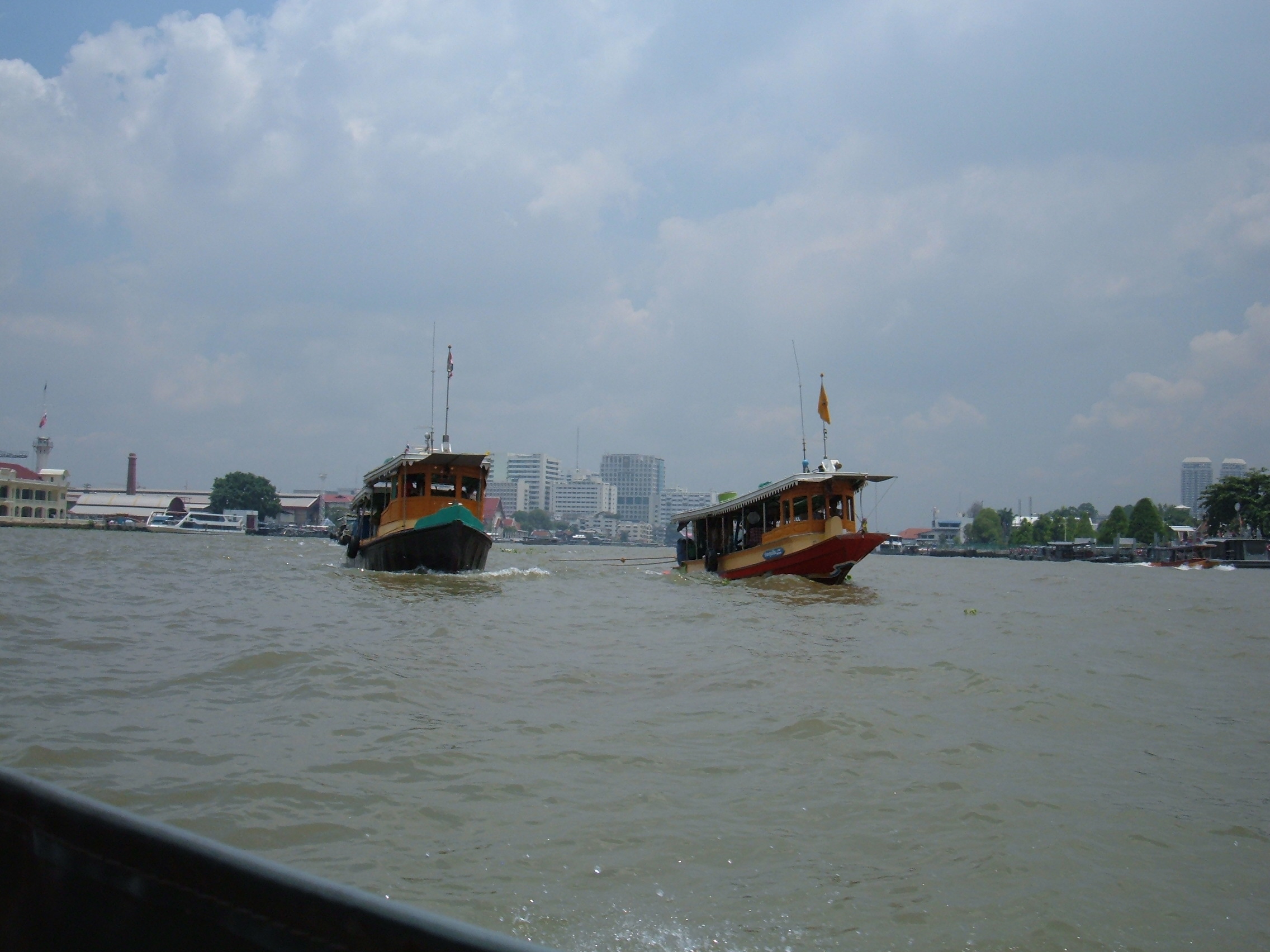
The Chao Phraya is the one place in Bangkok without traffic, and it’s the right way to get around. The orange line boats stop at around twenty piers and cost less than a euro; the people who ride them are on their way to work. From the Tha Tien pier a ferry crosses the river in three minutes.

On the other bank stands Wat Arun, the Temple of Dawn, with its central prang, seventy metres tall in Khmer style. The thing to examine up close is the cladding: it’s not mosaic or painted ceramic, but fragments of Chinese porcelain set into cement — plates and cups that arrived as ballast on merchant ships and were reused, piece by piece, to clad an entire temple. You climb a very steep staircase, and from the top you see the whole bend of the river.
The name refers to dawn, but the best time is sunset: you watch it from the other bank, from one of the riverside bars at Tha Tien, as the sky changes colour behind the prang. Then the lights come on and the show you saw in the photo above begins.
La regola vale ovunque nel paese ed è controintuitiva per un europeo: si mangia meglio in strada, e costa un decimo. Un piatto in un chiosco sta fra i 50 e gli 80 baht, un euro e mezzo o due; nei ristoranti con l’aria condizionata si paga cinque volte tanto per una cucina addomesticata. Il criterio per scegliere è semplice: fermatevi dove c’è la fila di thailandesi e dove il banco fa una cosa sola. Da provare: il pad kra pao, carne saltata con basilico santo e uovo fritto sopra, che è il piatto che i thailandesi mangiano davvero tutti i giorni; il som tam, insalata di papaya verde pestata nel mortaio, piccantissima; il khao soi nel nord, zuppa di noodle al curry con latte di cocco e tagliatelle fritte sopra, che è birmana d’origine; il mango sticky rice come dolce. Sul piccante: «mai phet» vuol dire «non piccante», e conviene impararlo — il livello standard thailandese è un’altra cosa rispetto a quello dei ristoranti thai in Europa.
Day 2 — Ayutthaya, the capital that was burned
Day trip from Bangkok · 80 km to the north · train or minivan, an hour and a half

From 1350 to 1767 Ayutthaya was the capital of Siam, and for a long stretch one of the largest cities in the world: around 1700 it was home to perhaps a million people, more than London and Paris. It stands on an island at the confluence of three rivers, and was an international port where the Portuguese, the Dutch, the Japanese, the Persians and the French kept permanent quarters. European diplomats who arrived there wrote that they had never seen anything like it.
In 1767 the Burmese army took it after a fourteen-month siege, plundered it and burned it down. Statues were beheaded for the gold that covered them, temples burned, and the population was deported. The capital was never rebuilt: fifteen years later Rama I founded Bangkok further south, and Ayutthaya remained a field of red-brick ruins. Today it’s a UNESCO World Heritage site.
The way to visit is by bicycle (50 baht a day) or by hourly tuk-tuk: the archaeological park is large and flat. The places not to skip:
- Wat Mahathat, where a Buddha head is engulfed in the roots of a fig tree — a sculpture fallen during the sack that the tree has slowly enveloped over two and a half centuries. It’s the iconic image of Thailand, and it’s at ground level: to photograph it you crouch down, because the rule here is that your head must never be higher than the Buddha’s.
- Wat Phra Si Sanphet, with its three aligned chedis covering the ashes of three kings. It was the royal temple, the equivalent of today’s Wat Phra Kaew.
- Wat Chaiwatthanaram, on the riverbank, in Khmer style: at sunset it’s the best spot in the park.
- Wat Yai Chai Mongkhon, with its towering chedi and rows of Buddhas wrapped in yellow cloth.
You get there by train from Krung Thep Aphiwat station: 15-60 baht depending on class, an hour and a half, and it’s an experience in itself. Alternatively, minivans from the Mo Chit terminal, or an organised tour that returns by boat on the river. Leave early: between 11am and 3pm the heat over the shadeless ruins is serious, and you’ll need water and a hat.
Al posto di Ayutthaya, la mattina del secondo giorno può andare al mercato sui binari di Maeklong e a quello galleggiante di Amphawa o Damnoen Saduak, tutti a sud-ovest di Bangkok. A Maeklong il mercato sta letteralmente sulla ferrovia: otto volte al giorno arriva il treno, i venditori ritirano le tende e i cesti in una manovra di dieci secondi, il convoglio passa a venti centimetri dalla merce, e poi tutto torna com’era. È diventato molto turistico, ma resta un mercato vero dove la gente compra il pesce.

Days 3 and 4 — Chiang Mai and the north
Flight Bangkok–Chiang Mai, 1h20 · 2 nights · the kingdom that was another country
Northern Thailand is a different thing altogether, and that’s not just a figure of speech: the Lanna kingdom, with its capital at Chiang Mai, was independent from 1296 and became definitively part of Siam only in 1892. It has its own dialect, its own alphabet, a different cuisine — less coconut, more bitter herbs and Burmese influences — and a dark-wood temple architecture that has nothing to do with Bangkok’s gilded one. It’s also cooler: we’re at three hundred metres, surrounded by mountains.
4 – Chiang Mai’s old town
Time half a day · Temples 40-50 baht each · All on foot within the walled square
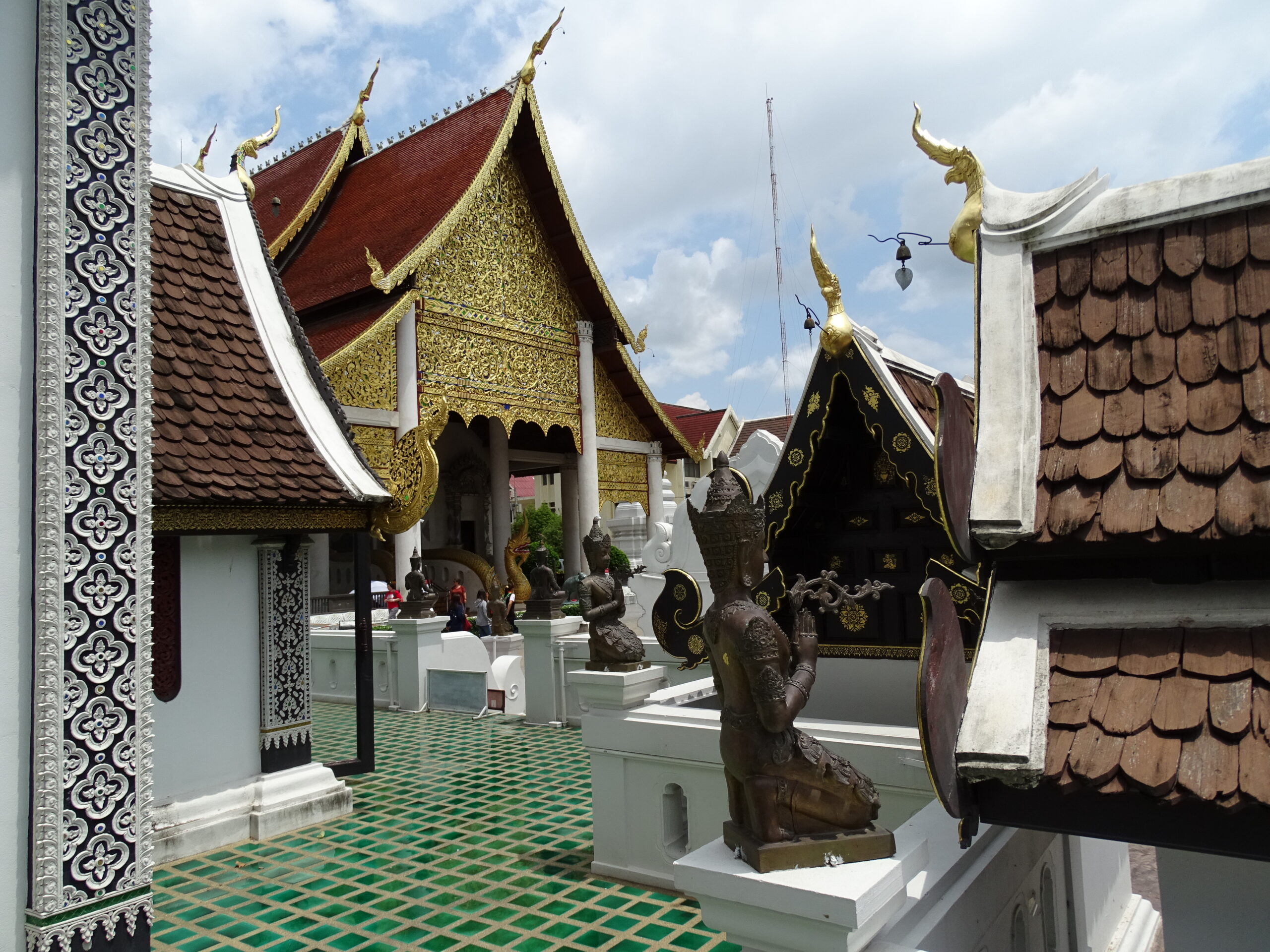
The old town is a perfect square, a kilometre and a half on each side, surrounded by a moat and what remains of its fourteenth-century walls. Inside there are more than thirty temples, and you can get around on foot in half a day.
Wat Chedi Luang is the most impressive: its chedi was eighty-two metres tall, once the tallest building in the kingdom, until an earthquake in 1545 brought down its upper section. It has stayed that way, truncated, and the effect is better than it would have been whole. The Emerald Buddha now in Bangkok was kept here for eighty years. Wat Phra Singh, meanwhile, has the city’s finest wooden hall, and Wat Chiang Man, from 1296, is the oldest.
Many temples in Chiang Mai have “monk chats”: tables where young monks studying English sit down to talk with visitors. It’s free, and it benefits them as much as you. Practical rule: women don’t touch a monk or hand him an object directly.

In the evening there’s the night bazaar every day, and on weekends two much better markets: the Saturday Walking Street on Wualai Road and the Sunday Walking Street inside the walls, which close whole streets to traffic. You eat while walking, spending very little.
5 – Doi Suthep
Time half a day · Admission 30 baht · Red songthaew, 40 minutes of hairpin bends

Wat Phra That Doi Suthep sits on a mountain at 1,070 metres, fifteen kilometres above the city, and is the most venerated temple in the north. You climb a staircase of three hundred and six steps flanked by two naga, mythical serpents, or take the funicular. At the top is a gilded terrace with the chedi at its centre, and from the balustrade you see the entire Chiang Mai plain.
The founding legend is one of the best in Southeast Asia: in 1383 a relic of the Buddha is said to have split in two; to decide where to house the second half, it was loaded onto a white elephant left free to walk wherever it wanted. The animal climbed the mountain, turned around three times, trumpeted and died. The temple was built on that spot.
You get there in the red songthaew, the pickup trucks with bench seats in the back that serve as Chiang Mai’s public transport: agree the price before getting in, around 200 baht per person round trip. Go early in the morning, when there’s haze over the valley and the tour buses haven’t arrived yet.
6 – The elephants, but the right way
Time a full day · Cost 2,500-3,000 baht · Book several days ahead
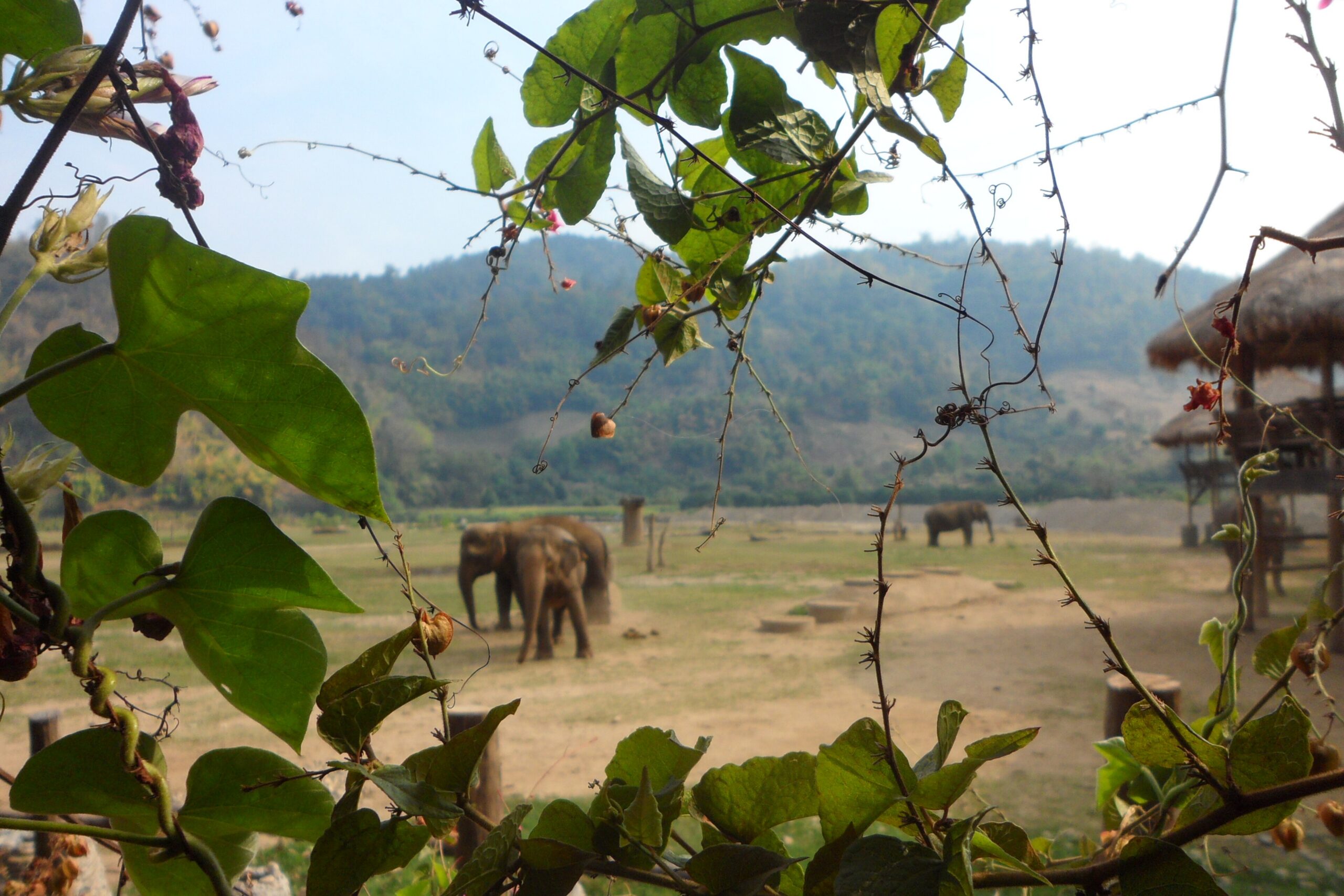
It’s worth being clear here, because this is the point most often gotten wrong in Thailand. The elephants you see at tourist camps with saddles on their backs, painting pictures or playing football, have been trained through a procedure called phajaan, meaning “to break”: the young animal is separated from its mother, restrained and deprived of sleep and food for days until it stops resisting. The saddle, moreover, damages the spine, which in elephants is not built to carry weight on top.
There are, however, genuine sanctuaries, created to take in elephants rescued from logging work, tourist camps and street begging. The best known is the Elephant Nature Park, an hour and a half from Chiang Mai, founded by Sangduen “Lek” Chailert, who has received international recognition for this work. There are other reputable ones in the same valley.
Here’s how you recognise an honest place, in three questions: can you ride them? If yes, no. Are there shows? If yes, no. Do the elephants live in a herd and can they move away? If no, no. At reputable sanctuaries you observe, walk alongside them, sometimes prepare their food; you don’t ride, you don’t bathe with them — that’s stressful too — and spots are limited, so book before you leave.
Days 5, 6 and 7 — The south: Krabi and the sea
Flight Chiang Mai–Krabi, 2 hours · 2 nights · long-tail boats
7 – Railay
Time a day · Boat 100-150 baht from Ao Nang · No road: you can only get there by sea

Railay isn’t an island: it’s a peninsula cut off from the mainland by sheer limestone cliffs, which is why you can only get there by long-tail boat, the wooden boats with a car engine and a propeller at the end of a very long shaft. It’s a twenty-minute crossing from Ao Nang.
There are four beaches connected by paths: Railay West for sunset, Phra Nang, which is the most beautiful and has a cave at one end with the princess’s shrine, where fishermen leave phallus-shaped offerings for a bountiful catch and children. The cliffs above the beach are one of the most famous rock-climbing spots in the world: there are more than seven hundred bolted routes and several schools offering courses, including half-day ones for beginners.
The trail up to the viewpoint and the inland lagoon is short but steep, muddy and fitted with fixed ropes: it’s twenty minutes that feel like more, and you need proper shoes, not flip-flops.
8 – The islands, by boat
Time a day · Cost 800-1,500 baht depending on the tour · National park fee 400 baht extra
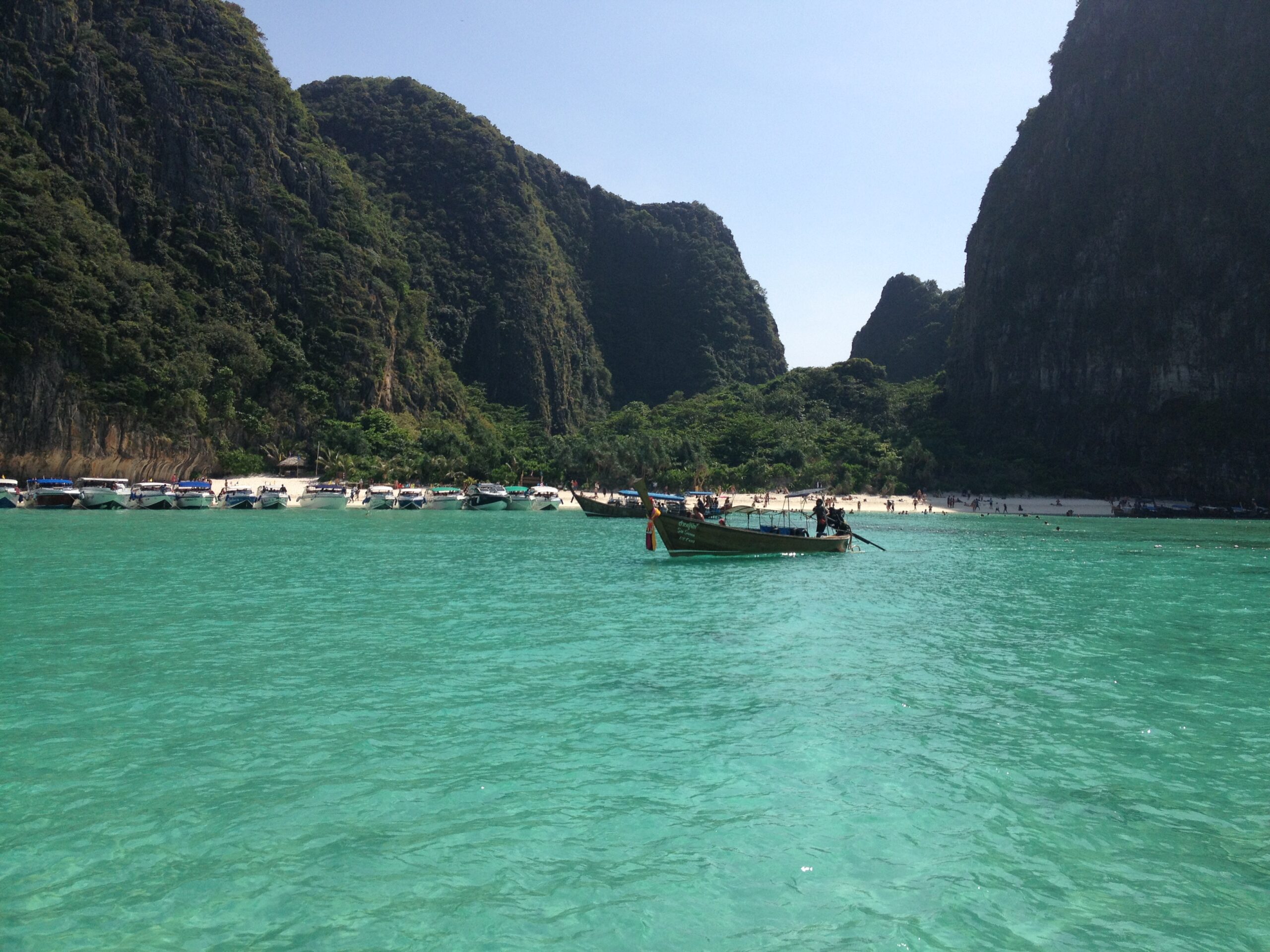
The last full day is spent on a boat. There are two options, and it’s worth choosing knowing what the difference is.
Phi Phi is the most famous: vertical cliffs rising out of turquoise water, and Maya Bay, the bay from the film The Beach. It should be said that Maya Bay was closed from 2018 to 2022 because mass tourism had killed eighty percent of its coral; it reopened with strict rules — no boats inside the bay, capped visitor numbers, total closure from August to September — and swimming isn’t allowed. They’re still gorgeous, but crowded.
The Hong Islands and the Four Islands, much closer to Krabi, are less famous and less crowded: inner lagoons enclosed by rock, small beaches and the tombolo of Koh Tup, a sandbar that appears at low tide and links two islands on foot. If you have to pick just one, for a genuine day at sea, these are it.
Trips are booked the evening before at any agency in Ao Nang. Prefer the small long-tail boats over the big speedboats: they cost less, go slower and can get into places the others can’t. And check whether the national park entry fee is included: often it isn’t, and it’s collected on landing.
Se cercate una spiaggia dove stare fermi invece di un posto da cui uscire ogni giorno, Koh Lanta è a due ore di traghetto da Krabi ed è molto più tranquilla: spiagge lunghe di sabbia, tramonti a ovest, niente vita notturna. Se invece vi interessano le immersioni, la destinazione è Koh Tao, nel golfo dall’altra parte del paese: è uno dei posti dove si rilasciano più brevetti subacquei al mondo, perché l’acqua è calma, poco profonda e il corso base costa meno che in qualunque altro posto. Ma sta dall’altro lato dell’istmo e cambia tutta la logistica: in una settimana non ci sta.

What a week costs
| Voce | Costo |
|---|---|
| Volo Bangkok–Chiang Mai | 40-70 euro |
| Volo Chiang Mai–Krabi | 50-90 euro |
| Alloggio, 7 notti (camera media con aria condizionata) | 150-350 euro |
| Ingressi (Grande Palazzo, Wat Pho, Wat Arun, Ayutthaya, templi del nord) | circa 2.200 baht, 58 euro |
| Santuario degli elefanti | 2.500-3.000 baht, 65-80 euro |
| Gita in barca alle isole | 800-1.500 baht, 21-40 euro |
| Trasporti locali (treno per Ayutthaya, songthaew, barche, taxi) | circa 60 euro |
| Pasti, 7 giorni mangiando in strada e ai mercati | 70-140 euro |
| Totale in loco | circa 550-900 euro a persona |
Figures as of September 2026, excluding the intercontinental flight. Payment is in baht, exchange rate around 38 to the euro. Thailand adapts to any budget: the same week can be done for €400, sleeping in guesthouses and eating only street food, or for €2,000 in resorts. The items that don’t compress are the domestic flights — though they cost half if booked a month ahead — and the elephant sanctuary. You’ll need cash: cards aren’t used in markets or on songthaew, and it’s worth withdrawing from an ATM (a fixed fee of 220 baht per transaction, so fewer, larger withdrawals are better).
In Thailandia la temperatura sta fra i 30 e i 38 gradi con umidità alta quasi tutto l’anno, e le rovine e i templi non hanno ombra. La giornata funziona se si spacca in due: fuori dalle 7 alle 11, riposo o museo o massaggio nel primo pomeriggio, fuori di nuovo dalle 16. In stagione delle piogge (da maggio a ottobre) piove quasi ogni giorno ma quasi sempre a rovesci di un’ora nel pomeriggio: non rovina il viaggio e i prezzi scendono parecchio. Il periodo peggiore per il nord è marzo-aprile, quando bruciano le stoppie e la qualità dell’aria a Chiang Mai diventa una delle peggiori del mondo.
Frequently asked questions
Is a week in Thailand enough?
It’s enough for three tastes: the capital, the north and the southern sea. It’s not enough to get to know the country, and it involves two domestic flights. If you only have seven days and want to stay more settled, the honest alternative is Bangkok plus just one other place: three nights in the city and four by the sea, or three and four in the north.
Are the domestic flights necessary, or can you go by train?
In a week, yes. Bangkok–Chiang Mai by night train is a beautiful experience but takes twelve hours; going down to Krabi is another fifteen. Domestic flights cost €40-90 and are booked with local carriers. If you had two weeks, the night train to Chiang Mai would be worth it: clean berths, curtains, and waking up amid the rice paddies.
What’s the best time to go?
November to February: dry season, more bearable temperatures, calm seas on both coasts. March to May is very hot (up to 40°C) and the north has the problem of agricultural burning. June to October is the rainy season: it costs much less, everything is lush and green, and rain comes as brief downpours — but on the Andaman coast the sea can be rough and some trips get cancelled.
How should you dress to enter the temples?
Shoulders and knees covered, men included: no tank tops, no short shorts, no see-through clothing. Shoes come off before entering buildings (it helps to have socks and shoes that slip off quickly). You should never point the soles of your feet at an image of the Buddha: sit with your legs folded to the side. At the Grand Palace they lend a sarong at the entrance; at other temples, not always.
How do you avoid scams?
The two classics are the “temple closed today” line near the Grand Palace, which ends up at a jewellery shop, and the broken meter: in Bangkok taxis you ask for “meter, please,” and if the driver refuses you get out and take another one. For tuk-tuks the price is agreed beforehand. These are scams worth a few dozen euros at most, with no physical danger: Thailand is a safe country to travel in.
Can you drink the tap water?
No. You drink bottled water, which costs 10-15 baht and is found everywhere; many hotels have refill stations for water bottles. Ice at restaurants, on the other hand, is safe: in Thailand it’s produced industrially with purified water, and the cylinders with the hole in the middle that you see in glasses are that kind. On street food: eat where there’s turnover, meaning where there’s a queue.
How much do you spend per day?
At an average level, €50-80 per day per person including lodging. Eating street food you’ll spend less: a dish costs 50-80 baht, that’s about one and a half to two euros. The priciest items are the domestic flights, the elephant sanctuary and the boat trips. You’ll need cash for markets and local transport.
Why shouldn’t you ride elephants?
Because the training that makes an elephant rideable is called phajaan and involves separating the calf from its mother, restraining it and depriving it of sleep and food until it gives in; and because an elephant’s spine isn’t built to carry weight on its back. At genuine sanctuaries the animals live in a herd, you observe them and walk alongside them, but you don’t ride and there are no shows. If a place offers rides or performances, it isn’t a sanctuary.
Do you need a visa?
Not for Italian citizens, for short tourist stays: you enter under the visa exemption by presenting a passport valid for at least six months and a return ticket. The rules on duration have changed several times in recent years: check the embassy website before leaving, along with any digital entry form.
Are there mandatory vaccinations?
None mandatory for entry. Hepatitis A and typhoid are generally recommended, and it’s worth talking to a travel medicine clinic at least a month ahead. Malaria isn’t an issue in the areas of this itinerary; dengue is, and it’s transmitted by a mosquito that bites during the day: repellent genuinely matters. And get health insurance: private care in Thailand is excellent but not free.
What’s the most common mistake?
Packing in too many stops. Thailand is sixteen hundred kilometres long and every move costs half a day: anyone trying to fit Bangkok, the north, the Gulf and the Andaman into seven days ends up spending more time in airports than in Thailand. The second mistake is underestimating the heat: you see much more by getting up at six and resting at lunchtime than by pushing through all day.
September 11, 2026


