Stockholm in 5 days: the city, the archipelago and Lake Mälaren
With five days, Stockholm stops being a capital and becomes what it actually is: the main town of an archipelago of twenty-four thousand islands. The first three days are for the city — Gamla Stan, the Vasa, Djurgården, the Nobel City Hall, the painted metro. The fourth and fifth are spent on the water, which is the whole reason Swedes live here: one day by boat among the skerries and the red-timber villages, and one day up Lake Mälaren to a baroque royal palace and a Viking city abandoned in the tenth century.
At a glance
- Duration · five days: three in the city, two on the water
- How much walking · 8, 9, 7, 6 and 7 km
- To book ahead · the Vasamuseet, the guided tour of City Hall, and the archipelago boats on summer weekends
- Budget · 3,700-5,000 kronor per person, accommodation excluded — around 330-440 euros
- Season · for days 4 and 5 you need May-September: out of season the boats run less often or not at all, and Birka closes
- Good to know · cash is almost never accepted: you need a card
- What’s left out · Gotland, Lapland and the Göta Canal: those are other trips
Notice the symmetry: day 4 goes east, into the salty Baltic; day 5 goes west, into the fresh-water lake. Stockholm sits exactly in between.
Days 1, 2 and 3 — The city
24 km in total · 9 stops · the three-day programme, in brief
The first three days are the ones covered in the dedicated itinerary, and here we sum them up: anyone wanting full timings, costs and stories can find them in Stockholm in 3 days. The real point of this page starts on day four.
Day 1 – Gamla Stan, the Vasa, the cliff

You start at Gamla Stan, the island where the city was born in 1252: Stortorget with its coloured facades and the memory of the 1520 bloodbath, the alley just ninety centimetres wide, the wooden Saint George and the Dragon from 1489 inside the cathedral. Then the Royal Palace — six hundred rooms, and in the armoury the very clothes the kings were wearing when they died — and the silent little island of Riddarholmen.

The afternoon is for the Vasamuseet: the warship that sank on its launch day, spent 333 years on the harbour floor, and was recovered almost intact because the worm that eats through wood doesn’t survive in the low-salinity Baltic. The day ends on Monteliusvägen, the path along the Södermalm cliff from which you can see the whole city you’ve just crossed.
Day 2 – All of Djurgården

The former royal hunting reserve is the island of museums. Skansen, the world’s first open-air museum (1891), with one hundred and fifty real buildings, craftspeople at work and a zoo of Nordic animals; the Nordiska Museet, which tells five centuries of everyday Swedish life and holds the largest Sami collection in the world; and, your choice, the ABBA museum or the Thielska Galleriet with its Munchs. In the evening, Fotografiska, the only major Stockholm museum open late.
Day 3 – The Nobels, the metro, the other shore
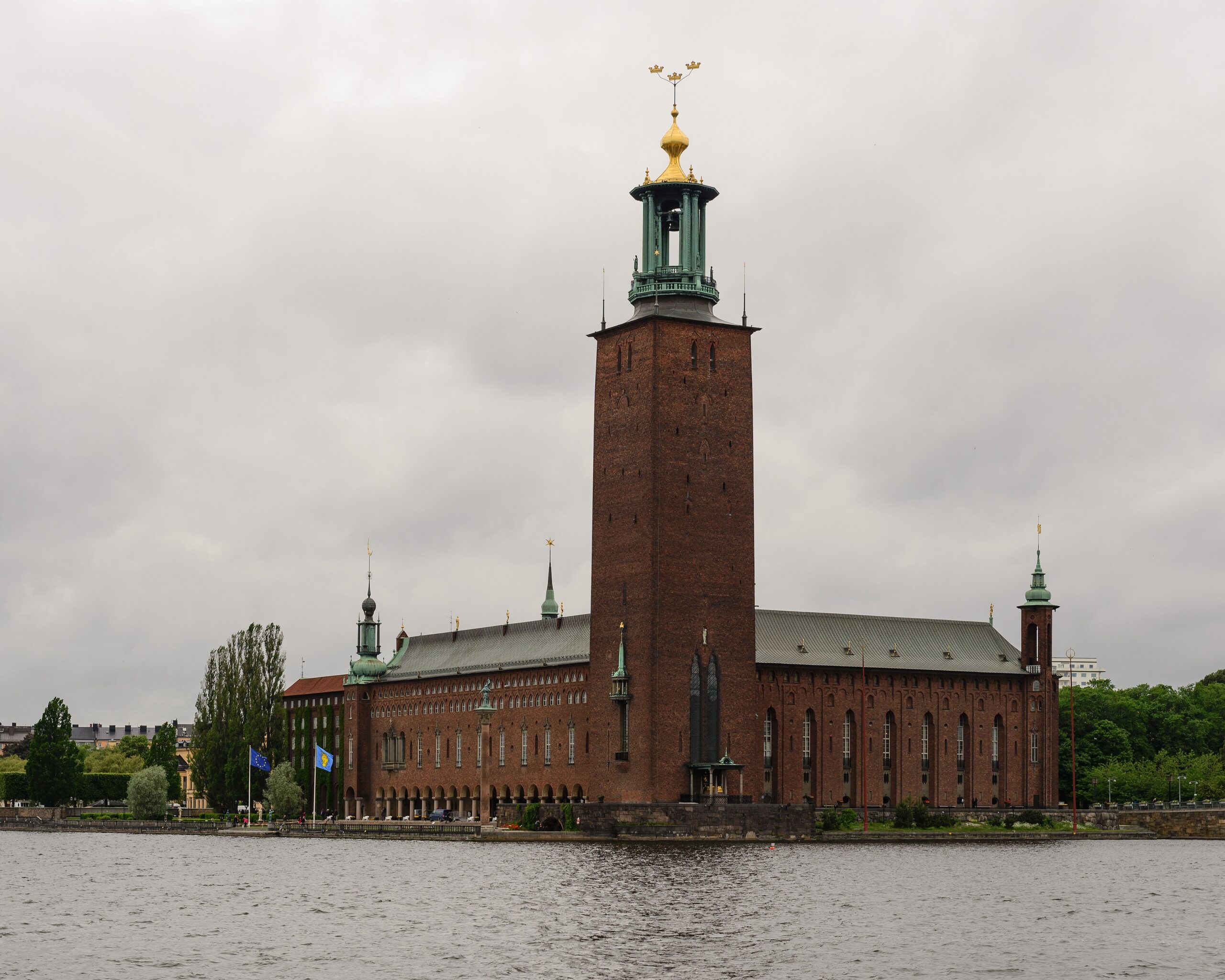
City Hall, eight million handmade bricks, with the Blue Hall of the Nobel banquet and the Golden Hall with its eighteen million mosaic tiles — you can only go in on the guided tour. Then the metro, which with ninety decorated stations out of a hundred is genuinely the longest art gallery in the world: T-Centralen, Kungsträdgården, Solna Centrum, Stadion. A walk along Norr Mälarstrand in Kungsholmen and dinner at the Östermalm covered market close out the city portion.
Day 4 — The archipelago: Vaxholm and Grinda
6 km on foot · 2 stops · from 8:30am to 9pm · a day spent almost entirely on the boat
The Stockholm archipelago, the Skärgården, has roughly twenty-four thousand islands, islets and skerries spread over eighty kilometres to the east. It isn’t an optional excursion: it’s where Stockholmers spend the summer, where they have grandpa’s red-timber cottage, and without seeing it you’ve only understood half the city.
The right way to get there is on the scheduled boats. The historic company is Waxholmsbolaget, which has run public service between the islands since 1849 with its white ferries, some of which are early-twentieth-century steamships still in service. You leave from the Strömkajen pier, in front of the Grand Hôtel, and the ticket isn’t included in the city transport pass: you buy it on board or via the app. There’s also a day pass that pays off if you make more than one crossing.
10 – Vaxholm, the gateway to the archipelago
Time 3 hours · Boat about an hour from Strömkajen, 100-160 kronor · Fortress about 130 kronor
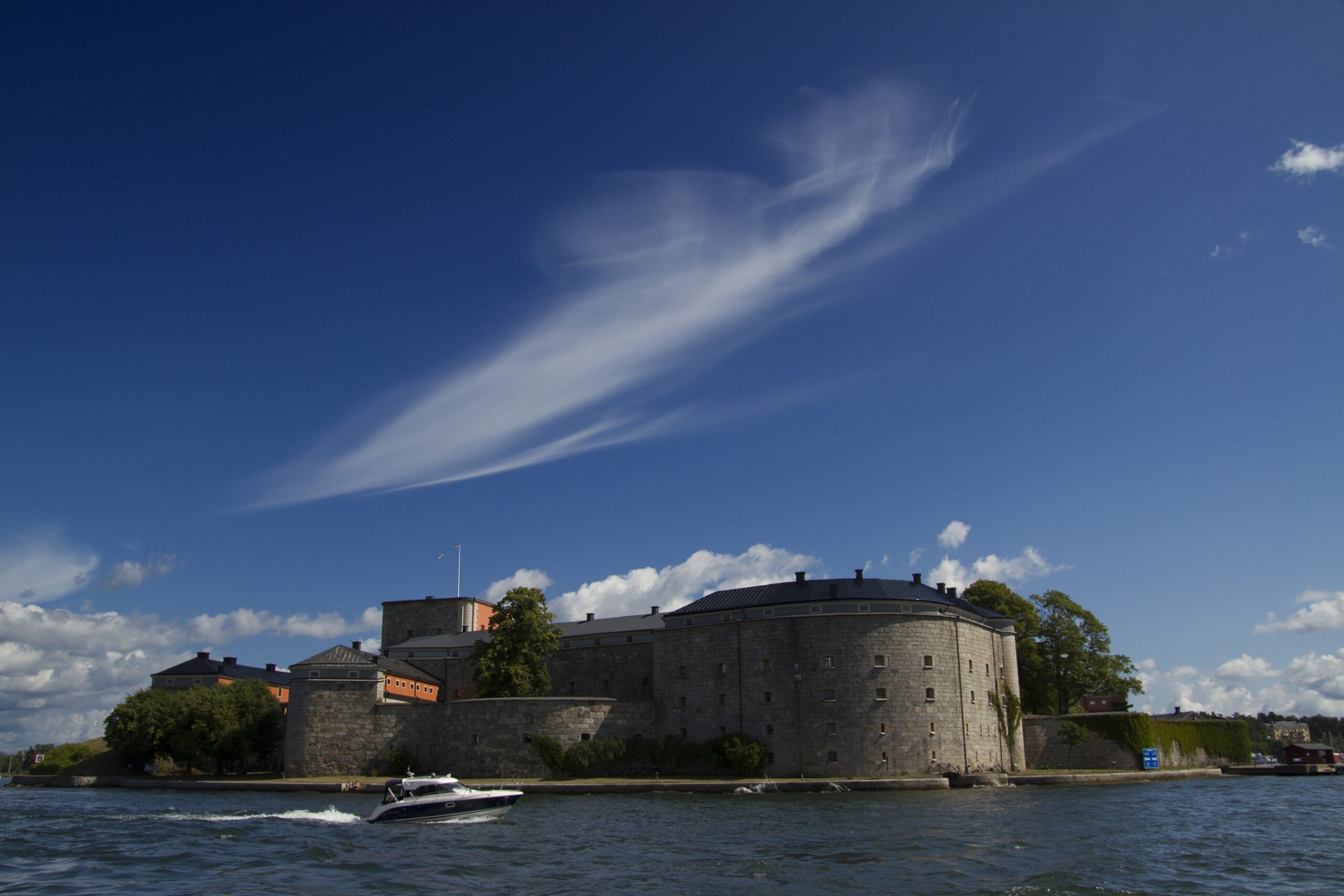
Vaxholm is the archipelago’s main town and the easiest to reach: just under an hour by boat, or forty minutes by bus if you’re in a hurry — though taking the bus to reach the archipelago rather misses the point, since half the value lies in the crossing itself.
The fortress, on a small island facing the harbour, exists because the channel is narrow here: Gustav Vasa had it built in 1548 to seal off Stockholm’s access from the sea, and for three centuries it was the plug protecting the capital. It worked: in 1719 the Russian fleet, which was burning its way along the whole Swedish coast, tried to pass here and was stopped. The current building is a nineteenth-century reconstruction, and today it’s a museum on coastal defence; you reach it by a two-minute ferry from the pier.
The town itself is reason enough to stop: the late-nineteenth-century wooden houses in the Norrhamn district, painted white, yellow and the typical falu red, with carved wooden lace under the eaves — the houses of the well-off summer visitors from the era when the archipelago came into fashion. There’s a waterfront, an ice-cream parlour, and places to eat smoked fish while watching the boats go by. An hour and a half is enough to see it all.
11 – Grinda, the island as it should be
Time 4 hours · Boat 1-2 hours from Vaxholm depending on the crossing · Free entry, it’s a nature reserve

Grinda is a small island in the middle archipelago, with no cars, no paved roads and no permanent residents beyond a handful. It’s a publicly owned nature reserve, and you go there to do exactly nothing: a path crosses the island in half an hour through pines, granite rocks polished smooth by the ice, and meadows; there are two beaches, a jetty to dive off, an early-twentieth-century inn with a terrace, and a small shop.
Anyone wanting something a bit more social can swap it for Sandhamn, the island of sailing and aperitifs — further out, more crowded and with white sand — or for Fjäderholmarna, twenty-five minutes from the centre, the compromise for those short on time: craft workshops, restaurants and a brewery.
Two things worth knowing. The first is allemansrätten, the right of public access to nature: in Sweden you can walk, pick berries and mushrooms and even pitch a tent for one night on almost any uncultivated land, even private, as long as you stay away from houses and leave no trace. It’s written into the constitution, and it’s the reason islands like this one can be freely explored. The second: in the archipelago the water is brackish, the Baltic has very low salinity, and in July swimming is no ordeal at all.
Questa è l’unica tappa dell’itinerario in cui non si improvvisa. Le corse della Waxholmsbolaget sono fitte da fine giugno a metà agosto, ridotte in maggio, giugno e settembre, e quasi assenti d’inverno. Costruite la giornata partendo dall’ultima corsa di rientro, non dalla prima di andata, e mettete un margine: se la perdete, sull’isola non c’è un piano B. Controllate gli orari sul sito della compagnia il giorno prima, perché il maltempo cancella le corse.
La cosa da cercare è la strömming, la piccola aringa del Baltico, fritta e servita con puré e mirtilli rossi: nei chioschi del porto costa poco ed è buonissima. Poi il gambero (il kräftskiva, la festa dei gamberi di fine agosto, è un rito nazionale con cappellini di carta e canzoni), il salmone affumicato e il pane di segale scuro. Sulle isole i locali sono pochi e chiudono presto: se arrivate dopo le 19 potreste non trovare niente aperto. La surströmming, l’aringa fermentata dall’odore leggendario, è roba del nord della Svezia e qui non ve la propone nessuno: se la cercate apposta, sappiate che si apre all’aperto e sottovento.
Day 5 — Heading west: Drottningholm and Birka
7 km · 2 stops · from 9am to 7pm · boat on Lake Mälaren
The fifth day goes the opposite way: not into the salt water to the east, but into Lake Mälaren to the west, Sweden’s third-largest lake and the reason Stockholm sits where it does. In one day you can fit in an inhabited baroque palace and a Viking town abandoned a thousand years ago, and you reach both by boat from City Hall.
12 – Drottningholm, the Versailles of the north
Time 3 hours · Boat 50 minutes from Stadshuskajen, about 165 kronor return · Palace about 160 kronor

Drottningholm — ‘the queen’s island’ — is the residence of the Swedish royal family, who genuinely live there: since 1981 the king and queen have lived in the south wing, which is closed to the public. The rest can be visited. It was the first Swedish site added to the UNESCO World Heritage list, in 1991.
The palace is by Nicodemus Tessin the Elder, begun in 1662 for Queen Hedwig Eleonora, and openly imitates Versailles — with Swedish means, which were smaller, and with a result that’s more restrained and, in its own way, better. Inside, the room to see is Hedwig Eleonora’s state bedroom, baroque to the point of excess, and the library of Louisa Ulrika, who was the sister of Frederick the Great of Prussia and brought the Enlightenment here: she corresponded with Voltaire and Linnaeus, and founded an academy.
But the two things that make Drottningholm different from any other royal palace stand outside the main building.
The first is the court theatre, the Slottsteater of 1766. After Gustav III’s death it was closed and used as a storeroom for one hundred and thirty years, and when a scholar reopened it in 1921 he found, intact inside, the original eighteenth-century stage machinery: the wooden winches that change every backdrop in twelve seconds, the wave machine, the thunder machine, the wind machine. It’s the only baroque theatre in the world that still works with its original mechanisms, and in summer real operas are staged there, with fake candles and stagehands pulling the ropes by hand.
The second is the Chinese Pavilion, at the far end of the park: a birthday gift King Adolf Frederick gave the queen in 1753, built in secret and assembled in a single night so she’d find it waiting in the morning. It’s rococo with oriental decoration, and it tells you a lot about the eighteenth-century European fashion for a China imagined by people who had never been there.
13 – Birka, the Viking town
Time 4 hours including travel · Boat about 2 hours from Stadshuskajen · Ticket 400-500 kronor, museum and guided tour included · Only May to September

Birka, on the island of Björkö, is Sweden’s first urban settlement: founded around 750, it was the trading port linking Scandinavia to Byzantium and the Abbasid caliphate via the Russian rivers. Perhaps seven hundred people lived there, which for the time made it a city. Graves have yielded Chinese silk, Arab silver coins, Rhenish glass and a ring inscribed with Arabic characters.
Here in 829 Ansgar landed, a Frankish monk sent to convert the north: it’s the first attempt to bring Christianity to Sweden, and it fails almost completely, which is exactly why Birka is called ‘the place where Sweden meets Europe.’ Then, around 975, the town was abandoned within a few years: probably because post-glacial land uplift — which is still happening here today, five millimetres a year — was closing off the access channel, making the harbour unusable. Trade shifted to Sigtuna.
Today nothing is left standing, and it has to be said plainly: you see a sloping meadow above the lake, the outline of the fortification on Borgberget, and beneath the grass around three thousand graves, only some of them excavated — it’s considered one of the most important Viking Age archaeological sites precisely because it has remained largely untouched. What makes the visit worthwhile is the guide included with the ticket, who walks with you and tells you what stood where, plus the museum with the finds and the reconstructed village. One of the richest graves, Bj 581, was classified for a century as that of a male warrior: in 2017 DNA analysis established that the skeleton is female, and the discussion that followed changed quite a few ideas about the Viking Age.
Drottningholm and Birka in the same day are possible only with the combined cruise that some companies run in summer, and it makes for a long day. If you’d rather take it easy, do only Drottningholm in the morning and spend the afternoon in Sigtuna, Sweden’s oldest medieval town, which is on the same lake, or head back into the centre for the museums you skipped.
Se i battelli non fanno per voi, o se venite fuori stagione, il quinto giorno si sostituisce con Uppsala: quaranta minuti di treno, corse ogni quarto d’ora. C’è la cattedrale gotica più grande della Scandinavia (118 metri, altezza pari alla lunghezza), dove sono sepolti Gustavo Vasa e Linneo; l’università del 1477, la più antica del nord, con il teatro anatomico secentesco sotto la cupola e il Codex Argenteus, la bibbia gotica del Sesto secolo scritta in argento su pergamena purpurea; il giardino di Linneo, ricostruito com’era quando ci lavorava; e a cinque chilometri Gamla Uppsala, i tumuli funerari regali del Quinto secolo, che erano il centro religioso della Svezia pagana. È una giornata piena e non teme la pioggia.

What five days cost
| Voce | Costo |
|---|---|
| Musei dei primi tre giorni (Palazzo Reale, Vasa, Skansen, Nordiska, Fotografiska, Municipio) | 1.185-1.275 corone |
| Trasporti urbani, biglietto SL da 72 ore | circa 350 corone |
| Battelli dell’arcipelago, giorno 4 | 250-400 corone |
| Fortezza di Vaxholm | circa 130 corone |
| Battello e ingresso a Drottningholm | circa 325 corone |
| Birka, crociera e visita guidata | 400-500 corone |
| Pasti, 5 giorni | 1.500-2.300 corone |
| Totale | circa 4.140-5.280 corone a persona, sui 365-465 euro |
Figures as of September 2026, accommodation excluded. Payment is in Swedish kronor (about 11.3 to the euro) and almost always by card. The two days on the water are the most expensive part of the itinerary: if the budget is tight, keep day 4 — the archipelago is the experience you won’t find anywhere else — and swap Birka for Sigtuna or Uppsala, which cost a fraction. Remember that the Nationalmuseum, Moderna Museet and Historiska Museet are free.
I giorni 4 e 5 funzionano da maggio a settembre e danno il meglio in giugno e luglio, quando i battelli hanno le corse fitte e la luce dura fino a mezzanotte. Da ottobre ad aprile l’arcipelago si svuota, molte corse spariscono, Birka chiude del tutto e Drottningholm riduce gli orari. In inverno cinque giorni a Stoccolma restano bellissimi, ma vanno costruiti diversamente: tre giorni di città come questi, poi Uppsala e una giornata di musei — il Nationalmuseum, il Moderna Museet e l’Historiska con l’oro vichingo — che sono gratuiti e chiudono tardi.
Frequently asked questions
Is five days too many for Stockholm?
No, provided you spend two of them outside the city, on the water. Stockholm can be seen in three days; the fourth and fifth are for the archipelago and Lake Mälaren, which are the reason the city exists and the part passing visitors never see. If you stay all five days shut up in the centre, then yes, that would be too many.
How do you get to the archipelago, and how much does it cost?
With the scheduled boats of Waxholmsbolaget, departing from Strömkajen, in front of the Grand Hôtel. They’re not included in the city transport ticket: one crossing costs 100-160 kronor, and there’s a day pass that pays off if you make more than two crossings. Sailings are frequent from late June to mid-August and reduced the rest of the year: check the timetable the day before and plan your day around the last return trip.
Which island should you pick if you can only do one?
It depends what you’re after. Vaxholm for the wooden houses and the fortress, and it’s the easiest to reach; Grinda for nature, diving off the jetty and doing nothing; Sandhamn for sailing, white sand and a lively atmosphere, but it’s the furthest; Fjäderholmarna if you only have half a day, since it’s twenty-five minutes from the centre.
Is there actually anything to see at Birka?
It has to be said honestly: there are no standing ruins. You see a sloping meadow, the outline of a fortification, and, beneath the grass, three thousand graves. What makes the day worthwhile is the guide included with the ticket, the museum with its finds — Chinese silk, Arab silver — and the reconstructed village. If archaeology doesn’t excite you, swap it for Sigtuna or Uppsala.
Can you do Drottningholm and Birka on the same day?
Only with the combined cruises some companies run in summer, and it’s a long day: you leave at nine and get back around seven. If you’d rather not rush, do Drottningholm in the morning — the palace, court theatre and Chinese Pavilion already fill three full hours — and save Birka for another time.
Can you visit Drottningholm’s court theatre?
Yes, with a guided tour, and it’s worth the ticket: it’s the only baroque theatre in the world where the original 1766 stage machinery still works, wooden winches that change every backdrop in twelve seconds. In summer real performances are staged there with an orchestra playing period instruments: if you happen to be there in season, get a ticket.
When’s the best time to do this itinerary?
Between May and September, and best of all in June, when the light lasts almost all night. Watch out for two dates: Midsommar, the last weekend of June, when Swedes leave the city and everything shuts downtown (but Skansen throws the loveliest celebration of the year), and the mid-August week, the only truly crowded period in the archipelago.
What is allemansrätten?
It’s the Swedish right of public access to nature: you can walk, pick berries and mushrooms, and pitch a tent for one night on almost any uncultivated land, even private, as long as you stay away from homes and leave no trace. It applies on the archipelago islands too, and it’s why they can be freely explored.
Are there mosquitoes in the archipelago?
Few on the wind-exposed rocky islands; in the inland areas and damp woods, in June and July, yes, and they’re bothersome at sunset. A repellent in your pocket sorts it out. Ticks are a more serious concern across all of southern Sweden: if you walk through tall grass, wear long trousers and check yourself in the evening.
Is it worth renting a house in the archipelago?
If you have more days, very much so: sleeping a night on an island changes the experience, because the best moment is the evening, once the boats carrying the day-trippers have left. There are historic inns on Grinda and Sandhamn and rental houses everywhere, but in July they’re booked months in advance.
How much does it all cost?
Between 4,100 and 5,300 kronor per person, accommodation excluded: around 365-465 euros for five days. The biggest costs are the boats and the meals. You can keep it down by having the dagens lunch, using the 72-hour transport ticket and taking advantage of the free museums; swapping Birka for Uppsala saves a couple hundred kronor.
September 11, 2026