Thailand in 2 weeks: from the night train to Chiang Mai to the Khao Sok jungle
Two weeks is the point at which Thailand stops being a string of postcards and becomes a country. One thing changes above all: you can slow down. Bangkok gets three days instead of one, the north stretches out to Chiang Rai and the mountains, and in the south you stay long enough to stop checking the clock. There’s also room for the piece that never fits into a single week: the jungle of Khao Sok, with a rainforest older than the Amazon and a man-made lake full of limestone pillars where you sleep in floating huts. And you can afford the night train instead of the plane, which is a different way of crossing a country.
At a glance
- Duration · 14 full days
- Route · Bangkok (3) → Chiang Mai (4) → Krabi and Railay (3) → Koh Lanta (2) → Khao Sok (2)
- Long-haul transfers · one night train and one domestic flight
- Budget · 900-1,600 euros per person on the ground, intercontinental flight excluded
- To book ahead · the night train (lower berths, they sell out), the elephant sanctuary, and the huts on Khao Sok lake
- Season · November to February. Avoid March-April for the north: farmers burn stubble and the air in Chiang Mai becomes unbreathable
- Good to know · shoulders and knees covered in temples, shoes off. This applies to men too
- What’s left out · the Gulf with Koh Tao and Koh Samui, Isaan, the Golden Triangle: that’s another trip
The route is a descent: you start in the north and work your way down to the Andaman Sea. Khao Sok sits halfway between the islands and the airport you’ll fly home from.
Days 1-3 — Bangkok, unhurried
3 nights · the royal temples, the razed capital, the markets
1 – The royal temples and the river
Day 1 · Grand Palace 500 baht, Wat Pho 300, Wat Arun 200 · Gates open at 8:30

The Grand Palace, built in 1782, houses Wat Phra Kaew and the Emerald Buddha: sixty-six centimetres of jade on a towering altar, the palladium of the kingdom, whose robes the king himself changes three times a year with the seasons. Then there’s Wat Pho, with its 46-metre reclining Buddha and the school of Thai massage, which is still inside the complex.

In the evening you cross the river to Wat Arun, the Temple of Dawn, whose seventy-metre prang is covered in fragments of Chinese porcelain that arrived as ballast on merchant ships. Watch it from the opposite bank at sunset.
The ‘temple is closed’ scam: outside the Grand Palace someone will tell you it’s closed today for a ceremony and offer to take you elsewhere. It’s false — the palace is open every day from 8:30 to 15:30, and the tuk-tuk always ends up at a jewellery shop.
2 – Ayutthaya
Day 2 · Day trip, 80 km north · train 15-60 baht, ninety minutes · Bicycle 50 baht

Capital of Siam from 1350 to 1767, and around 1700 one of the most populous cities in the world, with permanent Portuguese, Dutch, Japanese and Persian quarters. The Burmese army took it after a fourteen-month siege, sacked it and burned it down: statues were beheaded for the gold that coated them. It was never rebuilt.
Worth seeing: Wat Mahathat, with the Buddha head that a fig tree has swallowed over two and a half centuries — to photograph it you crouch down, since here your head must never be higher than the Buddha’s; Wat Phra Si Sanphet with its three aligned chedis; and Wat Chaiwatthanaram on the river, which is the best thing in the park at sunset.
3 – The markets and the Bangkok you live in
Day 3 · Maeklong and Amphawa in the morning, the modern city in the evening

Spend the morning of day three at the Maeklong railway market, where vendors pull back awnings and baskets in ten seconds flat every time the train comes through, then put everything back exactly as it was. Nearby is the Amphawa floating market, which on weekends is the most genuine of the three (Damnoen Saduak is the most famous and the most built for visitors).
Spend the afternoon and evening on the Bangkok that isn’t in the guidebooks: Chinatown along Yaowarat Road, which after sunset turns into one giant open-air kitchen; Chatuchak, if it’s the weekend, which with fifteen thousand stalls is one of the largest markets in the world; and a rooftop bar, which in Bangkok is practically its own architectural genre — you pay a lot for a drink while looking down on ten million people, and it’s worth doing once.
Si mangia meglio in strada, e costa un decimo: un piatto in un chiosco sta fra i 50 e gli 80 baht, un euro e mezzo o due. Il criterio è fermarsi dove c’è la fila di thailandesi e dove il banco fa una cosa sola. Da provare: il pad kra pao con basilico santo e uovo fritto, che è quello che i thailandesi mangiano davvero tutti i giorni; il som tam, insalata di papaya verde pestata nel mortaio; nel nord il khao soi, zuppa di noodle al curry con latte di cocco e tagliatelle fritte sopra; il mango sticky rice. In due settimane vale la pena fare un corso di cucina: a Chiang Mai costano 800-1.200 baht, durano mezza giornata, cominciano al mercato e si torna a casa sapendo fare quattro piatti. Sul piccante, imparate «mai phet»: il livello standard thailandese non è quello dei ristoranti thai in Europa.
Days 4-8 — The north: Chiang Mai and Chiang Rai
Night train Bangkok–Chiang Mai, 12 hours · 4 nights in the north
With two weeks you can take the night train instead of flying, and it’s worth it: you leave Bangkok around 18:00-20:00, sleep in a berth — clean sheets, a curtain that closes, air conditioning — and wake up as the train climbs through the rice paddies. It costs 800-1,500 baht in second class with air conditioning, and the lower berths, which are wider and have a window, sell out weeks in advance.
The north was the kingdom of Lanna, independent from 1296 and only formally absorbed into Siam in 1892: it has its own dialect, its own alphabet, a different cuisine, and dark-wood temples that have nothing to do with Bangkok’s gold.
4 – Chiang Mai’s old city
Day 5 · Temples 40-50 baht · everything on foot within the walls
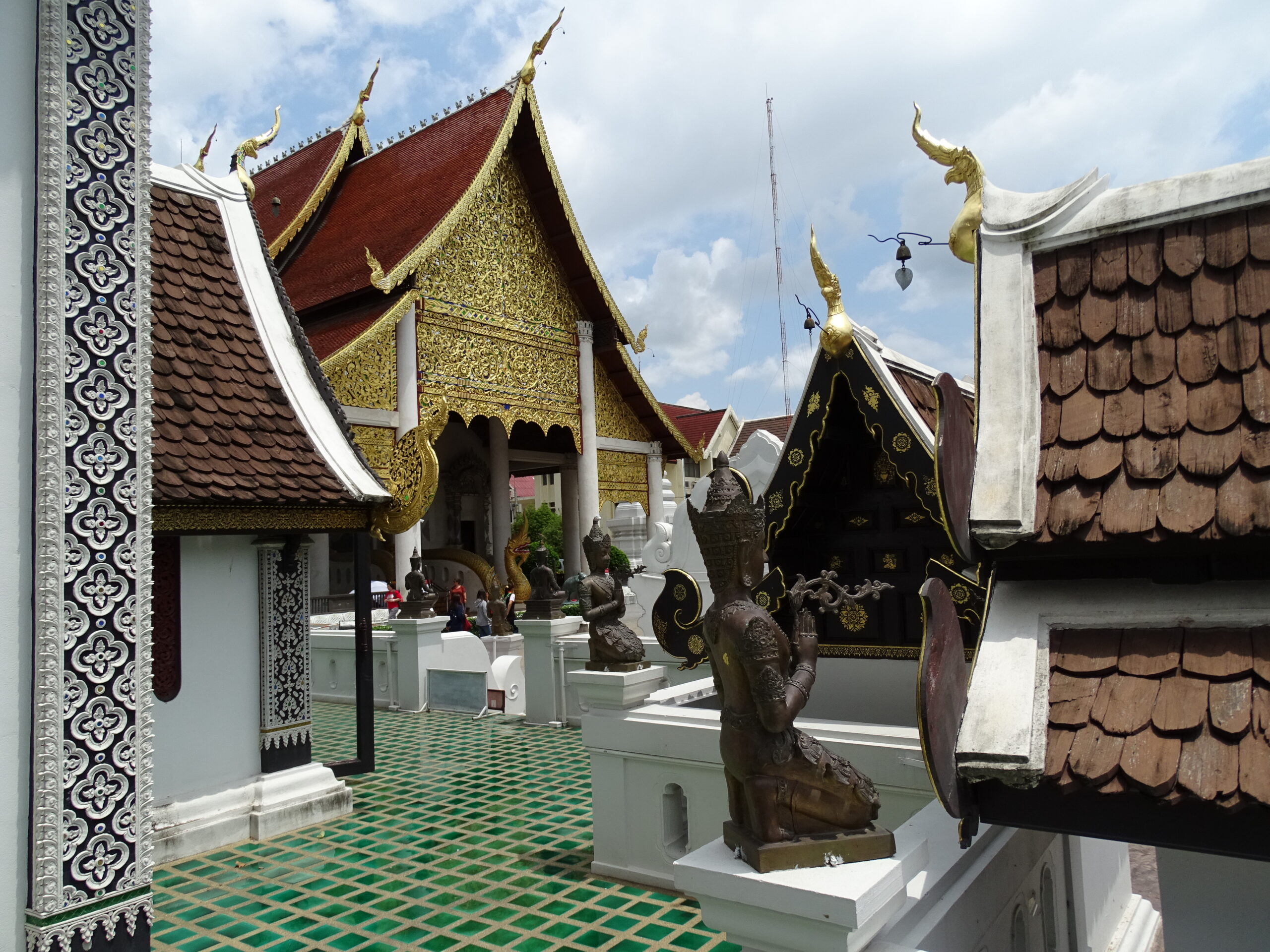
A one-and-a-half-kilometre square ringed by a moat, holding more than thirty temples. Wat Chedi Luang once had an eighty-two-metre chedi, the tallest in the kingdom, until the 1545 earthquake brought the top down: it’s stayed truncated ever since, and it’s more striking for it than it would be whole. The Emerald Buddha now in Bangkok sat here for eighty years. Wat Phra Singh has the most beautiful wooden hall, Wat Chiang Man is the oldest.
Many temples run monk chats: small tables where young monks studying English talk with visitors. It’s free, and it’s just as useful for them as it is for you.
5 – Doi Suthep and the mountain
Day 5, afternoon · Entry 30 baht · Red songthaew, about 200 baht return

Wat Phra That Doi Suthep sits at 1,070 metres, fifteen kilometres above the city: three hundred and six steps flanked by naga serpents, and at the top a golden terrace overlooking the whole plain. Legend says that in 1383 a Buddha relic split in two, and to decide where to house one half they loaded it onto a white elephant and let it roam free: the animal climbed up here, turned around three times, and died.
Anyone who fancies a day out of the city can add Doi Inthanon National Park, home to Thailand’s highest peak (2,565 metres), waterfalls, trails and twin chedis on the ridge. It’s a 2-3 hour round trip from Chiang Mai, and it’s the only place in the country where you’ll put on a jumper in the evening.
6 – The elephant sanctuary
Day 6 · full day · 2,500-3,000 baht · book days ahead
It’s worth being clear about this. The elephants at tourist camps who carry saddles, paint pictures or play football have been trained through a procedure called phajaan, meaning ‘to break’: the young animal is separated from its mother, restrained, and deprived of sleep and food until it stops resisting. The saddle itself damages the spine, which in elephants was never built to carry weight on its back.
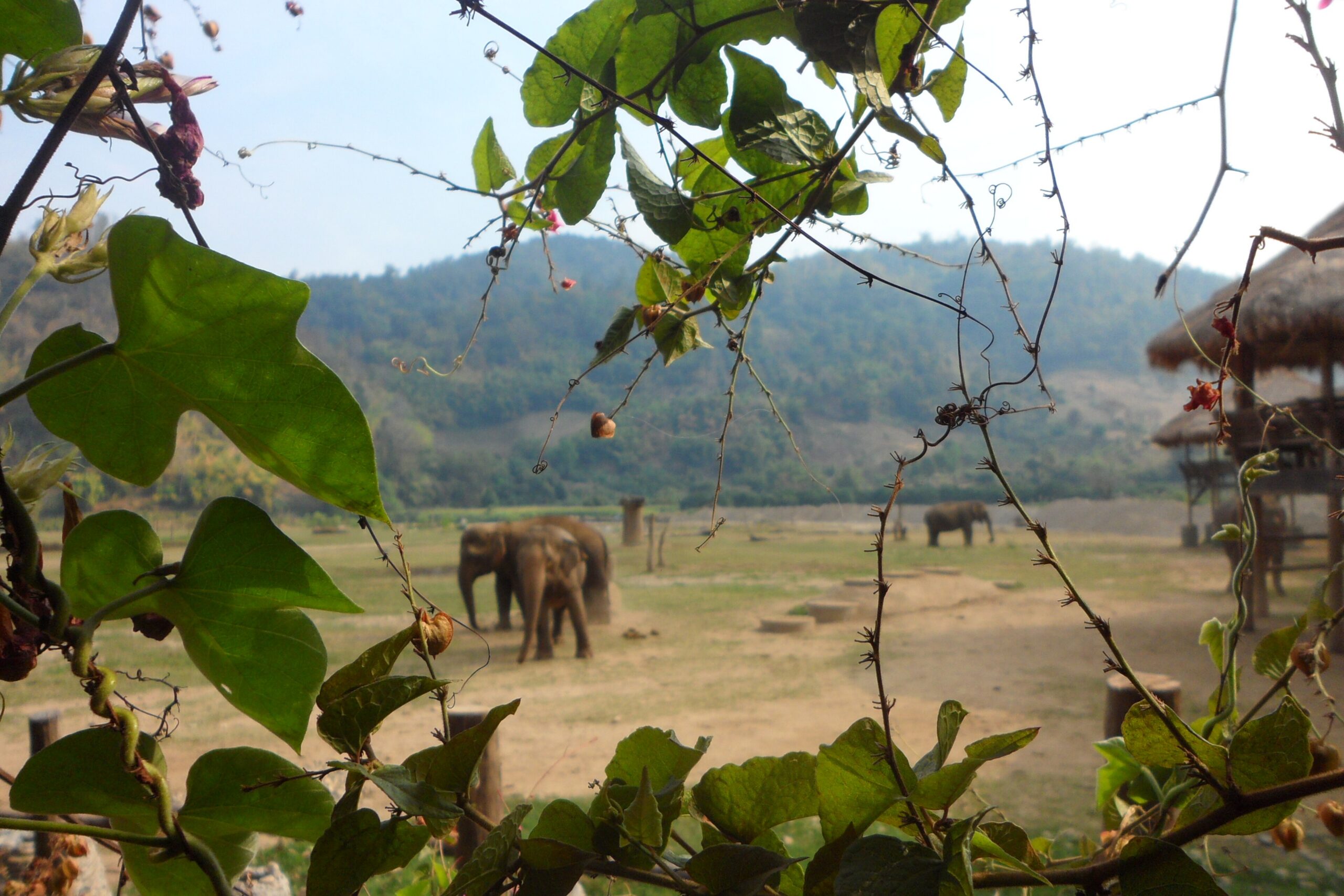
Genuine sanctuaries take in animals rescued from logging work, tourist camps and street begging. The best known is the Elephant Nature Park, an hour and a half from Chiang Mai, founded by Sangduen ‘Lek’ Chailert; there are other reputable ones in the same valley. Three questions to tell them apart: can you ride them? If yes, walk away. Are there shows? If yes, walk away. Do the animals live in a herd and can they move away from visitors? If no, walk away. At honest places you watch and walk alongside them, but you don’t climb on or bathe with them — that’s stress too. Spots are limited, so book before you leave home.
7 – Chiang Rai and the White Temple
Days 7-8 · 200 km north, 3 hours by bus · Wat Rong Khun 100 baht · better with one night on site
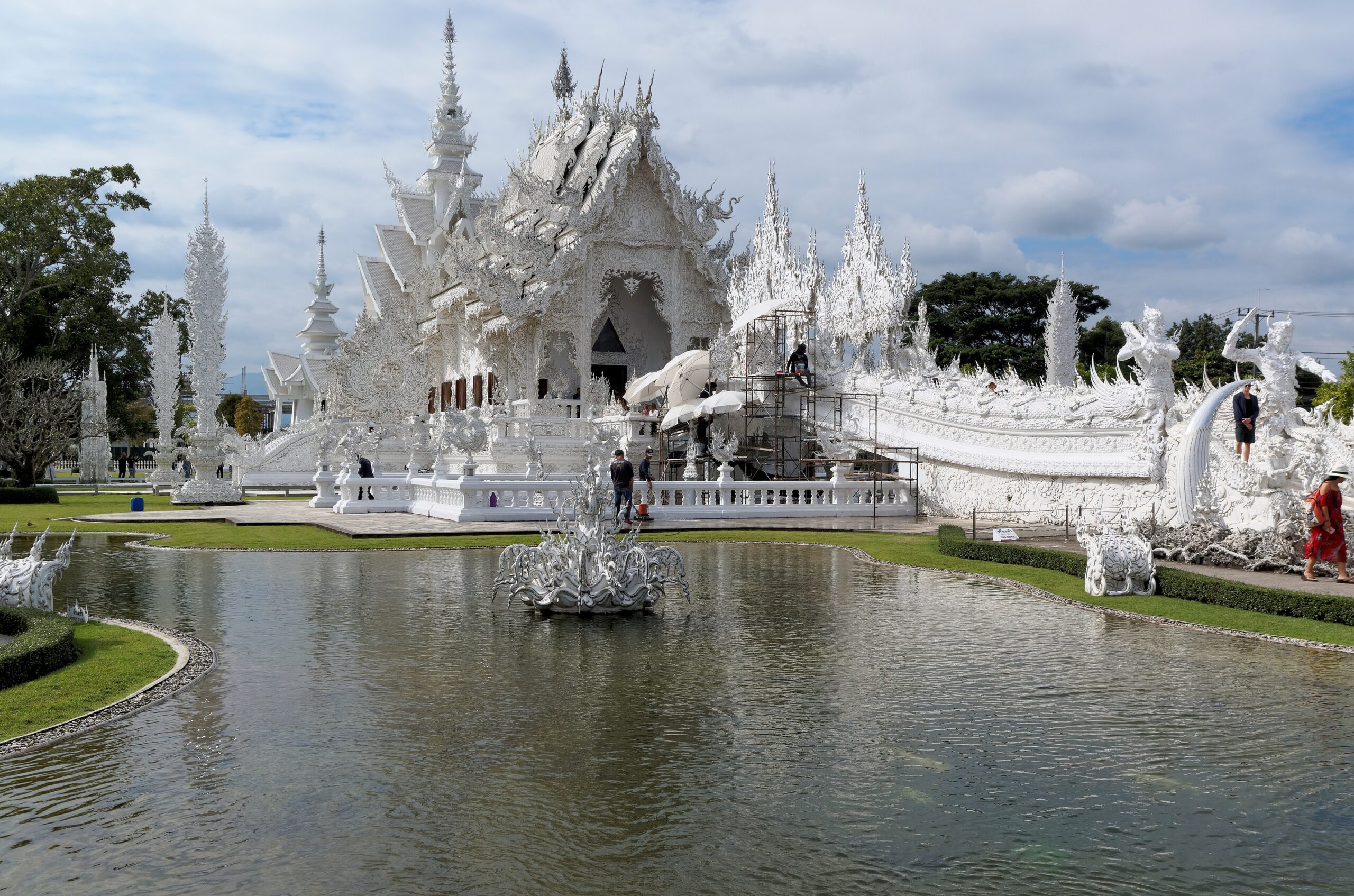
Wat Rong Khun, the White Temple, isn’t ancient: artist Chalermchai Kositpipat has been building it with his own money since 1997, turning down public donations because, he says, whoever pays wants to call the shots. He’s stated it will be finished around 2070, long after his death, and he’s already trained the students who will carry it on.
It’s all white with inlaid mirror glass: white stands for purity, the mirrors for reflected wisdom. To go in you cross a bridge over a sea of outstretched hands rising from the ground — souls in hell — and the message is that you escape desire by moving forward without looking back. Inside, the murals mix Buddhist iconography with pop culture: the burning Twin Towers, Neo from The Matrix, Superman, Hello Kitty — a deliberate choice, since the temple is talking about contemporary attachment using today’s images. The golden building next door, which looks like the most sacred one, is actually the public toilets: gold stands for the body, white for the mind.
In the same area you’ll find the Blue Temple (Wat Rong Suea Ten), built by one of the same artist’s students, and Baan Dam, Thawan Duchanee’s ‘black house’: forty dark pavilions filled with hides, bones and horns, the exact reverse of the White Temple.
Chiang Rai can be done as a day trip from Chiang Mai, but that’s six hours on a bus there and back. With two weeks it’s better to spend a night and take it easy: the town is small, has a good night market, and from there you can reach the Golden Triangle, where Thailand, Laos and Myanmar meet on the Mekong.
Days 9-11 — Krabi, Railay and the islands
Flight Chiang Mai–Krabi, 2 hours · 3 nights · long-tail boats
8 – Railay
Days 9-10 · Boat 100-150 baht from Ao Nang · There’s no road: you can only arrive by sea

Railay isn’t an island but a peninsula cut off by sheer cliffs, reachable only by long-tail boats, the wooden boats with a car engine and a propeller at the end of a long pole. Four beaches linked by paths: Railay West for the sunset, and Phra Nang, the most beautiful, with the Princess Cave shrine at its far end, where fishermen leave phallus-shaped offerings for a good catch.
The cliffs above the beach are among the most famous sport climbing spots in the world: over seven hundred bolted routes, and schools running half-day courses for beginners. With two weeks, this is one thing well worth adding.
9 – Island-hopping by boat
Day 11 · 800-1,500 baht · National park fee 400 baht extra
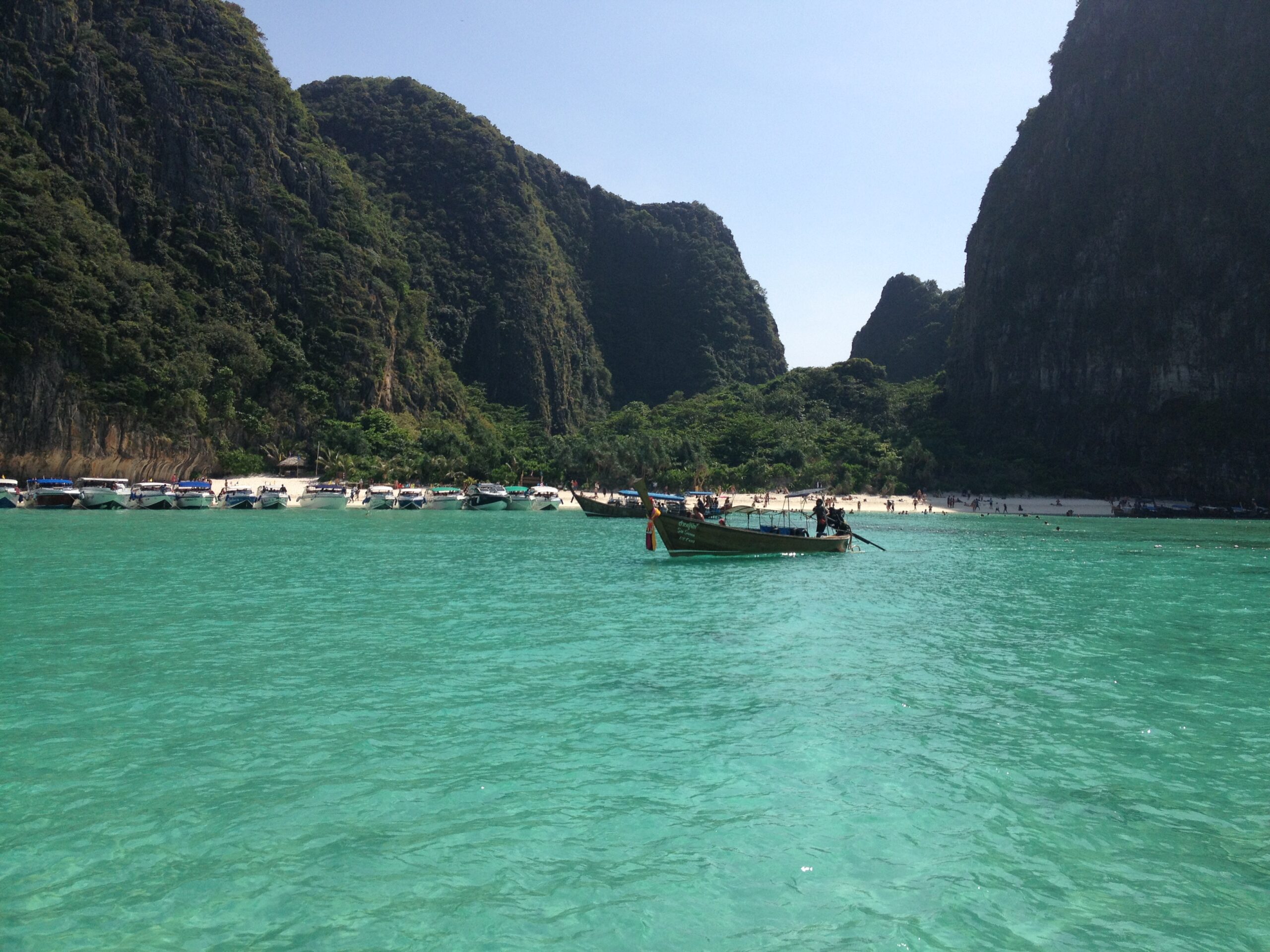
Two options. The Phi Phi islands are the famous ones, home to Maya Bay, the bay from The Beach: it was closed from 2018 to 2022 because mass tourism had killed eighty per cent of the coral, and it reopened with a visitor cap, a ban on boats inside the bay, no swimming, and a total closure between August and September. The Hong Islands and the Four Islands, closer to Krabi, are less famous and less crowded: lagoons enclosed by rock, and the Koh Tup sandbar, the strip of sand that at low tide links two islands on foot.
Choose the small long-tail boats over the speedboats: they cost less, go slower, and can reach places the others can’t. Check whether the national park fee is included: often it isn’t.
Days 12-13 — Koh Lanta, to stand still
Ferry from Krabi, 2 hours · 2 nights · nothing to see, and that’s the point

After eleven days of temples, ruins, mountains and boats, Koh Lanta is where you stop. It’s a long, narrow island two hours by ferry from Krabi, with a single road running along the west coast and a string of beaches one after another: Klong Dao further north and handiest for families, Klong Khong in the middle with bars right on the sand, Kantiang Bay to the south, the most beautiful and the most isolated. The sun sets over the sea from every one of them.
There’s nothing to visit, and anyone who comes here knows it. The only two things worth a trip are the old town on the east coast — a row of wooden houses on stilts over the water, once a Chinese trading port, still home to the chao ley, the ‘sea gypsies’ — and Mu Koh Lanta National Park at the southern tip, with its lighthouse, a forest trail, and monkeys that steal anything not zipped into a backpack.
To get around, rent a scooter (250-300 baht a day). If you’ve never ridden one before, this isn’t the place to learn: the road is narrow, there are potholes, driving is on the left, and scooter accidents are the number one cause of serious trouble for travellers in Thailand. Check your insurance covers you too: many policies exclude two-wheelers without the right licence.
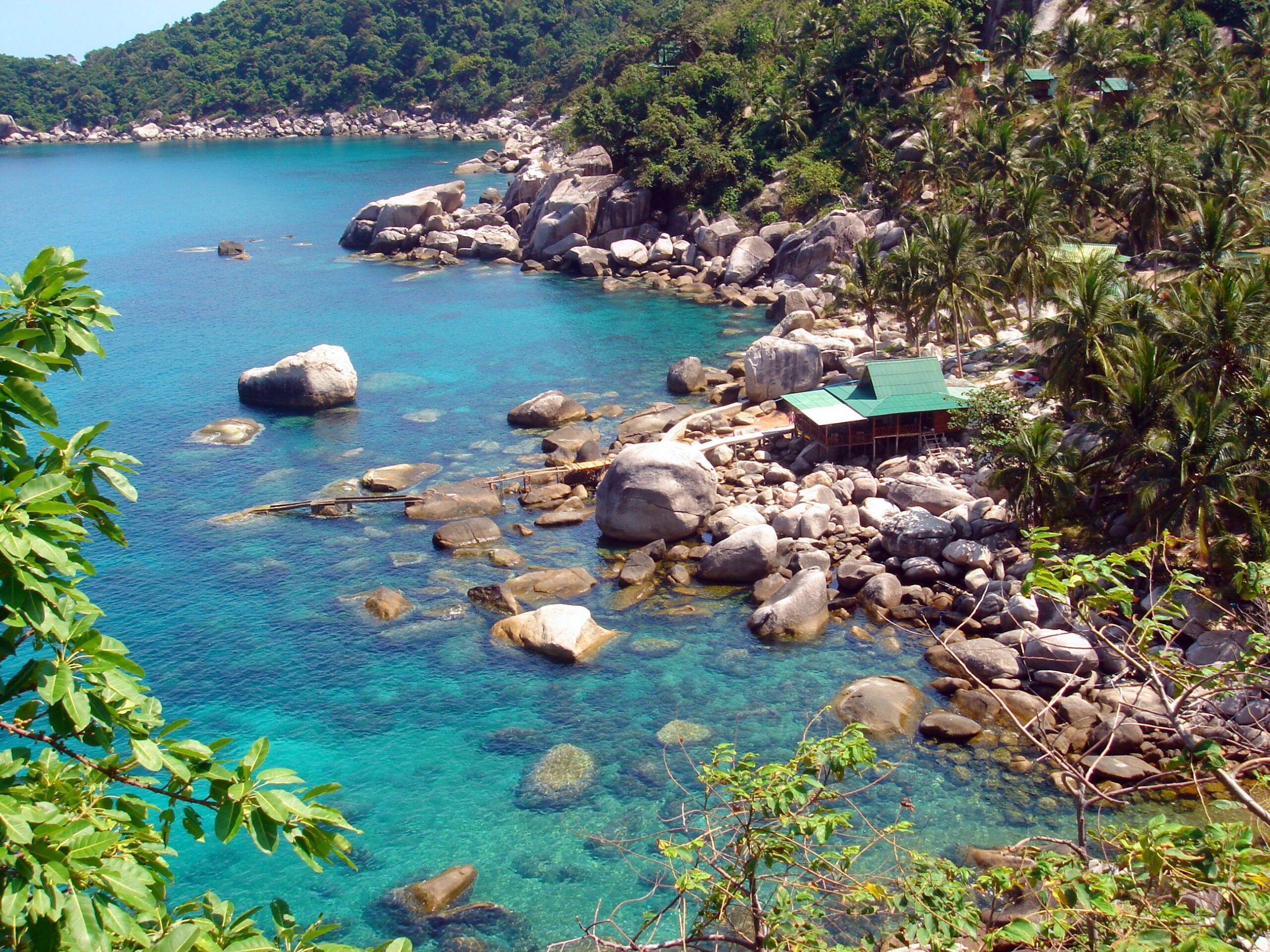
Se più che la spiaggia vi interessa il mondo sott’acqua, l’alternativa è Koh Tao, nel golfo dall’altra parte del paese: è uno dei luoghi dove si rilasciano più brevetti subacquei al mondo, perché l’acqua è calma e poco profonda e un corso base costa attorno agli 11.000 baht, meno che ovunque altrove. Attenzione però: cambia tutta la logistica, perché sta sull’altro versante dell’istmo — da Krabi sono un pullman fino a Chumphon e poi un traghetto, quasi una giornata — e le due coste hanno stagioni delle piogge sfasate: quando il mare delle Andamane è calmo, il golfo può non esserlo, e viceversa. Se ci tenete, costruite l’itinerario su quello.
Day 14 — Khao Sok, the jungle
2-3 hours from Krabi or Koh Lanta · 1-2 nights · floating huts on the lake
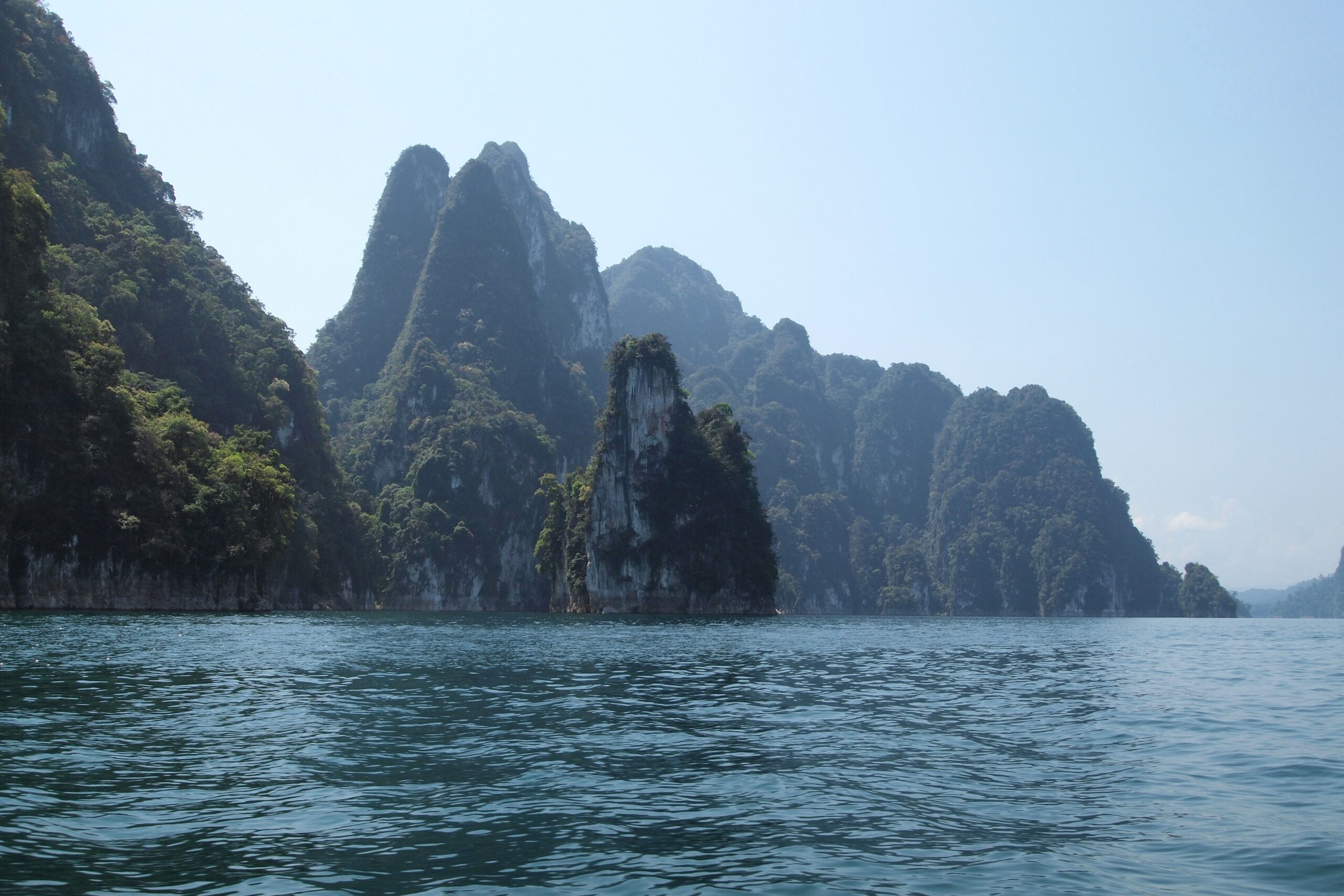
Khao Sok National Park is the piece that never fits into a single week, and it’s the best reason to have two. The rainforest covering it is older than the Amazon: around one hundred and sixty million years, because this area was untouched by the ice ages. It’s home to wild elephants, gibbons, tapirs and Rafflesia kerrii, the world’s largest flower — eighty centimetres across, with no leaves or roots, blooming for just a few days and smelling of rotting meat.
The highlight, though, is Cheow Lan Lake, which isn’t natural: it was created by a dam in 1987, and as the valley flooded, the tops of the karst formations were left poking through. The result is limestone pillars up to nine hundred metres tall rising out of emerald-green water, in a landscape that looks like it belongs to another geological era. You reach it by long-tail boat from the dam.
The thing to do is sleep in a floating hut: wood or bamboo structures anchored to the cliffs, with no electricity for most of the day, no wifi, and the generator switching off around 10pm. You sleep on the water, wake up to mist drifting between the pillars and the call of the gibbons, which starts at dawn and is one of the most beautiful sounds you’ll hear in Asia. Book ahead, since spots are limited.
Khao Sok sits halfway between the islands and the airport: Surat Thani has flights to Bangkok, so you can close the loop from here without backtracking. Bring insect repellent and closed shoes: in the wet season there are land leeches, which aren’t dangerous but are annoying.
What two weeks cost
| Voce | Costo |
|---|---|
| Treno notturno Bangkok–Chiang Mai (2a classe con aria condizionata) | 800-1.500 baht, 21-40 euro |
| Volo Chiang Mai–Krabi | 50-90 euro |
| Alloggio, 13 notti | 300-700 euro |
| Ingressi (templi di Bangkok, Ayutthaya, nord, Tempio Bianco) | circa 2.600 baht, 68 euro |
| Santuario degli elefanti | 2.500-3.000 baht, 65-80 euro |
| Corso di cucina a Chiang Mai | 800-1.200 baht, 21-32 euro |
| Gita in barca alle isole | 800-1.500 baht, 21-40 euro |
| Khao Sok: capanna galleggiante e barca, 2 notti | 3.000-5.000 baht, 79-131 euro |
| Trasporti locali (pullman, traghetti, songthaew, scooter) | circa 120 euro |
| Pasti, 14 giorni mangiando soprattutto in strada | 140-280 euro |
| Totale in loco | circa 900-1.600 euro a persona |
Figures as of September 2026, intercontinental flight excluded. Payment is in baht, at an exchange rate of around 38 to the euro. The same two weeks can be done for 700 euros staying in guesthouses, or for 3,000 in resorts: Thailand adapts to any budget, and almost nothing is fixed except transport. You’ll need cash for markets, songthaews and boats; the ATM fee is a flat 220 baht, so it pays to make fewer, larger withdrawals.
La temperatura sta fra i 30 e i 38 gradi con umidità alta quasi tutto l’anno, e rovine e templi non hanno ombra. La giornata funziona spaccata in due: fuori dalle 7 alle 11, riposo o museo o massaggio nel primo pomeriggio, fuori di nuovo dalle 16. Da maggio a ottobre piove quasi ogni giorno, ma quasi sempre a rovesci di un’ora nel pomeriggio, e i prezzi scendono molto. Il periodo peggiore per il nord è marzo-aprile: bruciano le stoppie e la qualità dell’aria a Chiang Mai diventa fra le peggiori del mondo. Se il vostro viaggio cade in quei mesi, spostate il peso sul sud.
Frequently asked questions
Is two weeks enough for Thailand?
Yes, and it’s the right amount of time: you see the capital, take the north at an easy pace, and cover the Andaman coast and the jungle without rushing, with just one domestic flight. What’s left out is the Gulf (Koh Tao, Koh Samui, Koh Phangan), Isaan in the northeast — the poorest and least-visited region, with its Khmer temples — and the Golden Triangle.
Is the night train or the plane better?
With two weeks, the night train: it’s twelve hours, but you sleep through it, save a night’s hotel bill, and waking up among the rice paddies makes the trip worth it on its own. It costs 800-1,500 baht in second class with air conditioning. The lower berths are wider and have a window: they sell out weeks ahead, so book as soon as you have your dates. For Chiang Mai–Krabi, though, flying is the only sensible option: by train and bus it would take two days.
When’s the best time to go?
November to February: dry season, bearable heat, calm seas on the Andaman coast. March-April is the hottest stretch, and the north has its agricultural burning season. June to October is the rainy season: it’s much cheaper, everything is green, and the rain comes in short downpours — but the sea can get rough and the odd boat trip gets cancelled. The two coasts have offset seasons: when it’s raining on one, it’s often dry on the other.
How do you recognise a genuine elephant sanctuary?
Three questions. Can you ride them? If yes, it’s not a sanctuary. Are there shows — elephants painting, playing football, doing tricks? If yes, no. Do the animals live in a herd and can they move away from visitors? If no, no. At honest places you watch, you walk alongside the elephants, sometimes you help prepare their food; you don’t climb on them or bathe with them, because that’s stress too. Spots are limited and are booked before departure.
Is it worth sleeping in a floating hut at Khao Sok?
Yes, and it’s one of the things that makes two weeks genuinely different from one. You sleep on a wooden structure anchored to a limestone cliff, with no electricity for most of the day and no wifi, and at dawn you hear the gibbons calling. There are few places to stay and they book up ahead; bring repellent and closed shoes, since the wet season brings out land leeches.
Can you ride a scooter?
You can, and it’s the best way to get around the islands, but it has to be said that scooter accidents are the number one cause of serious trouble for travellers in Thailand: narrow roads, potholes, driving on the left. If you’ve never ridden one before, this isn’t the place to learn. Check your insurance too: many policies don’t cover two-wheelers without the right licence, and an international driving permit is formally required.
How much does the whole trip cost?
Between 900 and 1,600 euros per person on the ground for fourteen days, intercontinental flight excluded. Eating on the street costs very little (50-80 baht a dish); the biggest expenses are accommodation, the domestic flight, the elephant sanctuary and Khao Sok. You’ll need cash: cards aren’t used at markets, on songthaews or on boats.
How should you dress for temples?
Shoulders and knees covered, men included, and shoes off before entering buildings. Never point the soles of your feet toward an image of the Buddha: sit with your legs folded to the side. Women don’t touch a monk and don’t hand him anything directly. At the Grand Palace they’ll lend you a sarong, but not always elsewhere: it’s worth always having something in your bag.
Can you drink the tap water?
No, drink bottled water (10-15 baht), and many hotels have refill stations for water bottles. Ice, on the other hand, is safe: in Thailand it’s produced industrially from purified water, and it’s the kind with a hole in the middle. For street food, the rule of thumb is turnover: where there’s a queue, you can eat without worrying.
Do you need a visa? And vaccinations?
Italian citizens don’t need a visa for short tourist stays: a passport valid for at least six months and a return ticket. The rules on length of stay have changed several times: check the embassy website before leaving, along with any digital entry form required. No vaccination is mandatory; hepatitis A and typhoid are generally recommended. Dengue is present, spread by a mosquito that bites during the day, so repellent matters. Get travel health insurance.
What’s the most common mistake, even with two weeks?
Adding stops instead of adding time. With fourteen days the temptation is to squeeze in the Gulf, Isaan or Laos too: the result is spending half the trip in transit. Five bases in two weeks is already the reasonable maximum, and whoever sticks to four is better off than whoever does six.
September 11, 2026