

Stockholm in 1 day: the Old Town, the Vasa and sunset from Södermalm
Stockholm is built on fourteen islands at the point where Lake Mälaren drains into the Baltic, and the first thing you understand on arriving is that here water isn’t scenery: it’s the connective tissue. You get around by crossing bridges, you’re always looking across at something, and the historic centre is an entire island. A single day fits the three things no other place has in quite the same way: a medieval old town you can walk across in twenty minutes, a seventeenth-century warship pulled up intact from the bottom of the harbour, and a neighbourhood atop a cliff from which you see everything else.
At a glance
- Duration · a full day, from 9am to 9pm
- How much walking · about 8 km, with two short climbs and a stretch by ferry
- Book ahead · the Vasa Museum, which has long queues in summer: an online ticket skips the line
- Budget · SEK 700-1,100 per person, excluding lodging — around €60-95
- Starting point · Gamla Stan, the old town
- Ending point · Monteliusvägen in Södermalm, at sunset
- Good to know · cash isn’t used in Sweden: many museums, bars and ferries simply don’t accept it. You’ll need a card
- What’s left out · City Hall, Skansen, the archipelago and the painted metro: that’s day two and three
Between stop 3 and 4 it’s worth taking the ferry: it costs the same as a metro ticket and is the best view of the day.
Morning — The old town on the island
2.5 km · 3 stops · 9:00 am to 1:00 pm · all on foot
1 – Gamla Stan and Stortorget
Time 2 hours · Free · Metro Gamla Stan, or a 10-minute walk from the central station

You start at Gamla Stan, which is an island: Stadsholmen, the island of the city. Stockholm was born here in 1252, when Birger Jarl had a fortress built at the narrowest point between the lake and the sea to control who passed through. The name probably means “island of the logs,” after the stakes driven into the seabed to block the channel. For five centuries the city was entirely contained here, and the layout hasn’t changed: crooked alleys, courtyards, and houses leaning against one another because space had already run out by the sixteenth century.
The centre is Stortorget, the main square, with the red, ochre and green façades that end up on every postcard. It’s also where the worst thing in Swedish history happened: in November 1520, the newly crowned Danish king Christian II had about ninety nobles, bishops and Stockholm burghers arrested and beheaded here in the square over the course of two days. It’s the Stockholms blodbad, the Stockholm Bloodbath. The reaction led to Gustav Vasa’s revolt, independence from Denmark and the birth of modern Sweden: in a sense, the country begins in this square. On the red façade at number 20 there are eighty-two white stones set into the wall: tradition says they’re one for every head that fell.
From here you wander without an itinerary, which is the right way to do it. Things to look for: Mårten Trotzigs gränd, the narrowest alley in the city, ninety centimetres between two walls, with a staircase in the middle; the Storkyrkan, the cathedral, home to Bernt Notke’s Saint George and the Dragon, a 1489 wooden sculpture as large as a real equestrian group, and the Vädersolstavlan, the oldest painting depicting Stockholm, painted in 1535 to record a strange solar halo phenomenon seen over the city; and the Tyska kyrkan, the German church, a reminder of how Hanseatic the city once was.
Gamla Stan is also the most touristy part of Stockholm: the main street, Västerlånggatan, is a row of shops selling plush moose. Just turn down any side street and it all disappears.
2 – The Royal Palace and the changing of the guard
Time 1.5 hours · Admission about SEK 200, includes four museums · 5-minute walk

The Kungliga slottet has more than six hundred rooms and is the largest royal palace in Europe still used as a head of state’s working residence. From outside it looks like a barracks: it’s Italian Baroque, willed into being by Nicodemus Tessin the Younger, all rigour and no flourish, and that’s deliberate — it was meant to resemble a Roman palace, not a Nordic castle.
Its predecessor, the Tre Kronor castle, burned down in 1697. The new palace took sixty-three years to build, because in the meantime Sweden lost the Great Northern War and the money ran out: the royal family moved in only in 1754. Inside, with the same ticket, you see the state apartments, the treasury with the royal regalia in the cellars, the Tre Kronor Museum in the medieval foundations that survived the fire, and the armoury, which is the part not to skip: it holds the clothes Swedish kings were wearing when they died, including the mud-stained one worn by Gustav II Adolf at Lützen and the one with the bullet hole from Gustav III, killed at a masked ball at the Opera in 1792 — the story Verdi drew on for Un ballo in maschera.
The changing of the guard takes place in the outer courtyard: daily from mid-April to the end of August, and on Wednesdays, Saturdays and Sundays the rest of the year. It’s usually at 12:15pm on weekdays and 1:15pm on Sundays, but the times change with the season: check the day before. On big days it arrives with a mounted band and lasts forty minutes.
3 – Riddarholmen, the island of knights
Time 30 minutes · Free (the church has a separate ticket) · 8-minute walk

A pedestrian bridge leads to Riddarholmen, a little island attached to Gamla Stan that’s something of a ghost neighbourhood: seventeenth-century noble palaces now occupied by law courts, no shops, almost no one around. The silence feels unreal just two hundred metres from the crowds.
The Riddarholmskyrkan, with its pierced cast-iron spire visible from half the city, is Stockholm’s oldest building: it was a Franciscan church from the late thirteenth century. Since the seventeenth century it has been the mausoleum of Sweden’s kings: Gustav II Adolf, Charles XII, and practically everyone up to 1950 are here. It’s no longer an active church, just a burial site and a museum.
The real reason to come here, though, is the quay behind it, facing west. From there you look out over the Riddarfjärden, the inner bay, with City Hall on the right and Södermalm rising on the left: it’s the classic view of Stockholm, one worth taking in twice, because tonight you’ll see it again from the other side.
In Svezia il pranzo nei giorni feriali funziona così: quasi tutti i locali fanno la dagens lunch, il piatto del giorno, servita all’incirca fra le 11 e le 14, che comprende il piatto, insalata a volontà, pane, burro e caffè, a 130-160 corone — cioè metà di quello che la stessa cucina costa la sera. È il modo per mangiare bene a Stoccolma senza spendere: pranzare bene e cenare leggeri è una scelta che qui ha senso economico. Cose da provare: le köttbullar, le polpette con puré, salsa e marmellata di mirtilli rossi, che sono una cosa seria e non un piatto dell’IKEA; la toast Skagen, pane tostato con gamberetti, aneto e maionese; il salmone in tutte le forme, e d’estate il sill, l’aringa marinata. Il giovedì mezza Svezia mangia zuppa di piselli gialli e frittelle: è un’usanza militare del Cinquecento, ed è sopravvissuta. E poi c’è la fika, la pausa caffè con qualcosa di dolce, che non è uno spuntino ma un’istituzione sociale: il dolce da chiedere è il kanelbulle, il rotolo alla cannella e cardamomo.
Afternoon — Djurgården and the ship that wasn’t supposed to sink
3 km · 2 stops · 2:00 pm to 6:00 pm · ferry plus a walk
4 – The Vasa Museum
Time 2 hours · Admission about SEK 220, free under 18 · Ferry from Slussen or Gamla Stan, 15 minutes

If there’s one thing to see in Sweden, this is it. The Vasa was the most powerful warship ever built for the Swedish navy: sixty-four cannons on two decks, commissioned by Gustav II Adolf while he was at war with Poland. On 10 August 1628, launch day, it sailed out of Stockholm harbour with flags flying and crowds on the quays. It travelled thirteen hundred metres. A gust of wind tipped it over, water poured in through the gun ports left open for the salute, and the ship sank in front of everyone, with about thirty dead.
It was too tall and too narrow, with too much weight up top and too little ballast; the inquiry closed without finding anyone guilty, because the proportions had been approved by the king himself. The Vasa lay on the harbour floor for 333 years, at a depth of thirty-two metres, and this is where luck steps in: the Baltic’s water is low in salt, and the teredo navalis, the worm that devours wood in warmer seas, cannot live there. When it was raised, in 1961, the ship was practically intact.
What you see today is 98 percent original wood: a sixty-nine-metre vessel, with seven hundred wooden sculptures — lions, Roman emperors, mermaids, a putto riding a sea monster — that were once painted in bright colours and gilded, floating political propaganda. The museum is built around the ship across six levels, so you view it from keel to crow’s nest. There are also the skeletons of people who died on board, with reconstructed faces and their stories told.
In the same area there are two more museums: the Spritmuseum, about alcohol and Sweden’s complicated relationship with it, and the Vikingaliv Museum. If you only have one day, skip them and keep the time for walking.
5 – Djurgården on foot
Time 1.5 hours · Free · Walk out of the museum and keep going

Djurgården was once the kings’ hunting reserve — the name means “animal garden” — and has remained an almost entirely green island ten minutes from the centre, within the largest urban national park in the world, the Ekoparken, which stretches across the city for twelve kilometres. There are four-hundred-year-old oaks, a canal, meadows, and foxes you can genuinely spot at dusk.
The right walk: leave the Vasa Museum, pass the Nordiska museet — the massive brick building in Danish Renaissance style that looks like a castle and is actually the museum of everyday Swedish life — and head east along the water, past Gröna Lund, the 1883 amusement park that hosts concerts in summer, all the way to the Djurgårdsbrunn canal. From there you loop back on the inland side, through the woods. It’s about four kilometres in total and there’s nothing to visit: that’s exactly the point.
If you’d rather have a museum than the woods, there’s also ABBA The Museum here (interactive, you sing and dance, book ahead) and the Thielska Galleriet at the far end of the island, a private villa with Munch, Zorn and Carl Larsson and almost no visitors.
Evening — Södermalm and the long light
2.5 km · 2 stops · 6:00 pm to 9:00 pm · ferry and a climb
6 – Fotografiska
Time 1.5 hours · Admission about SEK 200 · Open late, usually until 11pm on weekends · Ferry or bus to Slussen

Fotografiska is a photography museum inside the former 1906 customs building on the Södermalm quay, and the only major Stockholm cultural institution that stays open in the evening: that’s exactly why it belongs here rather than midday. It has no permanent collection, running four big exhibitions a year plus a series of smaller ones: everyone passes through, from Nan Goldin to Sebastião Salgado to Annie Leibovitz.
The practical tip is to go up to the bar-restaurant on the top floor even without stopping to eat: the glass wall looks out over the harbour, Djurgården and the old town, and it’s one of the best views in Stockholm from inside a building.
7 – Monteliusvägen at sunset
Time 1 hour · Free · 20-minute uphill walk, or the Katarina lift followed by a walk
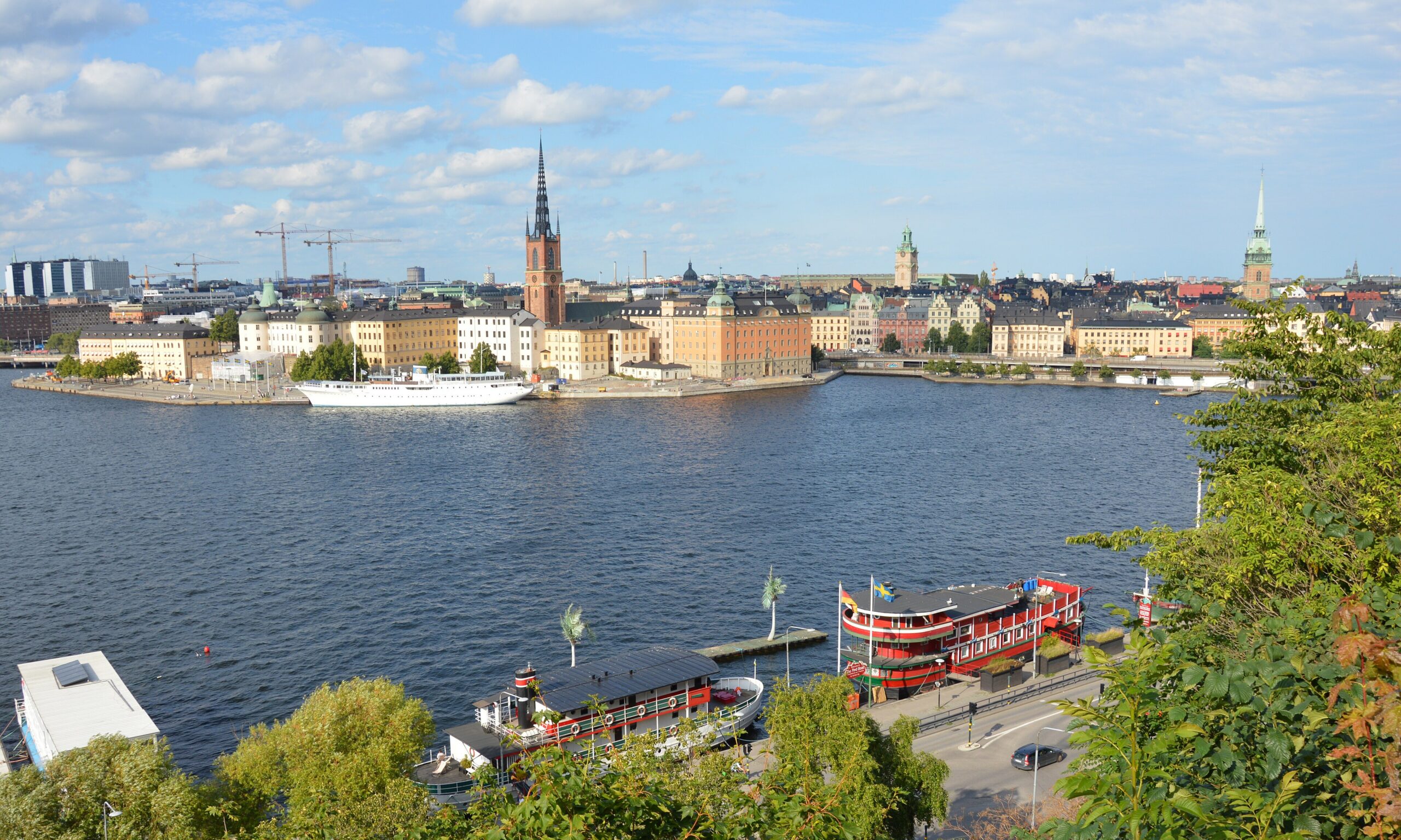
Monteliusvägen is a five-hundred-metre pedestrian path along the edge of the Södermalm cliff, with a railing, benches and wooden houses at your back. It faces north: below is the Riddarfjärden, opposite is City Hall with its tower and the three gilded crowns on top, to the right Riddarholmen and Gamla Stan. It’s the point where, after a day spent inside the old town, you see it all together from the outside.
The right time depends on the season, and in Sweden that matters a lot. In June the sun sets around 10pm and the light never really goes away: the sky stays blue all night and people stay out on the lawns until late. In December the sun goes down at 2:50pm, and sunset here is an afternoon affair, with the city lit up and candles in the windows. In the shoulder seasons the sky turns orange for a good hour.
If you have energy left, Södermalm deserves another half hour: the SoFo neighbourhood (south of Folkungagatan) with its independent shops and bars, and the Blåsüt staircase. Or head down the other side to Mariatorget and have dinner there.
La Svezia è il paese più vicino al mondo a essere davvero senza contante: molti musei, caffè, traghetti e autobus non accettano banconote per scelta, e sui negozi ci sono i cartelli «vi hanterar ej kontanter». Portate una carta di credito o di debito — ne basta una, contactless — e non cambiate corone in aeroporto. Le mance non sono attese: nei ristoranti si arrotonda e basta.
What the day costs
| Voce | Costo |
|---|---|
| Palazzo Reale (4 musei) | circa 200 corone |
| Vasamuseet | circa 220 corone |
| Fotografiska | circa 200 corone |
| Trasporti (biglietto giornaliero SL, traghetti compresi) | circa 175 corone |
| Pranzo (dagens lunch) | 130-160 corone |
| Fika e cena leggera | 150-250 corone |
| Totale | circa 1.075-1.205 corone a persona, sui 95-105 euro |
Figures as of September 2026: check them before you leave. Payment is in Swedish kronor, exchange rate around 11.3 to the euro. Stockholm isn’t a cheap capital: the way to keep spending down is to eat the dagens lunch, use the daily transport ticket (which includes the ferries to Djurgården) and take advantage of the free museums — the Nationalmuseum, Moderna Museet and Historiska museet cost nothing.
Stoccolma piove spesso e in inverno fa buio presto, quindi il piano B è una cosa seria. Il pomeriggio funziona lo stesso, perché il Vasamuseet è al coperto: si salta la passeggiata di Djurgården e si aggiunge il Nordiska museet, che è a duecento metri e ha la sala con la statua colossale di Gustavo Vasa in legno di quercia dipinto. La mattina, al posto di Riddarholmen, c’è il Nationalmuseum, che è gratuito, sta a dieci minuti a piedi da Gamla Stan e ha Rembrandt, Rubens e le stanze del design svedese. E il tramonto dal Monteliusvägen si sostituisce con il ponte panoramico dell’ascensore di Katarina, che è coperto in cima e guarda nella stessa direzione.
Frequently asked questions
Is one day enough for Stockholm?
It’s enough to get a sense of the place: the old town, the Vasa and a view from above are the bare minimum, and they fit into one day without rushing. What’s left out is a lot: the Nobel City Hall, Skansen, the painted metro and, above all, the archipelago, which is reason enough to come back.
How much does the Vasa Museum cost, and is it worth booking?
About SEK 220, free under eighteen. In summer, between 11am and 3pm, the entrance queue can exceed an hour: an online ticket with a time slot skips the line and costs the same. From September to May you get in without trouble. The museum is also open on Wednesday evenings in winter, which is the best time to see it nearly empty.
Do you need the Stockholm Pass?
Only if you’re doing at least three or four paid museums a day, which doesn’t happen with this itinerary. Do the maths on the museums you actually care about: many of the best (Nationalmuseum, Moderna Museet, Historiska) are free and don’t count toward the card’s value. The public transport day ticket, on the other hand, almost always pays for itself.
How do you get around Stockholm?
With SL, which runs the metro, buses, trams and ferries under a single ticket. The day pass costs about SEK 175, a single ticket SEK 42 and is valid for 75 minutes. You buy it via the app or with a contactless card directly at the turnstiles. The ferries to Djurgården are included, and they’re the city’s most beautiful mode of transport.
What time is the changing of the guard?
Usually at 12:15pm on weekdays and 1:15pm on Sundays and public holidays, but it varies by season and is suspended at certain times of year. From mid-April to the end of August it happens every day; the rest of the year only on Wednesdays, Saturdays and Sundays. Check the calendar on the royal household’s website the day before: it changes.
What’s the best time to come?
May to September, and June in particular, when the light never really ends and the city lives outdoors. Midsummer, the last weekend of June, is the most deeply felt holiday of the year — but be warned: that day Stockholm shuts down, Swedes head to the countryside and nothing is open in the city. December has the Christmas markets and lights but only six hours of daylight.
Can you drink the tap water?
Yes, and it’s excellent: in Sweden tap water is monitored as strictly as bottled water, and you can ask for it in any restaurant without a second thought. Buying mineral water is considered a bit odd.
Where’s the best place to stay?
Gamla Stan if you want the scenery (though rooms are small and pricey), Norrmalm near the central station for convenience, Södermalm if you prefer real neighbourhoods, local life and slightly lower prices. Stockholm is compact: from Södermalm to Gamla Stan is a fifteen-minute walk.
Is English spoken?
Everywhere, and very well: Sweden is consistently at the top of the world rankings for English proficiency among non-native speakers. You don’t need a word of Swedish, not even to read menus, which are almost always bilingual.
Alcohol: why is it so complicated?
Because in Sweden the sale of alcohol above 3.5 percent is a state monopoly: it can only be bought at Systembolaget shops, which close early, close midday on Saturdays and stay shut on Sundays. In bars and restaurants you drink normally, but prices are high: an average beer costs SEK 80-100.
September 11, 2026