Naples in 3 days: an itinerary with Pompeii and Vesuvius
Three days in Naples is the right length for a precise reason: one goes to the ancient city, one to Bourbon Naples and the hills, and the third to Pompeii, which is half an hour away by train and cannot be done in half a day. Anyone with only one day sees the centre and no more; anyone with three understands that Naples and its gulf are the same thing, and that Vesuvius is the reason both exist.
At a glance
- Length · 3 full days, 3 nights
- Best time to go · April-June and September-October
- Walking distance · between 6 and 9 km a day; more at Pompeii
- Budget · €65-100 per person per day, accommodation excluded
- To book · Sansevero Chapel and Underground Naples; Pompeii is worth booking
- Closures · the Archaeological Museum is closed on Tuesdays
- Where to stay · the old centre or Chiaia, not around the station
Three layers, one per day. The third day leaves the city: Pompeii is half an hour away by train.
Day 1 — The ancient city: the museum, the decumani, the underground
6 km · 5 stops · lunch on Via dei Tribunali · start at the Archaeological Museum
The first day follows the Greek grid of the fifth century BC, which is still the plan of the centre: three parallel east-west streets, the decumani, cut by alleys. You start at the museum that holds everything taken out of Pompeii and Herculaneum, and that has a practical advantage: anyone going to the excavations on day three arrives knowing what to look for.
1 – National Archaeological Museum
Visit 2 hours 30 · Ticket about €22 · Closed on Tuesdays
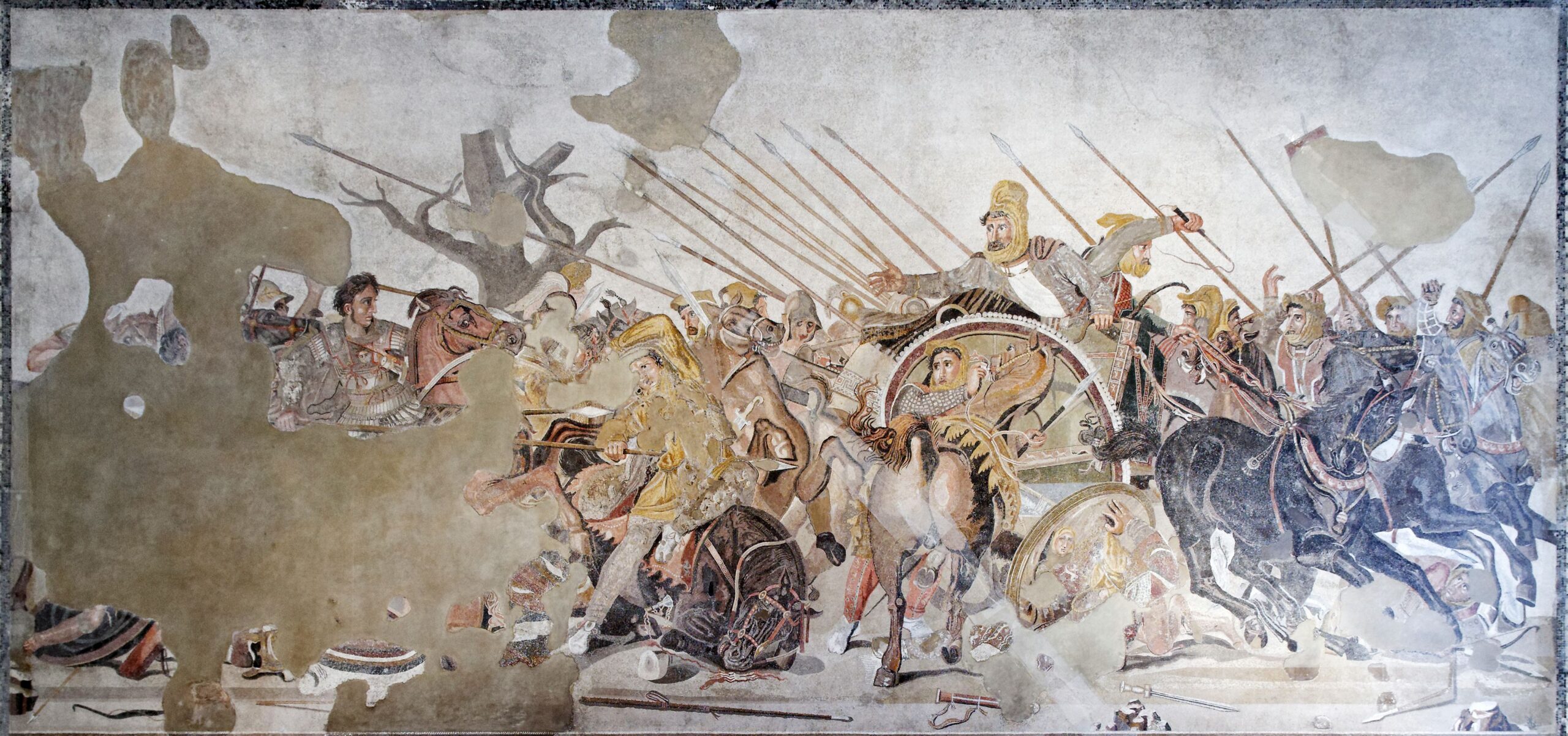
Three things not to skip. The Alexander Mosaic from the House of the Faun, ten square metres of a million and a half tesserae, showing Darius fleeing at Issus. The Farnese collection, with the Farnese Bull, the largest ancient sculptural group to reach us, carved from a single block. And the Secret Cabinet, the room of Pompeian erotic objects, walled up for nearly two centuries.
Upstairs, the cork model of Pompeii built in the nineteenth century: look at it, because in two days you will be walking through it.
2 – Via dei Tribunali, Spaccanapoli, San Gregorio Armeno
Visit 2 hours walking · Getting there 15 minutes downhill on foot · Entry free

Via dei Tribunali is the decumanus maximus; the parallel street further south, the one that slices the centre like a blade when seen from above, is Spaccanapoli — an unofficial name: on maps it is Via Benedetto Croce and then Via San Biagio dei Librai.
Between them runs San Gregorio Armeno, the street of nativity-scene craftsmen, open all year. With three days you can also go into the Pio Monte della Misericordia, which has Caravaggio’s Seven Works of Mercy in its original position over the altar, and into the Duomo, where three times a year the rite of San Gennaro’s blood takes place.
3 – Sansevero Chapel
Visit 45 minutes · Ticket about €10 · Limited entry, book ahead
Inside is the Veiled Christ by Giuseppe Sanmartino, from 1753: a body laid out under a marble veil so fine that for two centuries people believed it was a real veil petrified by alchemy. It is carved from the same block. The prince of Sansevero who commissioned it was an alchemist, a freemason and an inventor, excommunicated more than once: in the basement are his anatomical machines, two skeletons with the circulatory system preserved.
4 – Santa Chiara cloister
Visit 45 minutes · Ticket about €6 · Church free

The church was bombed in 1943 and rebuilt bare. The majolica cloister survived: sixty-six octagonal pillars covered in eighteenth-century tiles, with hunting scenes, sea scenes and everyday life, and a garden of orange trees in the middle. It is the quietest place in the centre.
5 – Underground Naples
Visit 1 hour 30 · Ticket about €12 · Guided only, fixed departures
Forty metres below the city is a second Naples carved out of tuff: Greek quarries, then cisterns of the Roman aqueduct, then air-raid shelters where thousands lived during the war — the toys and the beds are still there. The tour passes through a tunnel half a metre wide, walked sideways with a candle, and ends inside a Roman theatre beneath a private flat.
Lunch · Via dei Tribunali, where the historic pizzerias are: at midday they are half empty and the pizza is the same one you would queue an hour for in the evening.
Dinner · the old centre again, or the Pallonetto di Santa Lucia if you want to head down towards the sea.
Day 2 — The Bourbons, the charterhouse and the sea
7 km · 4 stops · up to the Vomero by funicular and back down on foot

The second day belongs to the monumental city and the hills. You start low, go up by funicular for the best view of the gulf, and come down to the sea for sunset.
1 – Piazza del Plebiscito and the Royal Palace
Visit 2 hours with the palace · Square free, palace about €10
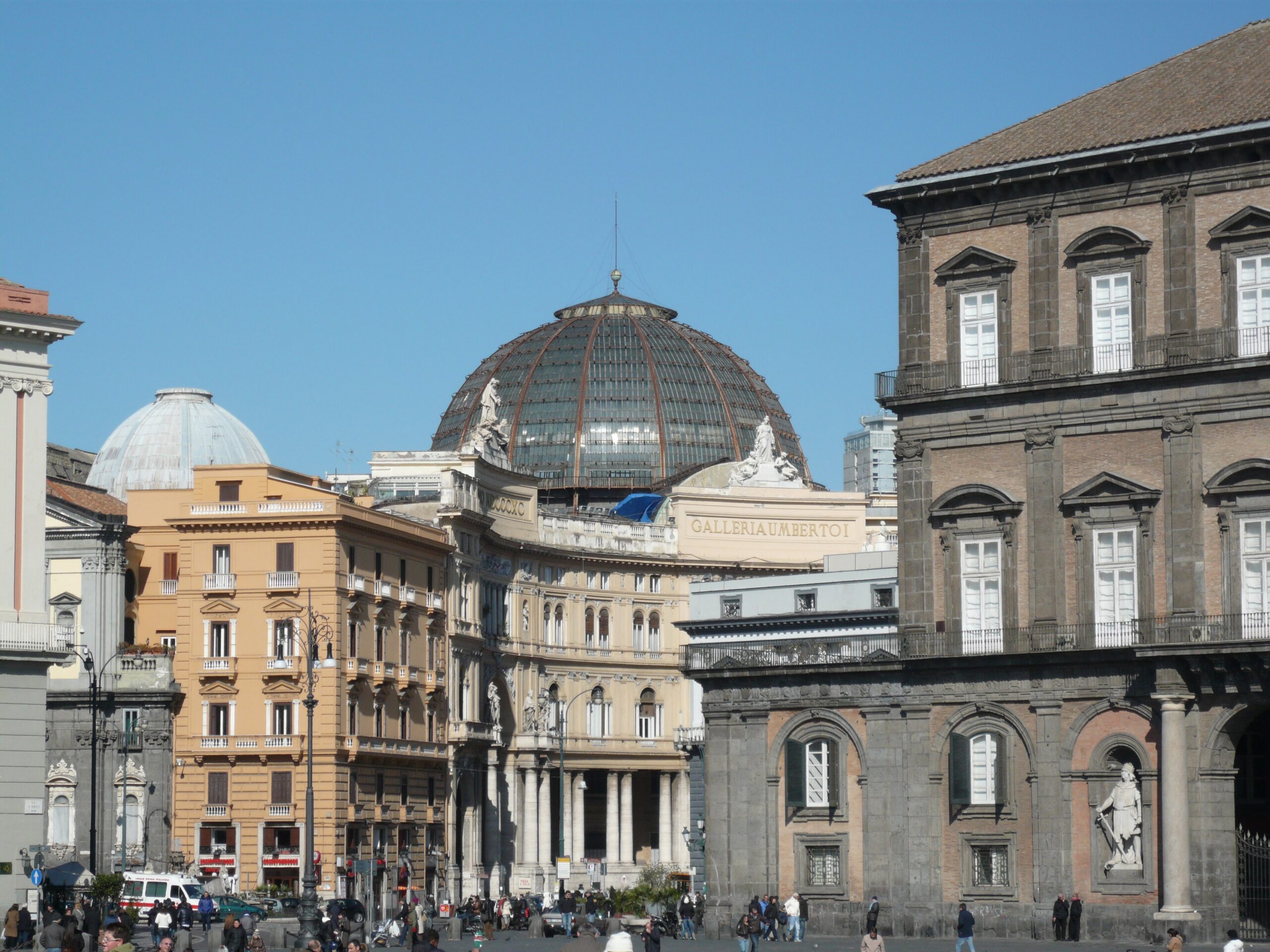
The square is a semicircle of columns with the basilica of San Francesco di Paola on one side and the Royal Palace on the other. Inside the palace you can see thirty rooms with the ceremonial staircase, the court theatre and the national library, which holds the carbonised papyri from Herculaneum.
2 – Galleria Umberto I and Teatro San Carlo
Visit 1 hour 30 with the theatre tour · Galleria free, theatre about €12
The Galleria Umberto I, from 1890, has an iron and glass dome fifty-seven metres high. Opposite it, the Teatro San Carlo: opened in 1737, it is the oldest working opera house in Europe, forty years older than La Scala. It is visited with a guide, and it is worth going into the auditorium to see the red and gold of the six tiers of boxes.
3 – San Martino charterhouse and Castel Sant’Elmo
Visit 2 hours 30 · Getting there funicular from Via Toledo, 5 minutes · Ticket charterhouse about €6, castle separate
You go up to the Vomero on the Centrale funicular, included in the city ticket. The San Martino charterhouse is a seventeenth-century monastery with cloisters, a baroque church and above all the nativity section: the eighteenth-century Cuciniello crib is an entire landscape with hundreds of figures, and it is why Neapolitans bring their children.
From the charterhouse terraces you see the whole gulf, with Vesuvius opposite and the city below. Fifty metres away, Castel Sant’Elmo has a 360-degree terrace, the highest viewpoint in Naples.
4 – Castel dell’Ovo and the seafront
Visit 2 hours with the sunset · Getting there funicular and 15 minutes on foot · Entry free
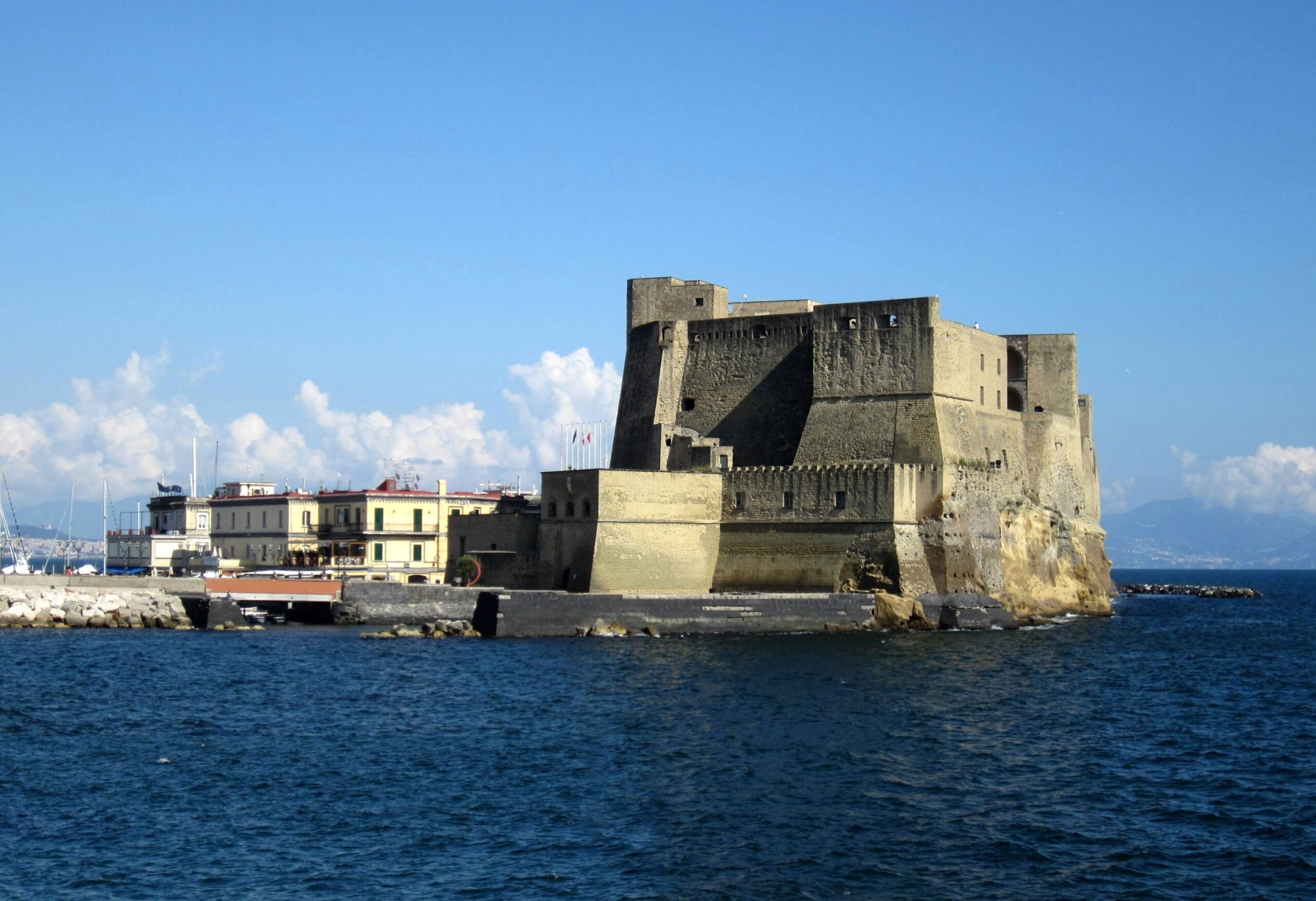
Castel dell’Ovo stands on an islet linked by a bridge, where the Greek colonists landed and founded Parthenope. The name comes from a legend about Virgil, who is said to have hidden a magic egg in the foundations: as long as the egg holds, Naples holds. Entry is free and you can climb to the terrace at the top.
Below is the Borgo Marinari, with restaurants on the water, and from there runs the Lungomare Caracciolo, closed to traffic and two and a half kilometres long: it is where Neapolitans walk.
Lunch · on the Vomero, around Via Scarlatti, where the residents eat and prices are those of a normal city.
Dinner · Chiaia or Borgo Marinari if you want the sea; the old centre if you would rather spend less.
Day 3 — Pompeii, Vesuvius or Herculaneum
A full day out of the city · Circumvesuviana train from Piazza Garibaldi · choose one of the three

The third day leaves the city, and there are three quite different options. The Circumvesuviana leaves from the lower level of Piazza Garibaldi station and is a slow, crowded local train, but it is the only cheap way: keep your bag in front and leave nothing on show.
Option A – Pompeii
Time a full day, minimum 4 hours on site · Getting there Circumvesuviana, Pompei Scavi stop, 35 minutes · Ticket about €22, booking advised
Sixty-six hectares, eight thousand inhabitants in AD 79, and a town preserved by the ash that killed it. It is not an archaeological site: it is a town where you walk down the street, go into the houses and read the election notices on the walls.
What to look for, because without a plan you get lost: the Forum with Vesuvius at the end of it, the House of the Faun which the Alexander Mosaic came from, the Villa of the Mysteries with its cycle of red frescoes just outside the walls, the Lupanar, the Stabian Baths and the Amphitheatre, the oldest known. The stretch between the Forum and the Villa of the Mysteries is long: allow four hours at least, five is better.
Bring water, a hat and solid shoes: there is no shade and the paving is uneven. In summer go at opening time.
Option B – Vesuvius
Time half a day · Getting there Circumvesuviana to Ercolano, then shuttle to the thousand-metre mark · Ticket about €10 plus shuttle, booking compulsory
From the end of the road you climb for twenty minutes on a path of lapilli to the crater rim, at 1170 metres. The crater is six hundred metres across and three hundred deep, and steam still comes out of the fumaroles. From the top you see the whole gulf, from Sorrento to Capo Miseno.
Access is capped with compulsory online booking, and it closes in bad weather or strong wind: check the day before. Bring a fleece even in summer, because it is windy at the top.
Option C – Herculaneum
Time half a day · Getting there Circumvesuviana, Ercolano Scavi stop, 20 minutes · Ticket about €16
It is much smaller than Pompeii and for many people more striking: here it was not ash but a flow of boiling mud that sealed everything, and so the upper floors of the houses, the wooden beams, the doors, the beds and even the food have survived. The houses are intact up to the mosaics on the walls.
On the ancient beach, under the arches of the boat sheds, three hundred skeletons were found: people waiting for a boat that never came. Herculaneum takes two and a half hours and combines well with Vesuvius on the same day, which Pompeii does not.
At Pompeii · there is one café inside the site, basic and expensive: better to bring something. Outside, around the station, there are normal trattorias.
Coming back · dinner in Naples, in the old centre, which after a day in the sun is welcome.
Pizza, which in Naples is not a detail

Neapolitan pizza is a regulated product: dough of flour, water, salt and yeast only, long proving, shaped by hand, baked in a wood oven at 485 degrees for sixty to ninety seconds. It comes out soft, with a puffed crust blistered black, and it folds: anyone expecting a crisp pizza will be disappointed.
The two classics are the marinara — tomato, garlic, oregano, oil, no cheese — and the margherita. In a serious pizzeria they cost between five and nine euros. With three days you can also try the fried pizza, which is another thing entirely and is eaten in the street.
Three things to know
The traffic does not follow the rules you expect. Scooters do not always stop at crossings: cross at a firm, predictable pace and the cars will slow. Stopping halfway is the most dangerous thing.
On the Circumvesuviana, bag in front and phone in your pocket. It is the train to Pompeii and Herculaneum, often crowded, and it is where pickpocketing happens. In central Naples the precautions are those of any large city.
Coffee is drunk at the counter and costs about a euro, half what it costs in the north. The caffè sospeso is the tradition of paying for an extra one for whoever comes next and cannot afford it.
What it costs
| Item | Indicative cost |
|---|---|
| National Archaeological Museum | about €22 |
| Pompeii | about €22 |
| Herculaneum, as an alternative | about €16 |
| Vesuvius, as an alternative, plus shuttle | about €10 + shuttle |
| Underground Naples with guide | about €12 |
| Teatro San Carlo, guided tour | about €12 |
| Sansevero Chapel | about €10 |
| Royal Palace | about €10 |
| San Martino charterhouse | about €6 |
| Santa Chiara cloister | about €6 |
| Transport, day ticket | about €4.50 |
| Train to Pompeii, return | about €6 |
| Lunch and dinner | €30-45 a day |
| Total per person, 3 days | about €200-300 excluding accommodation |
Reference figures as of August 2026: museums change their prices, check the official websites before you travel. Naples remains the Italian art city with the lowest cost of living.
Where to stay in Naples
The old centre, around the decumani: you are inside everything, you eat well and it costs little. In exchange it is noisy until late.
Chiaia is the elegant quarter, near the seafront and quiet: higher prices, though not as high as in other cities.
Vomero, on the hill, is residential and served by the funiculars: you sleep well and reach the centre in five minutes.
Avoid the area immediately around the central station, which is cheap for a reason.
Getting around
The old centre is walked and is almost flat. Metro line 1 is useful for coming back up from the sea and is worth taking anyway: the Toledo and Università stations are works of contemporary art, and Toledo has repeatedly been named among the finest in Europe.
For the hills there are four funiculars, included in the city ticket. The day ticket costs about €4.50 and covers metro, funiculars and buses.
For Pompeii and Herculaneum you use the Circumvesuviana from the lower level of Piazza Garibaldi: a slow, crowded local train, about three euros a ride. There is also the Campania Express, more expensive but with guaranteed seats and fewer stops.
Frequently asked questions
Are 3 days enough for Naples?
Yes, and it is the right length: one for the ancient centre, one for the monumental city and the hills, and a full day out of town between Pompeii, Vesuvius and Herculaneum. Capri, the Amalfi coast and the Campi Flegrei stay out; they want days of their own.
Pompeii or Herculaneum?
Pompeii if you want to walk through an entire town and have a full day: sixty-six hectares, four hours minimum. Herculaneum if you prefer preservation: here the mud sealed the upper floors, the wooden beams, the doors and even the food, and it takes two and a half hours. Herculaneum combines with Vesuvius on the same day; Pompeii does not.
What has to be booked in Naples?
The Sansevero Chapel has limited entry and sells out at weekends. Underground Naples has fixed departure times. Vesuvius has capped access with compulsory booking and closes in bad weather. Pompeii is not compulsory but is worth booking. The Archaeological Museum is closed on Tuesdays.
Is Naples dangerous?
The old centre and the tourist areas are walked comfortably, including in the evening. The precautions are those of any large city: bag in front in crowded alleys and on the Circumvesuviana, phone not in your hand while walking, nothing valuable on show.
How much do three days in Naples cost?
Between €200 and €300 per person excluding accommodation, and it is the cheapest art city in Italy: a pizza in a historic pizzeria costs between five and nine euros, a coffee at the counter about a euro, and city transport €4.50 a day.
How long do you need for Pompeii?
At least four hours, five is better, and it is sixty-six hectares with no shade. With less than four hours you see the Forum and little else, and the Villa of the Mysteries, which is outside the walls, stays out.
When is the best time to visit Naples?
April to June and September to October. Winter is mild and rainy but workable; August is hot and Pompeii becomes heavy going. December makes San Gregorio Armeno impassable with the nativity crowds — which for many is the reason to come.
What is the best order for the days?
The Archaeological Museum first, because it contains what was removed from Pompeii and lets you arrive at the site knowing what to look for. Pompeii third, once you have the context. In between, the most flexible day, which moves happily for the weather.
August 23, 2026