

Amsterdam in 1 day: the canals, Van Gogh and the Jordaan
Amsterdam is the European capital that pays off best in a single day, and the reason is scale: the historic centre sits inside a semicircle two and a half kilometres across, entirely flat, and can be crossed on foot in half an hour. The problem is not time, it is booking: the Anne Frank House and the Van Gogh Museum sell out weeks in advance, and without a ticket you do not get in. This itinerary puts the two museums at the right hours, walks the canals of the UNESCO ring and ends in the Jordaan, the district where Amsterdam stops being a postcard.
At a glance
- How long · a full day, from 9am to 10pm
- How much walking · about 7 km, entirely flat, no transport needed
- What has to be booked · Anne Frank House six weeks ahead, Van Gogh Museum and Rijksmuseum a few days ahead
- Budget · €60-100 per person excluding accommodation
- Starting point · Museumplein, tram or a 20-minute walk from Central Station
- Finishing point · the Jordaan
- Rule number one · never walk on the red cycle paths: bikes have right of way over everything here
- What is left out · Zaanse Schans, Haarlem, Utrecht, the Rembrandt House: those are day two
Eight stops, all on foot: the historic centre of Amsterdam fits inside two and a half kilometres.
Morning — The two museums on Museumplein
1.5 km · 3 stops · 9am to 1:30pm · the two museums are two hundred metres apart
1 – Rijksmuseum
Time needed 2 hours · Ticket about €25 · Open every day, from 9am

The Rijksmuseum is the Dutch national museum, and it tells one story, but tells it like no one else: the Golden Age, the seventeenth century in which a republic of merchants half the size of Lombardy became the richest trading power in the world.
At the centre of it all is the Gallery of Honour, which ends with Rembrandt’s The Night Watch, from 1642. It is enormous — almost four metres by four and a half — and it is the group portrait of a civic guard company, each member having paid their own share to be in it. Rembrandt did something no one expected: instead of lining them up as was customary, he painted them in motion, some in shadow, some cut off. The painting was actually cut down in 1715, when it was moved to the town hall and did not fit: about sixty centimetres are missing on the left, and since 2021 the museum has displayed a reconstruction of the lost parts alongside it.
In the same gallery are four Vermeers, including The Milkmaid and The Little Street: about thirty-five Vermeer paintings are known to exist in the whole world, so seeing four in one room is an event. Look at the light on the bread and the wall in The Milkmaid: it is the reason people write books about him.
The rest: seventeenth-century dollhouses, which were collector’s items for wealthy women and cost as much as a real house; models of East India Company ships; and the library, a hall of wrought iron and wood seen from a gallery above.
A detail that says everything about the Netherlands: a public cycle path runs right under the museum. When the building was renovated in the 2000s, the museum wanted to close it and turn it into a lobby; cyclists objected and won. The renovation took ten years instead of five, and the path is still there.
2 – Van Gogh Museum
Time needed 1.5 hours · Ticket about €24 · Online only, with a time slot · Walk 3 minutes

It is the largest collection in the world of a single artist: over two hundred paintings, five hundred drawings and seven hundred letters. That is no accident: when Vincent died in 1890, almost no one was buying his work, and it all passed to his brother Theo, who died six months later. It was Theo’s widow, Johanna van Gogh-Bonger, who spent the rest of her life making that legacy known: she translated the letters, organised the exhibitions, sold sparingly and with judgement. Without her, Van Gogh would be a footnote.
The route is chronological, and that is its strength: it begins with The Potato Eaters from 1885, brown and gloomy, and ends with Wheatfield with Crows from 1890. Five years lie between them. The Sunflowers, the Bedroom in Arles, the Almond Blossom — painted for the birth of the nephew who carried his name — and the self-portraits, which he painted because he could not afford models.
Tickets are sold online only, with a time slot, and in high season they run out days ahead. There is no ticket office.
3 – Vondelpark
Time 30-45 minutes · Free · Walk 5 minutes
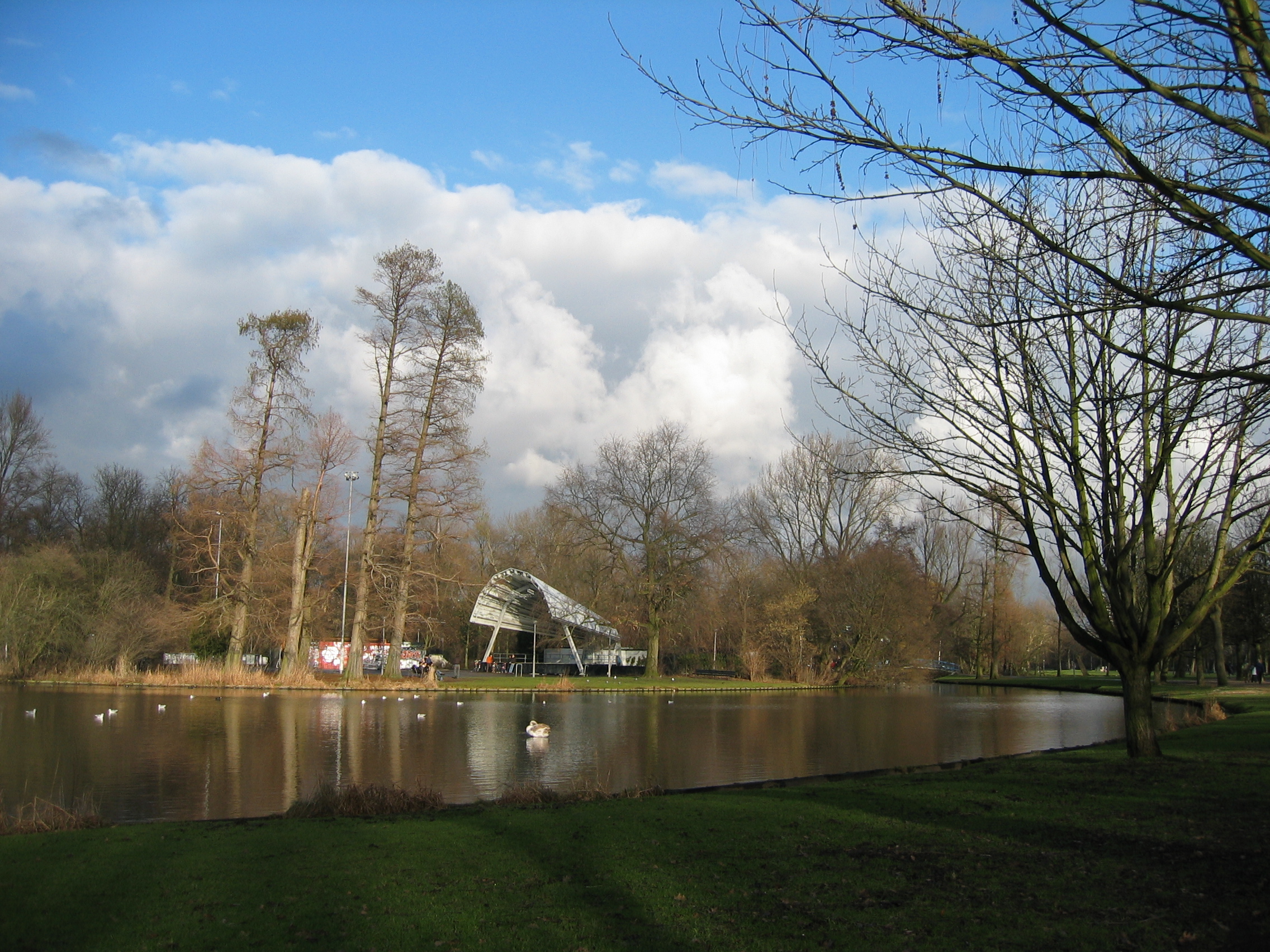
Behind Museumplein begins the Vondelpark, forty-seven hectares opened in 1865 and funded by a group of well-off citizens who wanted a place to walk. It gets ten million visits a year and is the city’s living room: people jogging, having lunch on the grass, cycling through on the way to work.
It is also a good spot for lunch: there is a café with a terrace at its centre, or you can just buy something and sit down.
Amsterdam has no great culinary tradition of its own, but it has two things worth having: bread and cheese and Indonesian food, a colonial legacy. For lunch, a broodje — a sandwich — with aged cheese or herring costs €5-8. Raw herring with onion and gherkins is bought from street carts, held by the tail and eaten in two bites: it is the most Dutch thing you can do, and it costs four euros. In cafés lunch runs €12-18. For the evening, save yourself for an Indonesian rijsttafel: fifteen small dishes on the table, €30-40 a head, and worth it.
Afternoon — The canal ring and the Jordaan
3 km · 3 stops · 2pm to 6:30pm · you pay for nothing here except one door
4 – The canal ring and the Nine Streets
Time 1.5 hours · Free · Walk 15 minutes north
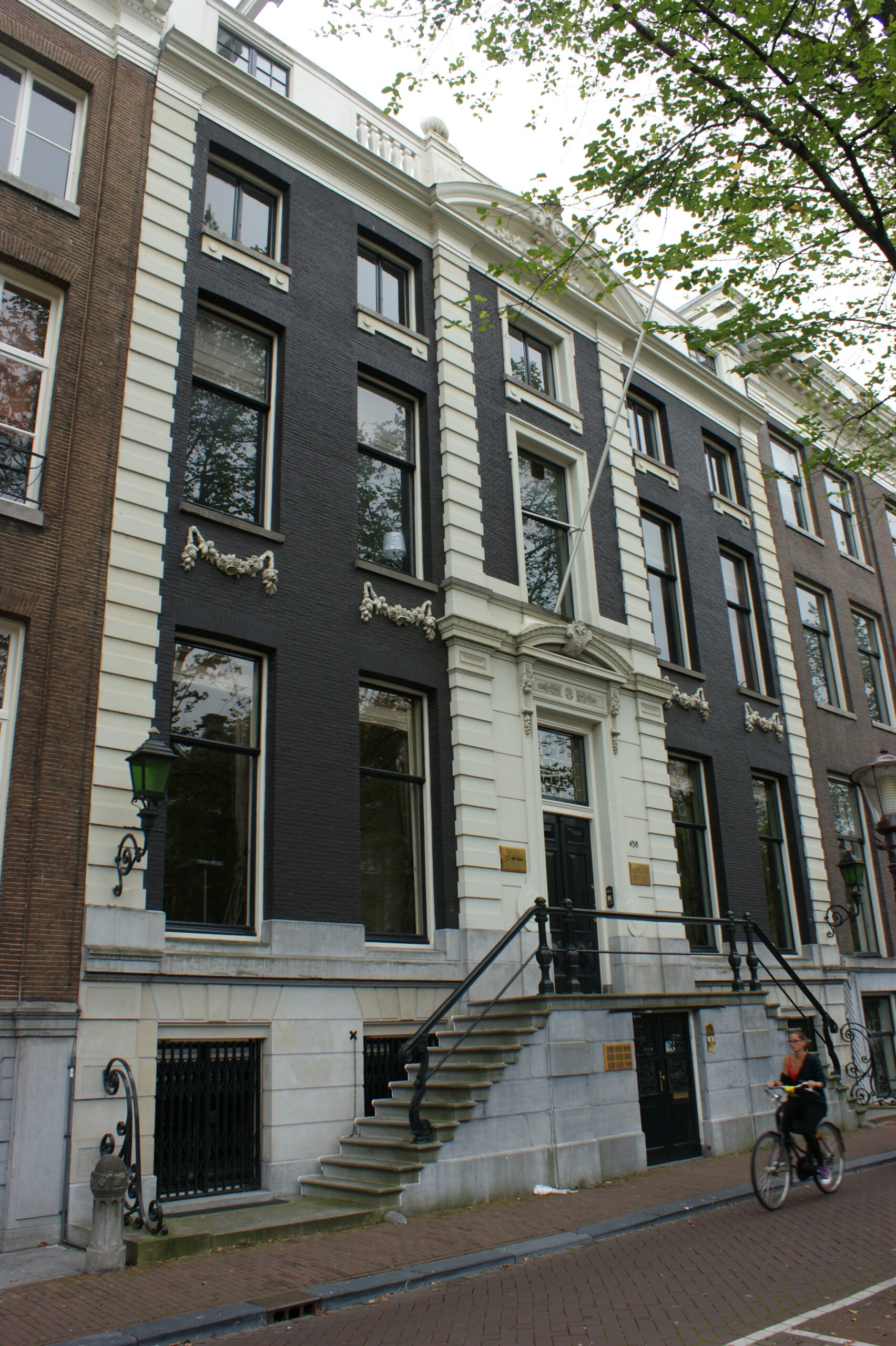
The canal ring — grachtengordel — is a UNESCO site, and it was not born out of beauty: it is a seventeenth-century property development. In 1613 the city was bursting, and the council decided to dig three concentric canals — Herengracht, Keizersgracht, Prinsengracht — on land reclaimed from the marsh, subdivide it and sell it. It is one of the first modern town plans in Europe, and it worked so well it is still there, unchanged, four centuries later.
Look at the houses, because every detail has an economic reason. They are narrow because tax was charged on the width of the façade, so people built narrow and deep, and some houses are just two metres wide. They lean forward not from subsidence but on purpose: so goods hoisted by the hook jutting from the gable would not bang against the wall on the way up. Interior staircases are extremely steep for the same reason of space, and furniture has always come in through the window.
The best part for walking is the Nine Streets (De 9 Straatjes), the cross-streets linking the three canals: small shops, real workshops, cafés, and a bridge every fifty metres. Amsterdam has over twelve hundred bridges and around a hundred and sixty-five canals: more than Venice.
5 – The Anne Frank House
Time needed 1 hour · Ticket about €16 · Online only, sells out six weeks ahead

At Prinsengracht 263 stands a building that gives nothing away from outside: an ordinary canal house, with a warehouse on the ground floor. Behind it, in the achterhuis, the annex at the back, eight people hid for two years and one month, from July 1942 to August 1944, helped by four employees of Otto Frank’s company who risked their lives to bring them food.
You climb a narrow staircase, pass behind the revolving bookcase that hid the door, and walk through empty rooms: Otto Frank, the sole survivor of the eight, wanted them left without furniture, as the Germans had left them after the raid. On the walls are the film-star pictures Anne pasted up and the pencil marks her parents used to note how much she had grown.
The original diary is displayed in a case at the end of the route. Anne was thirteen when she began writing it and fifteen when she died of typhus at Bergen-Belsen, weeks before the camp was liberated. Of the roughly hundred and forty thousand Jewish people living in the Netherlands in 1940, a little more than one in four survived: the worst rate in Western Europe.
Tickets are released online, on a fixed schedule of time slots, and sell out within hours. There is no ticket office and no queue: without a booking, you do not get in. Note the date sales open and log on that day.
6 – The Jordaan
Time 1 hour · Free · Walk across the canal

Across the Prinsengracht begins the Jordaan, built in the seventeenth century for workers and immigrants — French Huguenots, Portuguese Jews — while the canals were for the wealthy. The streets are narrow, the houses low, and the canals here are smaller.
Today it is one of the most expensive districts in Amsterdam, the paradox of every European city. What remains, though, are the hofjes, hidden courtyards: complexes of low houses around a garden, built between the seventeenth and nineteenth centuries by benefactors as free housing for elderly single women. Several still exist today; you enter through a small street door, and inside is total silence twenty metres from the traffic. They are not attractions: people live there, so go in quietly and do not photograph through the windows.
Evening — The centre and the water
2 km · 2 stops · 7pm to 10pm
7 – Dam Square and the Royal Palace
Time 45 minutes · Palace about €12, square free · Walk 15 minutes

The city was born here: Dam means dam, and it is the barrier on the river Amstel built around 1270 that gave Amstelredamme its name.
The Royal Palace was not built royal: it was built in the seventeenth century as the town hall, and was the largest civic building in Europe, a statement of wealth by a city of merchants that had neither king nor court. Napoleon put his brother Louis in it as King of Holland in 1808, and it has been a royal palace ever since. It rests on 13,659 wooden piles driven into the marsh, a number Dutch schoolchildren still learn by a rhyme.
On the square also stands the National Monument, the white obelisk dedicated to the victims of the Second World War, before which every 4 May at 8pm the country observes two minutes of total silence: trams stop, bicycles stop, everything stops.
8 – De Wallen and the old harbour
Time 1 hour · Free · Walk 5 minutes
Behind the square is De Wallen, the oldest part of Amsterdam and, at the same time, the red-light district. It is worth crossing because it is the medieval core of the city — here stands the Oude Kerk, from 1213, the oldest building in Amsterdam, with a floor made entirely of tombstones: there are two thousand five hundred of them, and ten thousand people are buried underneath, including Rembrandt’s wife.
Two things about the district, said plainly: prostitution is legal and regulated in the Netherlands, the women behind the windows are self-employed workers renting the space, and photographing them is forbidden — the ban is posted everywhere and enforced. The city is progressively reducing this kind of tourism, with bans on guided tours and on smoking cannabis outdoors on certain streets: if you see a sign, it is a real rule and it carries fines.
End by walking east toward the harbour: the Nemo Science Museum, Renzo Piano’s green, prow-shaped building, has a free rooftop terrace from which you see the whole old city with Central Station. At sunset, it is the right place to finish.
If it rains
It rains about one day in three in Amsterdam, so plan for it. The advantage is that the museums are many and close together.
- Instead of walking the canals · a covered boat tour: an hour, around €18-22, seeing the canal ring from the water — the vantage point it was built for — while staying dry.
- Instead of the Vondelpark · the Stedelijk Museum of modern art, on the same Museumplein, or the Rembrandt House, the studio-home where the painter lived for twenty years, its rooms restored thanks to the inventory drawn up for his bankruptcy.
- Always works · a bruin café, the historic cafés with walls darkened by two centuries of smoke: go in, sit down, have a drink and wait for it to pass. A national institution.
What the day costs
| Item | Cost |
|---|---|
| Rijksmuseum | about €25 |
| Van Gogh Museum | about €24 |
| Anne Frank House | about €16 |
| Royal Palace, if you go in | about €12 |
| Canals, the Jordaan, the Vondelpark, Dam Square, the Nemo terrace | free |
| Boat tour, optional | €18-22 |
| Lunch | €8-18 |
| Dinner | €20-40 |
| Total with all three museums | about €95-125 |
| Total with one museum only | about €60-75 |
Reference figures as of August 2026: check official websites before you travel. In Amsterdam everything is booked online and almost nothing is bought on the spot. If you plan on at least four or five museums, consider the Museumkaart or the I amsterdam City Card, which also covers transport.
Getting around

The centre is done on foot: end to end is thirty minutes, and this itinerary uses no transport. Trams are for the longer stretches; you pay by tapping a contactless card on entry and exit, and a ride costs around €3.50.
The bicycle is the real city vehicle: there are more of them than there are residents. Renting one is easy and costs €12-15 a day, but think it through: Amsterdam’s cycling traffic is fast, dense, and governed by unwritten rules locals take for granted, and an uncertain tourist in the middle of it is a danger to themselves and others. If you are not used to it, walk.
Amsterdam’s most important rule: never walk on the red tarmac. Those are cycle paths, bikes move fast, they do not brake and often have no bell. Before crossing anything, look twice, because the order is pavement, cycle path, tram tracks, road: four different flows in ten metres.
From Schiphol airport: the train reaches Central Station in fifteen minutes and costs a few euros, with departures every ten minutes. It is one of the best airport-to-city links in Europe, and there is no reason to take anything else.
Frequently asked questions
Is one day enough to see Amsterdam?
Amsterdam is the European capital that pays off best in a single day, because the historic centre fits inside two and a half kilometres and is entirely flat. In one day you can fit the Rijksmuseum, the Van Gogh Museum, the canal ring, the Anne Frank House, the Jordaan and Dam Square. Zaanse Schans with its windmills, Haarlem, Utrecht and the Rembrandt House are left out.
How far ahead do you need to book the Anne Frank House?
Very far: tickets are released online with a fixed schedule of time slots and sell out within hours, often six weeks ahead. There is no ticket office and no queue. Note the date sales open on the museum’s website and log on that day: it is the one thing in Amsterdam that genuinely needs organising well in advance.
Rijksmuseum or Van Gogh Museum, which is better?
If you only do one, it depends what you are after. The Rijksmuseum is the Dutch Golden Age, with The Night Watch and four Vermeers, and needs at least two hours. The Van Gogh is more concentrated, takes an hour and a half, and is laid out chronologically: you see a painter’s whole evolution across five years of work. They stand two hundred metres apart, so a single day fits both.
Why are Amsterdam’s houses narrow and leaning?
Narrow because tax was charged on the width of the façade, so people built narrow and deep — some houses are just two metres wide. They lean forward on purpose, not from subsidence: so goods hoisted by the hook jutting from the gable would not hit the wall on the way up. Interior staircases are extremely steep for the same reason of space, and furniture is still brought in through the windows today.
Is it worth renting a bicycle?
Only if you are a cyclist used to traffic. Amsterdam’s cycling flow is fast, dense and governed by conventions locals take for granted: an uncertain tourist in the middle of it is dangerous, to themselves and others. The centre is comfortably done on foot in thirty minutes end to end. If you walk, stay off the red tarmac: that is the cycle path, and no one will brake for you.
How much does a day in Amsterdam cost?
Between €95 and €125 per person doing all three museums, between €60 and €75 with just one. Tickets are the heavy item: the Rijksmuseum and the Van Gogh each cost around twenty-five euros. Canals, the Jordaan, the Vondelpark, Dam Square and the Nemo terrace cost nothing, and eating is reasonable if you stick to sandwiches and cafés.
Is the canal boat tour worth it?
Yes, especially if it rains. The canal ring was designed to be seen from the water, the houses read better from there, and an hour costs €18-22. Pick a small boat with no loud recorded commentary: that is the entire difference between a good tour and a bad one.
How do you get from Schiphol airport to the centre?
By train: fifteen minutes to Central Station, a few euros, departures every ten minutes. The station sits directly beneath the terminal. It is one of the best airport-to-city links in Europe, and there is no reason to take a taxi or a bus.
What do you eat in Amsterdam?
Dutch food is simple: bread, cheese, raw herring with onion — bought from carts, held by the tail and eaten in two bites, four euros — and chips with mayonnaise. The best thing, though, is Indonesian food, a colonial legacy: the rijsttafel is a table of fifteen different small dishes, €30-40, and worth an evening.
Can you photograph the windows in De Wallen?
No, and it is an enforced rule: the ban is posted everywhere. Prostitution in the Netherlands is legal and regulated, and the people behind the windows are self-employed workers. The city is also reducing this kind of tourism, with bans on guided tours and on smoking cannabis outdoors on certain streets: if you see a sign, it is a real rule with a fine behind it.
September 3, 2026


