Bologna in 3 days: the porticoes, the university and a trip to Ravenna or Modena
Three days is the right measure of Bologna, and not because the centre is large: because the city has three layers that cannot be seen at once. The first is the monumental one around Piazza Maggiore, and it fits into a day. The second has to be earned on foot — the San Luca portico, the university, the canals — and it takes its time. The third is not even in Bologna: it is the fact that from here, half an hour by train, you reach the mosaics of Ravenna and the cathedral of Modena. A third day spent at the station is a third day well spent.
At a glance
- How long · three full days, two in the city and one outside it
- How much walking · about 5 km on day one, 12 on day two if you walk up to San Luca
- What has to be booked · almost nothing; only the train on day three is worth buying ahead
- Budget · €160-260 per person for three days, excluding accommodation
- Where to stay · inside the historic centre: the perimeter is small, so you walk back from every dinner
- When to go · spring and autumn; in summer the Po plain is humid and in August half the old taverns close
- What is left out · the Certosa cemetery, the Museum of the History of Bologna, the hills: those are a fourth day
Three layers, one per day. Day two leaves the walls to the west, day three leaves the city.
Day 1 — The monumental centre
5 km · 6 stops · all within a kilometre and a half · almost entirely free

The first day is what anyone with a single day would do, and there is no reason to change it: the sights are close together and they hold hands.
Morning – Piazza Maggiore, San Petronio, Archiginnasio
Time 4 hours · Cost about €8 · Do not skip the Salaborsa and the meridian
The square is closed by four palaces from four different ages: Palazzo d’Accursio, still the town hall; Palazzo del Podestà; Palazzo dei Banchi by Vignola, which is only a facade put there to hide the market houses behind it; and Palazzo Re Enzo, where the son of Frederick II was held prisoner for twenty-three years until his death.

Next to it, the Neptune by Giambologna, 1566, his first major work: the trident would end up as the badge of Maserati, founded by Bolognesi. Inside Palazzo d’Accursio, step into the Salaborsa library: a covered piazza with a glass floor over the excavated Roman forum, free to enter and flagged by nobody.

In San Petronio, the largest brick basilica in the world, look for two things. The reliefs of the Porta Magna, carved by Jacopo della Quercia between 1425 and 1438, which the young Michelangelo came to study. And on the floor of the left aisle the Cassini meridian of 1655: 66.8 metres of brass line, the longest in the world, with which the Earth’s orbit was measured.

Behind the basilica, the Archiginnasio was from 1563 to 1803 the single seat of the oldest university in the Western world, founded in 1088. Its walls carry nearly seven thousand student coats of arms. The spruce-wood anatomical theatre of 1637 was destroyed by a bomb in January 1944 and rebuilt from the recovered fragments: the original parts are the darker ones.
In the Quadrilatero, which is the next stop: at the Mercato di Mezzo you eat standing for ten to fifteen euros, and in the trattorie around it a first course costs ten to fourteen. In Bologna the first course is the main one.
Afternoon – Quadrilatero, towers, Santo Stefano
Time 4 hours · Cost about €8 · Walks all on foot, none over ten minutes

The Quadrilatero is the medieval market still in its place: via Pescherie Vecchie, via Drapperie, via Caprarie, via Clavature. On via Clavature, inside the sanctuary of Santa Maria della Vita, is the Lamentation over the Dead Christ by Niccolò dell’Arca: seven life-size terracotta figures from shortly after 1460, three of them screaming. D’Annunzio called it «a scream in stone». It costs a three-euro donation and it is the most powerful thing in the city.

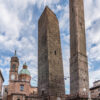
The Two Towers are five minutes away. Bologna had around a hundred in the Middle Ages and about twenty survive: the Asinelli is 97 metres with 498 steps, the Garisenda is 48 and leans by over three. Dante used it in canto XXXI of the Inferno to describe a giant bending down.
Please note: since 2023 the Garisenda has been inside a structural safety works site, the area around the towers is fenced off and climbs up the Asinelli have been suspended on and off. Check the city council website. If it is closed, take your view from the Clock Tower on Piazza Maggiore.

The day closes at Santo Stefano, at the end of the street of the same name, on a triangular square among the finest in Italy. The complex of the seven churches centres on the octagonal basilica of the Holy Sepulchre, built to reproduce the one in Jerusalem, holding the bones of Saint Petronius. In the Courtyard of Pilate stands an eighth-century Lombard basin which legend called the bowl in which Pontius Pilate washed his hands.
Day 2 — The San Luca portico, the university and the canals
12 km walking up to San Luca, 6 if you take the bus · 5 stops · uphill in the morning, in town in the afternoon
Morning – the 666 arches of San Luca
Time 4 hours there and back on foot · Free · Start early, and very early in summer

From Porta Saragozza begins the longest portico in the world: 3,796 metres, 666 arches, fifteen chapels, all uphill to the Guardia hill. It was built between 1674 and 1793 with citizens’ donations — each arch bears the name of the person who funded it — and its purpose was to bring the icon of the Madonna down into the city once a year without exposing it to rain. The procession still takes place, in May.
Halfway up the portico passes under the Meloncello arch, which vaults over the road in a Baroque curve. From there the climb turns serious, and you understand why Bolognesi come here to run on Sunday mornings.

At the summit stands the eighteenth-century sanctuary of the Madonna di San Luca, with the Byzantine icon that tradition says arrived from Constantinople in the twelfth century. But the reason to climb is the terrace: on one side the Po plain, flat to the horizon; on the other the first hills of the Apennines.
Those who would rather not walk take bus 20 to the Meloncello and do only the last kilometre, which is the steepest and the most striking. There is also a tourist road train that leaves from Piazza Maggiore and gets to the top without effort.
Since 2021 twelve stretches of Bologna’s porticoes, this one included, have been a UNESCO World Heritage Site. Across the city there are about 62 kilometres of them, thirty-eight in the historic centre alone: this is why rain does not spoil plans in Bologna.
Coming back down you pass via Saragozza, which has neighbourhood trattorie well away from centre prices. Alternatively the Mercato delle Erbe on via Ugo Bassi: a nineteenth-century covered market with stalls that cook, ten to fifteen euros.
Afternoon – San Domenico, the Picture Gallery, via Zamboni
Time 4 hours · Cost about €8 · Closures the Picture Gallery closes on Mondays

The basilica of San Domenico holds the Ark that gave its name to half the history of Italian sculpture. The marble chest was carved by Nicola Pisano and workshop around 1265; the crowning section was added in the fifteenth century by an artist who took his name from that very job, Niccolò dell’Arca — the same man who made the Lamentation. At his death the work was still unfinished, and three figures were supplied by a nineteen-year-old Florentine sculptor: Michelangelo, in 1494. They are the Saint Petronius, the Saint Proculus and the right-hand candle-bearing angel, recognisable because it is the only one that does not look like an angel.
Guido Reni is buried in the same church, and in 1770 a fourteen-year-old called Mozart, in town for his examination at the Accademia Filarmonica, studied counterpoint with Padre Martini a few hundred metres from here.
On the other side of the centre, on via delle Belle Arti, the National Picture Gallery gathers Emilian painting from the fourteenth to the eighteenth century: Giotto, Raphael’s Ecstasy of Saint Cecilia, the Carracci, Guido Reni, Guercino. In the seventeenth century the Bolognese school was the most influential in Europe, and this is where you see why.
Around it lies the university quarter: via Zamboni, the porticoes, the walls covered in posters and graffiti. Bologna has eighty thousand students out of four hundred thousand inhabitants and here the ratio is fully visible. It is also the district where you drink cheaply in the evening.

Before dinner, ten minutes on foot to via Piella. In an ordinary wall a small wooden window opens onto the Moline canal: it is what remains of the network of canals that from the twelfth century turned the silk mills and made Bologna the silk capital of Europe, before the whole thing was covered over in the twentieth century.
Day 3 — Out of town: Ravenna or Modena
A full day · train from Bologna Centrale · 1 hour to Ravenna, 25 minutes to Modena
Bologna is Italy’s railway hub and it would be a waste not to use it. The two day trips are very different and the choice is clear-cut: Ravenna if you want to see something that exists nowhere else, Modena if you want a lighter day made of Romanesque architecture, vinegar and engines.
Ravenna – the mosaics, one hour by train
Journey about 1 hour · Combined ticket around €12 · All on foot from the station

For a hundred and twenty years, between the fifth and sixth centuries, Ravenna was the capital of the Western Roman Empire, then of Theodoric’s kingdom, then of Byzantine Italy. From that period eight monuments survive, all UNESCO World Heritage, holding the finest mosaics in the world.
The Mausoleum of Galla Placidia is no bigger than a room and has a blue vault with eight hundred golden stars: entry is in small groups, for a few minutes. The octagonal basilica of San Vitale has in its apse the panels of Justinian and Theodora with their courts, which are not generic figures but portraits of people who lived. Sant’Apollinare Nuovo has two processions of martyrs and virgins running the length of the nave. And just outside town, at Classe, Sant’Apollinare in Classe closes the account with a green apse that looks like a garden.
The same city holds the tomb of Dante, who died here in exile in 1321 and was never returned to Florence, which has been asking for seven hundred years.
The combined ticket covers five monuments and is bought at the first one you visit. Galla Placidia carries a supplement in peak months and entry is capped: go there first thing in the morning.
Modena – Romanesque, vinegar and engines, 25 minutes by train
Journey 25 minutes · Cathedral and square free · Maranello half an hour by bus

Piazza Grande, the cathedral and the Ghirlandina tower have been UNESCO World Heritage since 1997 and form the most important Romanesque complex in Italy. The cathedral was begun in 1099 by the architect Lanfranco, and on the facade are the reliefs of Wiligelmo with scenes from Genesis: among the first monumental sculptures of the European Middle Ages, and the moment the human figure comes back after centuries of absence.
The Mercato Albinelli, covered and Art Nouveau, is the right place for lunch and for understanding Emilian cooking one step further west: tortellini, gnocco fritto, tigelle, and traditional balsamic vinegar aged twelve or twenty-five years, which has nothing to do with the supermarket product. Several vinegar lofts in town can be visited by appointment.
For those who care about engines: Modena has the Enzo Ferrari Museum in his birthplace, and Maranello, half an hour away by bus, has the Ferrari Museum. Nearby are also Lamborghini, Maserati, Pagani and Ducati: this is the Motor Valley, and the name was not invented by marketing.
Where to stay
Bologna’s historic centre is small and it is worth staying inside the walls: you walk back from any dinner, and in the morning you start already among the sights.
The area around via Santo Stefano and via Farini is the quietest and the finest. Around via Zamboni you pay less but the evenings are noisy, because it is the student quarter. Near the central station prices drop and you are ten minutes’ walk from Piazza Maggiore: if you are catching an early train on day three, that makes sense.
Bologna is a trade-fair city and hotel prices follow the fair calendar more than the seasons: in the weeks of Cersaie or the Motor Show a room can cost three times as much. Check the BolognaFiere calendar before fixing your dates.
What it costs
| Item | Indicative cost |
|---|---|
| Anatomical theatre of the Archiginnasio | about €3 |
| Clock Tower or Asinelli tower | about €5 |
| Lamentation in Santa Maria della Vita | donation, about €3 |
| National Picture Gallery | about €8 |
| MAMbo with Museo Morandi | about €6 |
| San Petronio, Santo Stefano, San Domenico, San Luca, porticoes | free |
| Train to Ravenna, return | €16-20 |
| Combined ticket for the Ravenna monuments | about €12 |
| Train to Modena, return | €8-12 |
| Lunches, three days | €40-60 |
| Dinners in trattorie, three days | €90-135 |
| Total per person, three days | €160-260 |
Accommodation excluded. Reference figures as of August 2026: museums, trains and transport change their fares, so check the official websites before you travel.
Getting around

The centre is done on foot and there is no other way: the Two Towers to Piazza Maggiore is five minutes, Santo Stefano ten, San Domenico a quarter of an hour. Bologna has no metro.
Buses cost about €1.50 a ride, a day ticket around €6. They are useful for two things: the San Luca portico (line 20 to the Meloncello) and the station, if you are sleeping further out.
For day three, regional trains to Ravenna, Modena and Ferrara run constantly and need no reservation: buy the ticket on the morning itself. Just watch the return times on Sunday evenings, when services thin out.
From Marconi airport the Marconi Express monorail reaches the central station in seven minutes for about ten euros.
Frequently asked questions
Are three days in Bologna too many?
No, if the third is used to leave the city. The monumental centre fits into one day; the second is for the San Luca portico, the Picture Gallery and the university quarter; the third pays off far better spent in Ravenna or Modena, both less than an hour away by train.
Ravenna or Modena as a day trip from Bologna?
Ravenna if you want to see something that exists nowhere else: eight UNESCO monuments with the finest early Christian and Byzantine mosaics in the world, plus Dante’s tomb. Modena if you prefer a lighter day: the Romanesque cathedral with Wiligelmo’s reliefs, the Albinelli market, traditional balsamic vinegar and the Ferrari museums. Ravenna is an hour by train, Modena twenty-five minutes.
How much does a long weekend in Bologna cost?
Between €160 and €260 per person for three days excluding accommodation, including the trains for the day trip. Bologna is clearly cheaper than Venice, Florence or Milan because San Petronio, Santo Stefano, San Domenico, the porticoes and the San Luca sanctuary are all free.
Can the San Luca portico be done without walking?
Yes. Bus 20 reaches the Meloncello arch, leaving the final kilometre, the steepest but also the finest. There is also a tourist road train from Piazza Maggiore up to the sanctuary. On foot from Porta Saragozza it is 3,796 metres and 666 arches, about two hours there and back.
When is the best time to visit Bologna?
Spring and autumn. Summer in the Po plain is humid, and in August many historic taverns close. Above all, watch the BolognaFiere calendar: during trade-fair weeks hotel prices can triple, and that matters more than the season.
What is Michelangelo’s connection with Bologna?
Two things. As a young man he came to study Jacopo della Quercia’s reliefs on the Porta Magna of San Petronio, and remembered them years later in the Sistine Chapel. And in 1494, aged nineteen, he carved three figures for the Ark of Saint Dominic, left unfinished at the death of Niccolò dell’Arca: the Saint Petronius, the Saint Proculus and the right-hand candle-bearing angel.
Where is the best area to stay in Bologna?
Inside the walls of the historic centre, which is small and entirely walkable. Via Santo Stefano and via Farini are the quietest areas; via Zamboni is cheaper but noisy at night because it is the student quarter; the central station is a ten-minute walk from Piazza Maggiore and makes sense if you are taking an early train on day three.
Is the Asinelli tower open?
It depends when you go: since 2023 the Garisenda has been inside a structural safety works site, the area is fenced off and climbs up the Asinelli have been suspended on and off. Check the Bologna city council website before you travel. The alternative is the Clock Tower on Piazza Maggiore, open and easier.
August 25, 2026