China in 2 weeks: Beijing, Xi’an, Chengdu, Guilin and Shanghai by high-speed train
China is as big as the whole of Europe, and in two weeks you cross only one slice of it. The good news is that slice can be covered almost entirely by high-speed train: in twenty years China has built forty-five thousand kilometres of lines, more than the rest of the world combined, and Beijing–Xi’an is four and a half hours at three hundred km/h instead of twelve by plane with all the checks. The itinerary that follows is the classic backbone — Beijing, Xi’an, Chengdu, Guilin, Shanghai — and it has a logic: you start from imperial power, pass through the point where China began to be an empire, arrive at the landscape painted on every scroll, and end in the city that chose to be the future.
In brief
- Duration · 14 full days
- Route · Beijing (4) → Xi’an (2) → Chengdu (2) → Guilin and Yangshuo (2) → Shanghai (3)
- Travel · three high-speed train legs and one domestic flight
- Budget · €1,200-2,000 per person on the ground, intercontinental flight excluded
- To prepare beforehand · the visa (it’s required, and must be applied for in advance), train tickets, and payments: in China you pay with your phone, foreign cards work in very few places
- Internet · Google, WhatsApp, Instagram and almost everything Western is blocked. You need a roaming eSIM, which gets around the problem because the traffic exits the country
- Season · April-May and September-October. Avoid the week of 1 October, when the whole country is on the move
- What’s left out · Pingyao, Zhangjiajie, Hangzhou and Hong Kong: those are for the third week
Look at the distances: from Beijing to Shanghai it’s 1,100 km as the crow flies, but the route covers almost 4,000. High speed rail is what makes it possible in two weeks.
Days 1-4 — Beijing
4 nights · the empire, the Wall, the alleys
1 – Tiananmen and the Forbidden City
Day 1 · Admission 60 yuan · Online booking and passport required only, spots sell out · Closed Mondays
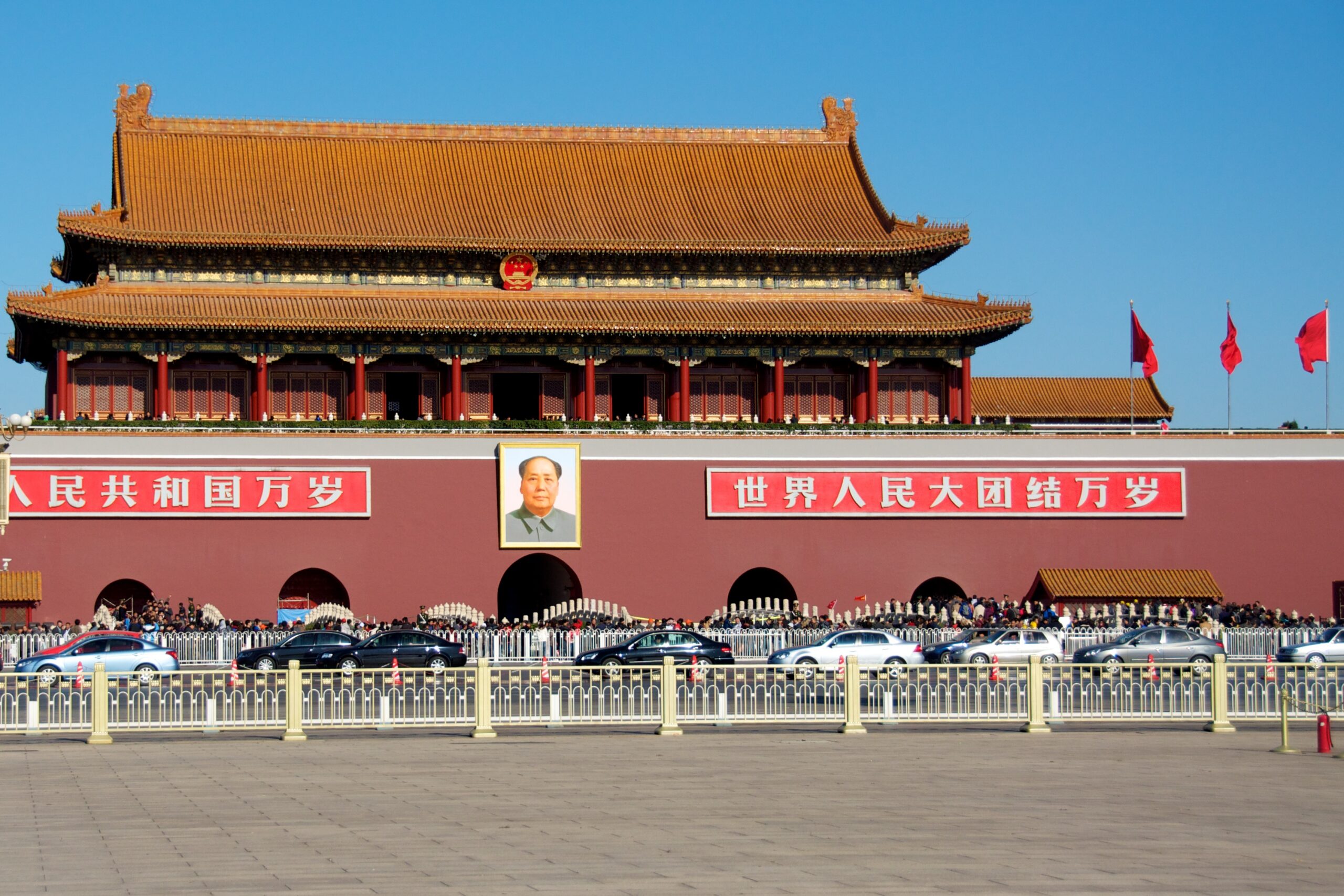
You start at Tiananmen Square, which at forty-four hectares is one of the largest squares in the world, designed in the 1950s to hold half a million people. Along its sides stand Mao’s mausoleum, the Great Hall of the People and the national museum. To enter you pass a passport security check, and it’s worth knowing the area is closely monitored: about the events of 1989 nothing can be found in China, neither on monuments nor online, and it’s not a topic to raise with your guides.

Beyond the Gate of Heavenly Peace begins the Forbidden City: seven hundred twenty thousand square metres, nine hundred eighty buildings, built between 1406 and 1420 with a million workers. It was home to twenty-four Ming and Qing emperors for almost five hundred years, and was called forbidden because no one could enter without the emperor’s permission.
You walk it along the central axis, south to north, which is how it was designed: three great ceremonial halls one after another — Supreme Harmony, Central Harmony, Preserving Harmony — then the private palace, then the imperial garden. The axis isn’t random: it continues for eight kilometres across the whole of Beijing, because the city was built around the throne. But the best part is the side courtyards, where almost nobody goes: the concubines’ quarters, the hall of mechanical clocks gifted by Europeans, the Nine Dragons Wall.
Leaving through the north gate, you cross the road and climb Jingshan Hill, artificial, made from the earth dug out for the moat: from up there you see the whole Forbidden City from above, the yellow roofs lined up, and it’s the photograph that explains the layout better than any map. It costs 2 yuan.
The Forbidden City must be booked online with your passport number, often days in advance, and it’s closed on Mondays. The number of daily admissions is capped. Check the up-to-date rules before you leave: they change often.
2 – The Temple of Heaven
Day 2, morning · Admission 34 yuan · Go at 7am, when the park is full of locals
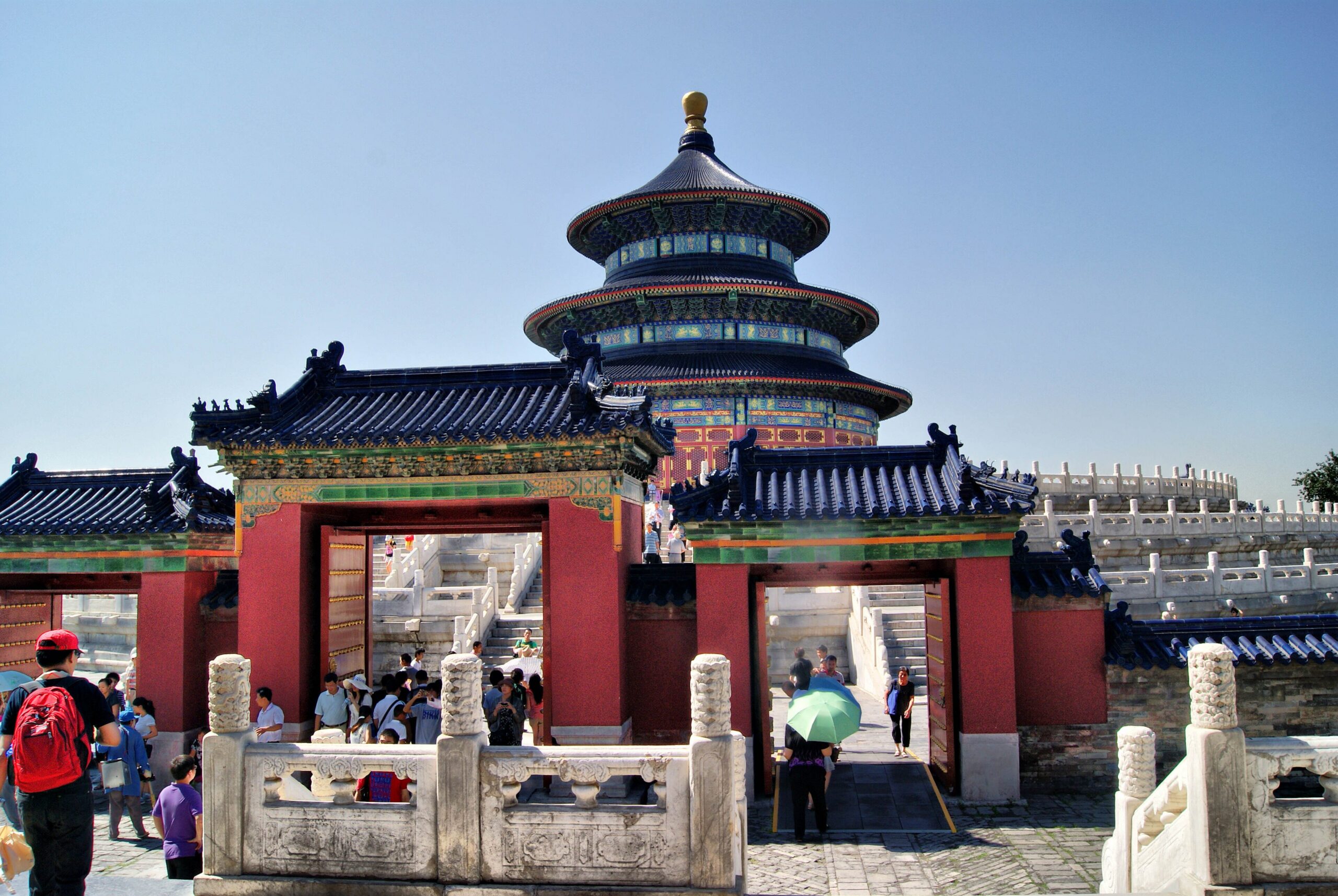
The Temple of Heaven, from 1420, is where the emperor came twice a year to pray for the harvest: he was the Son of Heaven, and this was his main duty, the rite on which his legitimacy rested. If the harvest failed for years running, it was said he had lost the mandate of heaven, and dynasties fell on that phrase.
The Hall of Prayer for Good Harvests is a circular wooden building on a three-tiered marble terrace, all in blue — the colour of the sky — and built without a single nail, only joinery. The geometry is a catechism: the roof is supported by four central columns for the seasons, twelve intermediate ones for the months, twelve outer ones for the double hours of the Chinese day. Everything you count in here counts for something.
But the real reason to come early is different: the park around it, at dawn, is Beijing’s living room for the elderly. Hundreds of people do tai chi, waltz, sing opera, play cards, kick jianzi, play the erhu. It’s one of the best things in the city, and it’s no show staged for visitors: it happens every morning, as it always has.
3 – The Great Wall at Mutianyu
Day 3 · full day · Admission 45 yuan, cable car 100-140 · 70 km from Beijing
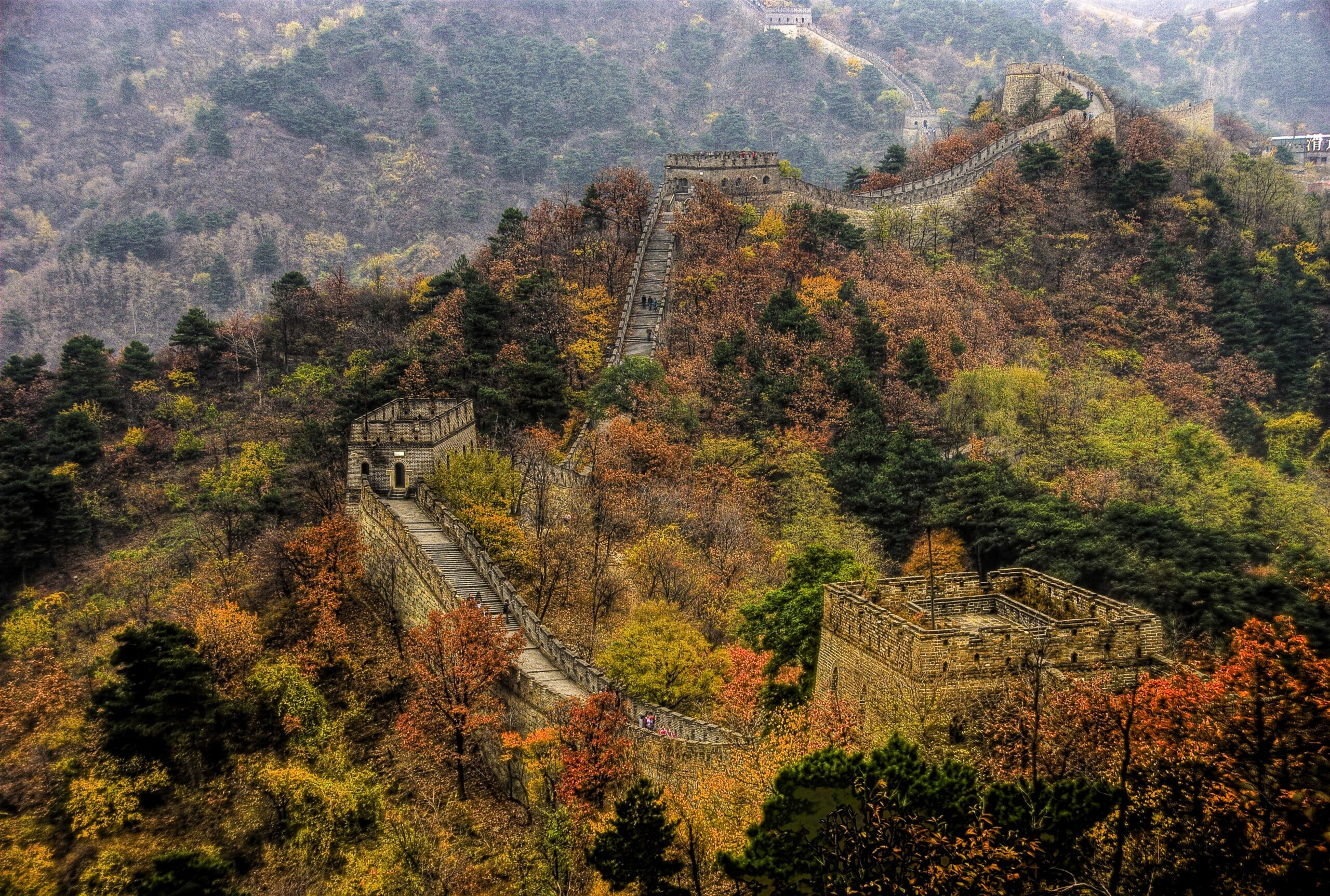
The Great Wall isn’t a single wall from a single era: it’s a sum of fortifications built, abandoned and rebuilt over two thousand years, and what you visit near Beijing is almost entirely Ming, from the 15th and 16th centuries. The combined length of every stretch ever built exceeds twenty-one thousand kilometres. And no, it’s not visible from space with the naked eye: it’s only a few metres wide, the same colour as the ground.
Which section you choose makes the difference between a great day and a disappointment:
- Mutianyu — the best compromise: well restored, twenty-two watchtowers, woods around it, a cable car up and a toboggan slide down. There are people, but it’s not oppressive.
- Badaling — the closest and most famous, with the high-speed train station. On weekends and holidays it’s a human queue that doesn’t move: to avoid.
- Jinshanling — two and a half hours away, partly unrestored: the most beautiful stretch and nearly empty, with a three- to four-hour walk among the towers. It demands legs and a full day.
- Simatai — the only one you can visit at night, lit up, with the rebuilt village of Gubei Water Town at its foot.
Don’t take the “free” buses offered on the street: they almost always lead to a jade shop or a tea factory before the Wall, and the day gets eaten up. Better a public bus, a taxi hired by the hour, or a tour booked in advance.
4 – The Summer Palace and the hutongs
Day 4 · Summer Palace 30-60 yuan depending on season · hutongs free
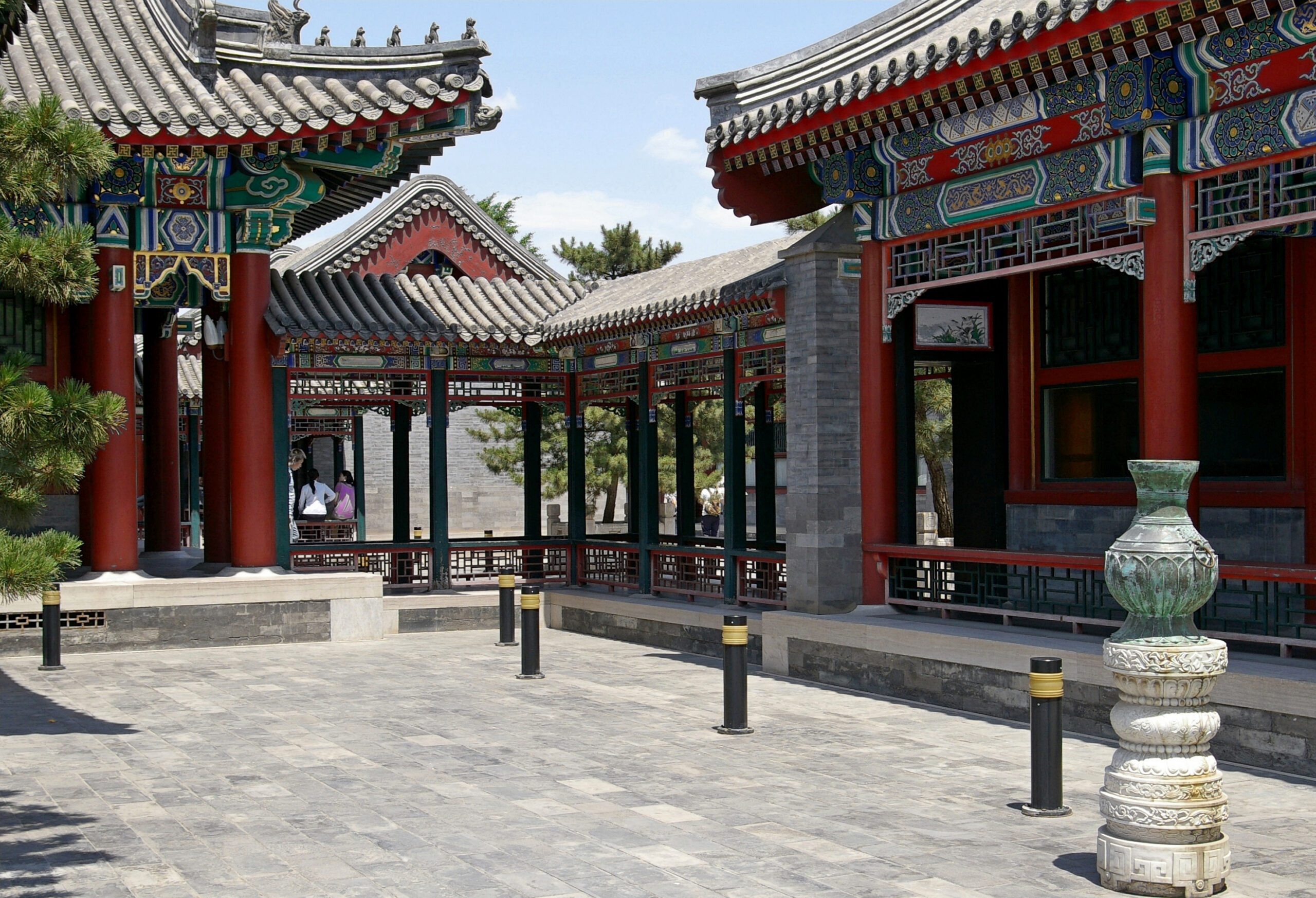
The Summer Palace is a two hundred ninety-hectare park around artificial Kunming Lake: the earth dug out to create it was used to build the hill next to it. It was the court’s summer residence, and the best-known part is the Long Corridor, a covered walkway seven hundred twenty-eight metres long with fourteen thousand scenes painted on its beams, all different.
Then there’s the marble boat, a ship-shaped building on the water that never sailed: tradition links it to Cixi, the dowager empress who effectively ruled China for almost fifty years, accused of diverting funds meant for the imperial navy to restore her own garden. The exact figures and details are debated by historians, but the stone ship sitting motionless on the lake while the fleet was destroyed by the Japanese in 1894 has remained a symbol of the empire’s end.
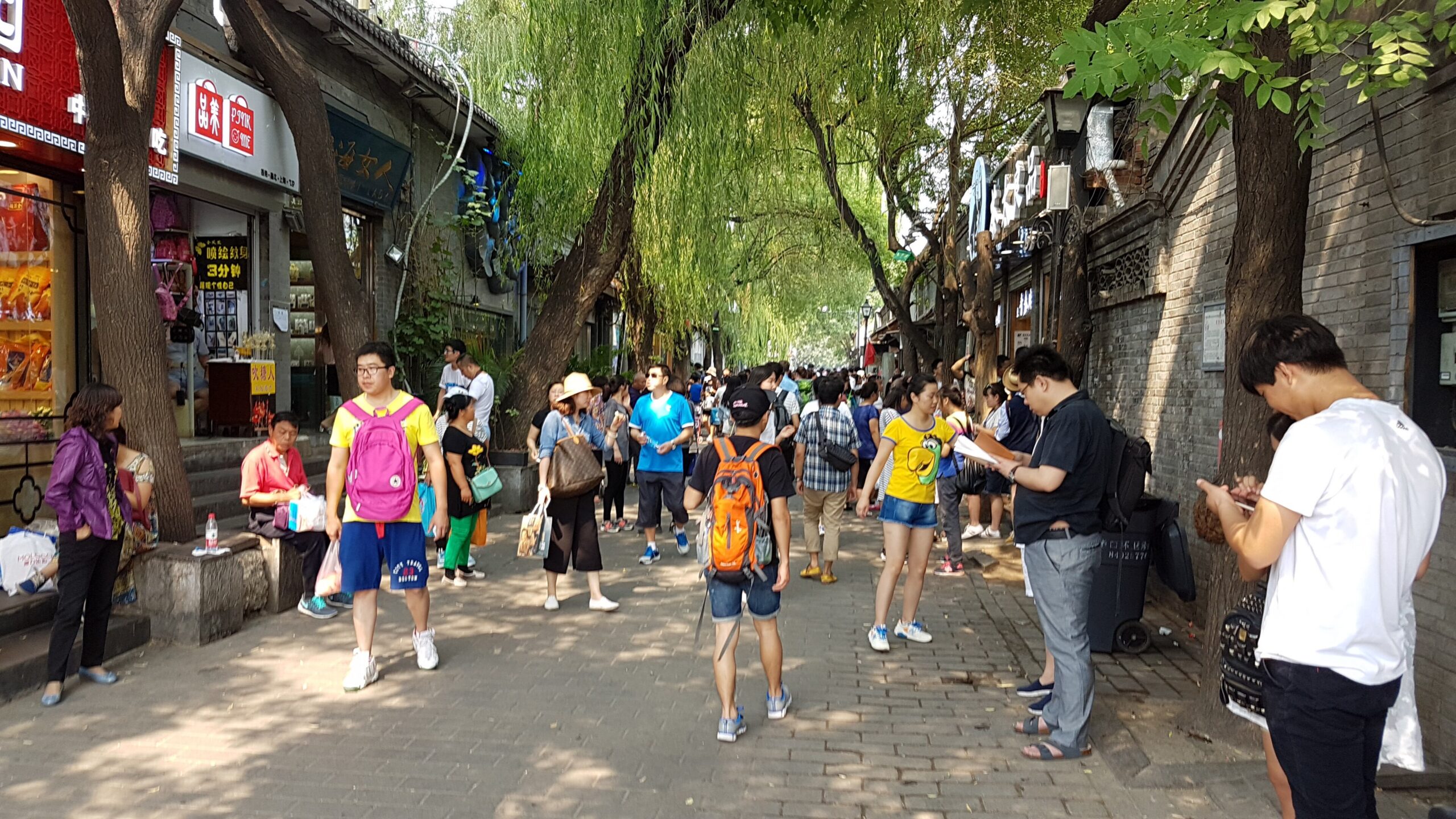
The afternoon is for the hutongs, the narrow alleys between the traditional siheyuan courtyard houses that once made up the fabric of all Beijing. In the 1980s and 1990s thousands were demolished to make way for skyscrapers and eight-lane roads; the ones that remain are partly protected and partly turned very expensive. The areas to explore on foot or by bike are Nanluoguxiang (the most commercial), the alleys around Houhai Lake, and the Drum and Bell Towers, which for centuries told the whole city the time.
In the evening, if you only want one thing: Peking duck, which was actually born right here at the Ming court, and is eaten carved tableside, wrapped in a thin pancake with cucumber, leek and fermented soybean sauce.
1. Il visto. Serve, non c’è esenzione turistica per gli italiani come in Thailandia, e va chiesto con anticipo al centro visti con itinerario e prenotazioni. Verificate le regole aggiornate: negli ultimi anni sono cambiate più volte, e sono comparse esenzioni temporanee per alcuni paesi europei che vanno confermate ogni volta.
2. I pagamenti. La Cina ha saltato la carta di credito ed è passata direttamente al telefono: si paga tutto con Alipay o WeChat Pay, inquadrando un codice. Entrambe le app oggi accettano carte straniere: installatele e collegatele prima di partire, perché farlo sul posto senza internet occidentale è complicato. I contanti si accettano per legge ma molti giovani commercianti non hanno il resto.
3. Internet. Google, Gmail, Maps, WhatsApp, Instagram, Facebook e gran parte dei siti occidentali sono bloccati. La soluzione più semplice e legale è una eSIM in roaming comprata prima: il traffico esce dal paese e i blocchi non si applicano. Scaricate comunque le mappe offline e tenete gli indirizzi scritti in caratteri cinesi, perché i tassisti non leggono il nostro alfabeto.
Days 5-6 — Xi’an, where the empire begins
High-speed train Beijing–Xi’an, 4h30 · 2 nights
5 – The Terracotta Army
Day 5 · Admission 120 yuan · 40 km from the centre, bus 306 from the station · half day

In March 1974, some farmers were digging a well in a field on the outskirts of Xi’an when they found fragments of terracotta and a head. Beneath lay the Terracotta Army: about eight thousand soldiers, horses and chariots, life-size, buried for two thousand two hundred years guarding the tomb of Qin Shi Huang, the first emperor, the one who unified China in 221 BC, standardised script, coinage and measures, and from whom the country’s very name comes.
What’s striking is that every face is different: hairstyles, moustaches, expressions, builds. They were assembled from mass-produced parts but with heads modelled one by one, and each piece bears the name of the workshop supervisor who made it, engraved — a quality-control system with personal accountability. They were also painted in bright colours: the lacquer that held the pigment curls and flakes off within minutes on contact with dry air, which is why much of the site hasn’t been excavated yet. They’re waiting until they know how to preserve what they find.
Pit 1, under a hangar as big as a football pitch, is the one with the rows of infantry in formation and is the photograph everyone knows; pits 2 and 3 are smaller, but 3 is the command post and 2 has the best-preserved kneeling archers. The emperor’s burial mound, a kilometre and a half further on, has never been opened: ancient sources speak of a chamber with rivers of mercury representing China’s waterways, and soil analysis has indeed found anomalous mercury concentrations.
6 – The city walls and the Muslim Quarter
Day 6 · Walls 54 yuan, bicycle 45 · Muslim Quarter free

Xi’an was Chang’an, capital of thirteen dynasties and for centuries the eastern terminus of the Silk Road: under the Tang, in the 8th century, it had perhaps a million inhabitants and was probably the largest and most cosmopolitan city in the world, with Persian, Arab, Jewish, Sogdian and Japanese communities.
The 1370 Ming walls are the most complete surviving in China: fourteen kilometres in circumference, twelve metres high, and a top so wide — up to eighteen metres — that you can cycle along it. The full circuit by bike takes an hour and a half and is the best way to understand the city’s layout: from up there you see the low roofs inside and the skyscrapers outside.
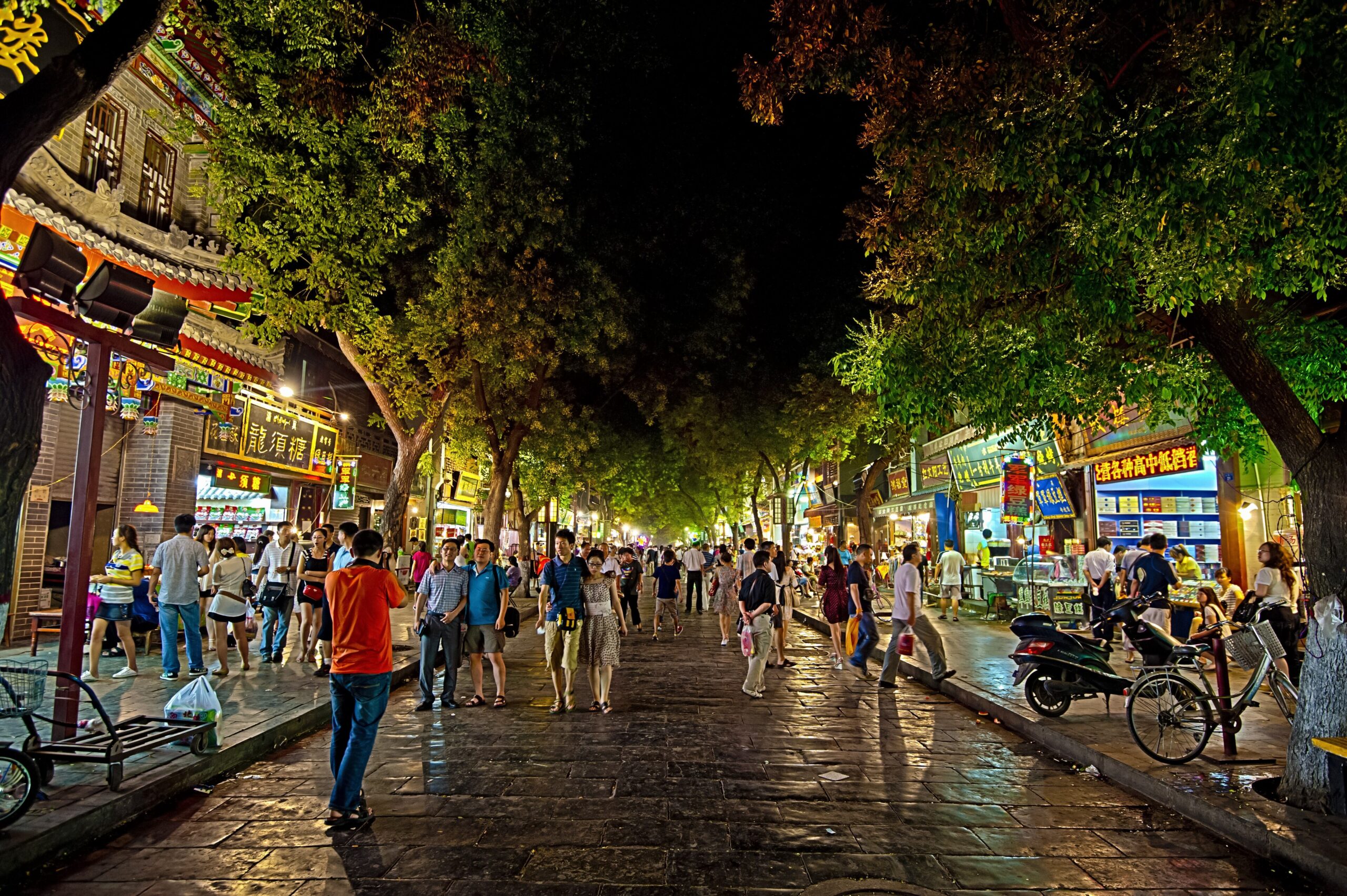
The Muslim Quarter is the part that makes Xi’an different from any other Chinese city. It’s home to the Hui, Chinese people of the Muslim faith descended from Arab and Persian merchants who arrived along the Silk Road over a thousand years ago: they speak Chinese, are Chinese in every respect, and have their own cuisine. The Great Mosque, founded in 742, is the thing to see: it has neither domes nor minarets, it’s built like a Chinese temple, with courtyards, wooden pavilions and a pagoda-shaped minaret — an architectural record of a thousand years of coexistence.
In the evening the quarter’s streets become a food market worth the trip on their own: roujiamo, often called “the Chinese hamburger”, stewed meat inside a flatbread that’s a thousand years old; biang biang noodles, wide hand-pulled noodles whose character is among the most complicated in existence; yangrou paomo, mutton soup where you crumble bread in with your hands; dates, sesame sweets, tea.
If there’s time left, the Giant Wild Goose Pagoda, from 652, was built to hold the Buddhist texts the monk Xuanzang had brought back from India after seventeen years of travel: that true story inspired Journey to the West, the novel of the Monkey King.
Days 7-8 — Chengdu and Sichuan
High-speed train Xi’an–Chengdu, 3-4 hours · 2 nights · pandas, a Buddha and chilli
7 – The pandas
Day 7, morning · Admission 55 yuan · Go at 7:30: by around 10 the pandas are asleep and no longer moving
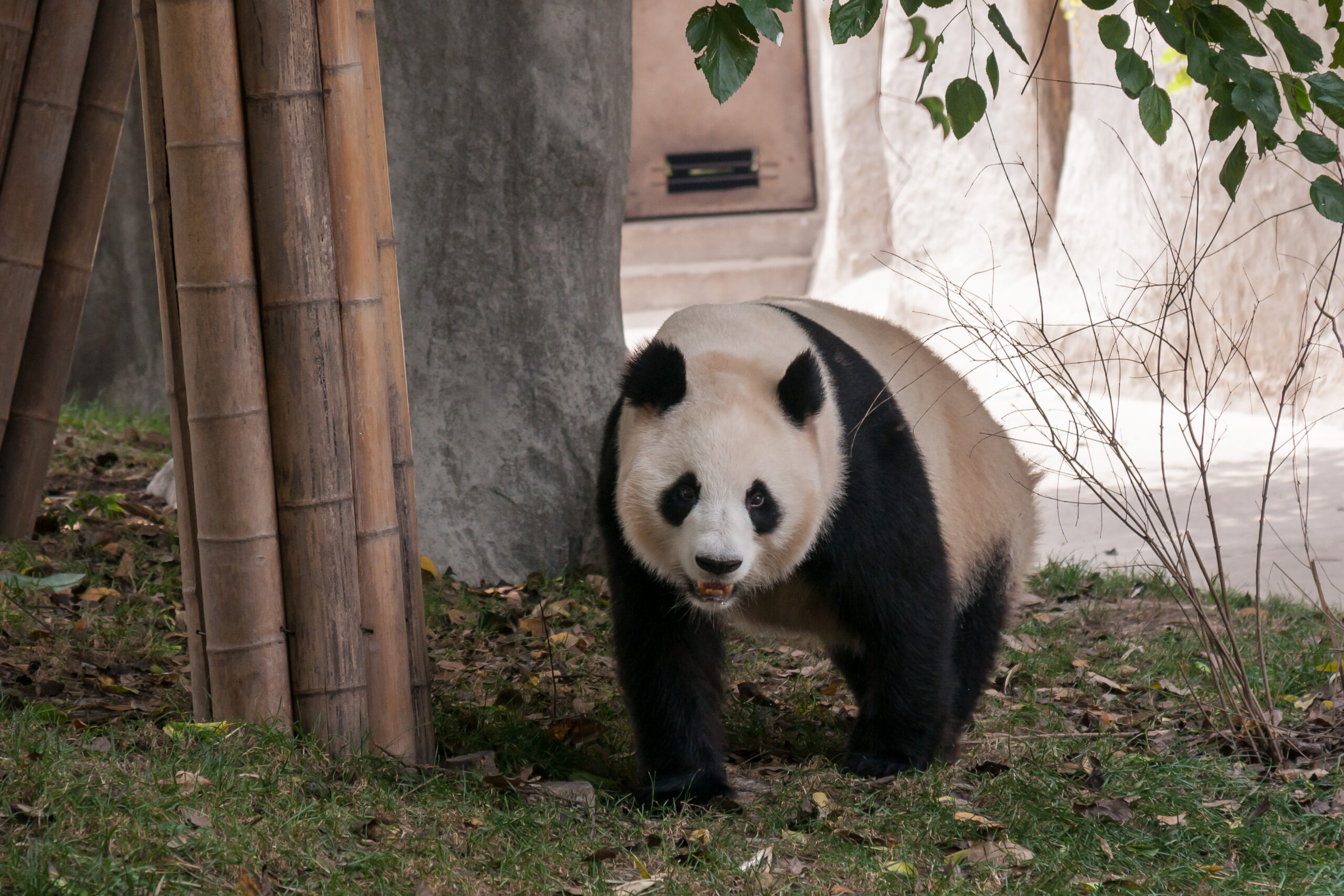
The Chengdu Research Base of Giant Panda Breeding, on the city’s northern outskirts, is not a zoo: it’s a breeding centre founded in 1987 with six animals rescued from the wild, which has since raised over two hundred. The giant panda was endangered until 2016, when it was downgraded to vulnerable: one of the few cases where a symbol species has genuinely recovered, even though it remains tied to a fragmented habitat of bamboo forests in the mountains of Sichuan.
There’s just one piece of practical advice, but it matters: arrive at opening. Pandas eat in the early morning hours — and they eat for about twelve hours a day, because bamboo provides very little nutrition — then fall asleep and stay motionless all afternoon. Those arriving at eleven see furry balls sleeping on a branch. There’s also the red panda area, a different family altogether, much more alert and sometimes roaming freely along the paths.
The paid experiences to hold a cub have been suspended: they were stressful for the animals and risky for disease transmission. If an agency still offers them, be wary.
8 – The Leshan Giant Buddha
Day 8 · Train 1 hour from Chengdu · Admission 80 yuan · full day
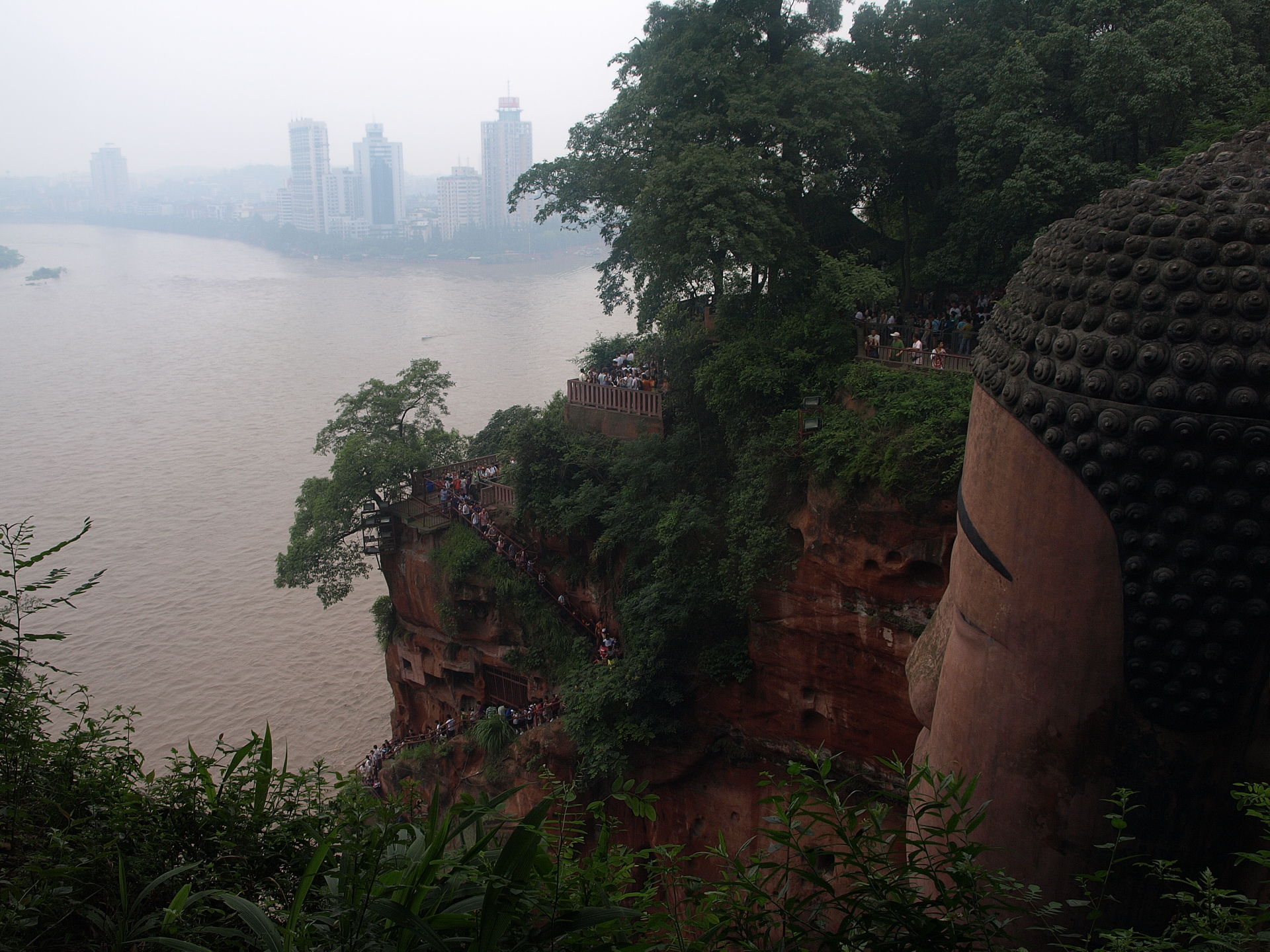
The Leshan Giant Buddha is 71 metres tall and is carved into the red cliff overlooking the confluence of three rivers. It’s the largest stone Buddha statue in the world: its ears measure seven metres, and several people can stand on one of its toenails.
The story of its construction is better than its measurements. In 713 the monk Haitong began carving it because at that point the currents of the three rivers sank boats, and he believed the Buddha’s presence would calm the waters. When local officials threatened to divert the funds, he gouged out his own eyes in front of them to prove his sincerity. He died before it was finished; the work was completed by his disciples in 803, ninety years after it began. And the curious thing is that it actually worked: the enormous quantity of stone carved away and dumped into the river changed the currents, making the stretch navigable.
You can climb down the Nine Bends staircase carved into the rock next to the statue, but in high season the queue can exceed two hours; the alternative is the boat, which passes in front and lets you see it whole from a distance — actually the better vantage point. The statue also has a drainage system hidden in its hair and behind its ears, designed in the 8th century, which still protects it from rainwater today.
La cucina del Sichuan non è solo piccante: è anestetizzante. Il pepe di Sichuan non è un pepe e non è piccante — contiene una molecola che fa vibrare e intorpidire le labbra, una sensazione che in cinese si chiama má. Combinata con il peperoncino (là) dà il málà, che è la firma di questa cucina e non assomiglia a niente di europeo: la prima volta è sconcertante. I piatti da provare: il mapo tofu, il gongbao jiding (il «pollo kung pao», che qui è tutta un’altra cosa), il dan dan mian, e soprattutto l’hotpot: un pentolone di brodo rosso che bolle al centro del tavolo in cui si cuoce quello che si sceglie. Chiedete la versione a due scomparti, metà piccante e metà no. Chengdu è anche la città delle case da tè: si passa un pomeriggio intero in un parco con una tazza che viene riempita all’infinito, mentre qualcuno gioca a mahjong e qualcun altro vi pulisce le orecchie con strumenti d’acciaio, che è un mestiere locale.
Days 9-10 — Guilin and Yangshuo
Flight Chengdu–Guilin, 1h40 · 2 nights · the landscape of painted scrolls
9 – The Li River
Day 9 · Guilin–Yangshuo cruise, 4 hours, 220-450 yuan · or a bamboo raft on the Xingping stretch
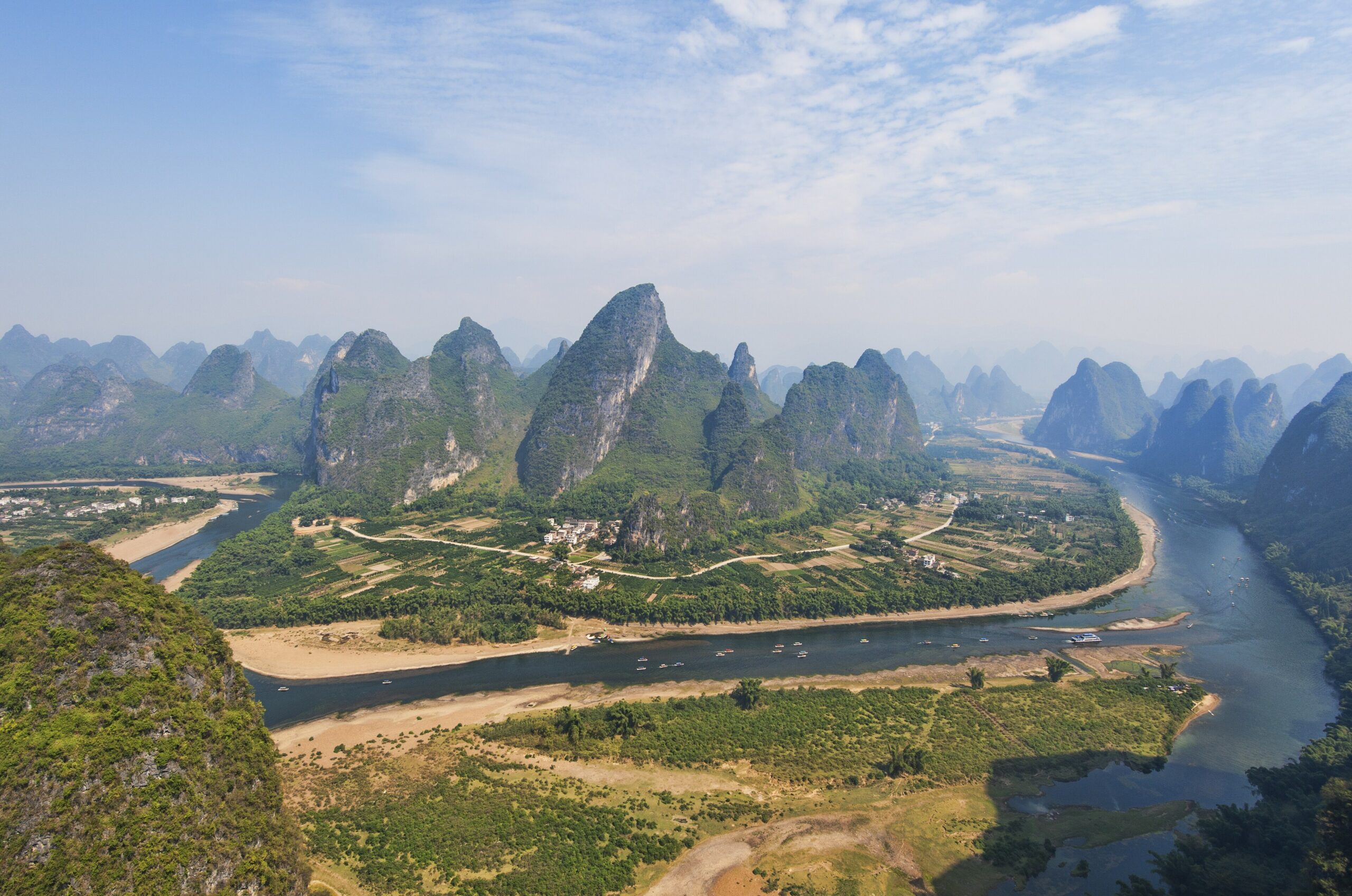
The landscape between Guilin and Yangshuo is the image Chinese people picture when they think of their own countryside: sugarloaf limestone hills rising vertically out of the plain, wrapped in mist, with the river winding among the fields. It’s tower karst, formed over three hundred million years by the erosion of an ancient seabed, and it’s been the subject of Chinese landscape painting for over a thousand years. One precise stretch of this river, the one at Xingping, is printed on the back of the 20-yuan banknote: if you have one in your pocket, you can compare it live.
The classic cruise departs from Guilin and reaches Yangshuo in four hours, on boats with lunch served on board. It’s convenient and beautiful, but also very crowded. The alternative worth considering is taking a bus to Xingping, halfway along, and doing an hour and a half on a bamboo raft along the most scenic stretch: it costs a fraction, you sit low on the water, and it’s much quieter.
10 – Yangshuo and the rice paddies
Day 10 · Bicycle 20-50 yuan a day · Longji Terraces 2-3 hours from Guilin, full day

Yangshuo is a small town that over the years has become a little capital of independent travel: the main street, West Street, is a row of bars and shops that might not appeal, but just two kilometres of cycling puts you among rice paddies and water buffalo. The classic route follows the Yulong River, smaller and prettier than the Li, past Ming stone bridges and villages.
Other things to do: climb Xianggong Hill or Laozhai Hill for the view over the river’s bend from above, at dawn or sunset; and watch the cormorant fishermen, who train the birds to fish with a ring around their neck — though it must be said today it’s almost entirely a staged show for photographers, no longer a real trade.
If you prefer mountains to the river, the detour is to the Longji rice terraces, the “Dragon’s Backbone”, two and a half hours from Guilin: rice paddies carved in steps starting in the 14th century up mountainsides as high as a thousand metres, farmed by the Zhuang and Yao minorities. They change completely with the season: mirrors of water in May, green in summer, gold in September.
Days 11-14 — Shanghai and Suzhou
Flight or train from Guilin · 3 nights · the city that chose the future
11 – The Bund and the old town
Days 11-12 · Bund free · Yu Garden 40 yuan · Shanghai Tower 180 yuan

The Bund is the riverfront lined with the bank and shipping company buildings built between 1890 and 1930, when Shanghai was divided into foreign concessions — British, French, American — where Chinese law didn’t apply. They were the result of the Opium Wars, and in China that period is called the century of humiliation: knowing this changes how you look at those neoclassical façades, which to a European eye seem merely elegant.
Across the river is Pudong, which in 1990 was fields and warehouses: the photograph from back then, with paddy fields where the Shanghai Tower now stands, is the most striking document of what thirty years of China have been. Today there’s the Shanghai Tower (632 metres, the world’s second-tallest building, with the fastest lift in existence), the Jin Mao Tower and the Oriental Pearl Tower. The Bund at night, all lit up, is the postcard; the Bund at seven in the morning, with elderly people doing tai chi in front of the skyscrapers, is far better.

In the old town is Yu Garden, from 1559: two hectares of pavilions, ponds, rocks and zigzag bridges — built that way because tradition says evil spirits can only travel in a straight line. It was built by an official for his elderly father and took twenty years, ruining him financially. The bazaar around it is very touristy, but the Huxinting teahouse in the middle of the pond is worth a stop.
The rest of the city: the former French Concession, with its plane trees, low shikumen-style houses and cafés, the most pleasant neighbourhood to walk through; Tianzifang, a maze of alleys with shops; the Shanghai Museum, free and excellent, with archaic bronzes and ceramics; and the Shanghai Jewish Refugees Museum, in the Hongkou district, which tells a little-known story: between 1938 and 1941 Shanghai was the only port in the world that took people in without a visa, and about twenty thousand Jews fleeing Europe found refuge there.
12 – Suzhou, the gardens
Day 13 · High-speed train 25-30 minutes · Gardens 30-80 yuan each · day trip
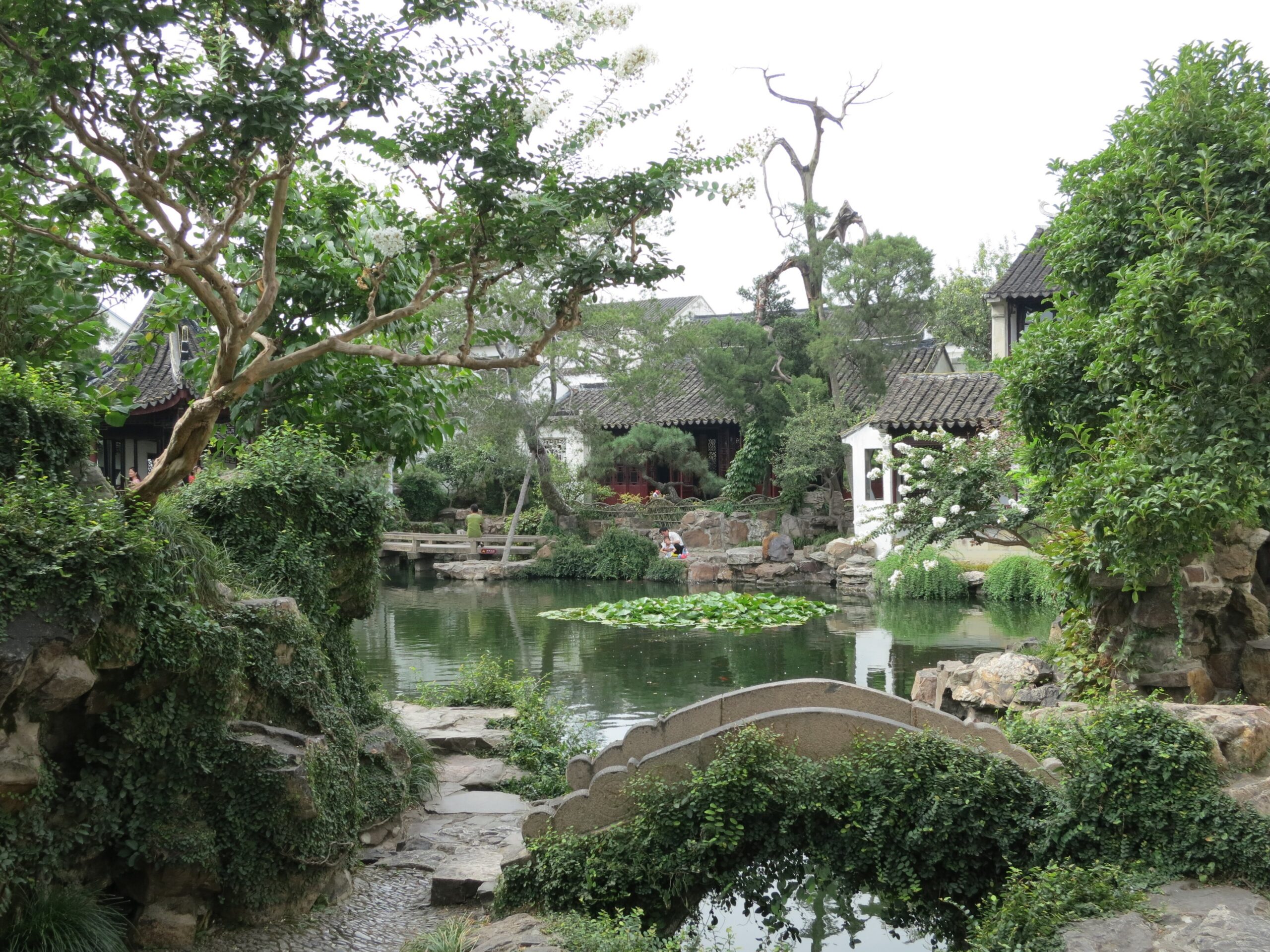
Suzhou is half an hour away by high-speed train and has nine gardens listed as UNESCO World Heritage sites. These are scholars’ gardens: not parks, but compositions conceived the way a poem is composed, where every window frames a different scene and the route is built to never show everything at once. There are four elements — water, rocks, plants, architecture — and the unwritten rule is that they must seem larger than they are.
The Humble Administrator’s Garden is the largest and most visited; the Master of the Nets Garden is the smallest — half a hectare — and is considered the most accomplished for exactly that reason: you get lost in a space you could cross in thirty seconds in a straight line. Suzhou was also the capital of silk, and the silk museum tells five thousand years of silkworm farming.
As an alternative to Suzhou, an hour from Shanghai are the water towns: Zhujiajiao is the closest and most convenient, Wuzhen and Xitang are prettier and further away. Canals, humpback bridges, houses on the water: they’re restored for visitors but remain evocative, especially in the evening once the tour buses have left.
L’alta velocità cinese è il modo migliore per attraversare il paese, ma ha regole sue. I biglietti si comprano online (l’app ufficiale accetta ormai i passaporti stranieri) o in stazione, e sono nominali: si viaggia col passaporto, che serve anche per entrare in stazione. Presentatevi almeno 45 minuti prima: le stazioni cinesi sono grandi come aeroporti, con controllo bagagli e sale d’attesa separate per binario, e l’imbarco chiude 5 minuti prima della partenza — chi arriva dopo non sale, senza eccezioni. La seconda classe è comoda e pulita e non serve pagare la prima. Le tratte di questo itinerario: Pechino–Xi’an 4h30 (circa 515 yuan), Xi’an–Chengdu 3-4 ore (circa 260), Shanghai–Suzhou 25 minuti (circa 40).

How much two weeks cost
| Voce | Costo |
|---|---|
| Treno Pechino–Xi’an | circa 515 yuan, 66 euro |
| Treno Xi’an–Chengdu | circa 260 yuan, 33 euro |
| Volo Chengdu–Guilin | 60-120 euro |
| Volo o treno Guilin–Shanghai | 70-140 euro |
| Alloggio, 13 notti (albergo medio) | 400-800 euro |
| Ingressi (Città Proibita, Tempio del Cielo, Muraglia, Palazzo d’Estate, terracotta, mura di Xi’an, panda, Leshan, giardini) | circa 800 yuan, 103 euro |
| Crociera sul fiume Li | 220-450 yuan, 28-58 euro |
| Trasporti urbani (le metropolitane cinesi sono economiche ed enormi) | circa 40 euro |
| Pasti, 14 giorni | 250-450 euro |
| Totale in loco | circa 1.200-2.000 euro a persona |
Reference figures as of September 2026, intercontinental flight and visa excluded. Payment is in yuan, exchange rate around 7.8 to the euro. China isn’t as expensive as people fear: eating is cheap (a meal at a real local eatery runs about 30-60 yuan, €4-8), the metro costs 3-8 yuan a ride, and state museums are often free. The pricier items are long-distance transport and accommodation. Set up Alipay or WeChat Pay before you leave: without them, many things simply can’t be bought.
Frequently asked questions
Is two weeks enough for China?
Enough for the classic backbone: Beijing, Xi’an, Chengdu, Guilin and Shanghai, meaning the empire, the archaeology, the landscape and the contemporary city. Not enough for China, which is as big as Europe. Left out are Pingyao, Zhangjiajie, Hangzhou, Hong Kong, Yunnan and Tibet: with three weeks you can add four more.
Do you need a visa?
Yes, and it must be applied for before departure at a visa centre, with itinerary, bookings and flights. There’s no standing tourist exemption for Italians the way there is for Thailand. In recent years temporary exemptions have appeared for some European countries and visa-free transits in certain cities: these are measures that change often, so check the up-to-date rules on the official website at the time you book, not on a forum.
How do you pay in China?
With your phone. China skipped the credit-card phase and went straight to code-based payments: Alipay or WeChat Pay are used practically everywhere, from restaurants to street vendors. Both apps today accept foreign cards, but they need to be installed and linked before you leave. Cash is legally accepted, but it happens that a shopkeeper doesn’t have change. Western credit cards work only at international hotels.
Does the internet work?
Google, Gmail, Maps, WhatsApp, Instagram, Facebook and most Western services are blocked. The simplest solution is a roaming eSIM bought before departure: the traffic exits the country and the blocks don’t apply. Download offline maps and an offline translator regardless, and keep addresses written in Chinese characters to show taxi drivers.
Train or plane — which is better?
The high-speed train, for journeys under six to seven hours: it’s punctual, comfortable, arrives right in the centre and has none of the airport’s dead time. Beijing–Xi’an is 4h30. For very long legs, like Chengdu–Guilin, the plane is better. Remember stations work like airports: arrive 45 minutes ahead, and boarding closes five minutes before departure.
Which stretch of the Wall should you choose?
Mutianyu is the best compromise: well restored, woods, a cable car up and a slide down, with people but not too many. Badaling is the most convenient and the most crowded, to avoid on weekends. Jinshanling is the most beautiful and nearly empty, partly unrestored, but requires a full day and good legs. Simatai is the only one you can visit at night.
What time can you see the pandas?
At opening, around 7:30. Pandas eat in the early morning hours and then sleep all day: those arriving at eleven see motionless animals on a branch. The Chengdu centre is not a zoo but a breeding centre, and the paid experiences to hold cubs have been suspended.
Is everything in Sichuan spicy?
No, but málà is everywhere, and it’s a thing of its own: Sichuan pepper doesn’t burn, it numbs the lips, and combined with chilli it produces a sensation that doesn’t exist in Europe. You can always ask for “bu la”, not spicy, and with hotpot you can get the two-section pot. Outside Sichuan the cuisine changes completely: Peking duck in Beijing, Hui bread and mutton in Xi’an, sweet flavours and xiaolongbao in Shanghai.
What’s the best time to go?
April-May and September-October: mild temperatures across almost the whole itinerary. Summer is very hot and humid in Shanghai and the south; winter in Beijing is cold and dry, but the Wall in snow is something else entirely. Two periods to avoid absolutely: Golden Week from 1 October and Chinese New Year (between late January and mid-February), when hundreds of millions of Chinese travel at once and trains and hotels become impossible to find.
Is English spoken?
A little, outside international hotels and among young people in big cities. It’s much less widespread than you’d expect, and Latin-alphabet signage exists in the metro but not everywhere. A translation app with a camera — that translates menus by scanning them — completely changes the trip, and should be downloaded with offline packs before you arrive.
Is it a safe country to travel in?
Yes, very: street crime is extremely low and you can move around comfortably even at night. The difficulties are of another kind: language, payments if you haven’t set up the app, and the internet. Watch out for the tea house scam in the tourist areas of Beijing and Shanghai: friendly students invite you to a tasting and then present a bill for hundreds of euros. If someone stops you on the street speaking perfect English and offering something, decline.
September 11, 2026